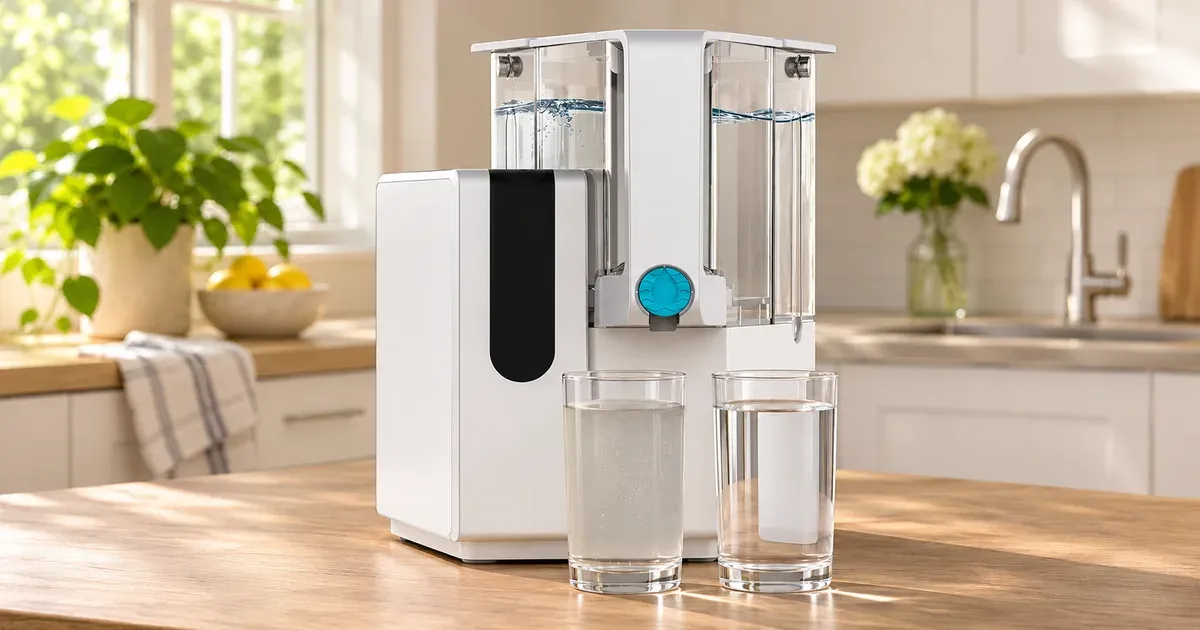
The short answer: reverse osmosis removes most dissolved contaminants, including fluoride, lead, arsenic (pentavalent), nitrate, PFOA and PFOS, chromium, copper, radium, microplastics and 85% to 95% of total dissolved solids. In certified lab tests, a countertop RO system reduced lead by 99.1%, fluoride by 93.5%, pentavalent arsenic by 98.0%, nitrate and nitrite by 89.9% and PFOA and PFOS by at least 97.5%. The carbon filters that sit before and after the membrane handle chlorine, chloramine and most volatile organic compounds.
RO does have gaps. It removes trivalent arsenic poorly, lets dissolved gases through, and home RO systems are not certified to make microbiologically unsafe water safe to drink. How much a given system removes depends on what it’s actually certified for, which varies a lot between brands.
What Reverse Osmosis Removes: Contaminant Chart
The percentages below are average reductions from the AquaTru Classic’s performance data sheet (revision 10.24.R4). IAPMO R&T certifies the Classic to NSF/ANSI 42, 53, 58 and 401, so these are certified results, not marketing claims. Its four stages are a sediment and carbon pre-filter, the RO membrane and a VOC carbon filter.
| Contaminant | Removed by RO? | Certified reduction (AquaTru Classic, average) | Standard |
|---|---|---|---|
| Lead | Yes | 99.1% (minimum 97.5%) | NSF/ANSI 58 |
| Fluoride | Yes | 93.5% (minimum 91.8%) | NSF/ANSI 58 |
| Arsenic, pentavalent (As V) | Yes | 98.0% (minimum 95.8%) | NSF/ANSI 58 |
| Arsenic, trivalent (As III) | Poorly | Not certified | — |
| Nitrate plus nitrite | Mostly | 89.9% (minimum 70.0%) | NSF/ANSI 58 |
| PFOA and PFOS (PFAS) | Yes | 97.5% minimum | NSF/ANSI 53 |
| Microplastics (0.5 to 1 micron particles) | Yes | 96.48% | NSF/ANSI 401 |
| Hexavalent chromium | Yes | 97.2% | NSF/ANSI 58 |
| Trivalent chromium | Yes | 98.0% | NSF/ANSI 58 |
| Copper | Yes | 95.2% | NSF/ANSI 58 |
| Barium | Yes | 96.4% | NSF/ANSI 58 |
| Radium 226/228 | Yes | 96.4% | NSF/ANSI 58 |
| Selenium | Yes | 98.1% | NSF/ANSI 58 |
| Perchlorate | Yes | 98.5% | NSF/ANSI 58 |
| Total dissolved solids (TDS) | Yes | 87.1% (minimum 75.7%) | NSF/ANSI 58 |
| Cysts (Giardia, Cryptosporidium) | Yes | 99.99% | NSF/ANSI 58 |
| Chlorine | Carbon stages | 97% | NSF/ANSI 42 |
| Chloramine | Carbon stages | 96% | NSF/ANSI 42 |
| VOCs (benzene, trihalomethanes and others) | Carbon stages | 95% to over 99% | NSF/ANSI 53 |
| Pharmaceuticals and BPA | Yes | 86.7% to 99.0% (BPA 99.0%) | NSF/ANSI 401 |
| Calcium and magnesium (hardness) | Yes | Not a certified claim | — |
| Dissolved gases (CO2, radon, hydrogen sulfide) | No | — | — |
The CDC’s guide to home water treatment says the same thing in general terms: RO removes lead, copper, chromium, chloride and sodium, and may also reduce arsenic, fluoride, radium, sulfate, calcium, magnesium, potassium, nitrate and phosphorus. It also tells buyers to check each system’s label for the specific chemicals it removes (CDC).
Certified vs. “Tested”: Why the Brand Matters
A reduction claim only means something if a certifier lists it. Among countertop RO systems, the gap is large:
- AquaTru Classic and Carafe: IAPMO R&T lists both under NSF/ANSI 58 (file W-10194) for TDS, fluoride, lead, arsenic, nitrate and more, and under NSF/ANSI 53 (W-10193) for PFOA, PFOS and VOCs.
- Bluevua ROPOT-Lite: WQA-certified to NSF/ANSI 58 for TDS, lead, cadmium and trivalent chromium only.
- Waterdrop K19-H and M6: IAPMO certifies them to NSF/ANSI 58 for TDS only. Their fluoride, lead and PFAS numbers are “tested by a third-party laboratory.”
- SimPure, Frizzlife, iSpring countertop units: no certifier listing for the system.
Every RO membrane removes fluoride and lead to some degree, but only a listing tells you how much a given machine removes over its filter life. Our page on which countertop RO systems are NSF certified has every listing and file number.
Fluoride
RO is one of the few home methods that removes fluoride. Pitcher filters with plain activated carbon don’t. AquaTru reports average fluoride reductions of 93.5% for the Classic and 96.4% for the Carafe under its NSF/ANSI 58 certification. The test water held 8 mg/L of fluoride, more than ten times the 0.7 mg/L that US community water fluoridation targets.
If fluoride is the reason you’re shopping, see our picks for the best countertop RO systems for fluoride.
PFAS (Forever Chemicals)
The EPA lists reverse osmosis, along with granular activated carbon and ion exchange, as a filter type that “can be effective at reducing PFAS,” and tells buyers to look for NSF/ANSI 53 or 58 PFAS certification (EPA fact sheet). The AquaTru Classic’s certified test cut combined PFOA and PFOS from 1.5 µg/L (1,500 parts per trillion) to under 0.02 µg/L, a reduction of at least 97.5%.
The EPA’s fact sheet adds a caveat: today’s certification standards don’t yet show that a filter removes PFAS down to the 4 parts per trillion limits the EPA set for PFOA and PFOS in 2024. A 97.5% reduction still takes typical contaminated tap water well below those levels. Our PFAS countertop RO guide covers which units carry a certified claim.
Lead
RO removes lead very well: 99.1% on average in the AquaTru Classic’s certified test, from 150 µg/L down to under the 10 µg/L limit. Bluevua’s ROPOT-Lite is also WQA-certified for lead. The ROPOT-Lite (UV)‘s listing doesn’t include lead, and the full-size ROPOT models aren’t certified for any contaminant.
Arsenic: Pentavalent vs. Trivalent
Arsenic comes in two forms, and RO handles them very differently. AquaTru’s data sheet says RO systems “do not remove trivalent arsenic from water very well” but are “very effective at removing pentavalent arsenic.” The Classic cut pentavalent arsenic by 98.0% on average.
A free chlorine residual in tap water quickly converts trivalent arsenic (As III) to the pentavalent form (As V), so chlorinated city water usually isn’t a problem. Chloramine may not convert all of it, and private wells can contain either form. If your well tests positive for arsenic, ask the lab to report both forms. If As III is present, add pre-oxidation or a dedicated arsenic filter before relying on RO.
Nitrate and Nitrite
Nitrate is one of RO’s weaker spots. The AquaTru Classic averaged 89.9% reduction of nitrate plus nitrite, but its minimum was 70.0%, the lowest of any contaminant on its data sheet. The certification covers water with up to 27 mg/L nitrate (as nitrogen); the federal limit is 10 mg/L. For a well far above that, a countertop unit’s output can still exceed the limit, so test the filtered water.
Microplastics
RO membranes have pores around 0.0001 micron, far smaller than microplastic particles. NSF/ANSI 401 tests microplastic reduction with particles 0.5 to 1 micron across. AquaTru reports 96.48% for the Classic and 98.96% for the Carafe. The standard doesn’t test nanoplastics smaller than that.
Chlorine and Chloramine
The RO membrane isn’t what removes chlorine. In fact, chlorine damages thin-film RO membranes, which is why every countertop RO system puts an activated carbon pre-filter in front of it. In the AquaTru Classic, the carbon stages cut free chlorine by 97% and chloramine by 96% (NSF/ANSI 42). If your utility uses chloramine, keep the pre-filter on schedule. A spent carbon filter lets chloramine reach the membrane and the glass.
Hardness: Calcium and Magnesium
RO removes calcium and magnesium along with everything else dissolved, so RO water is soft. The catch is that hardness is also what wears out countertop RO systems. The minerals concentrate in the reject water and scale the membrane and pump.
- AquaTru doesn’t recommend its countertop units for water above 10 grains per gallon (171 mg/L) of hardness unless you soften the water first or descale regularly.
- Waterdrop’s warranty requires feed water under 500 ppm TDS.
Emptying the leftover tap-tank water before every refill matters most in hard water. AquaTru says that water can hold six times the contaminant concentration of your tap.
What Reverse Osmosis Doesn’t Remove
- Trivalent arsenic: poorly removed unless it’s oxidized to the pentavalent form first.
- Dissolved gases: carbon dioxide, hydrogen sulfide and radon pass through the membrane.
- Some small organic compounds: small molecules such as some VOCs and trihalomethanes slip through membranes, which is why RO systems add carbon stages.
- Germs, as a certified claim: the CDC says RO removes parasites, bacteria and viruses, and the EPA says RO “can potentially” remove bacteria and viruses. But NSF/ANSI 58 certifies only cyst reduction, not bacteria or viruses. AquaTru’s data sheet warns: “Do not use with water that is microbiologically unsafe or of unknown quality without adequate disinfection.” Countertop units also store water in open tanks at room temperature. UV stages on some models (Bluevua ROPOT UV, iSpring RCD100) aren’t certified as microbiological purifiers either.
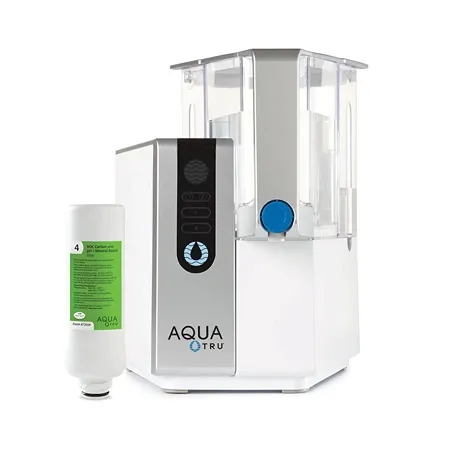
Most certified countertop RO
AquaTru Classic
IAPMO certified for fluoride, lead, arsenic, nitrate, PFOA, PFOS and microplastics.
How to Check What Your RO System Removes
- Find the performance data sheet. Certified systems publish one with the influent concentration, the maximum allowed in product water and the minimum and average reduction for each claim.
- Look up the listing. Search the brand at IAPMO R&T (pld.iapmo.org), WQA (find.wqa.org) or NSF (info.nsf.org). Check the exact model number, because suffixes matter.
- Match the claim to your water. Your water utility’s annual Consumer Confidence Report, or a lab test for a well, tells you what you need to remove.
- Measure TDS. A cheap TDS meter checks the membrane. AquaTru’s manual says to replace the RO filter if the reduction drops below 80% of your tap water’s reading.
Comparing models? Our guide to the best countertop reverse osmosis systems ranks them with their certifications.
What Does Reverse Osmosis Remove? FAQ
Does reverse osmosis remove fluoride?
Yes. A certified countertop RO system reduced fluoride by 93.5% (AquaTru Classic) to 96.4% (AquaTru Carafe) on average under NSF/ANSI 58. Carbon-only pitchers don’t remove fluoride.
Does reverse osmosis remove PFAS?
Yes. The EPA lists RO as effective for PFAS. The AquaTru Classic is certified under NSF/ANSI 53 to reduce PFOA and PFOS by at least 97.5%. Look for a certified PFAS claim, since most countertop brands only cite lab tests.
Does reverse osmosis remove microplastics?
Yes. Under NSF/ANSI 401, the AquaTru Classic reduced 0.5 to 1 micron microplastic particles by 96.48% and the Carafe by 98.96%.
Does reverse osmosis remove lead?
Yes. The AquaTru Classic’s certified lead reduction averages 99.1%. Bluevua’s ROPOT-Lite is also certified for lead.
Does reverse osmosis remove bacteria and viruses?
The membrane’s pores are small enough, and the CDC lists parasites, bacteria and viruses among what RO removes. But home RO systems aren’t certified as microbiological purifiers, only for cysts. Makers say to use them only on water that’s already microbiologically safe.
Does reverse osmosis remove chlorine and chloramine?
The carbon filters in an RO system do. The AquaTru Classic’s carbon stages cut chlorine by 97% and chloramine by 96%. Chlorine would damage the membrane on its own.
Does reverse osmosis remove nitrates?
Mostly. The AquaTru Classic averaged 89.9% reduction of nitrate plus nitrite, with a minimum of 70%. On a well with very high nitrate, test the filtered water.
Does reverse osmosis remove arsenic?
It removes pentavalent arsenic (As V) well, 98.0% in the AquaTru Classic’s test, but removes trivalent arsenic (As III) poorly. Chlorinated tap water usually converts As III to As V; well water may not.
Does reverse osmosis remove calcium and magnesium?
Yes, which is why RO water is soft and has a low TDS reading. Hard feed water also scales the membrane, so countertop units need descaling in hard-water areas.