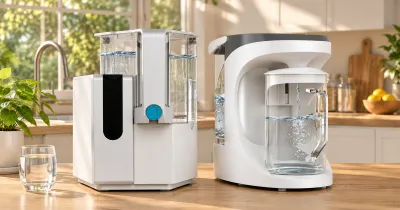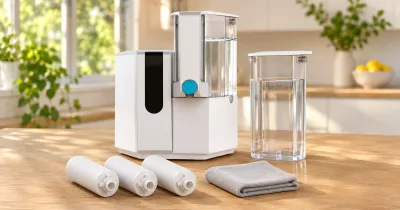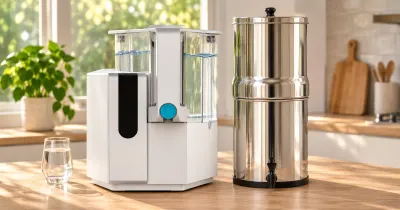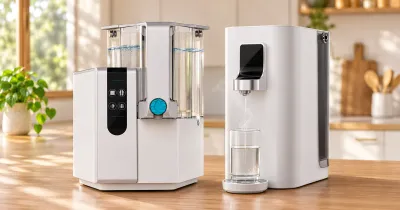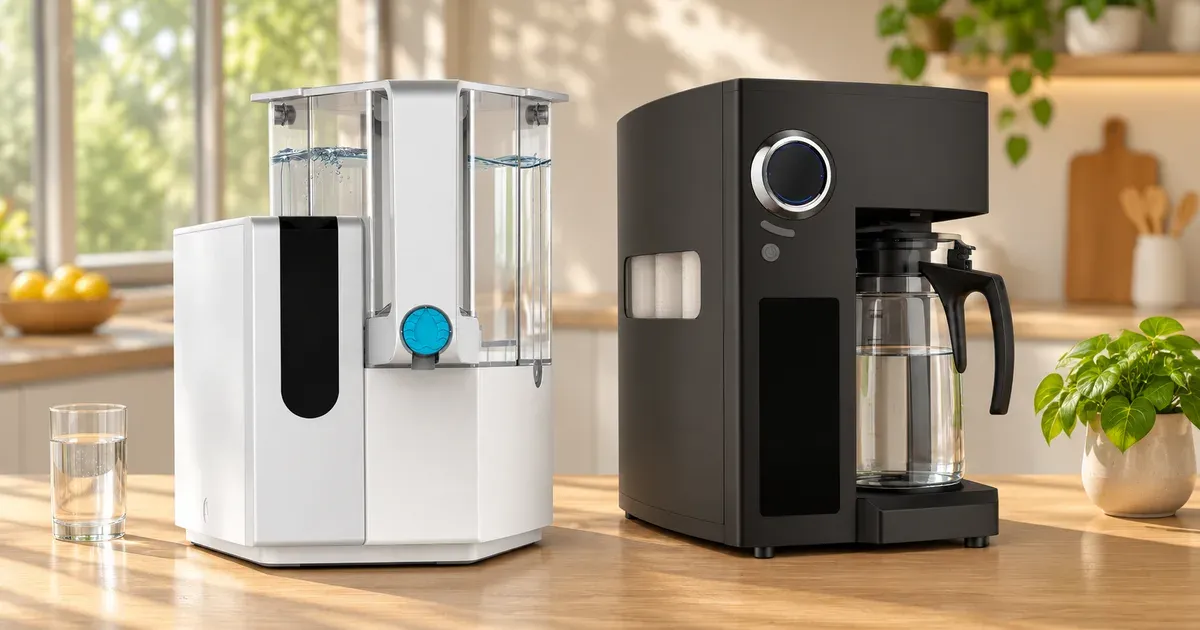
The short answer: buy an AquaTru if you’re filtering for something specific, like fluoride, lead or PFAS, and a Bluevua if you mainly want better-tasting water from glass for less. AquaTru’s Classic and Carafe are certified by IAPMO to NSF/ANSI 42, 53, 58 and 401, including fluoride, lead, arsenic, nitrate and PFOA/PFOS. Bluevua’s best-selling ROPOT and ROPOT UV are certified only to NSF/ANSI 372, a lead-free materials standard, and its ROPOT-Lite is certified under NSF/ANSI 58 for just TDS, lead, cadmium and trivalent chromium. Bluevua’s machines are faster, pour into larger glass carafes and add UV and a mineral stage.
Prices in November 2026: AquaTru’s Black Friday sale has the Classic at $380 (was $475) and the Carafe at $300 (was $375). Bluevua’s sale, November 13 to 30, has the ROPOT UV at $317 in cart (was $454), the ROPOT at $299, the ROPOT-Lite UV at $219 and the ROPOT-Lite at $209.
AquaTru vs. Bluevua at a Glance
| AquaTru Classic | AquaTru Carafe | Bluevua ROPOT UV | Bluevua ROPOT-Lite | |
|---|---|---|---|---|
| Model number | AT2000 to AT2050 | AT100 to AT140 | RO100ROPOT-UV | RO100ROPOT-LITE |
| Sale price, Nov. 2026 | $380 (was $475) | $300 (was $375) | $317 (was $454) | $209 (was $349) |
| NSF/ANSI 58 certified | Yes, IAPMO W-10194 | Yes, IAPMO W-10194 | No | Yes, WQA |
| Certified reductions | TDS, fluoride, lead, arsenic, nitrate/nitrite, chromium, copper, barium, radium, selenium, cysts, perchlorate (58); PFOA, PFOS, VOCs (53); 15 emerging compounds and microplastics (401); chlorine, chloramine (42) | Same as Classic | None (NSF/ANSI 372 lead-free materials only) | TDS, lead, cadmium, trivalent chromium (58) |
| Stages | 4 | 4 | 6, incl. UV and mineral | 6, incl. mineral |
| Rated output | 54 gal/day | 35 gal/day | 100 gal/day | 100 gal/day |
| Filtered water storage | 0.75 gal plastic tank | 64 oz glass carafe | 60 oz glass carafe | 40 oz glass carafe |
| UV | No | No | Yes, 270 to 280 nm | No (Lite UV adds it) |
| Remineralization | Optional ($20 more) | Optional ($20 more) | Standard | Standard |
| Size | About 17 lb | 7.5 x 14 x 13 in., 9 lb | 10.8 x 14.2 x 15.4 in. | 9.8 x 13.4 x 14.1 in. |
| Filters per year | About $130 | About $130 | About $120 | $79.90 |
| Warranty | 1 year | 1 year | 1 year | 1 year |
AquaTru certifications are from IAPMO R&T’s listings; Bluevua’s are from its NSF and WQA Gold Seal certificates and WQA’s directory, all checked November 15, 2026. Prices are from aquatru.com and bluevua.com.
Certification: AquaTru Is Far Ahead
This is the main difference. AquaTru has one of the broadest certifications of any countertop RO system. IAPMO certifies the Classic and Carafe under NSF/ANSI 58 for TDS, fluoride, lead, arsenic, nitrate and nitrite and seven more contaminants, under NSF/ANSI 53 for PFOA, PFOS and VOCs, and under NSF/ANSI 401 for 15 emerging compounds and microplastics.
Bluevua markets every model as “NSF & WQA Certified”, but the certificates say something narrower:
- ROPOT and ROPOT UV (RO100ROPOT, RO100ROPOT-UV): NSF/ANSI 372 only. That standard checks that parts touching water are lead-free. It makes no claim about what the system removes.
- ROPOT-Lite (RO100ROPOT-LITE): WQA certifies it under NSF/ANSI 58 for TDS, lead, cadmium and trivalent chromium.
- ROPOT-Lite UV (RO100ROPOT-LITE(UV)): NSF/ANSI 58 for TDS, cadmium and trivalent chromium, without lead.
No Bluevua model is certified for fluoride, nitrate, arsenic or PFAS, though Bluevua’s pages list them. Reverse osmosis membranes generally do reduce those, but only AquaTru has a certifier’s test behind the claim. Our Bluevua ROPOT vs. ROPOT-Lite page goes through the Bluevua listings model by model.
Speed and Capacity
Bluevua’s machines are rated for 100 gallons per day, almost twice the Classic’s 54 and three times the Carafe’s 35. A Bluevua ROPOT fills its 60 oz carafe in about 7 minutes. An AquaTru takes about 20 minutes to fill its tank or carafe.
For storage, the AquaTru Classic holds the most, 0.75 gallons (96 oz). Then come the AquaTru Carafe at 64 oz, the Bluevua ROPOT at 60 oz and the ROPOT-Lite at 40 oz.
Glass, UV and Minerals
Bluevua puts its filtered water in a borosilicate glass carafe on every model, and the ROPOT UV and Lite UV pass it under a UV light (270 to 280 nm) before it reaches the carafe. Every Bluevua also has a remineralization stage that adds some calcium and magnesium back for taste.
AquaTru’s Carafe also uses a glass carafe, but the Classic stores water in a plastic tank. Neither has UV. Remineralization is an option on both: the Alkaline Mineral Boost filter costs $20 more on the machine and $49.95 to replace, vs. $39.95 for the standard VOC filter.
The minerals these stages add are small next to food, and no maker publishes how much they add, so treat remineralization as a taste feature.
Filter Costs and Warranty
AquaTru filters cost about $130 a year for either model, bought one at a time: two pre/carbon filters ($29.95 each), one VOC filter ($39.95) and half of a two-year RO membrane ($59.95). The Carafe’s filters are rated for half as many gallons, so heavy use shortens them.
Bluevua’s ROPOT uses PP, CTO and post-carbon filters at $29.99 each every 12 months plus an RO membrane every 24 months; Bluevua’s four-filter pack is $149.96, so a year averages about $120. The ROPOT-Lite uses one 5-in-1 composite filter, $79.90 a year.
Both brands give a 1-year warranty. AquaTru sells a 3-year extension for $49.95. Our countertop RO filter cost comparison covers more brands.
Which Should You Buy?
| If you… | Better pick | Why |
|---|---|---|
| Need fluoride, PFAS, arsenic or nitrate reduction | AquaTru Classic or Carafe | The only one of the two brands certified for them |
| Want certified lead reduction for the least money | Bluevua ROPOT-Lite | NSF/ANSI 58 for lead, $209 on sale |
| Want water stored in glass and fast output | Bluevua ROPOT UV | 60 oz glass carafe, 100 GPD, UV |
| Want glass and the broadest certification | AquaTru Carafe | 64 oz glass carafe, NSF/ANSI 42, 53, 58, 401 |
| Have a family of three or more | AquaTru Classic | 0.75 gal tank and the longest-lasting filters |
| Mainly want better-tasting water | Either | Both reduce TDS and chlorine taste |
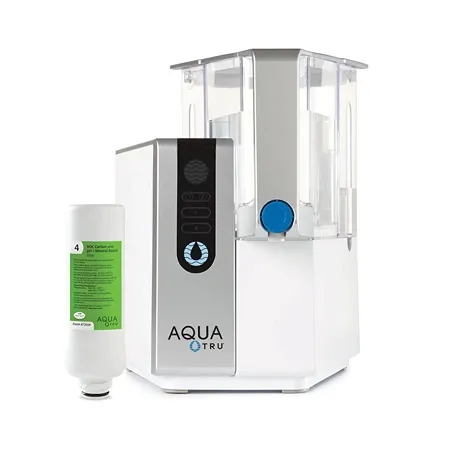
Best certified countertop RO
AquaTru Classic
IAPMO certified for fluoride, lead, PFOA/PFOS and more under NSF/ANSI 42, 53, 58 and 401.
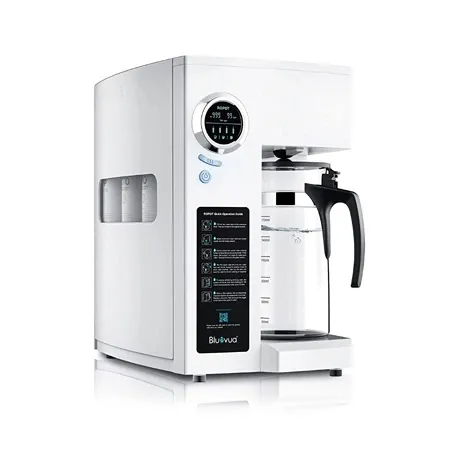
Best for glass and speed
Bluevua ROPOT UV
100 GPD into a 60 oz glass carafe, with UV and a mineral stage. Certified to NSF/ANSI 372.
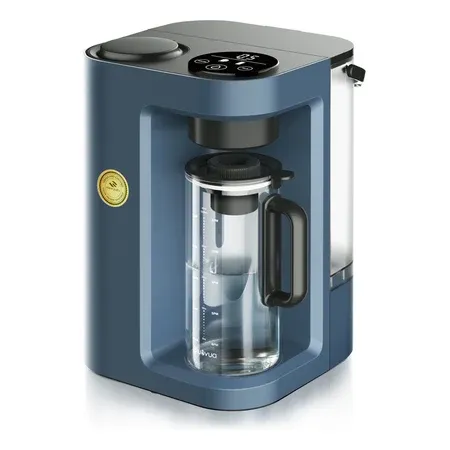
Cheapest certified for lead
Bluevua ROPOT-Lite
WQA certified under NSF/ANSI 58 for TDS, lead, cadmium and chromium; 40 oz glass carafe.
Bluevua’s prices on bluevua.com were lower than Amazon’s on November 15 (the ROPOT UV was $409 on Amazon). For the AquaTru models side by side, read AquaTru Classic vs. Carafe, and for more picks, our guide to the best countertop reverse osmosis systems.
AquaTru vs. Bluevua FAQ
Is AquaTru better than Bluevua?
For contaminant reduction, yes. AquaTru’s Classic and Carafe are certified by IAPMO for fluoride, lead, arsenic, nitrate, PFOA and PFOS, among others. Bluevua’s ROPOT and ROPOT UV are certified only for lead-free materials, and the ROPOT-Lite only for TDS, lead, cadmium and trivalent chromium. Bluevua is faster and stores water in glass on every model.
Is Bluevua NSF certified?
Partly. The ROPOT and ROPOT UV are certified to NSF/ANSI 372, which covers lead-free materials, not filtration. The ROPOT-Lite is WQA certified under NSF/ANSI 58 for TDS, lead, cadmium and trivalent chromium; the Lite UV for the same without lead.
Does Bluevua remove fluoride?
Bluevua lists fluoride among the contaminants its systems reduce, and reverse osmosis membranes generally do, but no Bluevua model is certified for fluoride. AquaTru’s Classic and Carafe are certified under NSF/ANSI 58 for fluoride reduction.
Which is faster, AquaTru or Bluevua?
Bluevua. Its countertop units are rated for 100 gallons per day and fill a 60 oz carafe in about 7 minutes. The AquaTru Classic is rated for 54 gallons per day and the Carafe for 35, about 20 minutes per fill.
Do AquaTru and Bluevua add minerals back?
Every Bluevua has a remineralization stage. AquaTru offers it as an option, the Alkaline Mineral Boost filter, for $20 more.
Which costs less to run?
The Bluevua ROPOT-Lite, at $79.90 a year for its single composite filter. The ROPOT and ROPOT UV average about $120 a year and AquaTru about $130.