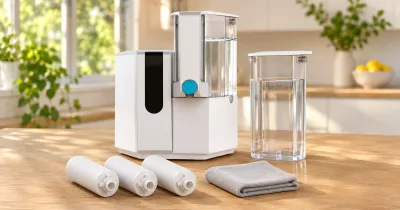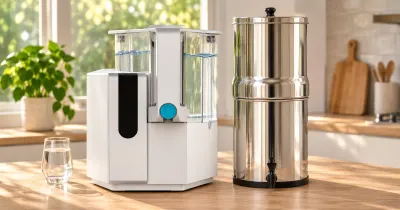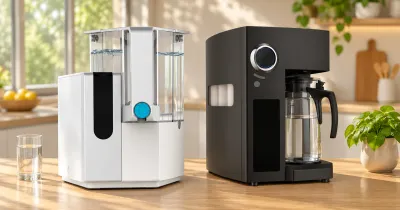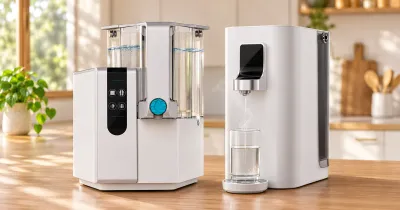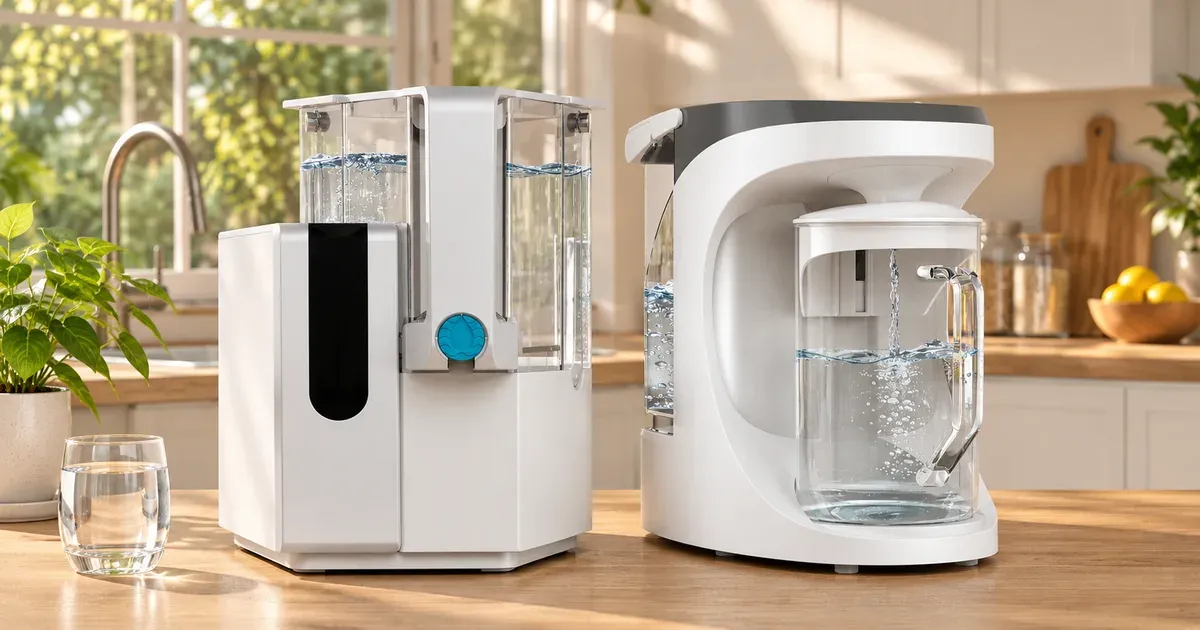
The short answer: get the AquaTru Classic if more than one or two people drink from it, and the Carafe if you want your water stored in glass and have a small kitchen. Both use the same four-stage reverse osmosis design and carry the same IAPMO certifications to NSF/ANSI 42, 53, 58 and 401, so they remove the same contaminants. The Classic is rated for 54 gallons a day and holds 0.75 gallons of clean water. The Carafe is rated for 35 gallons a day, pours into a 64 oz borosilicate glass carafe and is smaller and lighter.
Prices in November 2026: AquaTru’s Black Friday sale has the Classic at $380 (was $475) and the Carafe at $300 (was $375). On Amazon on November 15, the Classic was $475 and the Carafe $337.50, so AquaTru’s own store is cheaper during the sale.
AquaTru Classic vs. Carafe at a Glance
| AquaTru Classic | AquaTru Carafe | |
|---|---|---|
| Price, November 2026 | $380 on sale (was $475) | $300 on sale (was $375) |
| Model numbers | AT2000 to AT2050 | AT100 to AT140 |
| Filtration | 4-stage reverse osmosis | 4-stage reverse osmosis |
| NSF/ANSI 58 (RO) | Certified, IAPMO file W-10194 | Certified, IAPMO file W-10194 |
| NSF/ANSI 53 (PFOA, PFOS, VOCs) | Certified, IAPMO W-10193 | Certified, IAPMO W-10193 |
| NSF/ANSI 401 (emerging compounds, microplastics) | Certified, IAPMO W-10195 | Certified, IAPMO W-10195 |
| NSF/ANSI 42 (chlorine, chloramine) | Certified, IAPMO W-10188 | Certified, IAPMO W-10188 |
| Rated output | 54 gallons per day | 35 gallons per day |
| Clean water storage | 0.75 gal plastic tank | 64 oz (0.5 gal) glass carafe; 0.66 gal tap tank |
| Size and weight | About 17 lb | 7.5 x 14 x 13 in., about 9 lb |
| Pre/carbon filter | $29.95, 6 months or 600 gal | $29.95, 6 months or 300 gal |
| RO membrane | $59.95, 2 years or 1,200 gal | $59.95, 2 years or 600 gal |
| VOC carbon filter | $39.95, 1 year or 600 gal | $39.95, 1 year or 300 gal |
| Warranty | 1 year (3-year extension $49.95) | 1 year (3-year extension $49.95) |
Certifications are from IAPMO R&T’s listings for AquaTru, LLC, current on November 15, 2026. Specs, filter lives and prices are from aquatru.com.
Filtration and Certification: The Same
AquaTru lists the Classic and the Carafe on the same IAPMO certificates, so neither filters better than the other. Under NSF/ANSI 58, the reverse osmosis standard, both are certified to reduce TDS, fluoride, lead, arsenic (pentavalent), nitrate and nitrite, chromium, copper, barium, radium, selenium, cysts and perchlorate. Under NSF/ANSI 53 they’re certified for VOCs and for PFOA and PFOS, two of the PFAS the EPA now regulates. NSF/ANSI 401 covers 15 emerging compounds, such as pharmaceutical residues, plus microplastics, and NSF/ANSI 42 covers chlorine and chloramine taste and odor.
That certification list is the main reason to buy an AquaTru over cheaper countertop RO units. Most rivals are certified for far less: some only to NSF/ANSI 372, which covers lead-free materials, not filtration. Our countertop reverse osmosis certification guide lists what each brand’s units are actually certified for.
Both machines also have the same limits. AquaTru’s performance data sheet caps feed water at 1,500 mg/L TDS and 10 grains per gallon of hardness, and both use cold tap water only.
Capacity: The Classic Makes More Water
The Classic is rated for 54 gallons per day and stores 0.75 gallons of filtered water, so a full tank takes about 20 minutes. Its filters are rated for twice the gallons of the Carafe’s: the RO membrane lasts 2 years or 1,200 gallons, and the pre/carbon filter 6 months or 600 gallons.
The Carafe is rated for 35 gallons per day and fills a 64 oz carafe (half a gallon), which also takes about 20 minutes. Its membrane is rated for 2 years or 600 gallons. At more than about 0.8 gallons a day, that’s under two years: a household drinking a gallon a day replaces the Carafe’s membrane after about 20 months.
For one or two people, both keep up. For a family filling water bottles, cooking pasta and making coffee from it, the Classic’s bigger tank and filter life matter.
Glass Carafe vs. Plastic Tank
This is why most people choose the Carafe. Its filtered water collects in a borosilicate glass carafe that you lift out and put in the fridge or on the table, and the machine is about 9 pounds and 7.5 inches wide.
The Classic dispenses from a spout into your glass, and its clean water sits in a plastic tank. It’s bigger and heavier, about 17 pounds.
Filter Costs
Both use filters at the same prices: pre/carbon $29.95, RO membrane $59.95 and VOC carbon $39.95 (or $49.95 for the alkaline Mineral Boost version that adds calcium and magnesium). Bought one at a time on AquaTru’s schedule, that’s about $130 a year for either machine, averaging the membrane over two years. AquaTru’s filter subscription charges $79.88 in year one and $127.84 in year two.
The Carafe costs the same per filter but filters half the gallons, so per gallon it costs more if you use it heavily. Our countertop RO filter cost comparison compares yearly costs across brands.
Which Should You Buy?
| If you… | Better pick | Why |
|---|---|---|
| Live alone or with one other person | Carafe | 64 oz at a time is enough; smaller and cheaper |
| Have a family of three or more | Classic | 54 GPD and twice the filter life in gallons |
| Want water stored in glass, not plastic | Carafe | Borosilicate glass carafe |
| Want to keep filtered water in the fridge | Carafe | The carafe goes straight in |
| Want to fill bottles and pots from a spout | Classic | Dispenses on demand from a 0.75 gal tank |
| Have a small counter | Carafe | 7.5 in. wide, about 9 lb |
| Want the lowest price | Carafe | $300 on sale vs. $380 |
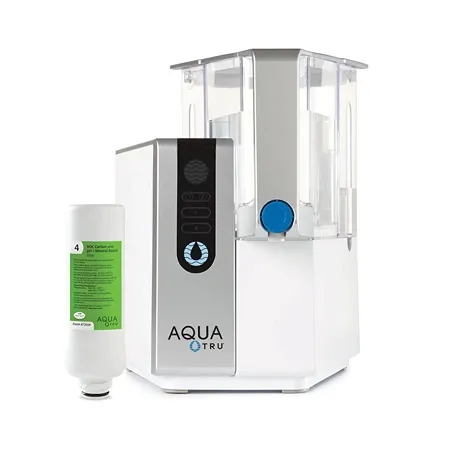
Better for families
AquaTru Classic
54 GPD, a 0.75 gal clean tank and IAPMO certification to NSF/ANSI 42, 53, 58 and 401.
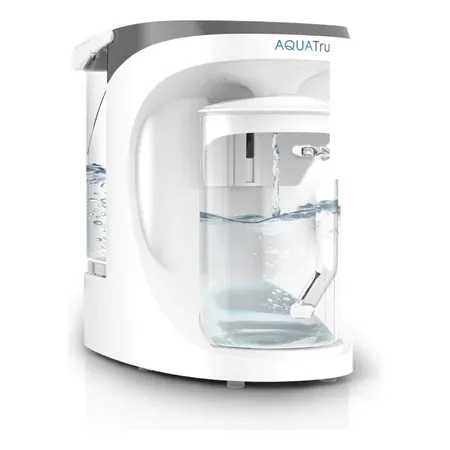
Best for glass storage
AquaTru Carafe
Same certifications as the Classic, with a 64 oz glass carafe in a smaller 9 lb unit.
To see how AquaTru compares with other brands, read AquaTru vs. Bluevua and AquaTru vs. Waterdrop. Our guide to the best countertop reverse osmosis systems covers more picks.
AquaTru Classic vs. Carafe FAQ
What is the difference between the AquaTru Classic and the Carafe?
They filter the same way and hold the same certifications. The Classic makes more water (54 gallons per day rated, 0.75 gallon clean tank) and its filters last twice as many gallons. The Carafe makes 35 gallons per day into a 64 oz glass carafe and is smaller, lighter and cheaper.
Is the AquaTru Carafe worth it?
Yes, for one or two people who want reverse osmosis water stored in glass. It carries the same IAPMO certifications to NSF/ANSI 42, 53, 58 and 401 as the Classic, which few countertop RO systems match. A bigger household is better served by the Classic, because the Carafe’s filters are rated for half the gallons.
Does the AquaTru Carafe filter as well as the Classic?
Yes. Both are listed on the same IAPMO certificates (W-10194 for NSF/ANSI 58, W-10193 for NSF/ANSI 53, W-10195 for NSF/ANSI 401 and W-10188 for NSF/ANSI 42), with the same contaminant claims.
Do AquaTru Classic and Carafe use the same filters?
They use the same filter types at the same prices, but the cartridges are model-specific: buy Classic filters for the Classic and Carafe filters for the Carafe. AquaTru rates the Carafe’s filters for half the gallons of the Classic’s.
Do AquaTru systems remove fluoride and PFAS?
Yes. Both are certified under NSF/ANSI 58 to reduce fluoride, and under NSF/ANSI 53 to reduce PFOA and PFOS. AquaTru’s data sheet lists 93.5% average fluoride reduction for the Classic.
Is there an AquaTru Freeze?
No. AquaTru doesn’t sell a product called the AquaTru Freeze. Its current lineup is the Classic, the Carafe, the Under Sink system, a shower filter and the Freestanding Model 1, a $1,699 hot-and-cold office unit.
How long do AquaTru filters last?
On the Classic, the pre/carbon filter lasts 6 months or 600 gallons, the VOC filter 1 year or 600 gallons and the RO membrane 2 years or 1,200 gallons. On the Carafe, each is rated for half as many gallons over the same months.