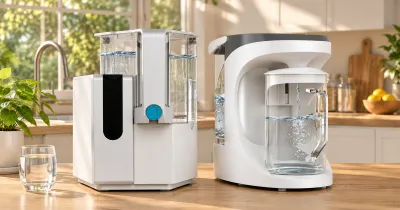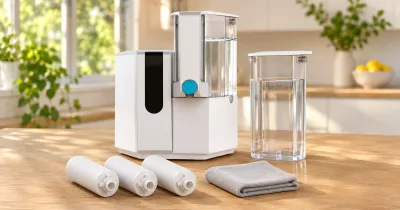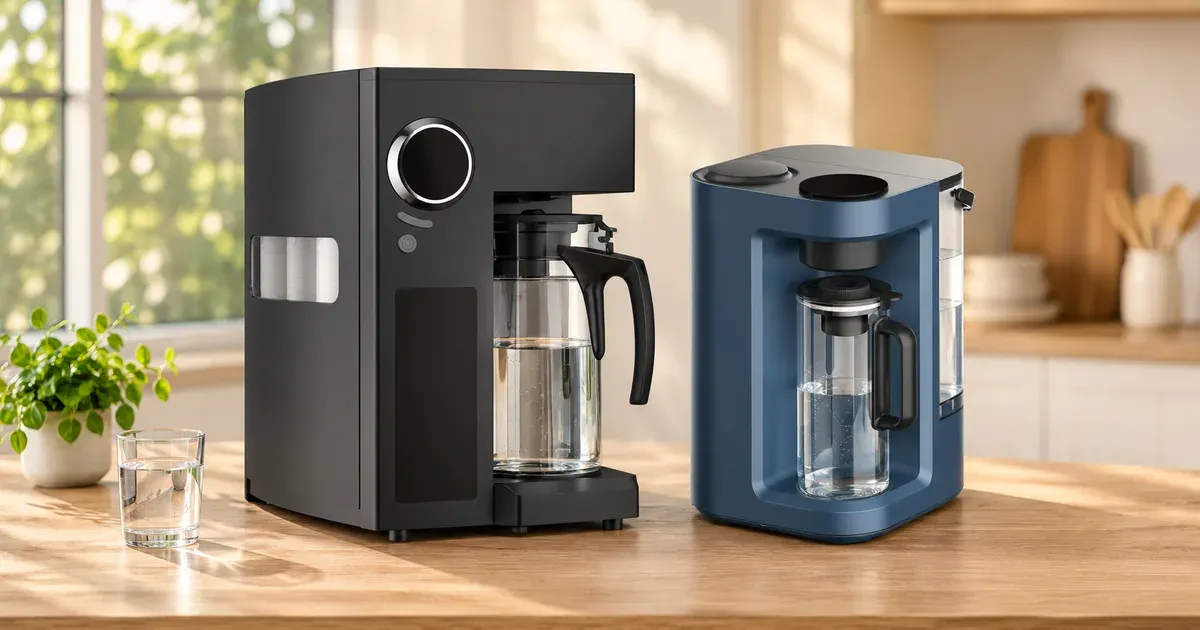
The short answer: the ROPOT-Lite is the better buy for one or two people, and the full-size ROPOT is for bigger households that want a 60 oz carafe. The surprise is certification. The cheaper ROPOT-Lite (RO100ROPOT-LITE) is the only Bluevua certified under NSF/ANSI 58 for lead, along with TDS, cadmium and trivalent chromium. The ROPOT-Lite UV is certified for the same minus lead. The full-size ROPOT and ROPOT UV, Bluevua’s best sellers, are certified only to NSF/ANSI 372, which covers lead-free materials, not what the system removes. All four make 100 gallons a day into a glass carafe and add minerals back.
Prices in November 2026: Bluevua’s Black Friday sale, November 13 to 30, takes these prices in cart: ROPOT UV $317 (was $454), ROPOT $299 (was $434), ROPOT-Lite UV $219 (was $369) and ROPOT-Lite $209 (was $349). On Amazon on November 15 they were $409, $389, $319 and $299.
Bluevua ROPOT vs. ROPOT-Lite at a Glance
| ROPOT UV | ROPOT | ROPOT-Lite UV | ROPOT-Lite | |
|---|---|---|---|---|
| Model number | RO100ROPOT-UV | RO100ROPOT | RO100ROPOT-LITE(UV) | RO100ROPOT-LITE |
| Sale price, Nov. 2026 | $317 (was $454) | $299 (was $434) | $219 (was $369) | $209 (was $349) |
| NSF/ANSI 58 (RO) | No | No | Yes, WQA | Yes, WQA |
| Certified reductions | None | None | TDS, cadmium, trivalent chromium | TDS, lead, cadmium, trivalent chromium |
| Other certification | NSF/ANSI 372 (NSF, WQA) | NSF/ANSI 372 (NSF, WQA) | NSF/ANSI 372 | NSF/ANSI 372 |
| Stages | 6 | 5 | 7 | 6 |
| UV light | Yes, 270 to 280 nm | No | Yes | No |
| Remineralization | Yes | Yes | Yes | Yes |
| Glass carafe | 60 oz (1.7 L) | 60 oz (1.7 L) | 40 oz (1.2 L) | 40 oz (1.2 L) |
| Rated output | 100 gal/day | 100 gal/day | 100 gal/day | 100 gal/day |
| Size | 10.8 x 14.2 x 15.4 in. | 10.8 x 14.2 x 15.4 in. | 9.8 x 13.4 x 14.1 in. | 9.8 x 13.4 x 14.1 in. |
| Filters | 4 separate (PP, CTO, RO, post-carbon) | Same | One 5-in-1 composite | Same |
| Filter cost per year | About $120 | About $120 | $79.90 | $79.90 |
| Warranty | 1 year | 1 year | 1 year | 1 year |
Certifications are from Bluevua’s NSF certificate (C0878345-01) and WQA Gold Seal certificate and from WQA’s online directory, checked November 15, 2026. Specs and prices are from bluevua.com and Bluevua’s manuals.
Certification: Read the Model Suffix
Bluevua’s product pages say “NSF & WQA Certified” on every model. The certificates are more specific, and the suffix decides what you get:
- RO100ROPOT-LITE is certified by WQA under NSF/ANSI 58, the reverse osmosis standard, for TDS, lead, cadmium and trivalent chromium.
- RO100ROPOT-LITE(UV) is certified under NSF/ANSI 58 for TDS, cadmium and trivalent chromium. Lead isn’t on its listing.
- RO100ROPOT and RO100ROPOT-UV are certified only to NSF/ANSI 372, by both NSF and WQA. That standard checks that the parts touching water are lead-free. It doesn’t test filtration.
No Bluevua model is certified for fluoride, nitrate, arsenic or PFAS, though Bluevua lists them among the contaminants its systems reduce. WQA also lists the small ROPOT-Travel under NSF/ANSI 58.
If certified lead reduction matters to you, the plain ROPOT-Lite is the one to buy. If you need certified fluoride or PFAS reduction, Bluevua doesn’t offer it; see AquaTru vs. Bluevua for a certified alternative.
Size and Carafe
The full-size ROPOT pours into a 60 oz (1.7 liter) borosilicate glass carafe and can dispense 0.5, 1 or 1.7 liters at a time. The ROPOT-Lite uses a 40 oz (1.2 liter) carafe and dispenses 0.65 or 1.2 liters. Both are rated for 100 gallons a day (0.26 liters a minute), so the ROPOT fills its carafe in about 7 minutes and the Lite in under 5.
The Lite is also about an inch smaller each way: 9.8 x 13.4 x 14.1 inches vs. 10.8 x 14.2 x 15.4 inches. For one or two people, 40 oz at a time is enough. For a family, the 60 oz carafe means fewer refills.
UV or No UV
The UV versions shine a 270 to 280 nm UV light on the water before it reaches the carafe, aimed at bacteria. The reverse osmosis membrane already blocks bacteria, so on treated city water UV is a backup rather than a requirement. It costs $18 more on the ROPOT and $10 more on the Lite during the sale. On the Lite, choosing UV also means losing the certified lead claim.
Filters and Running Costs
The full-size ROPOT uses four separate filters: PP sediment, CTO carbon and post-carbon at $29.99 each every 12 months, plus an RO membrane every 24 months. Bluevua’s four-filter pack is $149.96, so a year averages about $120.
The ROPOT-Lite uses one 5-in-1 composite filter, $79.90 every 12 months. It’s cheaper and quicker to change, but you replace the membrane every year along with the carbon.
Both also use a separate remineralization filter (Bluevua sells a two-pack for $33.99). Our countertop RO filter cost comparison covers other brands.
Which Should You Buy?
| If you… | Better pick | Why |
|---|---|---|
| Want certified lead reduction | ROPOT-Lite | The only Bluevua certified for lead |
| Live alone or with one other person | ROPOT-Lite | 40 oz carafe, $79.90 a year in filters |
| Have a family of three or more | ROPOT | 60 oz carafe |
| Want a UV stage | ROPOT UV or Lite UV | UV light before the carafe |
| Want the lowest price | ROPOT-Lite | $209 on sale |
| Need certified fluoride or PFAS reduction | None of these | No Bluevua is certified for them |
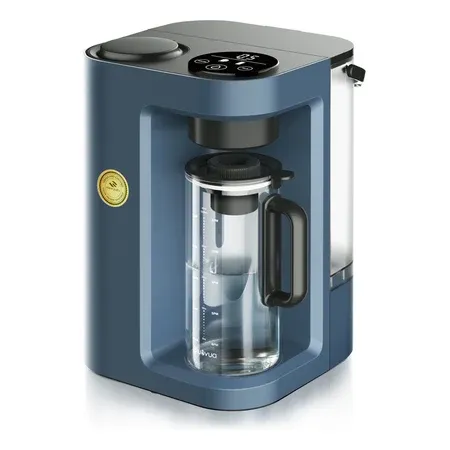
Best for most people
Bluevua ROPOT-Lite
WQA certified under NSF/ANSI 58 for TDS, lead, cadmium and chromium; 40 oz glass carafe.
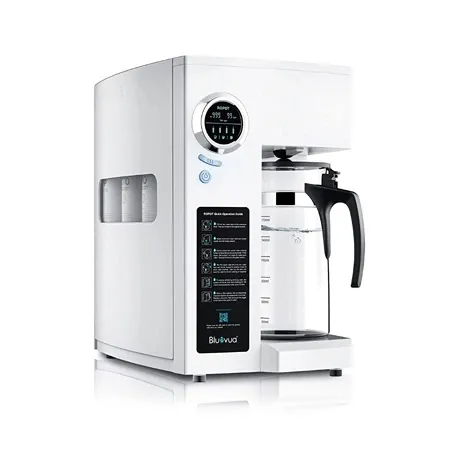
Best for bigger households
Bluevua ROPOT UV
60 oz glass carafe, UV light and a mineral stage, at 100 GPD. Certified to NSF/ANSI 372.
The Lite UV (Amazon) and the ROPOT without UV (Amazon) are sold on the same pages. Our Bluevua ROPOT UV review covers the full-size model in more detail, and our guide to the best countertop reverse osmosis systems covers other brands.
Bluevua ROPOT vs. ROPOT-Lite FAQ
What is the difference between the Bluevua ROPOT and the ROPOT-Lite?
The ROPOT is bigger, with a 60 oz glass carafe and four separate filters. The ROPOT-Lite has a 40 oz carafe, one 5-in-1 filter at $79.90 a year, a smaller body and a lower price. The Lite is also certified under NSF/ANSI 58 for TDS, lead, cadmium and trivalent chromium, while the ROPOT is certified only for lead-free materials (NSF/ANSI 372).
Is the Bluevua RO100ROPOT-UV NSF certified?
Only to NSF/ANSI 372, which covers lead-free materials. It isn’t certified under NSF/ANSI 58, the reverse osmosis standard, so none of its contaminant-reduction claims are certified.
Which Bluevua is certified for lead?
The RO100ROPOT-LITE, certified by WQA under NSF/ANSI 58 for lead, cadmium, trivalent chromium and TDS. The Lite UV is certified for the same except lead.
Is the Bluevua ROPOT-Lite any good?
Yes, for one or two people. It’s the cheapest Bluevua with NSF/ANSI 58 certification, costs $79.90 a year in filters and makes 100 gallons a day into a glass carafe. It isn’t certified for fluoride, arsenic, nitrate or PFAS.
Does the UV light make a difference?
On treated city water, little. The reverse osmosis membrane already blocks bacteria; UV is a second barrier. On the Lite, the UV version’s certification drops lead.
Do Bluevua ROPOT and ROPOT-Lite use the same filters?
No. The ROPOT uses four separate filters (PP, CTO, RO membrane and post-carbon). The ROPOT-Lite uses one 5-in-1 composite filter.