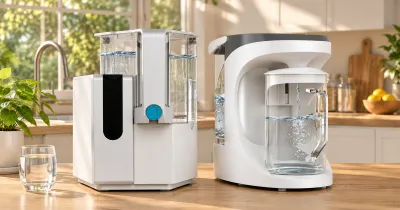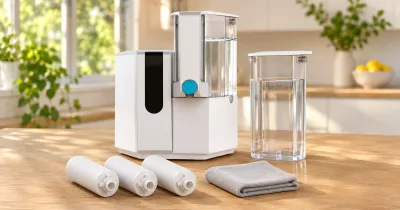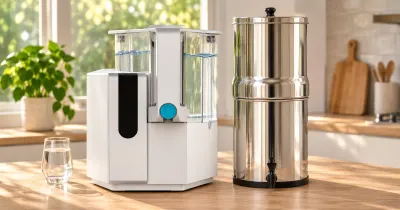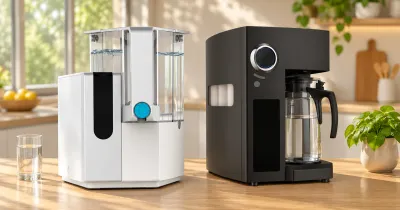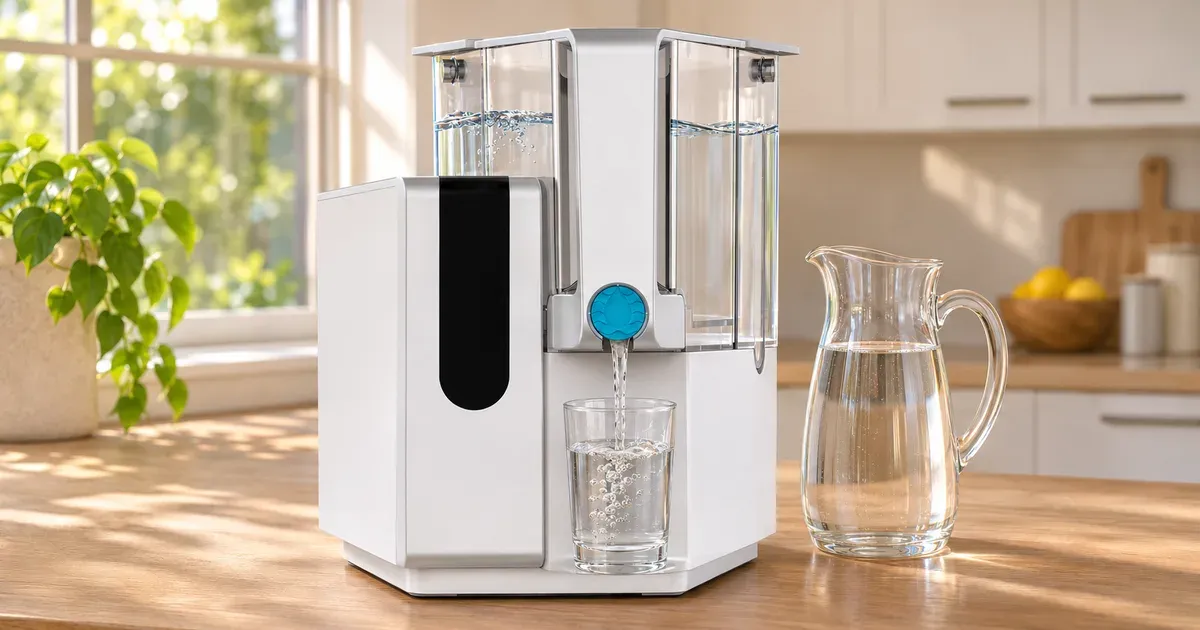
The short answer: buy the AquaTru Classic, or the AquaTru Carafe if you want glass. They are the only countertop reverse osmosis systems certified to reduce fluoride. IAPMO R&T lists both under NSF/ANSI 58 (file W-10194) with a fluoride claim, and AquaTru’s performance data shows a 91.8% minimum and 93.5% average reduction. Bluevua, Waterdrop, SimPure, Frizzlife and iSpring all say their countertop units reduce fluoride, and reverse osmosis membranes generally do, but none of those claims is certified.
Prices on November 15, 2026: AquaTru’s Black Friday sale has the Classic at $380 (was $475) and the Carafe at $300 (was $375). On Amazon the Classic was $475 and the Carafe $337.50.
Fluoride Certification by System
| System | Fluoride certified? | Certifier and file | Price, Nov. 15, 2026 |
|---|---|---|---|
| AquaTru Classic | Yes, NSF/ANSI 58 | IAPMO R&T W-10194 | $380 at AquaTru (was $475) |
| AquaTru Carafe | Yes, NSF/ANSI 58 | IAPMO R&T W-10194 | $300 at AquaTru (was $375) |
| AquaTru Under Sink | Yes, NSF/ANSI 58 (plumbed in) | IAPMO R&T W-10194 | $395 |
| Bluevua ROPOT-Lite | No; certified for TDS, lead, cadmium, trivalent chromium | WQA, NSF/ANSI 58 | $209 in cart (was $349) |
| Bluevua ROPOT UV, ROPOT | No; NSF/ANSI 372 (materials) only | WQA, NSF | $317 and $299 in cart |
| Waterdrop K19-H, M6 | No; certified for TDS only | IAPMO R&T W-17249 | $279 and $339 with codes |
| Waterdrop A1, K6 | No; NSF/ANSI 372 only | IAPMO R&T WC-13977 | $499 and $599 with codes |
| SimPure Y7P-BW | No listing; “against NSF/ANSI 58” SGS test report | None | $269.99 with code (was $369.99) |
| Frizzlife WB99-C | No listing; certified membrane only | None | $389.99 (was $449.99) |
| iSpring RCD100 | No listing | None | $419.99 |
Listings were checked in the IAPMO R&T, WQA Gold Seal and NSF directories on November 15, 2026. Our page on which countertop RO systems are NSF certified lists every claim on every listing.
Why Certification Matters for Fluoride
NSF/ANSI 58 is the standard for reverse osmosis systems. Every certified unit has to reduce TDS, and the maker can add specific claims, such as fluoride, lead or nitrate, that are each tested to a set level. A system certified for TDS only, like the Waterdrop K19-H, hasn’t had its fluoride reduction verified, even though the same kind of membrane usually removes most of it.
That matters most when fluoride is the reason you’re buying. If your water is fluoridated at 0.7 mg/L, the level U.S. community water fluoridation has targeted since 2015, an uncertified RO system will almost certainly cut it a lot. If you’re on a well with high natural fluoride, or you need a predictable result for infant formula, a certified claim is the only third-party evidence of how much a system removes.
Carbon filters, including most pitchers and faucet filters, don’t remove fluoride. Reverse osmosis, distillation and activated alumina do.
AquaTru Classic: Best for Fluoride
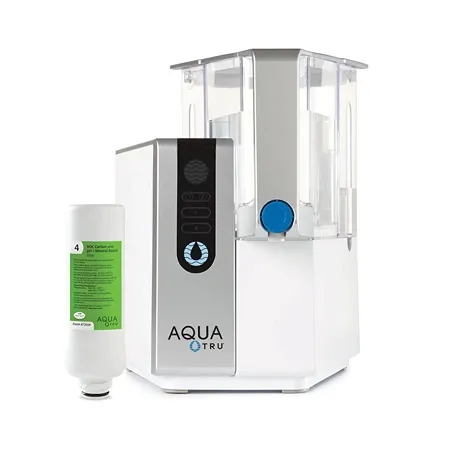
Best for fluoride
AquaTru Classic
Certified for fluoride under NSF/ANSI 58 (IAPMO W-10194); 54 gallons a day.
The AquaTru Classic is a four-stage countertop RO system rated for 54 gallons a day, with a 0.75-gallon clean-water tank. Besides fluoride, its NSF/ANSI 58 listing covers TDS, lead, pentavalent arsenic, nitrate/nitrite, barium, chromium, copper, radium, selenium, cysts and perchlorate, and its NSF/ANSI 53 listing covers PFOA, PFOS and VOCs.
AquaTru’s performance data sheet for the Classic (models AT2000 to AT2050) lists fluoride reduction at 91.8% minimum and 93.5% average, and the system’s maximum feed water at 1,500 mg/L TDS. The RO membrane ($59.95) lasts two years or 1,200 gallons; the pre/carbon filter ($29.95) six months and the VOC filter ($39.95) a year.
AquaTru Carafe: Best Glass Option for Fluoride
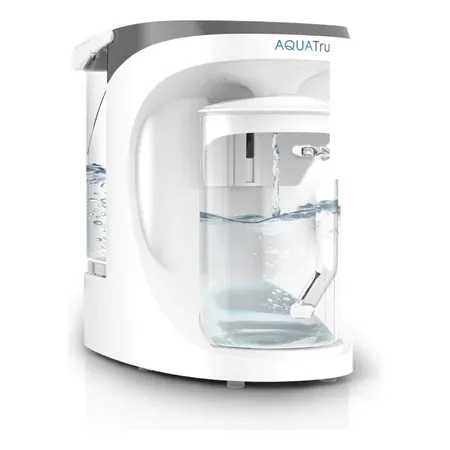
The AquaTru Carafe is on the same IAPMO listing with the same fluoride claim. It makes 35 gallons a day and pours into a 64 oz borosilicate glass carafe, and its filters are rated for half the gallons of the Classic’s at the same prices. It’s the better choice for one or two people with a small kitchen. Our AquaTru Classic vs. Carafe comparison covers the differences.
What About Bluevua and Waterdrop?
Bluevua’s countertop units list fluoride among the contaminants they reduce, but no Bluevua model has a fluoride claim on its WQA listing. The ROPOT-Lite is certified for TDS, lead, cadmium and trivalent chromium; the ROPOT and ROPOT UV only for lead-free materials. See AquaTru vs. Bluevua.
Waterdrop’s product pages list fluoride as “tested by a third-party laboratory.” The K19-H and M6 series are on an IAPMO NSF/ANSI 58 listing for TDS only; the A1 and K6 are certified only to NSF/ANSI 372. See AquaTru vs. Waterdrop.
Either brand will likely cut fluoride sharply, because that’s what RO membranes do. If you need certainty about how much, test your filtered water with a fluoride test kit, or buy an AquaTru.
Fluoride Limits and Infant Formula
- EPA limits: the enforceable maximum for fluoride in public water is 4.0 mg/L, with a non-enforceable secondary standard of 2.0 mg/L to prevent tooth discoloration.
- Fluoridated water: U.S. community water fluoridation has targeted 0.7 mg/L since the Public Health Service’s 2015 recommendation.
- CDC: mixing infant formula with fluoridated water “may increase the chance of dental fluorosis” when formula is a baby’s main food. Ready-to-feed formula doesn’t cause it, and bottled water labeled de-ionized, purified, demineralized or distilled has little or no fluoride. Where water has 4.0 mg/L or more, the CDC says to consider a filter that removes fluoride.
- American Academy of Pediatrics: fluoridated water is safe for formula, with a small risk of mild fluorosis, which is cosmetic. To lower the risk before the first tooth, it suggests bottled or purified water with no fluoride, or ready-to-feed formula.
Neither the CDC nor the AAP names home RO systems, but a certified RO system produces the kind of low-fluoride purified water they describe.
Which Should You Buy?
- Choose the AquaTru Classic if fluoride is the reason you’re buying and more than one or two people drink from it.
- Choose the AquaTru Carafe if you want glass storage, have a small kitchen, or are making formula for one baby.
- Choose an uncertified system (Bluevua, Waterdrop) if fluoride is a minor concern and you’d rather have faster filtering, hot water or a lower price. Test the output to confirm.
For the full field, including systems picked for other reasons, see our guide to the best countertop reverse osmosis systems.
Best Countertop RO System for Fluoride FAQ
Do countertop reverse osmosis systems remove fluoride?
Yes. Reverse osmosis membranes reduce fluoride, and AquaTru’s certified data shows 91.8% to 93.5% reduction. Among countertop units, only the AquaTru Classic and Carafe have that reduction certified, under NSF/ANSI 58 by IAPMO R&T.
Which countertop RO system is certified for fluoride?
The AquaTru Classic and AquaTru Carafe, on IAPMO R&T listing W-10194 under NSF/ANSI 58. AquaTru’s Under Sink model is on the same listing.
Does Bluevua remove fluoride?
Bluevua says its systems reduce fluoride, and RO membranes generally do, but no Bluevua model is certified for it. Its WQA listings cover TDS, lead, cadmium and trivalent chromium (ROPOT-Lite) or lead-free materials only (ROPOT and ROPOT UV).
Does Waterdrop remove fluoride?
Waterdrop lists fluoride as “tested by a third-party laboratory.” Its K19-H and M6 systems are certified under NSF/ANSI 58 for TDS only, and the A1 and K6 only for lead-free materials.
Does a Brita or carbon filter remove fluoride?
No. Activated carbon doesn’t remove fluoride. You need reverse osmosis, distillation or activated alumina.
Can I use reverse osmosis water for baby formula?
Yes. The CDC and the American Academy of Pediatrics both describe low-fluoride purified water as an option for formula to reduce the risk of mild dental fluorosis. If you’re unsure your tap water is safe to drink, follow your pediatrician’s advice on boiling it.