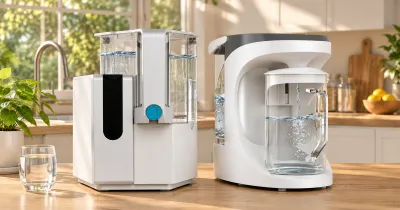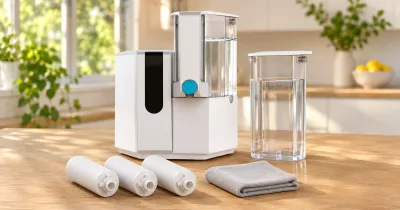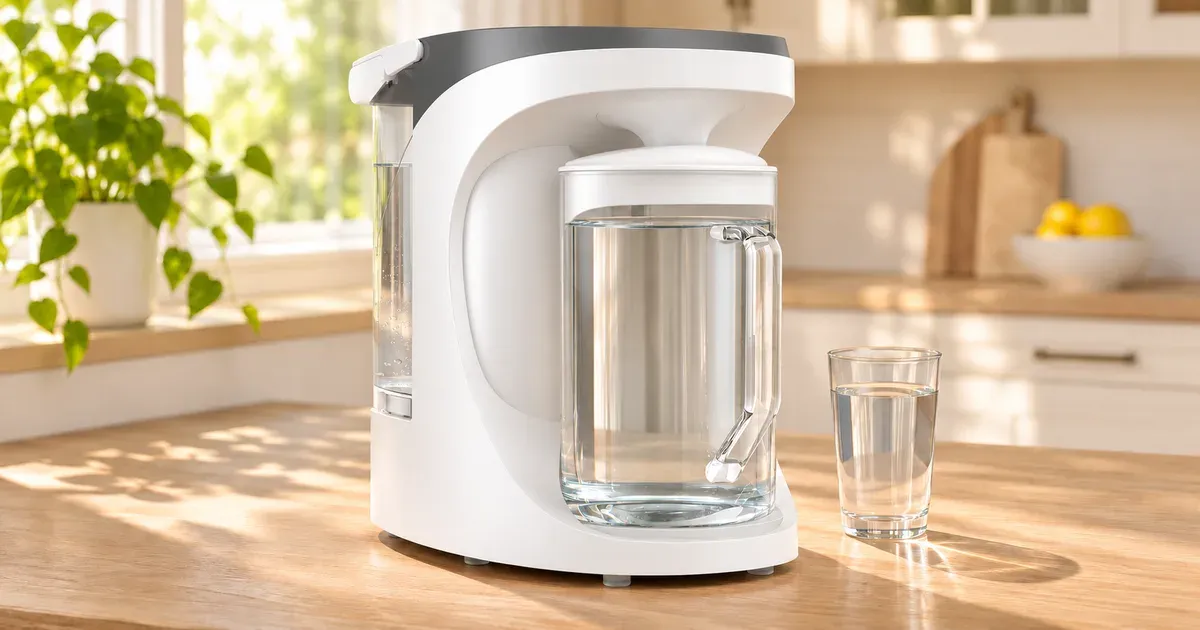
The short answer: the AquaTru Classic and AquaTru Carafe are the only countertop reverse osmosis systems certified to reduce PFAS. IAPMO R&T lists both under NSF/ANSI 53 (file W-10193) for PFOA and PFOS, the two PFAS chemicals EPA limits at 4 parts per trillion. Every other countertop brand, including Bluevua, Waterdrop and SimPure, says its systems reduce PFOA and PFOS, but none has a certified listing for it.
Prices on November 15, 2026: AquaTru’s Black Friday sale has the Classic at $380 (was $475) and the Carafe at $300 (was $375). On Amazon the Classic was $475 and the Carafe $337.50.
PFAS Certification by System
| System | PFOA/PFOS certified? | Certifier and file | Price, Nov. 15, 2026 |
|---|---|---|---|
| AquaTru Classic | Yes, NSF/ANSI 53 | IAPMO R&T W-10193 | $380 at AquaTru (was $475) |
| AquaTru Carafe | Yes, NSF/ANSI 53 | IAPMO R&T W-10193 | $300 at AquaTru (was $375) |
| AquaTru Under Sink | Yes, NSF/ANSI 53 (plumbed in) | IAPMO R&T W-10193 | $395 |
| Bluevua ROPOT-Lite | No; certified for TDS, lead, cadmium, trivalent chromium | WQA, NSF/ANSI 58 | $209 in cart (was $349) |
| Bluevua ROPOT UV, ROPOT | No; NSF/ANSI 372 (materials) only | WQA, NSF | $317 and $299 in cart |
| Waterdrop K19-H, M6 | No; certified for TDS only | IAPMO R&T W-17249 | $279 and $339 with codes |
| Waterdrop A1, K6 | No; NSF/ANSI 372 only | IAPMO R&T WC-13977 | $499 and $599 with codes |
| Waterdrop C2S | No; Waterdrop lists NSF/ANSI 372 only | Not confirmed | $149.99 on Amazon |
| SimPure Y7P-BW | No listing; SGS test report | None | $269.99 with code (was $369.99) |
| Frizzlife WB99-C, iSpring RCD100 | No listing | None | $389.99 and $419.99 |
Listings were checked in the IAPMO R&T, WQA Gold Seal and NSF directories on November 15, 2026. AquaTru’s PFOA and PFOS claims are rated for 600 gallons on the Classic’s carbon filters and 300 on the Carafe’s. Our page on which countertop RO systems are NSF certified covers every listing.
What EPA Says About PFAS and Home Filters
- The limits: EPA’s April 2024 drinking water rule set enforceable limits of 4.0 parts per trillion each for PFOA and PFOS. EPA said in May 2025 that it would keep those two limits, and in May 2026 it proposed giving water systems until 2031 to comply. Your utility’s annual water quality report is the first place to check whether PFAS were detected in your water.
- Which filters work: EPA’s home filter fact sheet names reverse osmosis, activated carbon and ion exchange as filter types that “can be effective at reducing PFAS.”
- How to check a filter: EPA says to look for NSF/ANSI 53 or NSF/ANSI 58 certification for PFAS on the packaging and confirm it in the certifier’s online directory.
- The caveat: EPA notes that current certification standards don’t yet show that a filter removes PFAS down to its new 4 ppt limits.
That last point applies to AquaTru too. Its certification proves it meets the NSF/ANSI 53 PFOA and PFOS test. AquaTru’s older performance data sheet lists 97.5% reduction of combined PFOA and PFOS.
AquaTru Classic: Best for PFAS
Best for PFAS
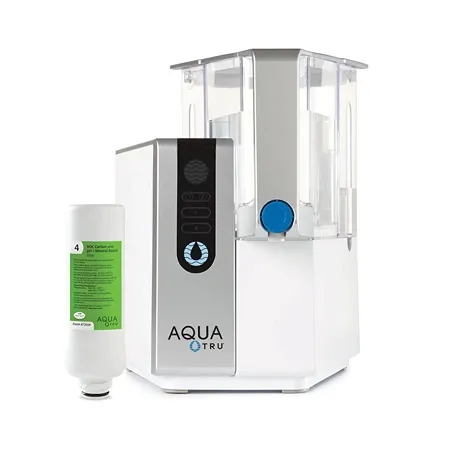
AquaTru Classic
Certified for PFOA and PFOS under NSF/ANSI 53 (IAPMO W-10193); 54 gallons a day.
The AquaTru Classic pushes tap water through a pre/carbon filter, an RO membrane and a VOC carbon filter, so PFAS have to get past both carbon and a membrane. Its NSF/ANSI 53 listing covers PFOA, PFOS and VOCs; its NSF/ANSI 58 listing covers fluoride, lead, arsenic, nitrate and TDS; and its NSF/ANSI 401 listing covers 15 emerging compounds and microplastics.
It’s rated for 54 gallons a day into a 0.75-gallon tank. Filters cost about $130 a year: the pre/carbon filter ($29.95) every six months or 600 gallons, the VOC filter ($39.95) every year, and the RO membrane ($59.95) every two years. Replace the carbon filters on schedule, because the PFAS rating is tied to their 600-gallon life.
AquaTru Carafe: Best Glass Option for PFAS
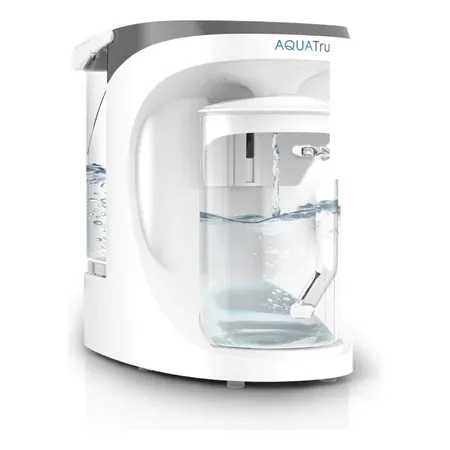
The AquaTru Carafe has the same filter design and certifications, makes 35 gallons a day, and stores water in a 64 oz borosilicate glass carafe. Its PFOA and PFOS rating is 300 gallons per set of carbon filters, half the Classic’s, so it suits one or two people. See AquaTru Classic vs. Carafe.
What About Uncertified Systems?
Reverse osmosis membranes generally reduce PFAS well, so a Bluevua or Waterdrop unit will probably cut PFOA and PFOS too. The difference is that nobody independent has verified how much, and for how many gallons. Bluevua’s site says “NSF & WQA Certified,” but the full-size ROPOT and ROPOT UV are certified only to NSF/ANSI 372, a lead-free materials standard. Waterdrop marks its PFOA and PFOS figures “tested by a third-party laboratory.”
If PFAS is your main reason for buying, the certified claim is worth paying for. If your utility reports no PFAS and you mostly want better-tasting water, see AquaTru vs. Bluevua and AquaTru vs. Waterdrop.
Which Should You Buy?
- Choose the AquaTru Classic if your water report shows PFOA or PFOS and you want the most certified water per day.
- Choose the AquaTru Carafe if you want glass storage and one or two people will drink from it.
- Choose AquaTru’s Under Sink model ($395) if you’d rather install a faucet and drain line than refill a tank; it’s on the same certifications.
Our guide to the best countertop reverse osmosis systems covers picks for other priorities, such as speed and hot water.
Best Countertop RO System for PFAS FAQ
Does reverse osmosis remove PFAS?
Yes. EPA lists reverse osmosis among the filter types that can be effective at reducing PFAS. Among countertop units, only the AquaTru Classic and Carafe have a certified PFOA and PFOS claim (IAPMO R&T, NSF/ANSI 53).
Are countertop RO systems certified to remove PFAS?
Only AquaTru’s. Bluevua, Waterdrop, SimPure, Frizzlife and iSpring countertop units make PFAS claims based on their own testing, without a certified listing.
Which certification should I look for for PFAS?
EPA says to look for NSF/ANSI 53 or NSF/ANSI 58 certification for PFAS reduction and to confirm it in the certifier’s directory (NSF, IAPMO R&T or WQA). NSF/ANSI 372 doesn’t count; it covers lead-free materials only.
Does a countertop RO remove all PFAS?
Certification covers PFOA and PFOS. EPA notes that current standards don’t yet show removal down to its 4 parts per trillion limits, and there are thousands of PFAS chemicals that no home filter certification covers individually.
How often should I change the filters for PFAS?
On the AquaTru Classic, the carbon filters every 600 gallons (six months for the pre/carbon filter, a year for the VOC filter); on the Carafe, every 300 gallons. The PFAS rating applies only within those limits.