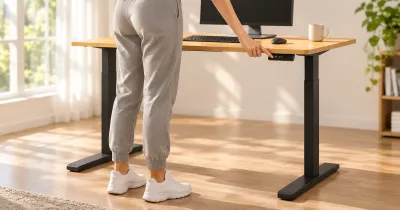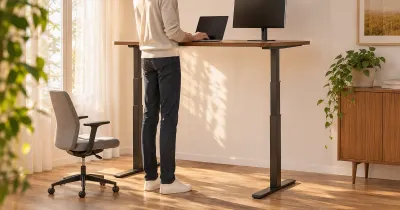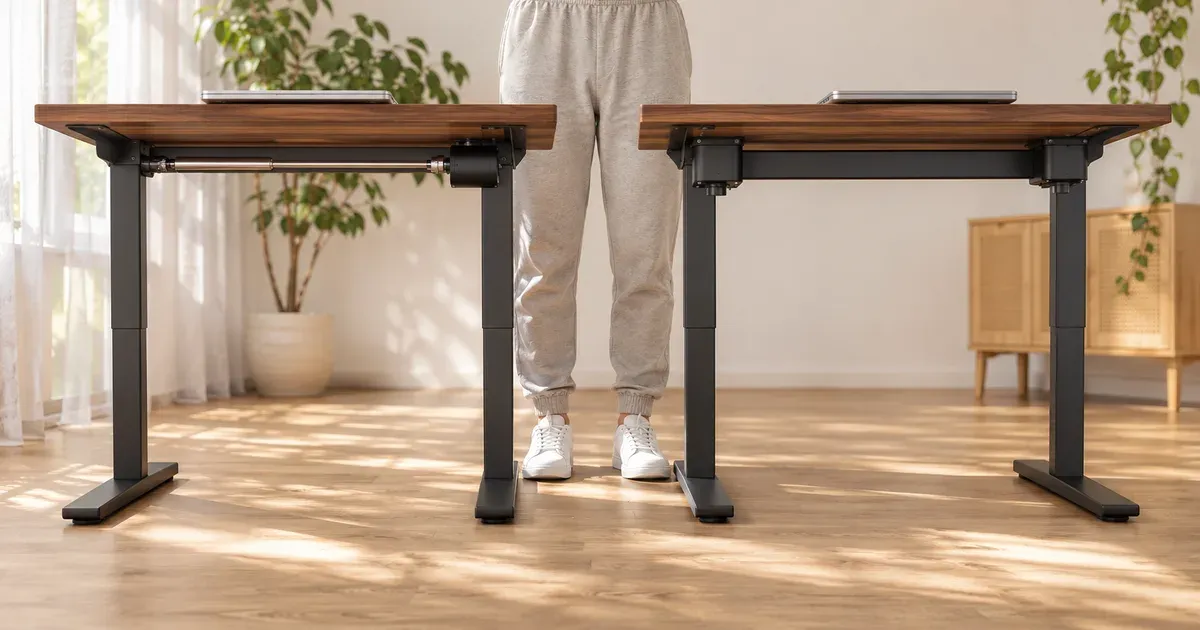
The short answer: the motor count matters less than what comes with it. Dual-motor desks are usually the better desks because they tend to have three-stage legs, a wider height range, and lift ratings of 220 to 355 pounds. Single-motor desks lift about 176 pounds, have a narrower range, and cost about $110 to $300. For a laptop and one or two monitors, a single motor is enough. For a heavy setup, a tall or short user, or a desk you plan to keep for ten years, buy dual.
Single vs. Dual Motor at a Glance
| Single motor | Dual motor | |
|---|---|---|
| How it works | One motor turns a rod that drives both legs | One motor in each leg, synchronized by the control box |
| Typical lift capacity | About 176 lb | 220 to 355 lb |
| Typical legs | 2-stage | 3-stage |
| Typical height range | About 28 to 47 in | About 23 to 49 in |
| Typical speed | 1 in. per second or less | 1 to 2 in. per second |
| If a motor fails | The desk stops but stays level | One side can stop while the other moves |
| Typical price | $110 to $300 | $300 to $700 and up |
How the Two Designs Work
A single-motor desk has one motor, usually mounted near one leg. A steel rod runs across the frame under the desktop and turns a gear in each leg, so both legs rise together.
A dual-motor desk has a motor inside each leg. The control box reads both and keeps them in step. Four-leg desks either put a motor in every leg, as the UPLIFT V3 4-Leg and QuadZen do, or drive four legs from two motors, as the FlexiSpot E7 Plus does.
What the Motor Count Changes
Lift capacity
Two motors share the load, so dual-motor frames are rated higher. Among desks sold today, single-motor models such as the FlexiSpot EN1 and Autonomous Desk Core are rated for 176 pounds. Dual-motor models run from 220 pounds (FlexiSpot E5, Vivo’s 2B series) and 250 pounds (UPLIFT V3 Essential, Autonomous Desk 2) to about 350 pounds (355 for the UPLIFT V3, 352 for the FlexiSpot E7).
On a frame sold without a top, the rating has to cover the desktop too. A 60-inch butcher block top can weigh 70 to 100 pounds on its own.
Speed under load
This is the difference you feel. In independent load tests, the weak desks of either type slow down sharply as weight is added: one dual-motor desk rated for 154 pounds fell from 1.25 inches per second empty to 0.33 near its limit. Well-built desks of either type lose less than about 0.3 inches per second across their whole range. One single-motor desk in the same tests ran 1.55 inches per second empty and 1.35 at 275 pounds, faster than several dual-motor desks.
So a good single motor beats a bad pair. The catch is that good single-motor frames are rare and expensive, and nearly every cheap single-motor desk is slow: about 1 inch per second or less, against 1.5 to 2 for a mid-range dual-motor desk.
Height range
Motor count doesn’t set the height range, but the two go together. Budget single-motor desks almost always use two-stage legs, which bottom out around 28 inches and top out around 46 to 47. Dual-motor desks usually have three-stage legs that go from about 23 to 49 inches. If you want to sit lower than regular desk height, or you’re taller than about 6 feet 2 inches, that range matters more than anything else on the spec sheet. Our standing desk height range chart lists the range of every desk we cover.
What happens when a motor fails
With one motor and a rod, a failure stops the whole desk, and the desktop stays level. With two motors, one can fail while the other still moves, which leaves the desk tilted until the control box stops it. Dual-motor desks also have two motors that can fail instead of one. Good control boxes watch for the legs getting out of step and stop the desk, and a reset re-levels it.
Noise
Electric desks run between about 45 and 60 decibels while moving, and they move for 10 to 15 seconds at a time. Motor count is not a reliable guide to noise. UPLIFT rates its dual-motor V3 frame under 48 dB, and budget single-motor desks are typically rated under 50 dB.
Price
Single-motor desks are the cheapest electric desks you can buy: the FlexiSpot EN1 is about $110 with a top, and the Autonomous Desk Core is $299. Dual-motor frames start at about $210 (FlexiSpot E5) and complete desks at about $300, running to $599 and up from UPLIFT.
Single and Dual Motor Desks Compared
| Standing desk | Motors | Legs | Lift capacity | Speed | Price |
|---|---|---|---|---|---|
| FlexiSpot EN1 | 1 | 2 legs, 2-stage | 176 lb | 1 in/s | About $110 |
| FlexiSpot E2 | 1 | 2 legs | 176 lb | 0.6 in/s | $110 for the frame |
| Autonomous Desk Core | 1 | 2 legs, 2-stage | 176 lb | 1 in/s | $299 |
| Autonomous Desk 2 | 2 | 2 legs | 250 lb | 1.1 in/s | $429 |
| Vivo 2B series | 2 | 2 legs, 3-stage | 220 lb | 1.5 in/s | $300 |
| UPLIFT V3 Essential | 2 | 2 legs, 3-stage | 250 lb | Not listed | $399 to $469 |
| FlexiSpot E5 | 2 | 2 legs, 3-stage | 220 lb | 1 in/s | $210 for the frame |
| FlexiSpot E7 | 2 | 2 legs, 3-stage | 352 lb | Up to 2 in/s | $300 for the frame |
| FlexiSpot E7 Plus | 2 | 4 legs, 3-stage | 440 lb | 1 in/s | $500 for the frame |
| UPLIFT V3 | 2 | 2 legs, 3-stage | 355 lb | 2 in/s | From $599 |
| UPLIFT QuadZen | 4 | 4 legs | 220 lb | 1.3 in/s | $749 to $849 |
| UPLIFT V3 4-Leg | 4 | 4 legs, 3-stage | 535 lb | 2 in/s | From $859 on sale |
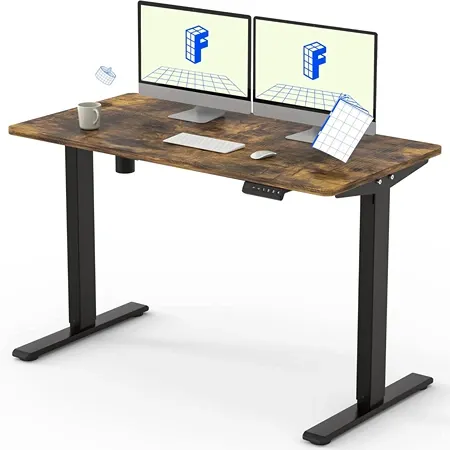
Best Single-Motor desk
FlexiSpot EN1 Standing Desk
A one-piece top on a single-motor frame rated for 176 pounds, with four memory presets, for about $110.
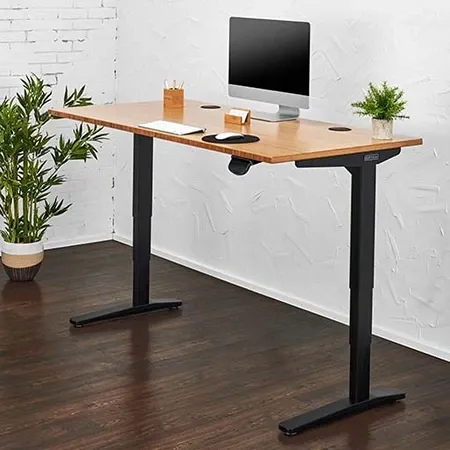
Best Dual-Motor desk
UPLIFT V3 Standing Desk
A motor in each three-stage leg, a 355-pound rating, and 2 inches per second of lift.
When a Single Motor Is Enough
- Your setup is a laptop, one or two monitors, and a keyboard, well under 100 pounds.
- You’re under about 6 feet 2 inches, and you’re fine sitting at regular desk height, about 29 inches.
- The desk is a second desk, a student desk, or a first try at standing.
- The budget is under $200.
When to Buy Dual Motor
- You run a desktop PC, several monitors on arms, or audio gear on the desk.
- You want a heavy top: solid wood, butcher block, or anything 60 inches and wider.
- You’re over about 6 feet 2 inches, you want the desk to drop to seated elbow height, or you’ll put a walking pad under the desk, which adds 4 to 6 inches to the height you need.
- You change heights many times a day and don’t want to wait.
Single vs. Dual Motor FAQ
Is a dual motor standing desk better than a single motor?
Usually, but because of what comes with it. Dual-motor desks tend to have three-stage legs, a wider height range, higher lift ratings and longer warranties. A well-built single-motor desk can be as fast and as reliable as a dual-motor one.
How much weight can a single motor standing desk lift?
Most are rated for about 176 pounds, including the FlexiSpot EN1 and the Autonomous Desk Core. Dual-motor desks are rated from 220 to 355 pounds, and four-motor desks such as the UPLIFT V3 4-Leg reach 535 pounds.
Are single motor standing desks slower?
The cheap ones are, at about 1 inch per second or less. Mid-range dual-motor desks move at 1.5 to 2 inches per second.
Do dual motor desks break more often?
They have two motors that can fail instead of one, and a failed motor can leave the desk uneven until it’s reset or repaired. In practice the warranty matters more: UPLIFT covers the V3’s motors for 15 years and FlexiSpot covers the E7’s for 15, while budget desks typically cover the electronics for 2 years.
Can a standing desk have more than two motors?
Yes. Three-leg L-shaped desks use three motors, and four-leg desks use either four motors (UPLIFT V3 4-Leg, UPLIFT QuadZen) or two motors driving four legs (FlexiSpot E7 Plus).
How do I know if a standing desk is single or dual motor?
Look under the desktop. A single-motor desk has a rod running between the two legs. A dual-motor desk has a motor housing at the top of each leg and a cable from each leg to the control box.