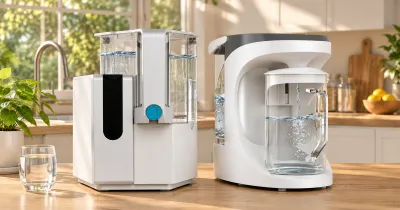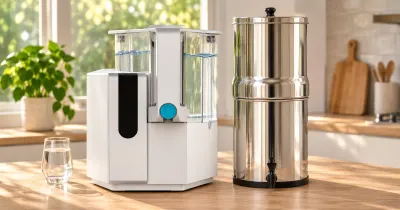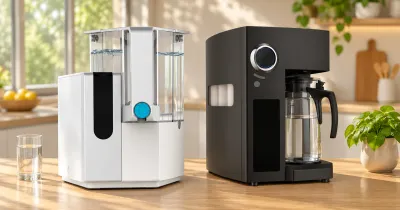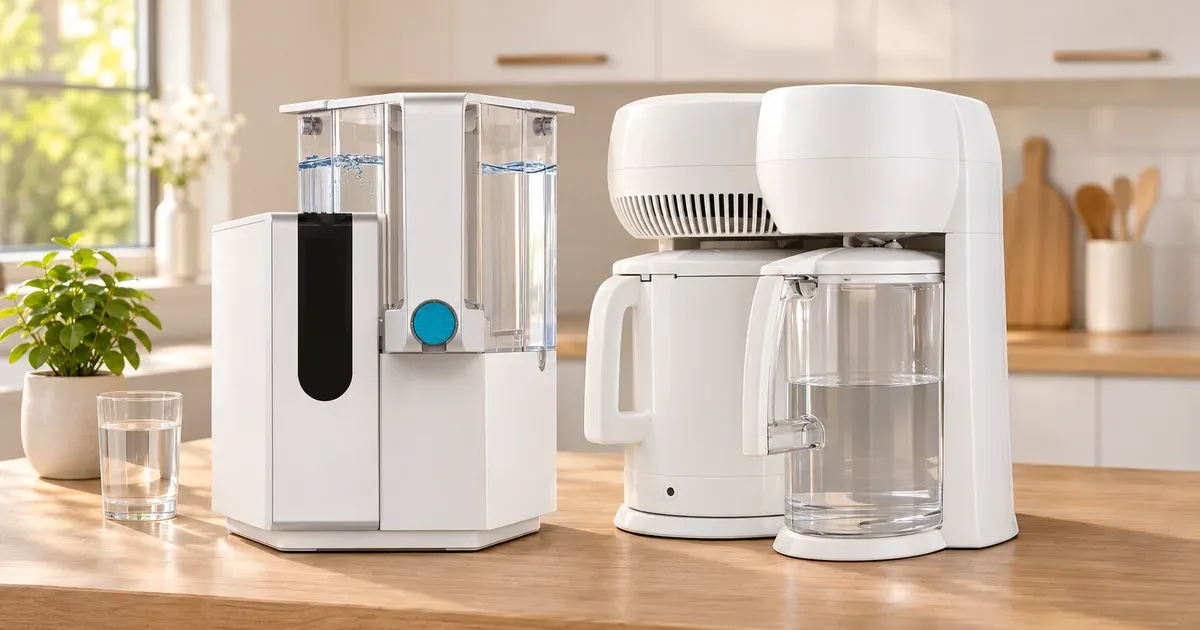
The short answer: a countertop reverse osmosis system is the better choice for everyday drinking water; a distiller makes sense only if you want the lowest possible mineral content and don’t mind waiting. Both remove germs and most dissolved chemicals. RO is much faster, about 20 minutes per tank vs. about 4 hours per gallon for a distiller, and far cheaper to run: a distiller uses about 3.2 kWh per gallon, roughly 50 to 60 cents of electricity. Distillation also doesn’t remove some volatile organic compounds on its own, which is why distillers add a carbon post-filter.
Prices on November 15, 2026: the AquaTru Classic RO system is $380 on AquaTru’s Black Friday sale (was $475). Waterwise countertop distillers cost $449 to $529, and the Waterwise 3200 was $469 on Amazon.
Reverse Osmosis vs. Distiller at a Glance
| Countertop RO (AquaTru Classic) | Countertop distiller (Waterwise) | |
|---|---|---|
| How it works | Pump pushes water through carbon filters and an RO membrane | Boils water and condenses the steam; carbon post-filter |
| Germs (CDC) | Removes parasites, bacteria, viruses | Removes parasites, bacteria, viruses; bacteria can grow on cooling coils between uses |
| Chemicals (CDC) | Lead, copper, chromium, sodium; may reduce arsenic, fluoride, radium, nitrate | Arsenic, barium, cadmium, chromium, lead, nitrate, sodium and many organics |
| VOCs | Carbon stages; AquaTru certified for VOCs (NSF/ANSI 53) | Some VOCs, solvents and pesticides boil over with the steam; needs the carbon post-filter |
| Certification | IAPMO: NSF/ANSI 58, 53 (incl. PFOA, PFOS), 401, 42 | NSF/ANSI 62 is the distiller standard; NSF’s directory listed no distillers on Nov. 15, 2026 |
| Speed | 54 gallons per day; about 20 minutes per 0.75 gal tank | About 1 gallon per 4 hours, up to 6 gallons a day |
| Electricity | Runs a small pump during filtering | About 3.2 kWh per gallon |
| Running cost | About $0.17 per gallon in filters at rated life | About $0.50 to $0.60 per gallon in power, plus carbon filters |
| Minerals left | Removes most | Removes nearly all |
| Waste water | About 1/3 gal per gallon (75% efficiency) | Little or none; scale left in the boiler |
| Maintenance | Replace 3 filters on a 6- to 24-month schedule | Descale the boiler, replace carbon post-filters |
| Price, Nov. 15, 2026 | $380 on sale (was $475) | $449 to $529 |
Sources: the CDC’s home water treatment overview; IAPMO R&T listings for AquaTru; AquaTru’s performance data sheet; Waterwise’s FAQ for distiller output, energy and price. Running cost uses 15.9 to 18 cents per kWh.
What Each Removes
According to the CDC, both technologies remove parasites, bacteria and viruses, and both remove most dissolved inorganic chemicals. RO “will remove” lead, copper, chromium, chloride and sodium and “may also reduce” arsenic, fluoride, radium, sulfate, nitrate and minerals. Distillation removes arsenic, barium, cadmium, chromium, lead, nitrate, sodium, calcium, magnesium “and many organic chemicals.”
The CDC’s caveat on distillers is the main one: distillation does not remove some volatile organic compounds, volatile solvents and certain pesticides, because they evaporate with the water and condense back into it. Waterwise says the same in its FAQ, which is why its distillers run the water through a carbon post-filter. With the filter, a distiller covers VOCs too. It also notes that bacteria can grow on a distiller’s cooling coils while it sits unused.
For PFAS, the EPA’s guidance on home filters names reverse osmosis, activated carbon and ion exchange; it doesn’t list distillation. AquaTru’s Classic is certified under NSF/ANSI 53 for PFOA and PFOS.
Certification
Countertop RO systems are certified under NSF/ANSI 58, and the AquaTru Classic also holds NSF/ANSI 53, 401 and 42 listings from IAPMO R&T. Distillers have their own standard, NSF/ANSI 62, but NSF’s online directory listed no distillers under it on November 15, 2026, so distillers usually rest on the maker’s own testing. Many countertop RO systems are in the same position, so check before you buy. Our list of certified countertop RO systems goes model by model.
Speed and Electricity
This is the biggest practical gap. Waterwise says its countertop distillers make one gallon in about four hours, up to six gallons in 24 hours, and use about 3.2 kWh per gallon, about 50 cents per gallon at the 2023 national average price. A family drinking two gallons a day would use about 45 kWh a week, roughly $7 to $8 of electricity, on drinking water.
An RO system’s pump runs only while filtering. The AquaTru Classic is rated at 54 gallons a day and fills its 0.75-gallon tank in about 20 minutes, so you can make a day’s drinking water in under an hour.
Running Costs and Maintenance
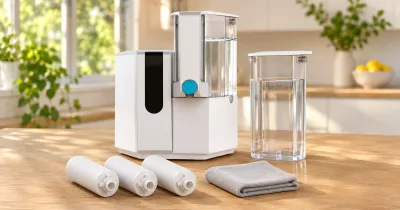
The AquaTru Classic’s three filters cost about $0.17 per gallon at their rated lives (pre/carbon $29.95 per 600 gallons, RO membrane $59.95 per 1,200, VOC carbon $39.95 per 600), or about $130 a year bought individually. A distiller has almost no filter cost but about $0.50 to $0.60 per gallon in electricity, plus carbon post-filters, and its boiler needs regular descaling because every mineral in the water stays behind in it.
RO does send some water down the drain; the Classic’s 75% efficiency rating means about a third of a gallon of reject water per gallon. A distiller wastes almost none. Our countertop RO waste water guide covers the numbers by model.
Minerals and Taste
Both make very low-mineral water. Distilled water is closer to pure; RO leaves a little more behind. Neither is a health concern for most people with a normal diet, and some RO systems, including AquaTru’s Alkaline Mineral Boost option, add a small amount of calcium and magnesium back for taste. Distillers have no such option, and some people find distilled water flat.
Which Should You Buy?
| If you… | Better choice | Why |
|---|---|---|
| Want drinking and cooking water for a household | Countertop RO | 54 gallons a day vs. about 6 for a distiller |
| Want the lowest running cost | Countertop RO | About $0.17 per gallon vs. about $0.50+ in power |
| Need certified PFAS, fluoride or lead reduction | AquaTru Classic | IAPMO certified under NSF/ANSI 53 and 58 |
| Want near-zero mineral water (CPAP, humidifier, irons) | Distiller | Removes nearly all dissolved solids |
| Want no waste water | Distiller | No reject stream |
| Don’t want to replace filters often | Distiller | Only carbon post-filters, but descaling instead |
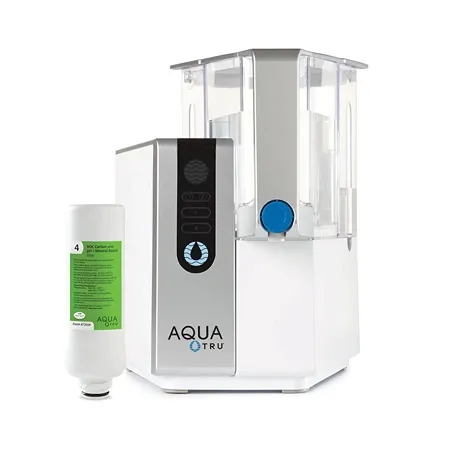
Best countertop RO
AquaTru Classic
54 gallons a day; IAPMO certified for fluoride, lead, arsenic, PFOA/PFOS and VOCs.
AquaTru’s own store was $95 cheaper than Amazon on November 15. For more picks, see our guide to the best countertop reverse osmosis systems.
Countertop Reverse Osmosis vs. Water Distiller FAQ
Is reverse osmosis or distilled water better to drink?
Both are safe and very clean. Reverse osmosis is more practical for daily drinking water because it’s much faster and cheaper to run. Distilled water has slightly fewer dissolved minerals, which matters for appliances like CPAP machines more than for drinking.
Does a distiller remove more than reverse osmosis?
It removes more dissolved minerals, but not necessarily more contaminants. The CDC notes distillation doesn’t remove some volatile organic compounds, solvents and pesticides, which boil off and condense with the water unless a carbon post-filter catches them.
How much electricity does a water distiller use?
Waterwise says about 3.2 kWh per gallon, about 50 cents at the 2023 US average electricity price, or about 58 cents at 18 cents per kWh.
How long does a distiller take to make a gallon?
About four hours for a countertop model, according to Waterwise, with up to six gallons in 24 hours. A countertop RO system like the AquaTru Classic fills its 0.75-gallon tank in about 20 minutes.
Does reverse osmosis waste more water than distillation?
Yes. RO sends some water to the drain to flush the membrane; the AquaTru Classic’s 75% efficiency rating means about a third of a gallon per gallon of clean water. A distiller has no reject stream.
Do distillers remove PFAS?
The EPA’s guidance on PFAS filters names reverse osmosis, activated carbon and ion exchange, not distillation. For a certified PFAS claim, look for NSF/ANSI 53 or 58 PFOA/PFOS certification, such as AquaTru’s.