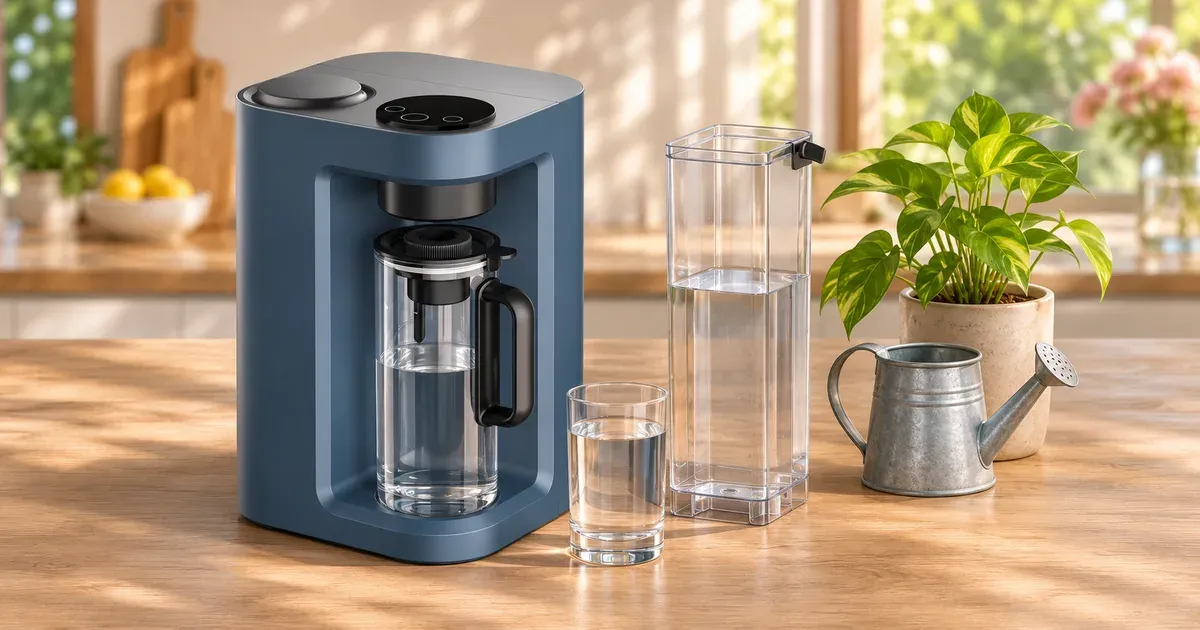
The short answer: a countertop reverse osmosis system sends about 0.25 to 0.6 gallons down the drain for every gallon of filtered water. That’s far less than a typical under-sink RO system, which the EPA says sends 5 gallons or more to drain per gallon. The most efficient published rating is the SimPure Y7P’s 4:1 (a quarter gallon of waste per gallon). The AquaTru Classic (75% efficiency) and Waterdrop K19-H (3:1) send about a third of a gallon to drain. The AquaTru Carafe (63%) sends about 0.6 gallons. On a countertop unit, the reject water stays in the machine, in a separate waste tank or back in the tap-water tank depending on the model, and you pour it out yourself, so you can reuse it.
Waste Water by Model
| System | Published rating | Waste per gallon of filtered water | Waste per year at 1 gal/day | Rated output | Minutes per gallon at rated output |
|---|---|---|---|---|---|
| SimPure Y7P-BW | 4:1 pure to drain | 0.25 gal | 91 gal | 100 gal/day | 14 |
| Frizzlife WB99-C | 3.5:1 | 0.29 gal | 104 gal | 100 gal/day | 14 |
| AquaTru Classic | 75% efficiency | 0.33 gal | 122 gal | 54 gal/day | 27 |
| Waterdrop K19-H | 3:1 | 0.33 gal | 122 gal | 75 gal/day | 19 |
| Waterdrop M6H, C2SL | 3:1 | 0.33 gal | 122 gal | 75 gal/day | 19 |
| iSpring RCD100 | 2.5:1 | 0.4 gal | 146 gal | 100 gal/day | 14 |
| SimPure Y11C | 2.5:1 | 0.4 gal | 146 gal | 75 gal/day | 19 |
| Waterdrop A1 | 2:1 | 0.5 gal | 183 gal | 100 gal/day | 14 |
| Waterdrop K6 | 2:1 | 0.5 gal | 183 gal | 600 gal/day (tankless) | 2.4 |
| AquaTru Carafe | 63% efficiency | 0.59 gal | 215 gal | 35 gal/day | 41 |
| Bluevua ROPOT, ROPOT-Lite | Not published | — | — | 100 gal/day | 14 |
Ratings and outputs are the makers’ published figures (AquaTru’s from its performance data sheets). Real-world output drops with colder water and higher TDS, so treat the minutes per gallon as a best case. For comparison, the EPA’s WaterSense label requires an RO system to send 2.3 gallons or less to drain per gallon, and says a typical system sends 5 or more.
Pure-to-Drain Ratio vs. Efficiency Rating
Makers state waste two ways:
- Pure-to-drain ratio (Waterdrop, SimPure, Frizzlife, iSpring): 3:1 means 3 gallons of filtered water for every 1 gallon to drain, or a third of a gallon of waste per gallon you drink.
- Efficiency rating (AquaTru, and the NSF/ANSI 58 term): the share of the water you pour in that comes out filtered. 75% efficiency means 1 gallon to drain for every 3 filtered, the same as 3:1. AquaTru’s Carafe data sheet lists 63%, about 1.7:1.
Bluevua doesn’t publish a ratio or efficiency rating for the ROPOT or ROPOT-Lite on its product pages or in its manuals.
What to Do With the Reject Water
The water in the waste tank is your tap water with the dissolved solids the membrane removed concentrated into it. At 3:1, it carries roughly four times the dissolved solids of your tap water. At 2:1, about three times. It’s not for drinking, cooking or pets, but it’s useful:
- Cleaning: mopping, wiping counters, rinsing dishes before the dishwasher, filling a bucket to wash the car.
- Flushing a toilet: pour it into the bowl or tank.
- Watering plants: fine for outdoor plants and lawns. For potted houseplants, alternate it with tap or filtered water, because salts from the concentrated water build up in container soil over time.
- Pre-soaking pots and pans.
If your tap water is softened with salt, or has a known contaminant such as arsenic or nitrate, use the reject water for cleaning and flushing only, not for edible plants.
Do Countertop RO Systems Need Electricity?
Yes. Every fill-and-plug countertop RO system has a built-in pump that pushes water through the membrane, so it needs an outlet. AquaTru’s units run on a standard 120-volt plug. Bluevua’s adapters are rated for 36 watts (ROPOT, 24 V 1.5 A) and 48 watts (ROPOT-Lite, 24 V 2.0 A) at maximum.
That’s very little energy. At the ROPOT-Lite’s 48-watt maximum, filtering a gallon takes about 14 minutes, or 0.011 kWh. A gallon a day for a year comes to about 4 kWh, under $1 at 18 cents per kWh.
Hot and cold models use much more. Heating a gallon of water from 60°F to 200°F takes about 0.34 kWh, so a K19-H or A1 that makes a quart of near-boiling water a day uses about 31 kWh a year (about $6) just for heating. The Waterdrop A1 also runs a compressor to keep its cold tank at 41°F, like a small refrigerator. Waterdrop doesn’t publish the K19-H’s or A1’s wattage.
How Long Does a Countertop RO System Take to Filter Water?
It depends on the output rating. At their rated output:
- AquaTru Classic (54 gal/day): about 20 minutes to fill its 0.75-gallon clean-water tank.
- AquaTru Carafe (35 gal/day): about 20 minutes to fill its half-gallon glass carafe.
- Bluevua ROPOT (100 gal/day, 0.26 L/min): about 6½ minutes for its 1.7-liter (60 oz) carafe. The ROPOT-Lite fills its 1.2-liter (40 oz) carafe in about 4½ minutes.
- Waterdrop K19-H (75 gal/day): filters into a cup on demand; 75 gallons a day is about 6.7 oz a minute.
- SimPure Y7P (100 gal/day): SimPure lists 8.8 oz a minute.
Cold tap water filters more slowly. AquaTru rates its units for feed water from 39 to 100°F.
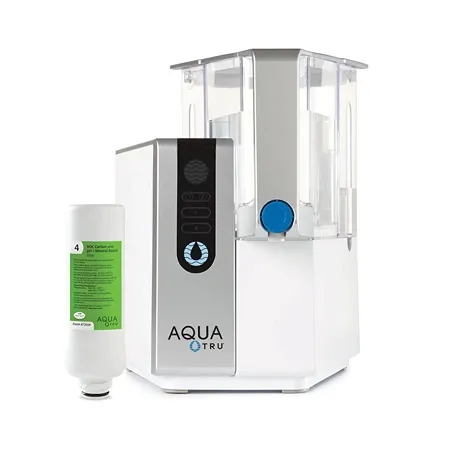
Efficient and fully certified
AquaTru Classic
75% efficiency (about 3:1), 54 gallons a day, and certified for fluoride, lead, arsenic, PFOA and PFOS.
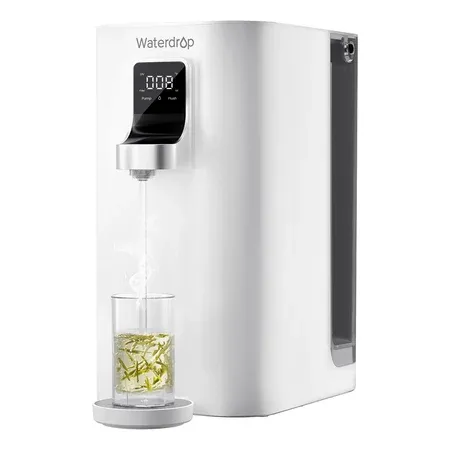
3:1 with instant hot water
Waterdrop K19-H
A 3:1 pure-to-drain ratio, 75 gallons a day and hot water up to 203°F, with one $68.99 filter a year.
For running costs, see our countertop RO filter cost guide. Which models are certified for what is in our countertop RO certification guide, and our guide to the best countertop reverse osmosis systems has the picks.
Countertop Reverse Osmosis Waste Water FAQ
How much water does a countertop reverse osmosis system waste?
About 0.25 to 0.6 gallons per gallon of filtered water, based on maker ratings: 4:1 on the SimPure Y7P, 3:1 on the Waterdrop K19-H, 75% efficiency on the AquaTru Classic and 63% on the AquaTru Carafe. At a gallon a day, that’s roughly 90 to 215 gallons a year.
What is the pure water to waste water ratio of a countertop RO system?
Published ratios run from 4:1 (SimPure Y7P) to 2:1 (Waterdrop A1 and K6). Most are around 3:1: the Waterdrop K19-H, M6H and C2SL, and the AquaTru Classic at 75% efficiency. The AquaTru Carafe is 63% efficient, about 1.7:1. Bluevua doesn’t publish one.
Do countertop RO systems waste less water than under-sink systems?
Usually, yes. The EPA says a typical point-of-use RO system sends 5 gallons or more to drain per gallon of treated water, and WaterSense-labeled systems 2.3 gallons or less. Countertop units with published ratings send a quarter to six-tenths of a gallon.
What can you do with reverse osmosis waste water?
Use it for cleaning, rinsing dishes, flushing toilets or watering outdoor plants. It’s your tap water with about three to four times the dissolved solids, so don’t drink it or cook with it, and alternate it with tap water on potted plants so salts don’t build up in the soil.
Do countertop reverse osmosis systems need electricity?
Yes. They use a built-in pump and plug into a standard outlet. Filtering uses very little power: Bluevua’s adapters are rated at 36 to 48 watts, about 4 kWh a year at a gallon a day. Models with hot water or a cooling compressor use more.
How many gallons per day does a countertop reverse osmosis system make?
Most are rated at 35 to 100 gallons a day: AquaTru Carafe 35, AquaTru Classic 54, Waterdrop K19-H 75, and Bluevua, SimPure Y7P, Frizzlife WB99-C, iSpring RCD100 and Waterdrop A1 100. The Waterdrop K6 is rated for 600, but it’s plumbed in under the sink.