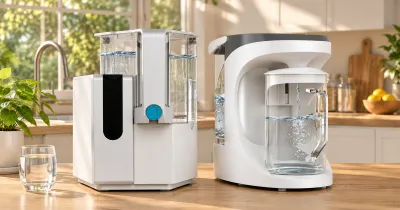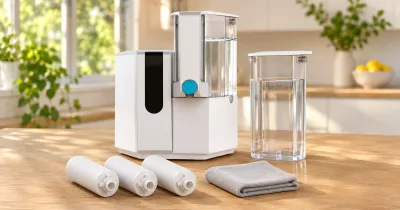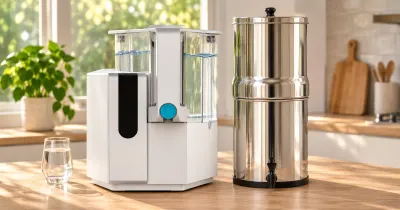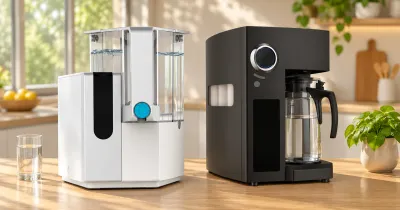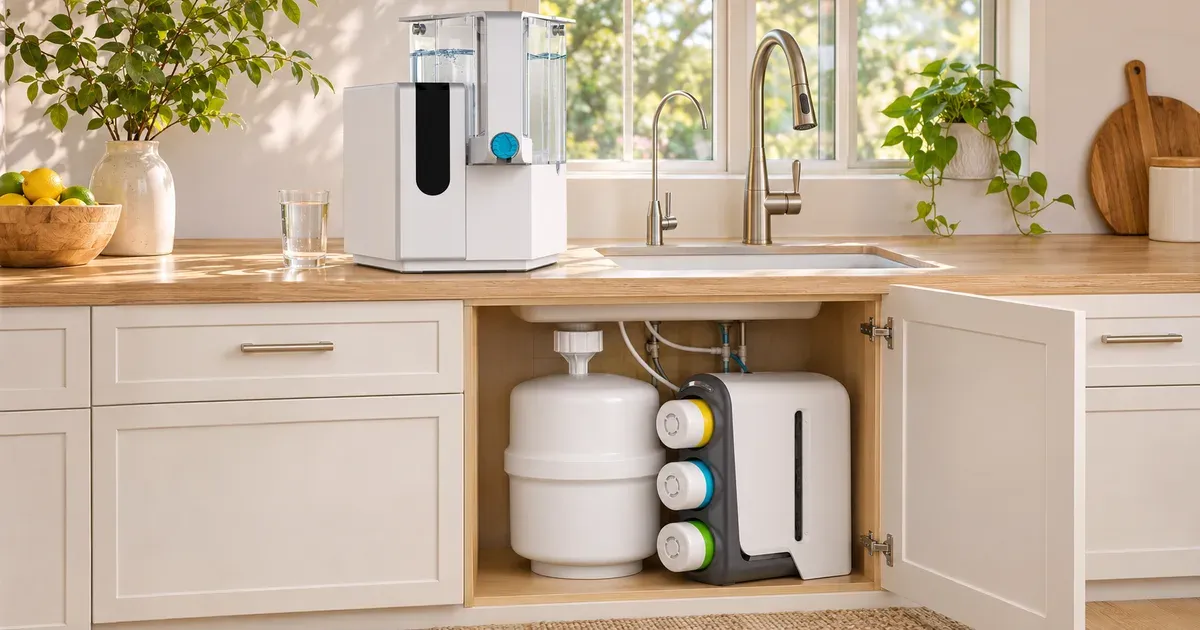
The short answer: an under-sink reverse osmosis system is better if you own your home and drink a lot of water; a countertop system is better if you rent, can’t drill or plumb, or want something you can move. The water itself can be the same. AquaTru’s countertop Classic and its Under Sink use the same four-stage design, carry the same IAPMO certifications to NSF/ANSI 42, 53, 58 and 401, and are both rated for 54 gallons a day. The difference is how water gets in and out: you fill a countertop unit by hand and empty its waste tank, while an under-sink unit connects to your cold-water line and drain and feeds its own faucet.
Prices on November 15, 2026: AquaTru’s Black Friday sale has the Classic at $380 (was $475) and the Under Sink at $316 (was $395). Amazon had both at full price: $475 and $395.
Countertop vs. Under-Sink RO at a Glance
| Countertop RO (AquaTru Classic) | Under-sink RO (AquaTru Under Sink) | |
|---|---|---|
| Price, Nov. 15, 2026 | $380 on sale (was $475) | $316 on sale (was $395) |
| Installation | None: fill the tap-water tank and plug it in | Connects to the cold-water supply and the drain (drain saddle and supply adapter) |
| Where the water comes out | Spout on the unit | Its own faucet on the sink |
| Purified water storage | 0.75 gal | Up to 1.7 gal |
| Rated output | 54 gallons per day | 54 gallons per day |
| NSF/ANSI 58 (IAPMO file W-10194) | TDS, fluoride, lead, arsenic (pentavalent), nitrate/nitrite, barium, chromium, copper, radium, selenium, cysts, perchlorate | Same list; the ATU200 version also lists uranium |
| NSF/ANSI 53 (W-10193) | VOCs, PFOA, PFOS; 600-gallon rating | VOCs, PFOA, PFOS; 360-gallon rating |
| NSF/ANSI 401 and 42 | Microplastics, 15 emerging compounds; chlorine, chloramine | Same |
| Waste water | Collects in the unit’s tap tank for you to empty | Goes straight down the drain |
| Power | Plugs into a 120 V outlet | AquaTru lists no electricity required |
| Filters per year | $79.88 first year, $127.84 second (subscription) | Same subscription pricing |
| Warranty | 1 year (3-year extension $49.95) | 1 year (3-year extension $29.95) |
Certifications are from IAPMO R&T’s listings for AquaTru, current on November 15, 2026. Specs and prices are from aquatru.com.
Filtration Is the Same; Certification Is What Varies
Countertop and under-sink RO use the same technology: a pre-filter, a carbon stage, a membrane with pores of about 0.0001 micron, and usually a final carbon filter. The CDC says RO removes parasites, bacteria and viruses and some chemicals, including lead, copper, chromium and sodium, and may reduce arsenic, fluoride, radium, nitrate and others. Which of those a given system actually reduces depends on the model, so check its certification, not its format.
That’s where systems differ far more than countertop vs. under-sink does. AquaTru’s countertop and under-sink models share one IAPMO certificate for NSF/ANSI 58. Many countertop units sold online are certified only to NSF/ANSI 372, a lead-free materials standard, or are just “tested to” NSF 58 by a lab. Our list of NSF-certified countertop RO systems shows what each one is certified for.
Installation and Renters
This decides it for most people.
A countertop RO system needs a counter and an outlet. You pour tap water into its tank, it filters a batch into a clean-water tank, and you empty the reject water when the unit tells you to. Nothing is drilled or connected, so it works in rentals, dorms, offices and RVs, and moves with you.
An under-sink system needs a free cold-water connection, a drain connection (AquaTru uses a drain saddle valve that clamps onto the drain pipe) and room in the cabinet. Most also need a hole in the sink or counter for the faucet, unless the sink has a spare one. AquaTru calls its Under Sink DIY-friendly, but if your lease doesn’t allow plumbing changes, it’s out.
Convenience and Capacity
Under-sink wins on daily convenience. Water comes from a faucet whenever you want it, the reject water drains on its own, and the AquaTru Under Sink stores up to 1.7 gallons, enough for cooking and filling pots.
A countertop unit has to be refilled. The AquaTru Classic’s clean tank holds 0.75 gallons, so a family that drinks and cooks with it will refill it several times a day. Both are rated at 54 gallons a day, so speed is the same; capacity and refilling are the difference.
Waste Water
Every RO system sends some water to the drain to flush the membrane. The EPA’s WaterSense program says a typical under-sink RO system sends five gallons or more down the drain for every gallon it makes, and inefficient ones up to 10. WaterSense-labeled models must use 2.3 gallons or less per gallon of treated water.
Countertop systems tend to do better because they recirculate. AquaTru’s data sheet gives the Classic a 75% efficiency rating, about a third of a gallon of reject water per gallon of clean water, which you pour out of the unit. AquaTru doesn’t publish an efficiency rating for the Under Sink. If you buy a different under-sink system, look for the WaterSense label. Our countertop RO waste water guide compares ratios by model.
Cost
Up front, under-sink systems range more widely because some need a plumber. AquaTru’s two cost about the same, and the Under Sink is actually cheaper during the Black Friday sale ($316 vs. $380). AquaTru sells the same filter subscription for both, $79.88 the first year and $127.84 the second, when the RO membrane is due. Our countertop RO filter cost comparison covers other brands.
Which Should You Buy?
| If you… | Better choice | Why |
|---|---|---|
| Rent or can’t modify plumbing | Countertop | No installation; take it when you move |
| Own your home and use filtered water for cooking | Under-sink | Water on tap, 1.7 gal stored, drains itself |
| Have no counter space | Under-sink | Lives in the cabinet |
| Have no cabinet space or no spare sink hole | Countertop | Needs only a counter and an outlet |
| Want the least water waste | Countertop (AquaTru Classic) or a WaterSense-labeled under-sink | 75% efficiency vs. 5:1 or worse for a typical under-sink unit |
| Want to filter for an office or RV | Countertop | Portable, no plumbing |
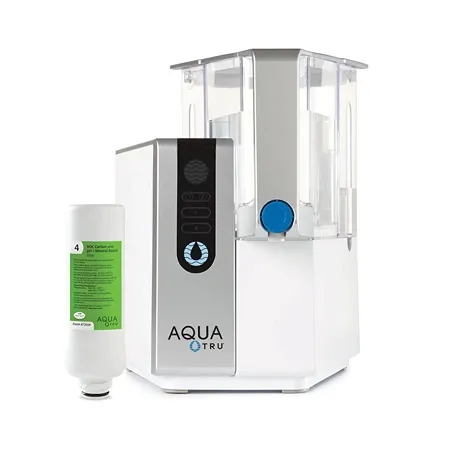
Best countertop RO
AquaTru Classic
No plumbing; IAPMO certified for fluoride, lead, arsenic, PFOA/PFOS and more.
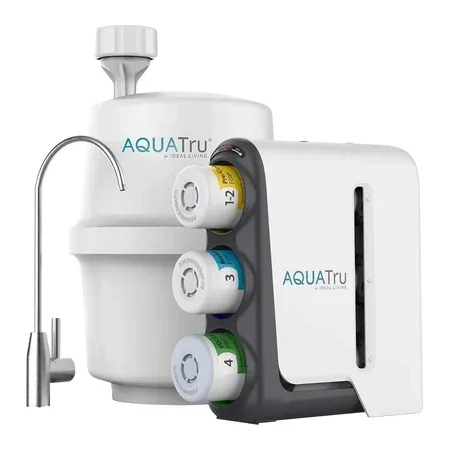
Best Under-Sink RO
AquaTru Under Sink
Same certifications as the Classic, 1.7 gal storage and its own faucet.
AquaTru’s own store was cheaper than Amazon for both on November 15. For more countertop picks, see our guide to the best countertop reverse osmosis systems.
Countertop vs. Under-Sink Reverse Osmosis FAQ
Is countertop reverse osmosis as good as under-sink?
It can be. The filtration is the same technology, and AquaTru’s countertop Classic and its Under Sink share the same IAPMO certification to NSF/ANSI 58 for TDS, fluoride, lead, arsenic and nitrate. What matters is the certification of the specific model, not whether it sits on the counter or under the sink.
Do under-sink RO systems waste more water?
Often. The EPA says a typical under-sink RO system sends five or more gallons to the drain for each gallon it makes. WaterSense-labeled systems use 2.3 gallons or less. The AquaTru Classic countertop unit has a 75% efficiency rating, about a third of a gallon of waste per gallon.
Can renters use reverse osmosis?
Yes, with a countertop system. It needs no drilling or plumbing: you fill it from the tap and plug it in. Under-sink systems connect to the water supply and drain, which most leases restrict.
Does an under-sink RO system need electricity?
Many don’t. They run on household water pressure. AquaTru lists no electricity requirement for its Under Sink, while the countertop Classic plugs into an outlet to run its pump.
Which holds more water?
Under-sink systems store more. The AquaTru Under Sink holds up to 1.7 gallons, vs. 0.75 gallons for the Classic.
Are the filters the same?
AquaTru sells the same filter subscription for the Classic and Under Sink: $79.88 for the first year and $127.84 for the second, when the RO membrane is replaced.