Labels are lab estimates. To see what your own fridge uses, plug it into a watt meter for a few days: it adds up kilowatt-hours across compressor cycles, defrosts and door openings, and shows the live draw while the compressor runs.
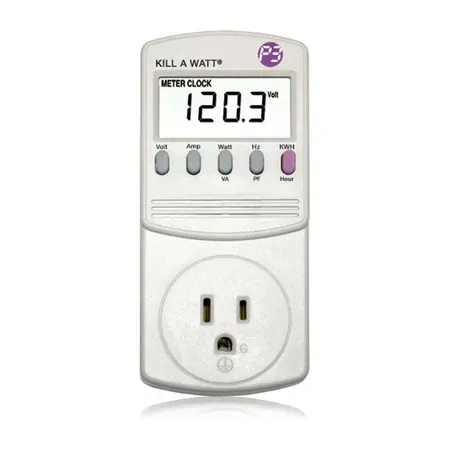
Measure your fridge's real power use
P3 Kill A Watt P4400
A plug-in meter that shows live watts and totals kWh and cost by day, week, month, or year.
How many watts does a refrigerator use?
A fridge has two wattage numbers, and they answer different questions:
- Running watts are what it draws while the compressor is on. GE lists 248 to 330 watts for its full-size French door, bottom-freezer and side-by-side models. This is the number for sizing a generator or an inverter.
- Average watts spread the yearly energy use over all 8,760 hours, because the compressor cycles on and off. A fridge rated at 609 kWh a year, like GE's 24.7 cu. ft. French door, averages 69.5 W, though GE rates it at 294 watts while running. This is the number that drives your bill.
Yearly use and average watts for the 4,893 ENERGY STAR certified refrigerators, by style:
| Style | kWh per year | Average watts | Cost per year |
|---|---|---|---|
| Top-freezer840 models | 363121–506 | 41.4 W | $65.30 |
| Bottom-freezer and French door, no dispenser1,343 models | 537200–714 | 61.3 W | $96.61 |
| French door with ice and water dispenser332 models | 715553–799 | 81.6 W | $128.63 |
| Side-by-side123 models | 640420–805 | 73.1 W | $115.14 |
| All-refrigerator (no freezer)296 models | 288124–370 | 32.9 W | $51.81 |
| Compact and mini fridge1,771 models | 246106–470 | 28.1 W | $44.26 |
| Wine and beverage cooler183 models | 14342–247 | 16.3 W | $25.73 |
Medians, with the full range below. Cost at the US average residential price of 17.99¢ per kWh for the 12 months ending July 2026 (EIA). Average watts is yearly kWh × 1,000 ÷ 8,760 hours.
Top-freezer fridges use the least energy of the full-size styles. French doors with a through-the-door ice and water dispenser use the most: among bottom-freezer and French door models, the median with a dispenser is 715 kWh a year, against 537 without one.
Refrigerator wattage by size
Bigger fridges use more, but style matters as much as size. Median yearly use and average watts by total capacity:
| Style and size | kWh per year | Average watts | Cost per year |
|---|---|---|---|
| Top-freezer, 8–14 cu. ft.207 models | 302263–416 | 34.5 W | $54.33 |
| Top-freezer, 14–19 cu. ft.467 models | 363332–458 | 41.4 W | $65.30 |
| Top-freezer, 19–23 cu. ft.139 models | 396378–489 | 45.2 W | $71.24 |
| Top-freezer, 23–27 cu. ft.24 models | 422417–506 | 48.2 W | $75.92 |
| Bottom-freezer and French door, no dispenser, 8–14 cu. ft.203 models | 395200–515 | 45.1 W | $71.06 |
| Bottom-freezer and French door, no dispenser, 14–19 cu. ft.537 models | 469305–590 | 53.5 W | $84.37 |
| Bottom-freezer and French door, no dispenser, 19–23 cu. ft.392 models | 574429–638 | 65.5 W | $103.17 |
| Bottom-freezer and French door, no dispenser, 23–27 cu. ft.119 models | 615510–670 | 70.2 W | $110.64 |
| Bottom-freezer and French door, no dispenser, 27–40 cu. ft.92 models | 655545–714 | 74.8 W | $117.83 |
| French door with ice and water dispenser, 19–23 cu. ft.73 models | 665553–716 | 75.9 W | $119.63 |
| French door with ice and water dispenser, 23–27 cu. ft.96 models | 699670–746 | 79.8 W | $125.75 |
| French door with ice and water dispenser, 27–40 cu. ft.157 models | 744705–799 | 84.9 W | $133.85 |
| Side-by-side, 14–19 cu. ft.9 models | 420420–420 | 47.9 W | $75.56 |
| Side-by-side, 19–23 cu. ft.37 models | 594460–645 | 67.8 W | $106.86 |
| Side-by-side, 23–27 cu. ft.54 models | 647495–785 | 73.9 W | $116.40 |
| Side-by-side, 27–40 cu. ft.23 models | 715546–805 | 81.6 W | $128.63 |
| All-refrigerator (no freezer), 8–14 cu. ft.101 models | 250124–302 | 28.5 W | $44.97 |
| All-refrigerator (no freezer), 14–19 cu. ft.107 models | 286135–333 | 32.6 W | $51.45 |
| All-refrigerator (no freezer), 19–23 cu. ft.84 models | 314273–370 | 35.8 W | $56.49 |
Total capacity in cubic feet, fridge and freezer combined, as listed by ENERGY STAR. Sizes with fewer than 8 certified models are left out. Not sure what size you have? See our refrigerator size chart.
Wattage of popular GE refrigerators
GE publishes both rated watts and yearly kWh on its spec pages, so its models show the gap between the two numbers. These are the GE models on our refrigerator size pages:
All run on a standard 120-volt, 15-amp circuit. A dash means GE doesn't list a rated wattage for that model.
How many watts does a mini fridge use?
ENERGY STAR certified compact refrigerators use a median of 246 kWh a year, about 28.1 W on average, or $44.26 a year. That's less than a full-size fridge but more than its size suggests: a 4.4 cu. ft. compact can use more than half as much as a 17 cu. ft. top-freezer.
| Type and size | kWh per year | Average watts | Cost per year |
|---|---|---|---|
| Compact and mini fridge, Under 2 cu. ft.272 models | 208106–247 | 23.7 W | $37.42 |
| Compact and mini fridge, 2–4 cu. ft.736 models | 222150–330 | 25.3 W | $39.85 |
| Compact and mini fridge, 4–8 cu. ft.762 models | 274106–470 | 31.3 W | $49.29 |
| Wine and beverage cooler, 2–4 cu. ft.38 models | 13869–145 | 15.8 W | $24.83 |
| Wine and beverage cooler, 4–8 cu. ft.94 models | 13442–200 | 15.3 W | $24.11 |
| Wine and beverage cooler, 8–14 cu. ft.31 models | 170114–200 | 19.4 W | $30.58 |
| Wine and beverage cooler, 14–19 cu. ft.16 models | 235185–247 | 26.8 W | $42.28 |
Compact models with a separate freezer door, like GE's 3.1 cu. ft. double-door (321 kWh a year), use more than single-door models with a small freezer compartment, like GE's 4.4 cu. ft. compact (227 kWh).
How many watts does a freezer use?
| Type and size | kWh per year | Average watts | Cost per year |
|---|---|---|---|
| Upright freezer, 4–8 cu. ft.14 models | 428381–440 | 48.9 W | $77.00 |
| Upright freezer, 8–14 cu. ft.178 models | 394247–523 | 45 W | $70.88 |
| Upright freezer, 14–19 cu. ft.172 models | 436305–588 | 49.8 W | $78.44 |
| Upright freezer, 19–23 cu. ft.134 models | 493424–649 | 56.3 W | $88.69 |
| Compact freezer, Under 2 cu. ft.20 models | 216215–216 | 24.6 W | $38.77 |
| Compact freezer, 2–4 cu. ft.51 models | 240137–377 | 27.4 W | $43.18 |
| Compact freezer, 4–8 cu. ft.91 models | 283184–408 | 32.3 W | $50.91 |
From the 673 ENERGY STAR certified freezers, almost all uprights with automatic defrost. Few full-size chest freezers are certified, so they're not listed.
How much does it cost to run a refrigerator?
Multiply yearly kWh by your electricity price. At the US average of 17.99¢ per kWh, a typical 19–23 cu. ft. bottom-freezer fridge (574 kWh) costs about $103.17 a year, or $8.60 a month. Prices vary several-fold by state, from 12.36¢ in North Dakota to 46.28¢ in Hawaii for January to July 2026, so the same fridge costs $70.88 a year in North Dakota and $265.42 in Hawaii.
The yellow EnergyGuide label in the store gives the model's yearly kWh and a dollar estimate at a fixed national rate, so use the kWh figure and your own price per kWh from your bill.
What size generator or battery runs a refrigerator?
Generac's advice for sizing a generator for a fridge: find the volts and amps on the nameplate inside the fridge, multiply them to get running watts, and remember the compressor needs a surge of 2 to 3 times the running watts to start. A fridge that runs at 300 watts may need 600 to 900 watts for a moment at startup, and the generator's surge rating has to cover it on top of anything else plugged in.
Two other problems Generac flags:
- Some fridges trip a generator's GFCI outlet. Check the manual; Generac suggests using the generator's 30-amp twist-lock outlet with an adapter cable instead.
- Fridges with electronic controls may need "clean" power with low harmonic distortion, which inverter generators provide and some open-frame generators don't.
For a battery power station, the question is energy, not just power. A fridge averaging 65.5 W uses about 1570 watt-hours a day, so a 1,000 Wh battery runs it for roughly 13 hours after inverter losses. The calculator above works this out for any battery size. The station's inverter must also handle the startup surge. If the power is out and you have no backup, a closed fridge keeps food cold for about 4 hours; our food storage chart covers what to keep and what to throw out.
Do old refrigerators use more electricity?
Every new fridge sold in the US must meet a federal maximum for its type and size. ENERGY STAR certified full-size and compact models use at least 10% less than that maximum, and the median certified model is 10% below it. An older fridge was built to looser rules and has had years for its door seals to wear and its condenser coils to collect dust, so it usually uses more than its original label says.
The only way to know is to measure it. Leave a plug-in watt meter on it for a few days, divide the kWh by the hours, and enter the result in the calculator's "Measured watts" mode. If your fridge is also aging, our guide to how long refrigerators last covers when replacing it pays off.
How to lower a refrigerator's energy use
- Set it no colder than it needs to be: 40°F or below in the fridge and 0°F in the freezer keeps food safe.
- Keep the door seals clean and check that they close tightly on a sheet of paper all the way around.
- Clean dust off the condenser coils (behind the bottom grille or at the back) as your manual recommends.
- Leave the clearance your manual asks for around the fridge, and keep it away from the oven, dishwasher and direct sun.
- A second fridge in a hot garage works harder than the one in your kitchen. If you don't need it, unplugging it saves its whole yearly use.
How this calculator works
- Electricity per year is the fridge's yearly kWh: the median for its style and size from ENERGY STAR, a GE model's rating, your EnergyGuide label, or your measured average watts × 8,760 ÷ 1,000. A month is 365 ÷ 12 days.
- Cost = kWh × your price per kWh. The default is the EIA's US average residential price for the 12 months ending July 2026; the state options are EIA averages for January to July 2026.
- Battery time = battery watt-hours × 85% ÷ average watts. Real run time is shorter in a hot room or if the door is opened often.
Sources
All figures checked October 29, 2026.
- ENERGY STAR Certified Residential Refrigerators dataset (US EPA), 4,893 models, downloaded October 29, 2026. data.energystar.gov/Active-Specifications/ENERGY-STAR-Certified-Residential-Refrigerators/p5st-her9
- ENERGY STAR Certified Residential Freezers dataset, 673 models, downloaded October 29, 2026. data.energystar.gov/Active-Specifications/ENERGY-STAR-Certified-Residential-Freezers/8t9c-g3tn
- ENERGY STAR key product criteria for refrigerators and freezers (10% below the federal standard for full-size and compact models). www.energystar.gov/products/refrigerators/key_product_criteria
- US federal energy conservation standards for refrigerators and freezers, 10 CFR 430.32. www.ecfr.gov/current/title-10/chapter-II/subchapter-D/part-430/subpart-C/section-430.32
- FTC Energy Labeling Rule (EnergyGuide labels), 16 CFR Part 305. www.ecfr.gov/current/title-16/chapter-I/subchapter-C/part-305
- Generac, "Why won't my fridge run off my portable generator?" (running and surge watts). support.generac.com/s/article/Why-won-t-my-fridge-run-off-my-portable-generator-Troubleshooting-guide
- US Energy Information Administration, Electric Power Monthly, Table 5.3: average residential price, the 12 months ending July 2026 (17.99¢/kWh). www.eia.gov/electricity/monthly/epm_table_grapher.php?t=epmt_5_03
- EIA Electric Power Monthly, Table 5.6.B: average residential price by state, January to July 2026. www.eia.gov/electricity/monthly/epm_table_grapher.php?t=epmt_5_6_b