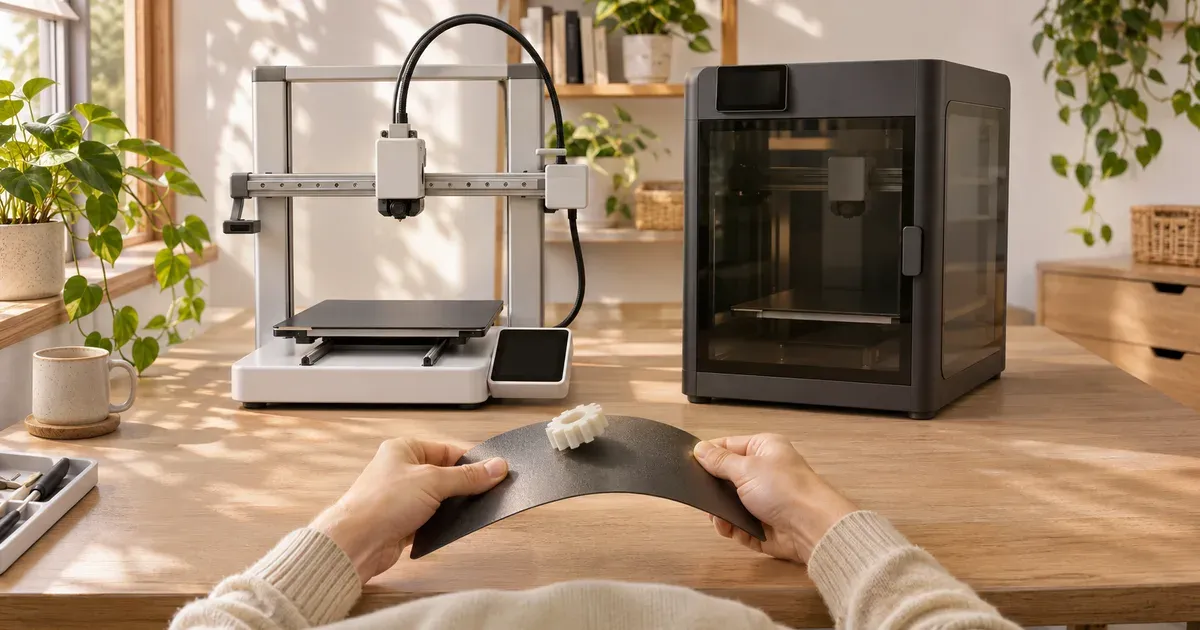
The short answer: buy the A1 if you’ll print PLA and PETG and want the quietest, cheapest way into Bambu Lab. Buy the P1S if you want to print ABS, ASA or nylon, or want faster prints of tall parts. Both print parts up to 256 × 256 × 256 mm and calibrate themselves. The A1 is an open-frame printer whose bed slides back and forth. The P1S is an enclosed box whose bed only moves down, which lets it accelerate twice as hard and keep warm air around the print.
In Bambu Lab’s Black Friday sale (through December 1, 2026), the A1 is $259 and the P1S is $349. With four-color feeders, the A1 Combo is $359 and the P1S with an AMS 2 Pro is $509.
A1 vs. P1S at a Glance
| Bambu Lab A1 | Bambu Lab P1S | |
|---|---|---|
| Price (Bambu store, Black Friday) | $259 (typically $299) | $349 (typically $399) |
| Four-color bundle | $359 with AMS lite | $479 with AMS, $509 with AMS 2 Pro |
| Build volume | 256 × 256 × 256 mm | 256 × 256 × 256 mm |
| Motion system | Bed slinger (bed moves front to back) | CoreXY (bed moves only down) |
| Enclosure | No | Yes |
| Max nozzle / bed temperature | 300°C / 100°C | 300°C / 100°C |
| Top speed / acceleration | 500 mm/s / 10,000 mm/s² | 500 mm/s / 20,000 mm/s² |
| Published noise | Under 48 dB in Silent Mode | Not published |
| Camera | Up to 1080p, low frame rate | 720p, 0.5 fps |
| ABS and ASA | Not recommended | Recommended |
| Nylon and polycarbonate | Not recommended | Capable |
| Most colors | 4 with AMS lite, or 4 AMS units via the AMS Hub | 16 (four 4-spool AMS units) |
What the Enclosure Changes
Which filaments you can use
PLA, PETG and TPU print well on both. ABS and ASA, which are tougher and handle heat and sunlight better, shrink as they cool. On an open printer a draft is enough to make corners lift and layers crack. The P1S’s enclosure holds warm air around the part, and Bambu lists ABS and ASA as ideal on it and “not recommended” on the A1. The same goes for nylon and polycarbonate. If you want parts for a car, a garden or anything that will sit in the sun, that alone decides it. See enclosed vs. open-frame 3D printers for more on what an enclosure does and doesn’t do.
Fumes
Every filament gives off ultrafine particles while it prints, PLA the least and ABS much more. An enclosure contains some of them, and the P1S has a fan that pulls air through a filter. Neither printer replaces ventilation. NIOSH guidance on 3D printing recommends PLA where it does the job, a ventilated or filtered enclosure for anything more, and keeping your distance from a running printer.
Noise
The A1 has the published edge: Bambu rates it under 48 dB in Silent Mode, which slows the bed down. The P1S’s fans run harder to cool fast prints, and Bambu doesn’t publish a figure for it. If the printer will sit in the room where you work, the A1 is easier to live with. Our quietest 3D printers list ranks the published figures.
What CoreXY Changes
The A1 moves the bed (and the part on it) back and forth for one axis. The P1S moves only the toolhead side to side and front to back, and lowers the bed one layer at a time. Moving a light toolhead instead of a heavy bed lets the P1S accelerate at 20,000 mm/s² against the A1’s 10,000. That shows up most on tall parts, where a swinging bed wobbles the print, and on parts with lots of short moves. On a small PLA toy, where few moves reach full speed, the gap is small. Our CoreXY vs. bed slinger explainer goes further.
The trade-off is that a bed slinger needs clear space in front of and behind it for the plate to travel, while the P1S stays inside its own box.
Multicolor
Both print in four colors with an add-on feeder. The A1 Combo includes the AMS lite, an open four-spool feeder that sits beside the printer. The P1S works with the enclosed AMS (four spools, kept dry in a sealed box), the AMS 2 Pro (which also dries filament at up to 65°C), and the single-spool AMS HT, and can chain up to four units for 16 colors. The A1 can also use up to four enclosed AMS units through the A1 AMS Hub. Our AMS comparison covers the differences.
Which Should You Buy?
| If you… | Better pick | Why |
|---|---|---|
| Print PLA and PETG toys, gifts and household parts | A1 | Same results, quieter, $90 less |
| Want ABS or ASA for outdoor or car parts | P1S | The enclosure keeps parts from warping |
| Print tall, thin parts often | P1S | No moving bed to wobble the part |
| Keep the printer in a living space or office | A1 | Quieter in Silent Mode |
| Have kids or pets around the printer | P1S | The hot nozzle and moving parts are behind a door |
| Want four colors for the least money | A1 Combo | $359 against $509 |
If you think you might want tougher materials later, buy the P1S now. If you’re sure you’ll stay with PLA and PETG, the A1 is the better value, and it’s our top pick in the best 3D printers for beginners. The newer P2S adds a hardened nozzle and a better camera for $100 more than the P1S.
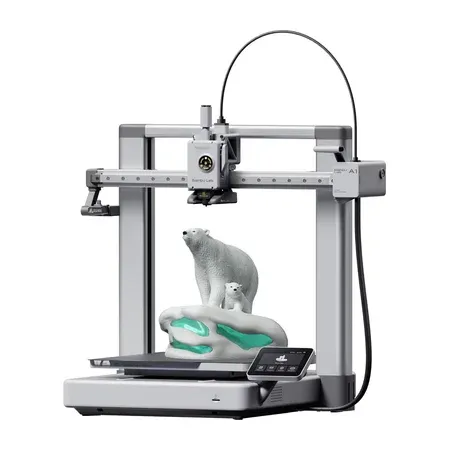
Best for PLA and quiet rooms
Bambu Lab A1
A 256 mm open-frame printer that calibrates itself, runs under 48 dB in Silent Mode, and takes the AMS lite.
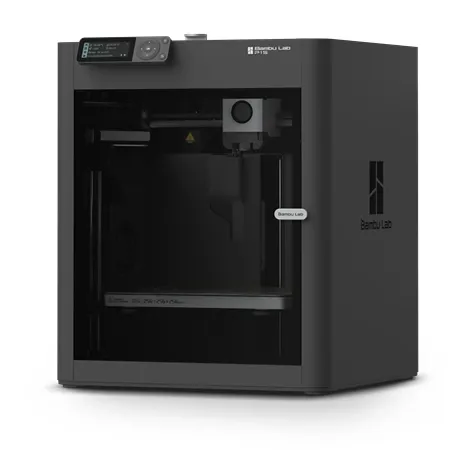
Best for ABS, ASA and tall parts
Bambu Lab P1S
An enclosed 256 mm CoreXY printer that handles ABS and ASA and accelerates twice as hard as the A1.
Bambu Lab A1 vs. P1S FAQ
Is the P1S better than the A1?
It’s more capable: it prints ABS, ASA and nylon, and handles tall parts better. For PLA and PETG the A1 produces the same quality, runs quieter and costs $90 less, so it’s the better buy if that’s all you print.
Is the P1S faster than the A1?
Both have a 500 mm/s top speed, but the P1S accelerates at 20,000 mm/s² against 10,000. That cuts time on tall parts and parts with lots of short moves. On small PLA prints the difference is usually a few minutes.
Can the A1 print ABS?
Bambu lists ABS and ASA as not recommended on the A1. Without an enclosure, larger ABS parts tend to warp and crack. Small ABS parts sometimes work, but if you need ABS, buy an enclosed printer.
Which is quieter, the A1 or the P1S?
The A1 has the published rating: Bambu rates it under 48 dB in Silent Mode and publishes no figure for the P1S.
Do I need the enclosure for PLA?
No. PLA prints best with plenty of cooling, and some people prop the P1S door open or take the top glass off for long PLA prints. The enclosure matters for ABS, ASA, nylon and polycarbonate.