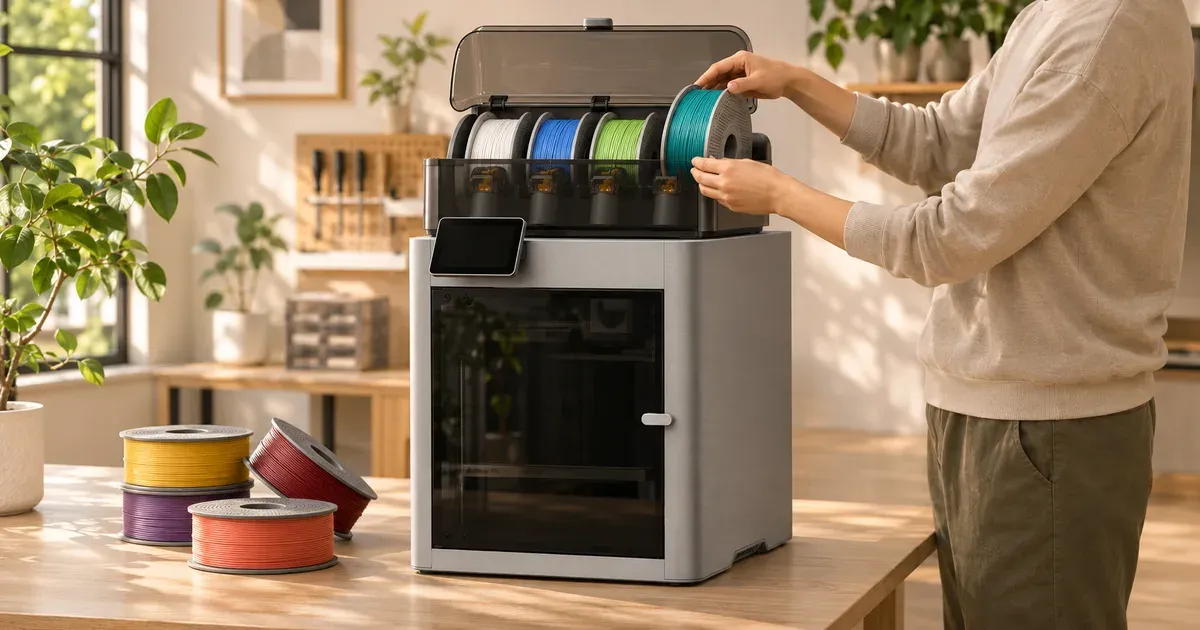
The short answer: if you have an A1 or A1 mini, get the AMS lite. For any other Bambu printer, get the AMS 2 Pro. The AMS lite is a $159 open feeder made only for the A-series. The AMS 2 Pro ($229 on sale) holds four spools in a sealed box and dries them at up to 65°C, which the original AMS can’t do, for only $30 more than the original. The single-spool AMS HT ($119) dries at up to 85°C and is for nylon, polycarbonate and other filaments that soak up moisture.
All prices are Bambu Lab’s US store Black Friday prices, which run through December 1, 2026.
The Four Units at a Glance
| AMS lite | AMS (original) | AMS 2 Pro | AMS HT | |
|---|---|---|---|---|
| Price (Black Friday) | $159 (typically $199) | $199 (typically $249) | $229 (typically $299) | $119 (typically $139) |
| Spools | 4 | 4 | 4 | 1 |
| Enclosed | No (open) | Yes, sealed | Yes, sealed | Yes |
| Dries filament | No | No | Yes, up to 65°C | Yes, up to 85°C |
| Works with | A1, A1 mini, A2L | X1, P1, P2S, H2 series, X2D, A1, A2L | Every current printer except the A1 mini (with per-model accessories) | Every current printer except the A1 mini |
| Units per printer | 1 | Up to 4 | Up to 4 | Up to 8 on H2 series and X2D, 4 on P2S |
AMS lite
The AMS lite is an open four-spool stand that sits next to an A1, A1 mini or A2L and feeds filament to the printer through a hub. It’s the cheapest way to print in four colors, and the A1 Combo ($359) and A1 mini Combo ($299) bundle it at a discount. It doesn’t keep filament dry, and it works only with the A-series. On the A1 you can’t mix it with other AMS units; the A2L takes one AMS lite plus up to four enclosed units.
Buy it if you have an A1 or A1 mini and print PLA or PETG in a reasonably dry room.
AMS (original)
The original AMS holds four spools in a sealed box with desiccant, which slows how fast filament absorbs moisture but doesn’t dry it. Bambu still sells it. At $199 against $229 for the AMS 2 Pro, there’s little reason to buy it new unless you find it heavily discounted or bundled.
AMS 2 Pro
The AMS 2 Pro is the original AMS with a heater. It dries filament at up to 65°C and pushes the moist air out, so spools that have picked up humidity can be dried in place, before or during a print. That matters for PETG, PVA and nylon, which print stringy and weak when damp. It also seals the spools between prints.
On the H2 series, P2S and X2D, the printer can power drying for one AMS 2 Pro directly. On the A1, P1S and X1, each unit needs a Switching Adapter to dry. Up to four can be chained on one printer.
Buy it if you have anything other than an A1 or A1 mini, or you print PETG and nylon and want filament kept dry.
AMS HT
The AMS HT is a single-spool unit that dries at up to 85°C, hot enough for nylon, polycarbonate and other engineering filaments. It ships with its own power adapter for drying. The H2 series and X2D take up to eight; the P2S takes four. A common setup is one AMS 2 Pro for everyday colors plus an AMS HT for a spool of nylon or carbon fiber.
Buy it if you print engineering filaments that need hot drying, or want one extra color without a full four-spool unit.
How Many Colors Each Printer Supports
From Bambu Lab’s compatibility guide:
| Printer | Maximum colors | Compatible units |
|---|---|---|
| A1 mini | 4 | AMS lite |
| A1 | 4 with AMS lite, or up to 4 enclosed units via the A1 AMS Hub | AMS lite, AMS, AMS 2 Pro, AMS HT |
| A2L | 19 (1 AMS lite + 4 enclosed units) | AMS lite, AMS, AMS 2 Pro, AMS HT |
| P1S | 16 | AMS, AMS 2 Pro, AMS HT (4 units total) |
| P2S | 20 | AMS, AMS 2 Pro (4), AMS HT (4) |
| X2D, H2D, H2C | 25 | AMS, AMS 2 Pro (4), AMS HT (8), plus an external spool |
| H2S | 24 | AMS, AMS 2 Pro (4), AMS HT (8) |
| H3C | 24 | Built-in AMS 3H plus up to 4 external units |
Most people use one four-spool unit. More than eight colors is mostly for print farms and people who leave many materials loaded at once.
Do You Need an AMS?
No. Every Bambu printer prints single-color models without one, and you can make simple multicolor prints by pausing at a layer and swapping filament by hand. An AMS earns its price in three ways:
- Multicolor prints that change color many times per layer, like figures and signs.
- Automatic backup: when one spool runs out, the AMS switches to another spool of the same filament and keeps printing.
- Dry storage, and with the AMS 2 Pro and AMS HT, drying.
The cost is waste. Every color change on a single-nozzle printer purges filament, and a model with hundreds of changes can purge more plastic than the model weighs. Two-nozzle printers like the H2D and X2D cut that waste.
Buying a printer as a Combo is cheaper than adding an AMS later: the A1 Combo costs $100 more than the A1, while the AMS lite alone is $159.
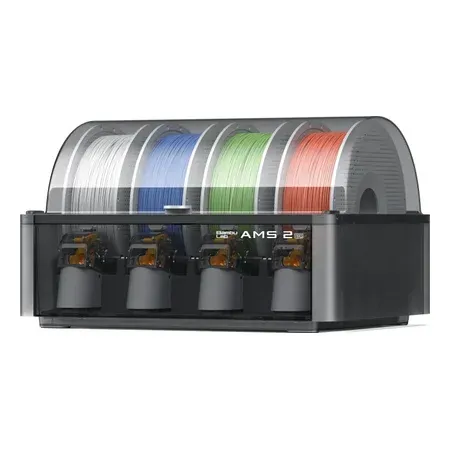
Best for most bambu printers
Bambu Lab AMS 2 Pro
A sealed four-spool multicolor unit that dries filament at up to 65°C. Works with every Bambu printer but the A1 mini.
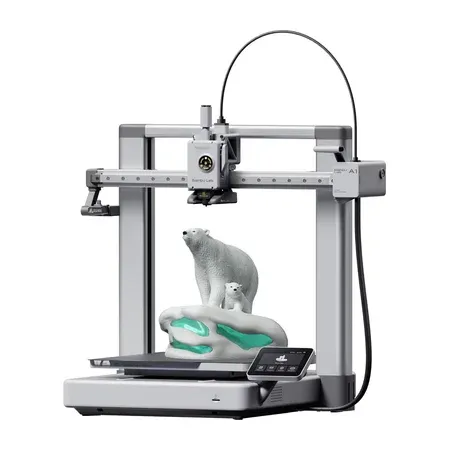
Pair with the AMS lite
Bambu Lab A1
The A1 is sold alone or as a Combo with the four-spool AMS lite, the cheapest way into four-color printing.
The AMS units aren’t sold on Amazon by Bambu Lab, so the AMS 2 Pro link goes to Bambu’s US store. For which printer to pair them with, see Bambu Lab P1S vs. P2S and A1 vs. A1 mini.
Bambu Lab AMS FAQ
What’s the difference between the AMS and the AMS 2 Pro?
The AMS 2 Pro dries filament at up to 65°C and actively removes moisture. The original AMS only stores filament in a sealed box with desiccant. Both hold four spools and chain up to four units.
Does the AMS lite work with the P1S or P2S?
No. The AMS lite works only with the A1, A1 mini and A2L. The P1S and P2S use the AMS, AMS 2 Pro and AMS HT.
Can I use third-party filament in the AMS?
Yes. Any 1.75 mm filament that suits the unit works. Bambu’s own spools carry RFID tags that the AMS reads automatically; with other brands you set the filament type and color in Bambu Studio or on the printer.
Does the A1 work with the AMS 2 Pro?
Yes, through the A1 AMS Hub, which connects up to four enclosed AMS units to an A1. Drying on the A1 needs a Switching Adapter for each unit.
Is the AMS HT worth it?
If you print nylon, polycarbonate or carbon fiber nylon, yes: it dries at up to 85°C, hotter than the AMS 2 Pro. For PLA and PETG, the AMS 2 Pro is enough.
Do I need an AMS with my Bambu Lab printer?
No. It’s needed only for automatic multicolor printing, automatic spool backup and dry storage. Every Bambu printer prints single-color models without one.