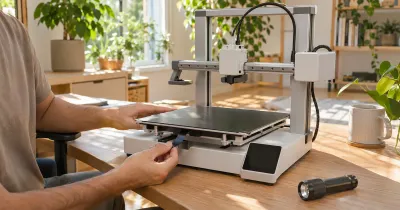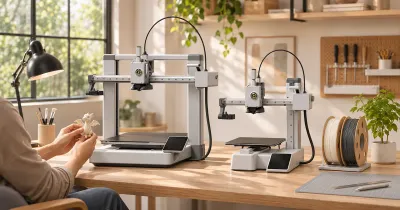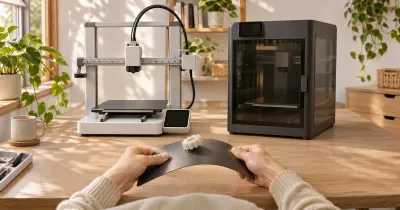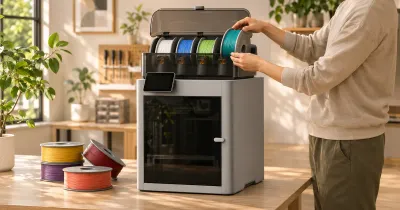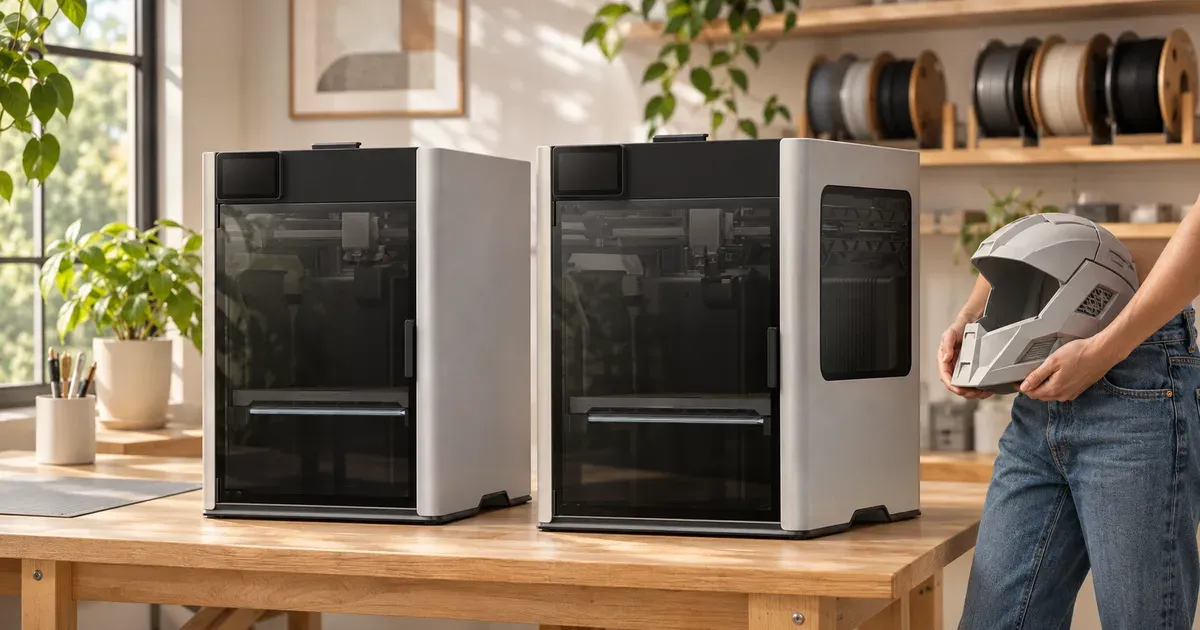
The short answer: the H2S is the H2D with one nozzle instead of two. It costs $350 less, prints a slightly taller and wider part (340 × 320 × 340 mm against 325 × 320 × 325 mm on one nozzle), and is the better buy if you print one material at a time. The H2D’s second nozzle earns its price if you print soluble or breakaway supports, combine a rigid and a flexible material in one part, or do a lot of two-color work, where it wastes far less filament than swapping colors through one nozzle.
In Bambu Lab’s Black Friday sale (through December 1, 2026) the H2S is $1,049 and the H2D is $1,399. As AMS Combos they’re $1,249 and $1,599.
H2S vs. H2D at a Glance
| Bambu Lab H2S | Bambu Lab H2D | |
|---|---|---|
| Price (Bambu store, Black Friday) | $1,049 (typically $1,199) | $1,399 (typically $1,549) |
| AMS Combo | $1,249 | $1,599 |
| With laser module | $1,599 (Laser Full Combo) | $1,949 (10 W), $2,399 (40 W) |
| Nozzles | 1 | 2 (switching) |
| Build volume, one nozzle | 340 × 320 × 340 mm | 325 × 320 × 325 mm |
| Build volume, both nozzles | n/a | 300 × 320 × 320 mm |
| Max nozzle / bed / chamber | 350°C / 120°C / 65°C | 350°C / 120°C / 65°C |
| Top speed / acceleration | 1,000 mm/s / 20,000 mm/s² | 1,000 mm/s / 20,000 mm/s² |
| Most colors | 24 (4 AMS 2 Pro + 8 AMS HT) | 25 (4 AMS 2 Pro + 8 AMS HT + external spool) |
| AMS lite support | No | No |
| Published noise | Under 50 dB | Not published |
| Warranty (Bambu US store) | 2 years | 2 years |
What Two Nozzles Do
The H2D has two hotends side by side. Only one prints at a time; the other lifts out of the way. That sounds minor, but it changes three kinds of print.
Supports. You can print the part in one material and the supports in another: PLA with a breakaway support material, or PLA with water-soluble PVA. Supports come off cleanly and leave smooth undersides, which matters for mechanical parts and figures with overhangs.
Two materials in one part. A rigid body with flexible TPU feet or grips, or a PETG part with a carbon fiber section, in one print.
Less waste in two-color prints. A single-nozzle printer changes color by pulling one filament out, pushing the next one in, and purging the mixed plastic. On a print with hundreds of color changes, the purged plastic can weigh more than the part. With two colors loaded in two nozzles, the H2D switches nozzles instead and purges very little. With more than two colors it still swaps filament through each nozzle, but fewer swaps add up to less waste.
If none of that describes how you print, the second nozzle is $350 you won’t use.
What’s the Same
Both printers share the same enclosed CoreXY frame and the parts that make the H2 series Bambu’s engineering line:
- 350°C hotend and 120°C bed, hot enough for polycarbonate, nylon and high-temperature blends like PPA-CF and PPS.
- Active chamber heating to 65°C, which keeps large ABS, ASA and nylon parts from warping and cracking. The cheaper P1S and P2S don’t actively heat the chamber.
- The same AMS options: up to four AMS 2 Pro units and eight single-spool AMS HT units, both of which dry filament. Neither works with the AMS lite. See our AMS comparison.
- Laser and cutting modules for engraving and cutting, sold as Laser Full Combos.
- Live view and toolhead cameras.
- 1,000 mm/s top speed and 20,000 mm/s² acceleration.
Build Volume
The H2S is the bigger single-nozzle printer by a small margin: 340 × 320 × 340 mm against the H2D’s 325 × 320 × 325 mm. That’s 15 mm more width and height. When the H2D prints with both nozzles, its usable area shrinks to 300 × 320 × 320 mm, because each nozzle has to reach the whole part. Both are well above the 256 mm cube of the P1S, P2S and X2D.
Where the H2C Fits
The H2C ($1,899 in the sale, sold only as a combo with an AMS) is the H2D with a rack of swappable induction hotends on one side, Bambu’s Vortek system. It can hold a different filament in each hotend, which cuts purge waste further on prints with many colors. It’s the step to take if you print multicolor models every day. For most people choosing between the H2S and H2D, it’s more than they need.
Which Should You Buy?
| If you mostly… | Better pick | Why |
|---|---|---|
| Print large single-material parts | H2S | Bigger single-nozzle volume, $350 less |
| Print engineering filaments for functional parts | H2S | Same 350°C hotend and 65°C chamber |
| Need clean supports on complex parts | H2D | Prints soluble or breakaway supports |
| Combine rigid and flexible materials | H2D | Two materials in one print |
| Print two-color models often | H2D | Far less purge waste |
| Print four or more colors every day | H2C | Swappable hotends cut waste most |
If you’re coming from a P1S or A1 and want a bigger, hotter printer, the H2S is the sensible default. For two-material work, or if you compare it with Creality’s large-format flagship, see Creality K2 Plus vs. Bambu Lab H2D.
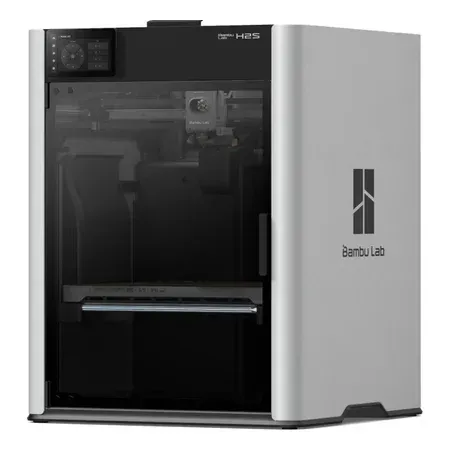
Best Single-Nozzle large printer
Bambu Lab H2S
A 340 × 320 × 340 mm enclosed printer with a 350°C hotend and a 65°C heated chamber.
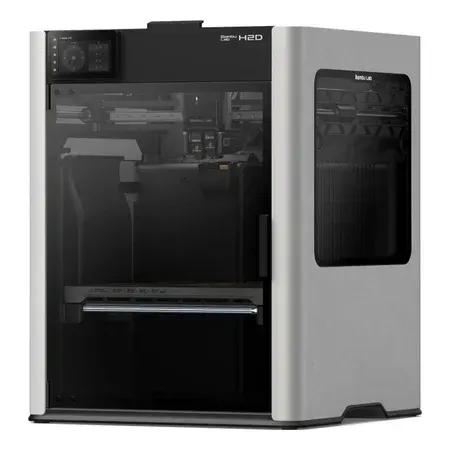
Best for supports and two materials
Bambu Lab H2D
Two switching nozzles for soluble supports and multi-material parts, on the same heated-chamber frame.
Neither printer is sold on Amazon by Bambu Lab, so the links above go to Bambu’s US store.
Bambu Lab H2S vs. H2D FAQ
Is the H2S just an H2D with one nozzle?
Essentially, yes. They share the frame, hotend temperature, bed, heated chamber, speed and module options. The H2S drops the second nozzle, gains 15 mm of width and height, and costs $350 less.
Is the H2D worth the extra money?
If you print soluble supports, multi-material parts or two-color models often, yes. If you print one material at a time, the second nozzle sits idle and the H2S is the better buy.
Can the H2S print multiple colors?
Yes. With AMS units it prints up to 24 colors through its single nozzle, purging filament at each color change like other single-nozzle Bambu printers.
Does the H2D use the AMS lite?
No. The H2D, H2S and H2C work with the AMS, AMS 2 Pro and AMS HT. The AMS lite is only for the A1, A1 mini and A2L.
How loud is the H2S?
Bambu rates the H2S at under 50 dB. It publishes no noise figure for the H2D.
Can the H2S and H2D laser engrave?
Yes. Both are sold as Laser Full Combos with a laser module, and the H2D offers 10 W and 40 W versions.