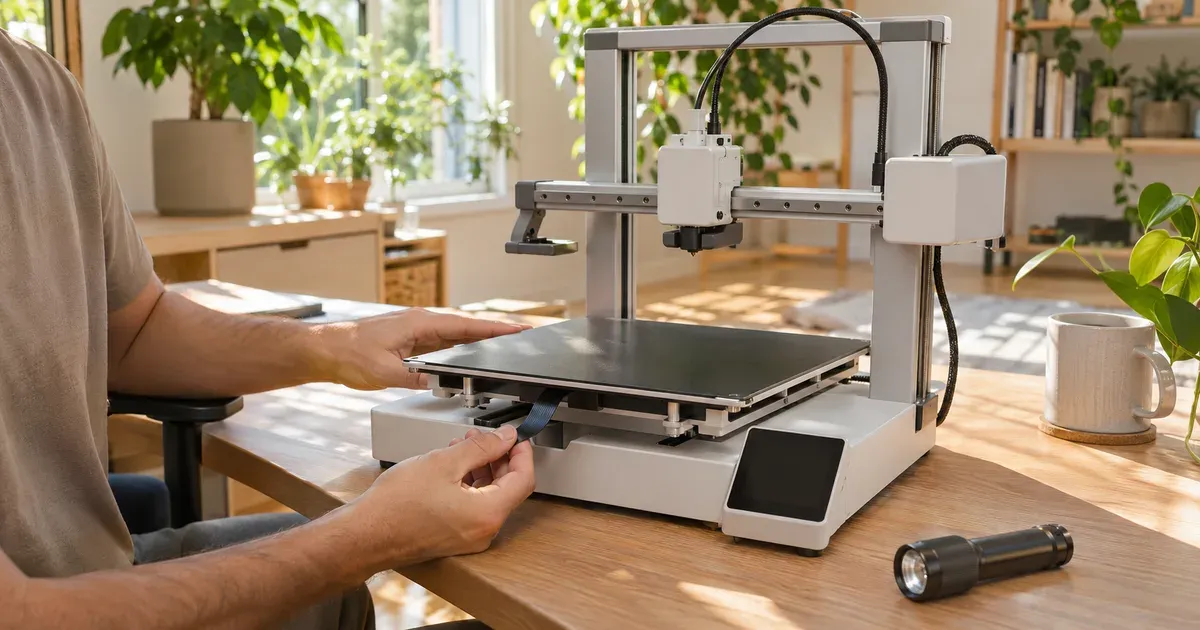
Since 2023, one consumer 3D printer has been recalled in the US and Canada: the Bambu Lab A1, in June 2024. About 12,800 A1 printers sold from December 2023 to January 2024 had a heatbed cable that could short-circuit, spark or burn through its insulation. Owners were offered a full refund or a free replacement heatbed and cable. The A1 mini was not included, and Health Canada’s notice limits the recall to A1 printers made before January 30, 2024.
A search of U.S. Consumer Product Safety Commission (CPSC) and Health Canada recall notices from 2023 to November 2026 found no other recalls of consumer 3D printers from Bambu Lab, Creality, Elegoo, Anycubic, Prusa, QIDI, Flashforge, Sovol, Snapmaker or Formlabs.
Recent 3D Printer Recalls
| Date | Agency | Product | Hazard | Units | Remedy |
|---|---|---|---|---|---|
| June 13, 2024 | U.S. CPSC (recall 24-264) | Bambu Lab A1, sold December 2023 to January 2024 | Heatbed cable could short, spark or burn through, causing shock and fire hazards | About 12,800 | Full refund with prepaid return, or free heatbed and cable replacement |
| July 24, 2024 | Health Canada (RA-75840) | Bambu Lab A1, made and sold before January 30, 2024 | Same heatbed cable hazard | 1,040 in Canada | Refund or repair from Bambu Lab |
Sources: the CPSC recall notice and the Health Canada notice.
The Bambu Lab A1 Heatbed Cable Recall
What went wrong. The A1’s bed slides back and forth on every print, flexing the flat cable that carries power to the heated bed. On early units that cable could wear, short-circuit and spark. The CPSC listed 19 reports of damaged cables in the US, one of which sparked, and no injuries. Health Canada listed seven reports in Canada, also with no injuries.
Which printers. In the US, A1 printers sold at Micro Center and on Bambu Lab’s US store from December 2023 to January 2024, for about $400 to $560. Health Canada describes the affected units as A1 printers made and sold before January 30, 2024, and says they have an “A” as the sixth character of the serial number, printed on the QR code sticker at the right rear of the printer.
What owners were told to do. Stop using the printer and contact Bambu Lab for either a full refund, with a prepaid return label, or a free replacement heatbed and cable, installed by a local repair facility.
Buying a used A1. Ask for the serial number and check its sixth character. If it’s an “A” and the printer still has its original heatbed, ask whether the recall repair was done, and contact Bambu Lab before using it if not. A1s sold new today aren’t affected.
The 2025 A1 Power Board Reports
In 2025, some A1 owners reported scorching inside the printer near the AC power board. This was not a recall: no CPSC or Health Canada action followed. Bambu Lab has said it fitted a redesigned power board to A1 printers from the third quarter of 2025, that it repairs or replaces affected printers for owners who report the problem, and it advises using surge protection. If your A1 smells of burning electronics or the case near the power inlet discolors, unplug it and contact Bambu support.
Why There Are So Few 3D Printer Recalls
A 3D printer runs mains power to a heated bed and a hotend, both controlled by firmware. Most failures, like clogged nozzles, worn belts or a failed thermistor, stop the print rather than create a hazard, and current firmware from the major brands includes thermal runaway protection, which cuts the heater if temperature readings stop making sense. A recall happens when a design flaw creates a shock or fire risk across many units, as the A1 cable did.
A recall search isn’t proof that a product is problem-free. The CPSC database has no category for 3D printers, and many problems are handled with free repairs instead of formal recalls, as with the A1 power board.
How to Check Any 3D Printer for Recalls
- Search the CPSC site at cpsc.gov/Recalls for the brand and model.
- In Canada, search Health Canada’s recalls and safety alerts.
- Check the maker’s support site and community forum for safety notices and free repair programs.
- Register your printer or keep the receipt and account with the maker, so you’re contacted if a recall is announced.
Are 3D Printers a Fire Hazard?
The risk is low but real, because a 3D printer runs a heater at 200 to 300°C for hours, often unattended. NIOSH’s guide to safe 3D printing recommends keeping printers clear of combustible materials and in areas with fire detection. In practice:
- Put a smoke detector in the room, ideally above or near the printer.
- Keep paper, curtains and filament boxes away from the printer and its power supply.
- Use a printer with thermal runaway protection. Check before buying an old used printer or flashing custom firmware.
- Watch long prints from your phone. Most current printers have cameras, and many detect failed prints and stop automatically.
- Don’t modify the wiring or power supply, and replace a damaged cable rather than taping it.
- Plug the printer into a wall outlet or a quality surge protector, not a chain of extension cords.
For fumes and ventilation, see enclosed vs. open-frame 3D printers. For how the A1 compares with its smaller sibling, see Bambu Lab A1 vs. A1 mini.
3D Printer Recalls FAQ
Have any 3D printers been recalled?
Yes. In June 2024 the CPSC and Bambu Lab recalled about 12,800 Bambu Lab A1 printers sold from December 2023 to January 2024 over a heatbed cable that could spark. Health Canada recalled 1,040 units in July 2024. No other consumer 3D printer recall was announced by the CPSC or Health Canada from 2023 to November 2026.
Was the Bambu Lab A1 mini recalled?
No. The recall covered only the A1.
How do I know if my Bambu A1 is part of the recall?
The recall covered A1 printers sold from December 2023 to January 2024. Health Canada says affected units have an “A” as the sixth character of the serial number on the QR sticker at the right rear. If yours matches, contact Bambu Lab support.
Is it safe to buy a Bambu A1 now?
Yes. The recall covered A1 printers sold from December 2023 to January 2024. New units sold since then aren’t part of it.
Are 3D printers a fire hazard?
The risk is low with a current printer that has thermal runaway protection, but they run hot heaters for hours. Keep a smoke detector nearby, keep combustibles away, and monitor long prints.
Can I leave a 3D printer running overnight?
Many people do, with a current printer, a smoke detector in the room and a camera to check on it. Don’t run an older printer without thermal runaway protection unattended, and don’t print in the room where you sleep.