The short answer: on most 2026 gaming laptops you can’t undervolt the CPU anymore, but you can undervolt the Nvidia GPU, and you can get much of the same benefit by lowering power limits. Intel locked CPU undervolting on most laptops after the 2019 “Plundervolt” security flaw, and its Undervolt Protection (12th-gen and newer) blocks voltage offsets below the boot voltage unless the laptop maker exposes a BIOS switch, which few do. GPU undervolting through a voltage-frequency curve still works on Nvidia laptop GPUs and is the main way to cut heat and noise without losing much performance.
What You Can Change on a 2026 Laptop
| Method | Works on most laptops? | Benefit | Risk |
|---|---|---|---|
| Intel CPU undervolt (XTU, ThrottleStop) | Usually no: locked by Undervolt Protection | Lower CPU temps | Crashes if too aggressive |
| AMD CPU Curve Optimizer | Only where the maker exposes it in BIOS | Lower CPU temps | Crashes if too aggressive |
| Nvidia GPU curve undervolt | Yes | Lower GPU temps and noise at similar fps | Crashes in games until dialed in |
| Lower power limits in the maker’s app | On many models (Manual / Custom modes) | Lower temps and noise | None; just less performance |
| Frame-rate cap | Yes, always | Less heat, less noise, less power | None |
Why CPU Undervolting Is Locked
In 2019 researchers showed that software undervolting could be used to break the security of Intel’s SGX enclaves (Intel advisory INTEL-SA-00289). Intel’s fix was to let microcode disable the undervolting interface. Since 12th-gen Core, Intel also has Undervolt Protection (UVP): with it on, negative voltage offsets that would go below the boot voltage are ignored. Intel says UVP can be turned off in BIOS only on certain overclockable configurations and doesn’t recommend it, and its Extreme Tuning Utility won’t run alongside Windows’ virtualization-based security unless UVP is enabled. Laptop BIOSes rarely offer the switch.
Bottom line: if Intel XTU or ThrottleStop shows the voltage offset as locked or your offset has no effect, that’s by design. Don’t flash modified BIOSes to get around it.
If your Intel laptop isn’t locked
A few laptops, mostly older ones, still accept offsets because their BIOS leaves the undervolt interface open or has an Undervolt Protection switch. If yours does, work in small steps:
- In Intel XTU or ThrottleStop, set a core voltage offset of −10 mV.
- Run a CPU-heavy game or Cinebench for 15–30 minutes.
- If it’s stable, go another −10 mV and test again. Stop at the first crash, freeze or WHEA error, then back off two steps.
- Don’t copy a large offset from a forum post. Two chips of the same model often need different values.
Undervolting an AMD Ryzen Laptop CPU
AMD’s equivalent is Curve Optimizer, which shifts the voltage curve per core or for all cores at once. Two catches on laptops:
- Ryzen Master is a desktop tool. AMD’s Ryzen Master utility supports desktop Ryzen processors, not laptop chips, so on an AMD laptop Curve Optimizer only shows up if the maker puts it in the BIOS. Few gaming laptops do.
- The values are counts, not millivolts. If your BIOS has it, start with an all-core negative value of −5, test for 15–30 minutes, and go further in steps of −5. Lower counts that crash only under light loads (idle, browsing) are still unstable.
If neither the Intel nor the AMD route is open, skip to lowering the power limit. It gets most of the same benefit.
How to Undervolt an Nvidia Laptop GPU
This works on RTX 50, 40 and 30 laptop GPUs. You’ll use a curve editor such as MSI Afterburner’s (free; it works on non-MSI laptops).
- Benchmark first. Run a demanding game or benchmark for 10 minutes and note frame rate, GPU clock, GPU temperature and fan noise at your normal power mode.
- Open the voltage/frequency curve (in Afterburner, Ctrl+F).
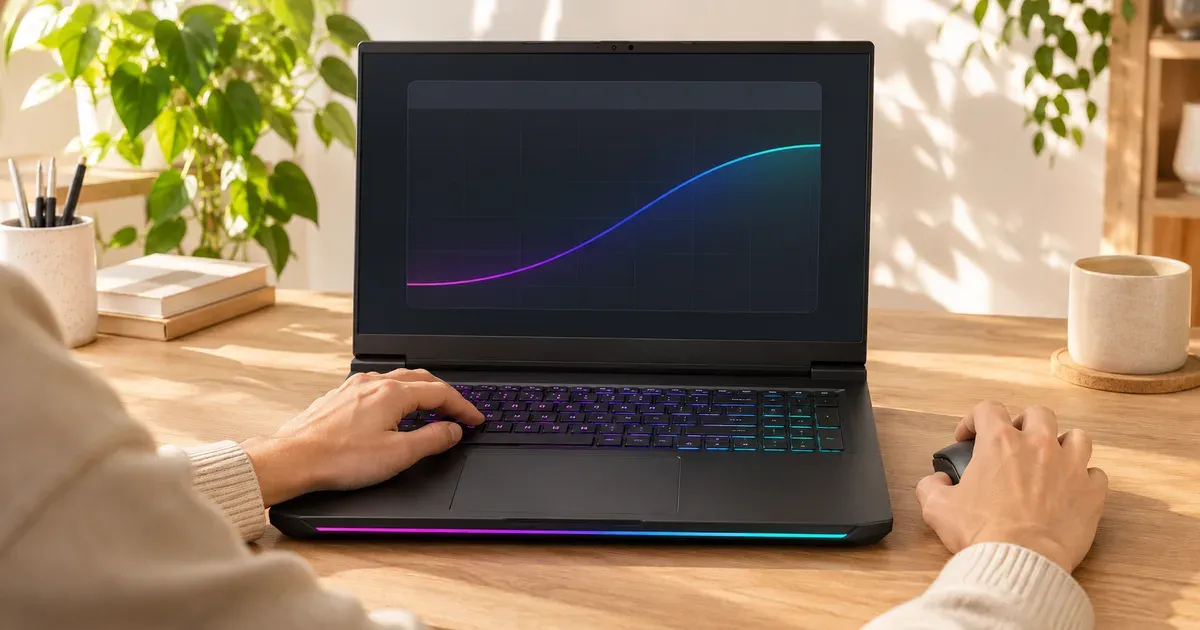
- Pick a target point. Choose a voltage below where the curve normally peaks under load and drag that point up to roughly the clock speed you saw in step 1.
- Flatten the curve after it. Select every point to the right and pull them down to the same clock (or, in Afterburner, Shift-select them and apply), so the GPU never goes above that voltage.
- Apply and test in the same game for 15–30 minutes. If it crashes or shows artifacts, raise the voltage one step or lower the clock a little.
- Save the profile and set it to load at startup once it’s stable across a few games.
MSI documents this same curve method in its official Afterburner undervolting guide. Some laptops limit what the curve editor can change: the GPU’s maximum power is set by the laptop’s firmware, so an undervolt lowers heat and power at a given clock but can’t raise the GPU’s power limit.
Expect similar frame rates with lower GPU temperatures and quieter fans. Every chip is different, so copy settings from someone else’s laptop only as a starting point.
The Easier Alternative: Lower the Power Limit
Undervolting and power limiting reach the same goal from different directions. If you’d rather not touch a curve:
- ASUS Armoury Crate: Manual mode lets you set CPU and GPU power and fan curves on supported models. Even switching from Turbo to Performance lowers power a lot.
- Lenovo Legion Space / Vantage: on Legion models with a Custom mode, it lets you adjust CPU and GPU power. Otherwise Quiet or Balanced mode (Fn+Q) does the same job.
- Nvidia app or in-game settings: cap the frame rate; WhisperMode and BatteryBoost also limit frame rates.
These can’t crash your games, and a small cut in power often costs only a few percent of performance. More on heat in is 95°C normal for a gaming laptop.
Undervolting FAQ
Is undervolting a gaming laptop safe?
Lowering voltage doesn’t damage hardware; the risk is instability (crashes, artifacts) until you find a stable setting. Save your work and test gradually.
Why can’t I undervolt my Intel laptop?
Intel’s Undervolt Protection, and the Plundervolt mitigation before it, block voltage offsets below the boot voltage unless the laptop maker exposes a BIOS option to disable them. Most don’t.
Does undervolting reduce FPS?
A good GPU undervolt keeps frame rates close to stock, sometimes higher if the laptop was throttling. Too aggressive a setting crashes rather than slowing down.
Does undervolting void the warranty?
Software settings are reversible and don’t change the hardware. Modified BIOS files are another matter: avoid them.
Can I use ThrottleStop on a 2026 gaming laptop?
It runs, but on most Intel laptops from 12th-gen Core onward the voltage offsets are locked, so ThrottleStop is useful only for monitoring and power limits. Changing power limits there or in the maker’s app is the working route.
Should I undervolt the CPU or the GPU first?
The GPU. In games it uses the most power and makes the most heat, and it’s the one you can still undervolt on almost every laptop.
Should I undervolt or use a cooling pad?
Try power mode and a frame cap first, then a GPU undervolt. A cooling pad adds a few degrees of headroom on top.
Sources
- Intel: what is Undervolt Protection
- Intel: XTU incompatible with VBS when UVP is not enabled
- Intel security advisory INTEL-SA-00289 (Plundervolt)
- MSI: Afterburner overclocking and undervolting guide
- MSI Afterburner download
- AMD Ryzen Master user guide: Curve Optimizer
- AMD Ryzen Master user guide: supported platforms
- ASUS ROG: Armoury Crate operating modes explained
- Nvidia Control Panel: Manage 3D Settings (Max Frame Rate)