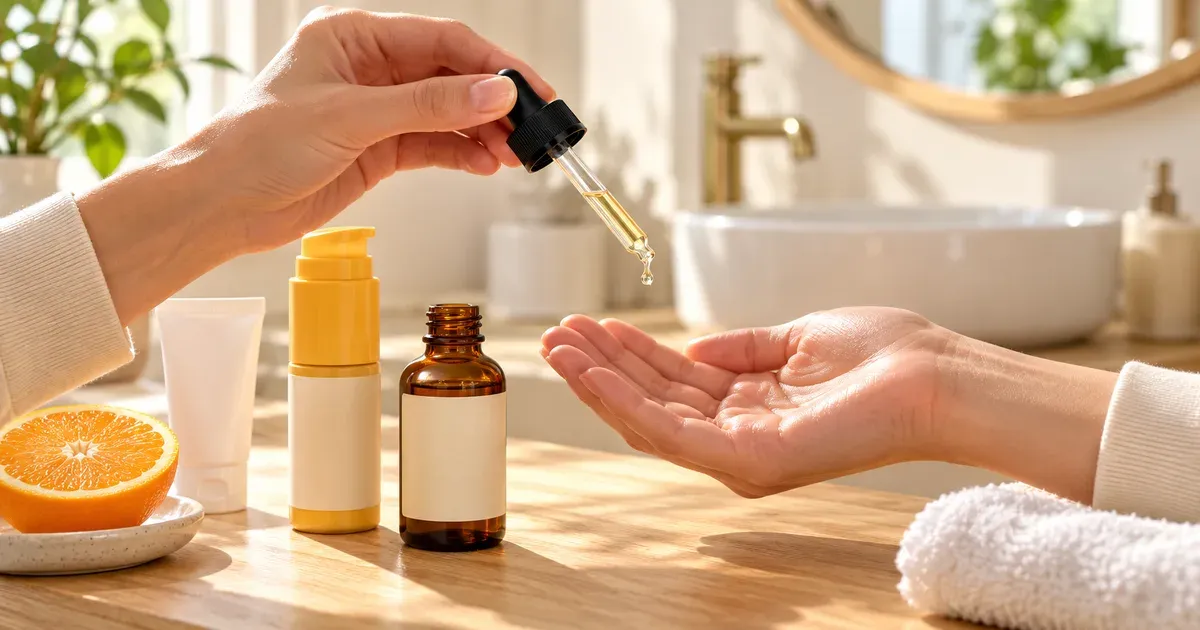
A vitamin C serum does three useful things: it mops up free radicals from sunlight and pollution before they damage skin, it fades dark spots by slowing pigment production, and over months it helps skin make collagen, which softens fine lines. It’s best applied in the morning, under sunscreen. The hard part is choosing one, because vitamin C is unstable and only a few forms and formulas reliably get into the skin.
Our top pick is Timeless 20% Vitamin C + E Ferulic Acid Serum (about $28 for 1 ounce). It uses the same proven trio, L-ascorbic acid, vitamin E and ferulic acid, as the famous $180 SkinCeuticals C E Ferulic, for a fraction of the price. If you have dry skin or want a drugstore option, get CeraVe Skin Renewing Vitamin C Serum. For sensitive or acne-prone skin that stings with strong acids, the gentler Mad Hippie Vitamin C Serum is the better choice.
Our Picks at a Glance
| Serum | Best for | Vitamin C form | Strength | Price |
|---|---|---|---|---|
| Timeless 20% Vitamin C + E Ferulic | Best overall | L-ascorbic acid + vitamin E + ferulic acid | 20% (10% version too) | About $28 per oz |
| CeraVe Skin Renewing Vitamin C Serum | Dry skin, drugstore | L-ascorbic acid + ceramides | 10% | About $24 per oz |
| Mad Hippie Vitamin C Serum | Sensitive, acne-prone skin | Sodium ascorbyl phosphate + vitamin E + ferulic acid | Not disclosed | About $28 per oz |
What to Look for in a Vitamin C Serum
The form of vitamin C. L-ascorbic acid (often listed as ascorbic acid) is the form with the most research. It also works only in an acidic formula: a classic study found it has to be formulated below pH 3.5 to get into skin, with absorption peaking at 20% (Pinnell et al., Dermatologic Surgery, 2001). Higher concentrations don’t help and irritate more. Gentler derivatives such as sodium ascorbyl phosphate, ascorbyl glucoside and tetrahexyldecyl ascorbate are more stable and less irritating but have less evidence. In that same study, several derivatives didn’t raise vitamin C levels in skin at all.
Vitamin E and ferulic acid. These two make L-ascorbic acid work harder and last longer. Adding ferulic acid to 15% vitamin C and 1% vitamin E made the formula more stable and doubled its protection against UV damage, from about 4-fold to 8-fold, in a 2005 study (Lin et al., Journal of Investigative Dermatology, 2005). That research is the basis for SkinCeuticals C E Ferulic and the many serums that copy it.
Packaging. Light and air turn vitamin C into a yellow, then orange or brown, inactive compound. Look for opaque or amber bottles, airless pumps or tubes, and buy the smallest size you’ll finish in about three months.
What the evidence says. A 2023 systematic review of seven randomized trials (139 people) found topical vitamin C made skin smoother and less wrinkled and lightened pigmentation, but noted that changes take long-term use (Correia and Magina, Journal of Cosmetic Dermatology, 2023). Expect a few months, not a few days.
Best Overall: Timeless 20% Vitamin C + E Ferulic Acid Serum
Best overall
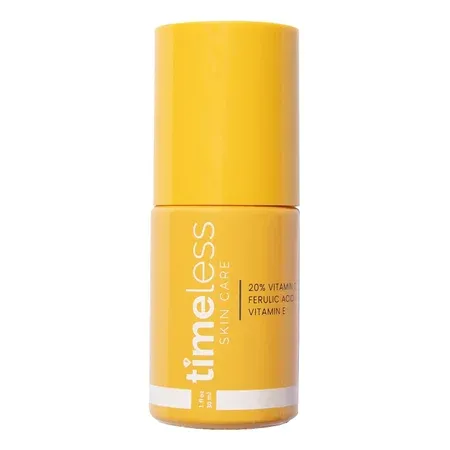
Timeless 20% Vitamin C + E Ferulic Acid Serum
20% L-ascorbic acid with vitamin E and ferulic acid in an airless pump, for about $28 an ounce.
Timeless 20% Vitamin C + E Ferulic Acid Serum is the best value in vitamin C. Its short ingredient list centers on 20% L-ascorbic acid, vitamin E (alpha tocopherol) and ferulic acid, the same combination studied in the research above, with hyaluronic acid and panthenol for hydration. It’s free of fragrance, parabens and dyes, and costs about $28 for an ounce, compared with roughly $180 for SkinCeuticals C E Ferulic.
The serum is thin and watery. Apply one or two pumps to dry skin in the morning, let it absorb, then moisturize and apply sunscreen. Expect a brief tingle at first. That’s the low pH, and it usually fades within a couple of weeks. Like other pure L-ascorbic acid serums, it can feel slightly tacky.
At 20%, it’s at the top of the useful range, so it can sting or redden sensitive skin. If that happens, Timeless sells the same formula at 10% strength for the same price. The airless pump helps protect it from air. Still, finish it within about three months, and store it somewhere cool and dark.
Buy it if you want the proven C, E and ferulic formula without paying luxury prices.
Best Drugstore Pick: CeraVe Skin Renewing Vitamin C Serum
Best for dry skin
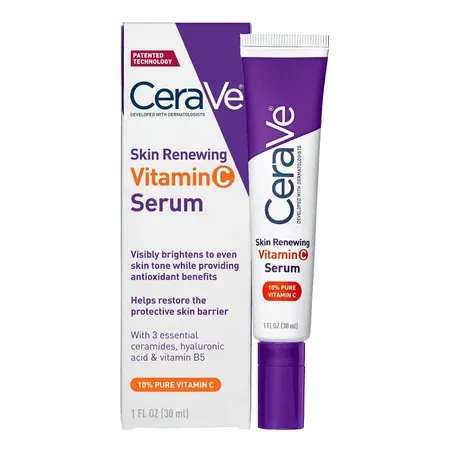
CeraVe Skin Renewing Vitamin C Serum
A 10% L-ascorbic acid serum with ceramides and hyaluronic acid in a light-blocking tube.
CeraVe Skin Renewing Vitamin C Serum is the easiest vitamin C to find, and one of the most comfortable for dry or easily irritated skin. It contains 10% L-ascorbic acid, half the strength of Timeless, plus CeraVe’s three ceramides, cholesterol, hyaluronic acid and panthenol to support the skin barrier. It’s a lightweight, non-greasy gel with less tingle than most vitamin C serums.
It comes in a squeeze tube that keeps out light and air, a smart choice for such an unstable ingredient, and it’s fragrance-free and non-comedogenic. Apply a thin layer to the face and neck each morning before moisturizer and sunscreen. Let it absorb fully before layering.
The lower strength means slower results than a 15% to 20% serum, and it doesn’t contain ferulic acid. In exchange, it’s gentle enough to use daily from the start.
Buy it if your skin is dry or reactive, or you want a reliable vitamin C from the drugstore.
Best for Sensitive and Acne-Prone Skin: Mad Hippie Vitamin C Serum
Best for sensitive skin
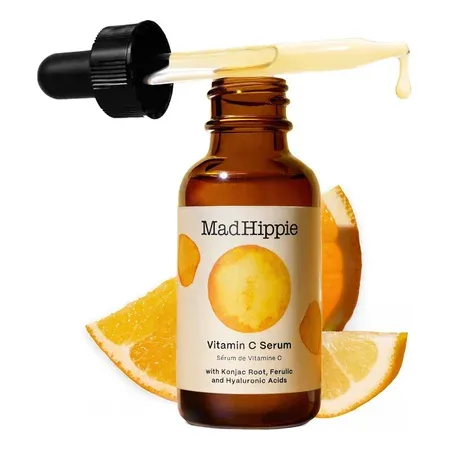
Mad Hippie Vitamin C Serum
A gentle sodium ascorbyl phosphate serum with vitamin E, ferulic acid and hyaluronic acid.
Mad Hippie Vitamin C Serum uses sodium ascorbyl phosphate (SAP), a stable vitamin C derivative that works at skin-friendly pH. It won’t sting the way L-ascorbic acid can, and it doesn’t oxidize as quickly. Mad Hippie pairs it with vitamin E (tocotrienols), ferulic acid, hyaluronic acid and konjac root.
SAP has a specific advantage for breakouts: it has antibacterial activity against the bacteria involved in acne. In a small trial, a 5% SAP lotion cut inflammatory acne lesions by about 49% over eight weeks (Ruamrak et al., International Journal of Cosmetic Science, 2009). Mad Hippie doesn’t disclose its SAP percentage, and SAP has less evidence than L-ascorbic acid for wrinkles and sun protection.
It’s fragrance-free, though it includes clary sage and grapefruit extracts, which some very sensitive skin may dislike. It comes in an amber dropper bottle.
Buy it if L-ascorbic acid serums sting or break you out, or you want vitamin C for acne-prone skin.
What about SkinCeuticals C E Ferulic?
SkinCeuticals C E Ferulic (15% L-ascorbic acid, 1% vitamin E, 0.5% ferulic acid) is the original. Its formula is based on the research described above, and many dermatologists still recommend it. At about $180 an ounce, though, it costs more than six times as much as Timeless, which uses the same three actives. SkinCeuticals sells through dermatologists and authorized retailers, not Amazon; buy it from those sources to avoid counterfeits.
How to Use Vitamin C
- Use it in the morning after cleansing and before moisturizer and sunscreen. That’s when its antioxidant protection matters most.
- Start with a few drops or one to two pumps for the face and neck.
- Always wear sunscreen. Vitamin C boosts sunscreen’s protection but doesn’t replace it.
- Pair it with retinoids at night, not in the same step. See our retinol vs. tretinoin explainer for help choosing one.
- Niacinamide is fine alongside it. The old warning about mixing them came from studies on raw ingredients at high heat, not finished skincare.
- If it stings, drop to a lower strength, use it every other day, or switch to a derivative like SAP.
When Vitamin C Has Gone Bad
L-ascorbic acid serums start out clear or pale straw-colored. As they oxidize, they turn yellow, then dark orange or brown. A slight yellow tint is normal; once the serum is noticeably orange, much of the vitamin C is gone, and it can leave an orange tint on skin. Toss it. To slow oxidation, keep the cap closed, store it out of light and heat (a cool cabinet or the fridge), and finish it within about three months of opening.
How We Chose
We compared each serum’s form and strength of vitamin C, supporting antioxidants, pH-dependent formulation, packaging, fragrance and irritants, owner ratings and price per ounce. We weighed the published research on topical vitamin C, ferulic acid and vitamin C derivatives, and favored serums that disclose their strength and protect against oxidation.
For the rest of your routine, see our guides to the best facial cleansers and best retinol products.