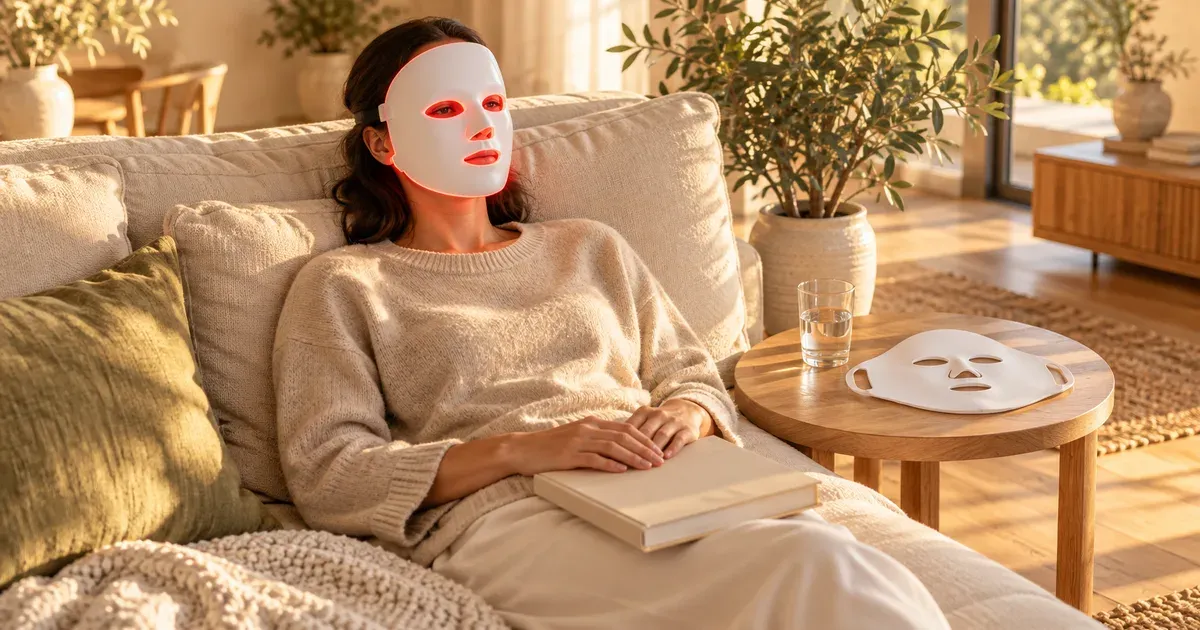
An LED face mask shines low-level red, near-infrared or blue light onto your skin for a few minutes at a time. Used consistently for two to three months, red and near-infrared light can soften fine lines and improve texture a little. Blue light is aimed at acne, though the evidence there is weaker. None of this works like a laser or a prescription retinoid, and results fade if you stop. A mask is a slow, gentle add-on to a good routine, and the best ones make that routine easy to keep.
Our top pick is the Shark CryoGlow ($299). It’s FDA-cleared for both wrinkles and acne, its programs run 4 to 8 minutes, and it adds chilled under-eye pads that no other mask here has. If breakouts are your main concern, the Dr. Dennis Gross DRx SpectraLite FaceWare Pro runs a 3-minute red and blue program. The Therabody TheraFace Mask Glo is the most comfortable cordless option, and the Nanoleaf LED Light Therapy Face Mask covers the basics for about $170.
Our Picks at a Glance
| Mask | Best for | Light | Session | Price |
|---|---|---|---|---|
| Shark CryoGlow | Best overall | Red, blue, infrared + under-eye cooling | 4–8 min | About $299 |
| Dr. Dennis Gross FaceWare Pro | Acne | Red, blue | 3 min | About $455 |
| Therabody TheraFace Mask Glo | Cordless comfort | Red, red + infrared, blue | 4–12 min | About $380 |
| Nanoleaf LED Face Mask | Budget | Seven modes, including 850nm near-infrared | 5–10 min | About $170 |
Best Overall: Shark CryoGlow
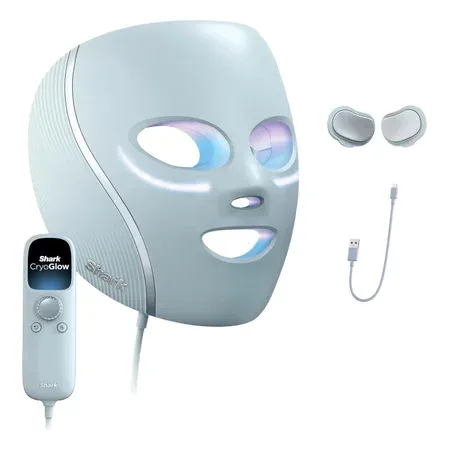
Best overall
Shark CryoGlow LED Face Mask
An FDA-cleared red, blue and infrared mask with 4- to 8-minute programs and chilled under-eye pads.
The Shark CryoGlow is the easiest mask to recommend because it covers the two reasons most people buy one, lines and breakouts, in short sessions. The FDA cleared it in November 2024 (510(k) K242796) as an over-the-counter device for wrinkles and for mild to moderate acne. Its 480 LEDs emit red, blue and infrared light.
It has four programs, picked from a handheld remote:
- Better Aging (6 minutes): red and infrared light for fine lines and firmness.
- Skin Clearing (8 minutes): blue, red and infrared light for acne and redness.
- Skin Sustain (4 minutes): all three colors, meant for maintenance after an 8-week cycle.
- Under-Eye Revive (5 to 15 minutes): clip-on pads that chill the under-eye area, with three cold settings.
The cooling pads are what set it apart. Cold temporarily tightens and depuffs the skin under the eyes, much like a chilled spoon or eye mask. It’s a same-day effect, not a long-term treatment, but it makes the mask more pleasant to use in the morning. Shark’s own 12-week studies, with about 60 people per program, reported fewer fine lines and less acne with daily use. Those are maker-funded studies, so treat the exact percentages as marketing.
The CryoGlow is a rigid shell that sits slightly off the face, with an adjustable strap. That shape spreads light evenly and keeps the LEDs off your skin, but it’s bulkier than a silicone mask. It charges over USB-C and may be eligible for FSA and HSA funds.
Buy it if you want one mask for both aging and acne, in sessions short enough to do every day. The same mask comes in other colors on separate listings that usually cost about $50 more.
Best for Acne: Dr. Dennis Gross DRx SpectraLite FaceWare Pro
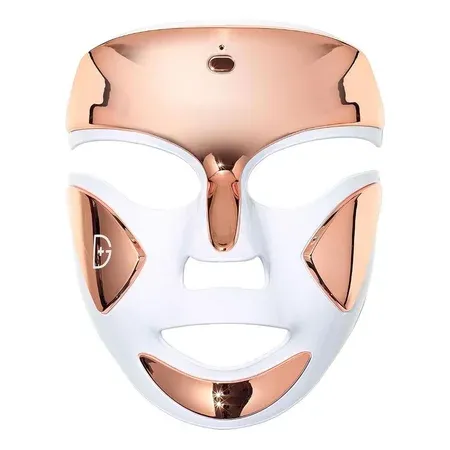
Best for acne
Dr. Dennis Gross DRx SpectraLite FaceWare Pro
A dermatologist-developed red and blue mask that runs a 3-minute treatment, with blue light for breakouts.
The DRx SpectraLite FaceWare Pro was one of the first popular at-home masks, and it’s still the simplest way to get blue light for breakouts alongside red light for lines. You pick red, blue or both, and every session lasts 3 minutes, the shortest of any mask here. That matters more than it sounds: a mask only works if you keep using it for weeks.
Dermatologist Dennis Gross developed it, and the brand lists it as FDA-cleared. It’s a rigid white and rose-gold shell that you wear with a head strap and run from a button on the mask itself, so there’s no remote or cable during treatment.
The catches are price and reliability. At about $455 it costs more than the Shark, it has no near-infrared light, and its Amazon rating (3.8 stars) is the lowest of our picks. Many complaints are about the battery and charging. The brand says to charge it only from a USB-A port with the included cable, not a high-powered USB-C charger, to avoid damaging the battery.
Buy it if acne is your main concern and you want the shortest possible session. If you also want near-infrared or cooling, the Shark covers acne at a lower price.
Best Cordless Mask: Therabody TheraFace Mask Glo
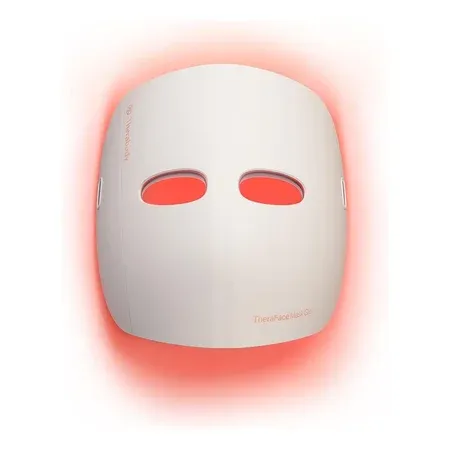
Best cordless mask
Therabody TheraFace Mask Glo
A cordless mask with 504 LEDs, red, infrared and blue light, and a built-in vibrating scalp massage.
The TheraFace Mask Glo is the one to get if you want to walk around, read or answer email while you treat. It’s fully cordless, with no remote or cable, and it hovers just above the skin instead of pressing on it. The original TheraFace Mask was FDA-cleared in 2023. The Glo is Therabody’s newer, lower-priced version.
It packs 504 LEDs, the most of our picks, with three light settings: red for fine lines and dark spots, red plus infrared for firmness, and blue for acne. The preset program runs 12 minutes, cycling through 4 minutes of each. You can also run any single setting for 4 minutes. A gentle vibrating scalp massage with three patterns runs during treatment or on its own. It’s a spa touch rather than a skin benefit, but it makes the routine feel less like a chore.
The 12-minute full cycle is twice as long as the Shark’s anti-aging program, so it’s harder to fit into a busy morning. It has no under-eye cooling, and at about $380 it costs more than the Shark.
Buy it if you’d rather move around during sessions and like the idea of a massage built in.
Best Budget Pick: Nanoleaf LED Light Therapy Face Mask
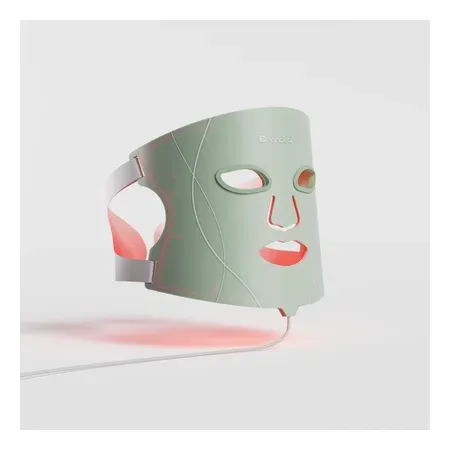
Best budget pick
Nanoleaf LED Light Therapy Face Mask
A flexible silicone mask with 432 LEDs, seven light modes including near-infrared, and five intensity levels.
Nanoleaf is best known for smart home lighting, and its LED Light Therapy Face Mask is the most capable mask we found under $200. It’s made of flexible silicone that curves to your face, with 432 LEDs and seven modes that pair visible colors with 850nm near-infrared light. Nanoleaf lists it as FDA-cleared.
You get more manual control than with the pricier masks: five intensity levels and a timer you can set from 1 to 30 minutes. The recommended routine is 5 to 10 minutes, three to five times a week. A small battery controller on a short cable runs it, so there’s no wall outlet involved, and a full charge lasts about 80 minutes of use.
The trade-offs are polish and proof. Nanoleaf hasn’t published the kind of clinical studies Shark and Therabody have, and a flexible mask presses some LEDs closer to the skin than others. Nanoleaf will send a free strap extender if the mask doesn’t fit.
Buy it if you want to try LED therapy without spending $300 or more.
Also worth knowing
The Omnilux Contour Face (red and near-infrared, about $395) is a well-regarded flexible mask from a company that has made professional LED panels for about two decades, but it isn’t sold through Amazon in the US. The CurrentBody Series 3 (about $570) is new for fall 2026 and lets you choose the wavelength of every LED through an app. It’s too new to have much owner feedback, so we’d wait before paying that much.
Do LED Face Masks Work?
For mild signs of aging, modestly. A 2026 systematic review of at-home LED masks and devices found eight studies with 365 participants. Red and near-infrared devices were linked to measurable improvements in wrinkles, texture and elasticity, and side effects were rare and mild (Das et al., Aesthetic Plastic Surgery, 2026). The authors also noted that the studies were small, used different treatment schedules, rarely compared devices head to head and included few people with darker skin.
For acne, the case is weaker. A 2019 meta-analysis of 14 randomized trials with 698 people found that blue light didn’t significantly reduce inflammatory pimples compared with no light treatment (Scott et al., Annals of Family Medicine, 2019). Many of the trials were small and short. Some people do see fewer breakouts, but a mask shouldn’t replace benzoyl peroxide, adapalene or a dermatologist’s plan for moderate to severe acne.
Results build slowly. Most makers suggest 3 to 5 sessions a week and say visible changes take 4 to 12 weeks. Once you stop, the benefits gradually fade.
Red, Blue and Near-Infrared Light: What Each Color Does
- Red light (about 630–660nm) reaches the upper layers of skin. It’s the main color used for fine lines, tone and redness.
- Near-infrared light (about 800–1,072nm) is invisible and reaches deeper. Masks usually pair it with red for anti-aging programs.
- Blue light (about 415nm) stays near the surface and targets the bacteria involved in acne.
- Amber, yellow and green modes appear on cheaper masks. They have much less research behind them.
More LEDs and more colors don’t automatically mean better results. What matters is that the mask covers your whole face evenly and that you use it often.
FDA-Cleared vs. FDA-Registered
Many masks advertise an FDA connection, and the wording matters:
- FDA-cleared means the maker submitted a 510(k) showing the device is substantially equivalent to one already on the market for the same use, such as over-the-counter wrinkle reduction. The FDA reviewed it for safety and intended use. You can look up the clearance by company in the FDA’s 510(k) database.
- FDA-registered only means the company has listed its facility with the FDA. It says nothing about whether the device works.
- FDA-approved almost never applies to LED masks. Approval is a separate, stricter process.
A clearance doesn’t prove a mask works better than another one, but it’s a reasonable minimum for something you’ll wear over your eyes.
How to Use an LED Mask Safely
- Start with clean, dry, bare skin. Apply serums and moisturizer afterward. Thick creams and sunscreen can block some light.
- Protect your eyes. Most masks have shields or openings designed for eye safety, but don’t stare into the LEDs. In 2019, Neutrogena recalled its Light Therapy Acne Mask over a possible risk of eye injury for people with certain eye conditions or who take medications that make the eyes more sensitive to light.
- Check your medications. Isotretinoin, some antibiotics such as doxycycline, and other drugs can make skin more sensitive to light. Ask your doctor or pharmacist first.
- Skip it or ask a doctor first if you have a seizure disorder triggered by light, an eye condition, lupus or another light-sensitive condition, or if you’re pregnant. Device manuals list their own exclusions.
- Be consistent, not excessive. Longer or twice-daily sessions don’t speed up results and can irritate skin.
How We Chose
We compared each mask’s FDA clearance, light colors and wavelengths, LED count, coverage, session length, comfort features such as cordless design and fit, published clinical data, owner ratings and complaints, and price. We favored masks with short programs, since consistency predicts results more than any spec. We also weighed the published research on at-home LED devices, summarized above.
LED masks work best alongside the basics. Pair one with a gentle cleanser from our best facial cleansers guide, and if you want stronger anti-aging results, see our picks for the best retinol products. For tired, puffy eyes, our caffeine eye cream guide covers cheaper fixes than a mask.