

Power-bank capacity is only the beginning. Port speed determines whether a device merely charges or runs properly under load, watt-hours govern air-travel rules, and the weight and cable arrangement decide whether the battery actually leaves home with you.
We compared rated and usable energy, input and output standards, simultaneous charging behavior, portability, warranty, and current safety information. Product names are often recycled across generations, so match the model number and port layout, not just the family name, before buying.
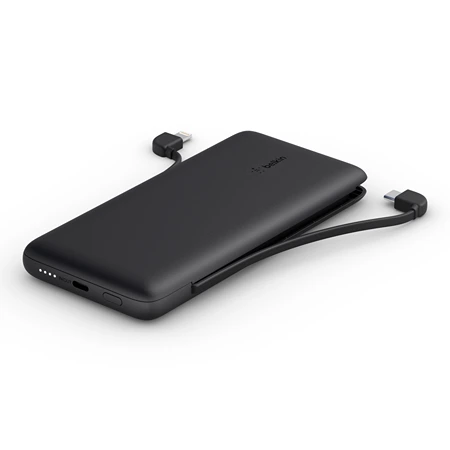
Belkin Boost Charge Plus 10K
Best Overall Option
A compact 10,000 mAh power bank with built-in Lightning and USB-C cables, USB-C PD fast charging, and passthrough charging.
Two short cables fold into the sides of the Belkin Boost Charge Plus 10K, which is why it remains convenient despite unremarkable charging speed. One terminates in Lightning and the other in USB-C, covering an older iPhone and most newer mobile devices without a cable pouch. A separate USB-C port accepts input or supplies power to a third cable.
The 10,000mAh rating is suitable for roughly one to two modern phone recharges after conversion losses, depending on the phone and conditions. Belkin rates the USB-C port at up to 18W and total output at up to 23W, enough for phones, earbuds, and many small tablets but far below current laptop-charger territory.
Pass-through charging can top up a connected device while the bank itself is plugged in, with operating limits that depend on its remaining charge. That can simplify a hotel night with one wall adapter. No AC adapter is included, so recharge time and pass-through behavior depend on supplying a compatible USB-C charger.
At a little over ten ounces, the pack is bag-friendly but thick for a trouser pocket. The tethered cables eliminate clutter and introduce the biggest longevity concern: a damaged connector or fatigued cable cannot be swapped as easily as an ordinary cord. Users who have moved entirely to USB-C also carry a Lightning lead they may never use.
Belkin’s two-year warranty and simple charge indicators round out a sensible travel design. It is best for mixed-connector households that value always-attached cables over leading-edge speed. Inspect those cables regularly, stop using any swollen or damaged battery, and avoid leaving lithium power banks in a hot vehicle.
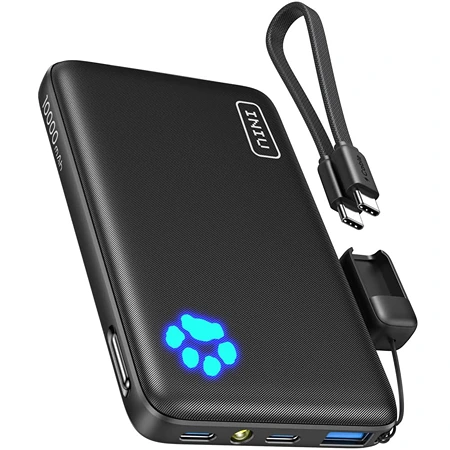
INIU Portable Charger 10000mAh
Best Budget Option
An affordable, slim 10,000 mAh power bank with USB-C input and output, two USB-A ports, and up to 15W charging.
The INIU Portable Charger 10000mAh covers the basics at a price that makes sense for an emergency battery or occasional travel. Its slim body fits more easily into a crowded bag than many 10,000mAh packs, while the rated capacity provides roughly one to two full phone charges after normal conversion losses.
The USB-C port works for both charging devices and refilling the power bank, so most current phone owners can carry one cable for both jobs. Two USB-A outputs accommodate older cables or additional accessories. Maximum output is 15W, which is adequate for overnight charging and routine top-ups but slower than modern 20W to 30W USB-C PD models.
Subscribe to Product Bible
Stay updated with the latest product reviews, buying guides, and expert recommendations. Fresh advice on the best things we've researched, tested, and reviewed, sent to your inbox weekly.
Want to know more about how we handle your data or opt out of marketing emails? Check out our Privacy Policy. If you have any questions, we're always here to help.
Charging several devices at once divides the available power, making the extra ports more useful for convenience than speed. The paw-shaped indicator gives a quick estimate of remaining charge but not a precise percentage, and the built-in flashlight is better treated as an emergency extra than a reason to buy.
The tradeoff for the low price is modest performance. It is not designed for laptops, fast-charging tablets, or users who routinely need the quickest possible phone recharge. Buyers should also confirm the exact capacity and port layout because INIU sells several similar-looking batteries under closely related listing names.
For a spare kept in a backpack, desk drawer, or travel kit, the INIU delivers useful capacity and modern USB-C connectivity without much expense. Spend more for higher USB-C PD output, faster power-bank recharging, or a numerical display; for straightforward phone charging, this is the better budget choice.
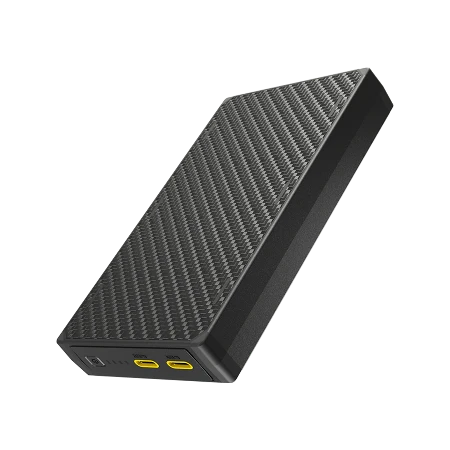
Nitecore NB20000 Gen 3
Best Lightweight Option
A 20,000 mAh, 72Wh power bank weighing about 10 oz, with dual USB-C ports and an IPX5 water-resistant body.
Every gram is scrutinized in backpacking gear, and that is the logic of the Nitecore NB20000 Gen 3. It fits a 20,000mAh, 72Wh battery into a body that weighs about 10.3 ounces, roughly 290 grams, and measures under an inch thick. That is exceptionally light for the rated energy and considerably easier to justify on foot than most high-capacity banks.
As with any power bank, the 20,000mAh headline describes the cells, and voltage conversion means noticeably less energy reaches your devices. Nitecore says it can fully charge a modern smartphone about four times, which also covers repeated camera, headlamp, GPS, and satellite-communicator top-ups, with cold, cable loss, and device behavior affecting the final result.
Two USB-C ports handle both input and output, so it can charge two devices at once or refill itself while powering something else. There is no USB-A port, but Nitecore includes a USB-C to USB-A adapter for older trail cables, and four blue LEDs show the remaining charge. This is an energy-to-weight specialist built around phones and small electronics, not a fast laptop bank; for notebooks, the Anker 737 below is the better tool.
The seamless body carries a stated IPX5 water-resistance rating. That improves confidence around rain and splashes without making the pack submersible, the ports waterproof, or the case crush-proof. Keep it protected from prolonged moisture, sand, sharp gear, and extreme heat just as with any lithium battery.
The NB20000’s price buys low mass rather than a display, high wattage, or many ports, and Nitecore backs it with a two-year warranty. Earlier NB20000 generations may still appear in listings, so confirm you are getting the Gen 3. For an ultralight kit built around phones and small electronics it is unusually efficient; for office travel, a cheaper 65W bank is typically more useful.
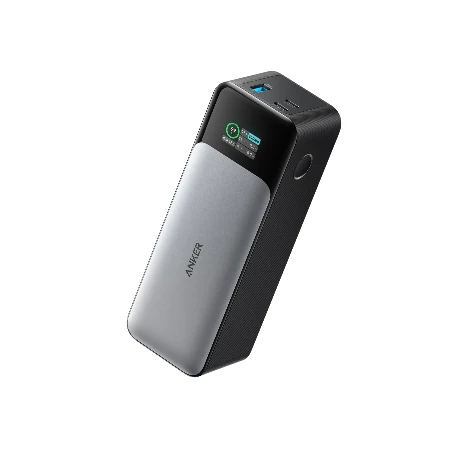
Anker 737 Power Bank
Best for Laptops
A 24,000 mAh power bank with 140W USB-C Power Delivery, a live power display, and three ports for a laptop, phone, and more.
A 140W USB-C port makes the Anker 737 Power Bank one of the more capable ways to keep a laptop running away from an outlet. Using USB Power Delivery 3.1, it can feed full-size notebooks that would charge slowly or not at all from older 60W banks, while a second USB-C port and a USB-A port handle a phone, tablet, or earbuds at the same time. Total output is rated at 140W, so simultaneous loads share that budget.
Its 24,000mAh battery works out to roughly 86Wh, below the common 100Wh threshold used for passenger-aircraft carry-on batteries, and Anker describes it as meeting airline carry-on requirements. That does not guarantee acceptance: power banks belong in carry-on baggage, quantities can be restricted, and the airline and destination rules control. The capacity adds meaningful runtime to an efficient laptop rather than promising a full charge for every model.
140W suits ultrabooks, business notebooks, and many larger machines, but high-performance gaming laptops can still charge slowly, throttle, or drain under heavy use. Reaching the full 140W requires a 5A cable; Anker includes one, and substituting an ordinary USB-C cable can cap the speed. Recharging also runs over USB-C, and Anker lists a recharge time of under an hour when paired with a 140W charger.
The built-in display shows real-time input and output wattage and estimates the time to recharge, which makes it easy to tell whether a laptop is actually gaining charge or only holding steady. At about 22 ounces and roughly 6 by 2 by 2 inches, this is work-bag equipment rather than a pocket battery, and a travel pouch is included.
The 737 is not Anker’s newest design, since the Prime line charges faster and holds slightly more, but it has a long track record and a 24-month warranty. Choose it when your laptop charges over USB-C and you want one bank for the notebook and phone. If you depend on a DC barrel-plug laptop or want a built-in wireless pad, look for a more specialized pack.
Add the maximum wattage of the devices that genuinely need simultaneous power, then choose the smallest bank that meets that load with margin. Capacity labels are measured inside the battery, so useful USB output will always be lower after conversion; watt-hours are the better number for travel and cross-model comparison. Our mAh to Wh calculator converts any capacity and checks it against current airline limits.
Register safety notices, inspect the case and ports, and retire any pack that swells, leaks, smells unusual, or becomes abnormally hot. Use a reputable charger and cable, keep batteries out of checked luggage and extreme temperatures, and follow local hazardous-waste guidance at end of life.