An electric kettle heats water without tying up a burner, but speed alone does not tell you whether it will be pleasant to use. A broad pitcher spout is handy for tea, oatmeal, and cooking water. It is clumsy over a pour-over dripper. Temperature buttons are valuable when you regularly brew green tea or coffee below a full boil, yet they add cost and another set of electronics that can fail.
Capacity and handling deserve the same attention. A 1.7-liter kettle can serve several mugs or fill a saucepan, but it becomes heavy when full. A smaller gooseneck is easier to guide in slow circles, though its restrained flow can feel painfully slow when all you want is boiling water for pasta. The lid opening, water-level window, alert volume, and shape of the handle will matter more often than a rarely used preset.
A useful kettle should be simple to fill, lift, pour, and clean. Temperature controls need to solve a recurring brewing need rather than decorate the base, and a lower price should not come at the expense of competent boiling. Warranty coverage and available replacement parts also matter because a kettle with digital controls is still a frequently heated countertop appliance.
Best overall
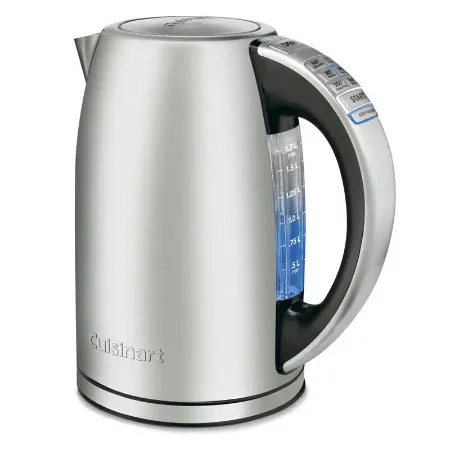
Cuisinart PerfecTemp CPK-17P1
A full-size temperature-control kettle with six labeled presets, a 30-minute hold, and straightforward controls.
The Cuisinart PerfecTemp CPK-17P1 suits the widest range of kitchens because it combines a full 1.7-liter capacity with temperature control that does not require menu diving. Its 1,500-watt heater is quick enough for routine tea and cooking water, while the conventional pitcher shape pours faster than a coffee-focused gooseneck. This is the kettle to buy when several people with different hot-drink habits will share it.
Six fixed buttons cover delicate, green, white, oolong, French press, and black or herbal tea. That approach is less flexible than choosing any temperature one degree at a time, but it is easier to understand before the first cup of the morning. A keep-warm mode holds the selected temperature for 30 minutes, and the two-minute memory lets you lift the kettle briefly without resetting the heating cycle.
The Cuisinart has a strong record for quick heating and accurate preset behavior. The advantage is not that it wins every speed comparison. Test volumes vary too much for that claim. What matters is that it brings a household-size amount of water up to temperature without making the user trade capacity for useful controls.
Daily operation is pleasantly ordinary. The buttons sit on the handle, the blue window makes the fill level visible, and the cordless body returns to a 360-degree base from either direction. A concealed heating element and removable scale filter simplify routine care. Automatic shutoff and boil-dry protection are documented features, though they do not replace following the fill limits and care instructions.
The familiar design also carries familiar annoyances. Its beeps are loud, the alerts cannot be mistaken for subtle, and a full 1.7-liter kettle feels heavy. The fixed presets will frustrate anyone who wants an exact temperature between them. Buyers trying to avoid plastic near hot water should also know that plastic appears around the lid and water-window area.
Cuisinart backs the model with a three-year limited warranty and still sells a replacement base and scale filter. That support and the kettle’s long history give it an ownership advantage, but not a promise of indefinite service. Owner reports include both decade-long use and temperature-control failures after several years. For most households, the combination of capacity, quick heating, usable presets, and available parts is still the strongest balance here.
Best budget
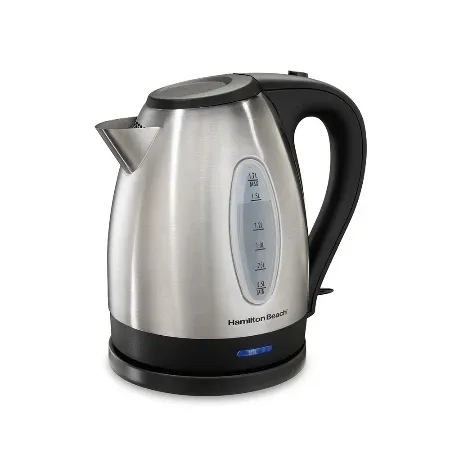
Hamilton Beach Electric Tea Kettle
A simple 1.7-liter boil-only kettle that skips temperature controls to keep the price low.
There is refreshing honesty in the Hamilton Beach 40880. Flip the switch and its 1,500-watt heater boils up to 1.7 liters of water. There is no display, temperature choice, hold mode, or completion chime. That narrow remit is exactly why it works as the budget pick for someone who only needs reliably hot water.
The kettle lifts off its base for serving and uses a wide spout suited to filling a mug, French press, or saucepan. Its automatic shutoff activates at the boil, and the manufacturer also documents boil-dry protection. Those are sensible core features at this price. They should not be read as a guarantee against misuse, and the minimum and maximum fill marks still matter.
Its basic boiling performance has held up well in comparative evaluations. The 40880 heats quickly for an inexpensive full-size kettle, pours without much fuss, and keeps the controls simple enough for a shared kitchen or office. Avoiding temperature electronics also means there is almost nothing to configure. You give up precision, not the essential job.
The cost cutting becomes apparent when it is time to refill and clean the body. The opening is small enough to make access awkward, the water-level window favors one viewing angle, and the lid feels less substantial than the rest of the kettle. Regular descaling needs a little more patience than it does with a wide removable lid.
Long-term reports are mixed. Some owners have kept the 40880 working for years, while others describe failures inside the one-year warranty period. The lid and surrounding plastic parts also feel plainly utilitarian. A three-year warranty, adjustable heat, and a more polished handle all require moving into a higher price tier.
Choose this model when the budget is tight and every batch is headed to a full boil. It is a poor match for temperature-sensitive tea or controlled pour-over coffee, and daily heavy users may reasonably pay more for easier cleaning and longer warranty coverage. For straightforward boiling, though, the 40880 preserves the capacity and speed that matter while leaving expensive extras behind.
Best for Pour-Over
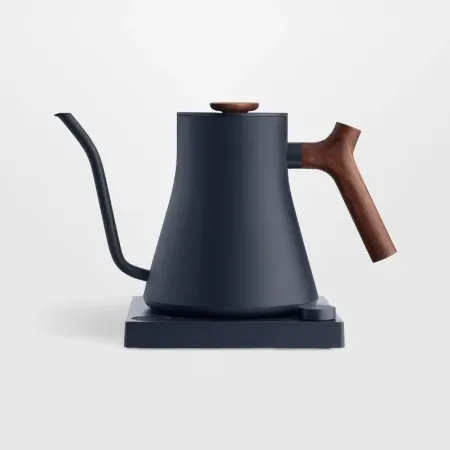
Fellow Stagg EKG Pro
A precise 0.9-liter gooseneck kettle with one-degree control, a balanced pour, and coffee-specific timing tools.
Pour-over coffee rewards a kettle that can release a thin, steady stream without fighting the wrist. The Fellow Stagg EKG Pro is built around that job. The linked configuration is the 0.9-liter Pro model in Stone Blue with a walnut handle, not the first-generation Stagg EKG or the Pro Studio.
Its dial allows one-degree selection across a range of 104 to 212 degrees Fahrenheit, and the color screen shows both the target and current temperature. The base adds a brew stopwatch, scheduling, an altitude setting, a guided mode, and selectable 15, 30, 45, or 60-minute holds. The chime can be adjusted, a welcome contrast with kettles that insist on announcing every button press at full volume.
The Stagg earns its place through the way it pours rather than the length of that settings list. Its narrow gooseneck and balanced handle make it easier to wet a coffee bed evenly, pause during a bloom, and control agitation. That measured flow complements a manual dripper in a way a broad pitcher spout cannot. Readers building a wider setup can find complementary brewers in our guide to the best coffee makers.
Specialization creates the biggest drawbacks. A 0.9-liter body is small for a large teapot, and the restrained spout takes too long when filling cookware. The Pro also costs far more than a basic kettle. Its extra controls make sense for someone who notices small brewing changes, but they add software and interface complexity to an appliance that can otherwise be a switch and a heating element.
Temperature behavior is the concern to weigh most carefully. The kettle has useful one-degree control and a stable hold, but recurring owner reports describe lagging display readings, overshoot, firmware trouble, and occasional base or screen failures. Wi-Fi is used for firmware updates, not remote control. Those complaints do not establish a failure rate, but buyers should not assume the premium price removes the usual risks of a temperature-controlled kettle.
Fellow gives the Pro model a two-year warranty and sells replacement kettle bodies for compatible bases. The less expensive Cuisinart GK-1 remains attractive if five-degree adjustment, a shorter hold, and a louder interface are acceptable in exchange for simpler controls and longer warranty coverage. Choose the Stagg when manual pour-over is a frequent ritual and flow control matters every day. For ordinary tea, instant meals, or cooking water, the larger Cuisinart is the more practical purchase.
The first decision is whether you need temperature control at all. Black tea, instant food, and most cooking tasks can start with a full boil, so a simple switch may be enough. Green tea and pour-over coffee give adjustable heat more purpose. Even then, plainly labeled presets suit most households better than one-degree control they will rarely touch.
Capacity and pour shape determine what happens after the water is hot. A full-size pitcher handles several servings and general kitchen work. A small gooseneck trades that flexibility for precision over a dripper. If espresso is the main event, the kettle may play only a supporting role, and our guide to the best home espresso machines is a more useful place to spend time before buying another specialized tool.
Think through one ordinary week, including who fills the kettle, what they brew, and how often someone will descale it. Then choose the least complicated model that handles those jobs comfortably. The right kettle will still be easy to lift, pour, and clean after the new controls stop being interesting.