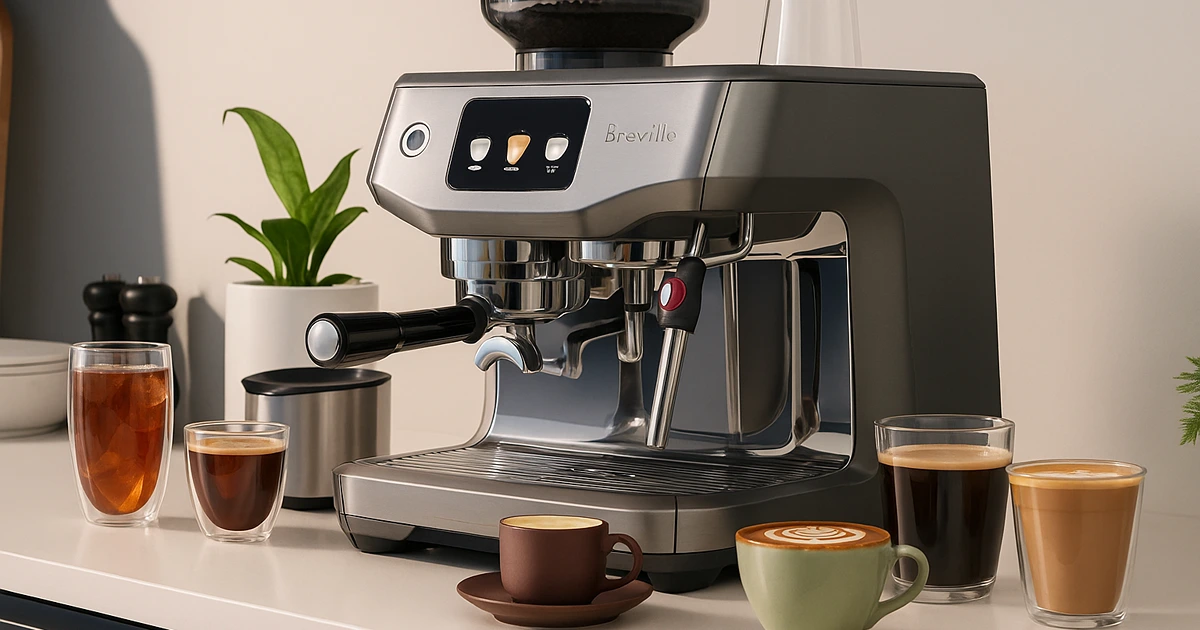

Home espresso is less about finding one machine that does everything than deciding which parts of the ritual you want to learn. Some machines coach you through each drink, others expose every variable, and the most luxurious models quietly handle the messiest steps while leaving the portafilter in your hands.
We compared current manufacturer specifications with long-term owner feedback and professional testing, paying particular attention to temperature behavior, grinder consistency, milk texture, cleanup, and the learning curve after the novelty wears off. The machines below span three very different approaches, but each makes sense for a specific kind of home barista.
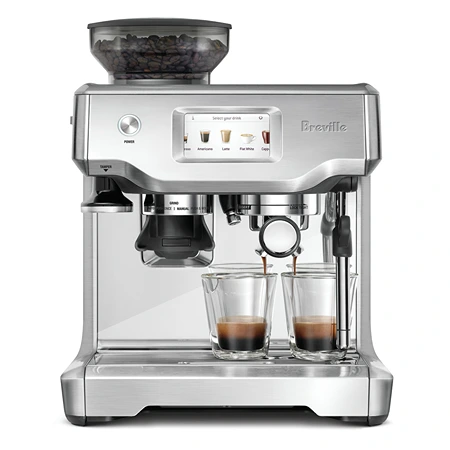
Breville Barista Touch
Best Overall Option
All-in-one espresso machine with built-in grinder, touchscreen controls, and automatic milk frothing.
The Breville Barista Touch earns its place by shortening the distance between opening a bag of beans and making a genuinely good flat white. Its color touchscreen lays out the grind, brew, and milk stages in order, with preset drinks that can be adjusted and saved. That structure is genuinely useful in a shared kitchen: a beginner can follow the prompts, while a more practiced user can change dose, shot time, milk temperature, and texture without digging through a manual.
Breville’s ThermoJet system reaches its stated operating temperature in about three seconds, although the group head and 54mm portafilter still benefit from a hot-water flush before the first shot. The integrated conical-burr grinder keeps the counter tidy and gives enough adjustment for most medium and darker espresso roasts. It is convenient rather than exceptional, however; very light roasts and unusually demanding beans can expose its limits in grind uniformity and fine adjustment.
In the cup, the machine favors repeatable, forgiving espresso over endless experimentation. Single- and dual-wall baskets accommodate both freshly ground coffee and less-than-perfect preground beans, and low-pressure pre-infusion helps produce balanced shots once the grind and dose are close. The narrower portafilter cannot match the broad accessory ecosystem or puck geometry of a commercial 58mm group, but it is far easier to live with than the specification might suggest.
Automatic milk steaming is the feature that makes the Touch particularly persuasive for latte and cappuccino drinkers. Set a temperature and texture, place the pitcher on the sensor, and the wand stops on its own before purging into the drip tray. Manual steaming remains available, but the automatic mode is consistent enough that different people can reproduce the same drink without learning to judge milk by sound and touch.
Daily upkeep is manageable rather than invisible: the wand must be wiped immediately, the tray fills quickly because of the purge cycle, and the grinder and brew path still need regular cleaning. The machine also costs more than a conventional entry-level setup, and an enthusiast may eventually want a better standalone grinder. For a household that values speed, guided controls, and dependable milk drinks more than upgradeability, though, the Barista Touch is an unusually coherent all-in-one package.
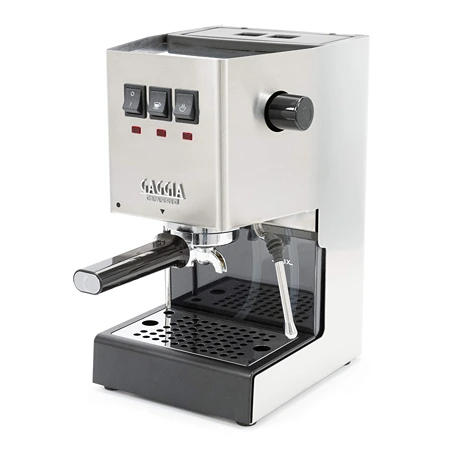
Gaggia Classic Pro
Best Budget Option
No-frills semi-automatic with commercial-grade components, fast heat-up, and reliable performance.
Three rocker switches and a heavy 58mm portafilter tell you exactly what the Gaggia Classic Pro expects: this is a small traditional espresso machine, not an appliance that will diagnose a fast shot for you. The current Classic E24 iteration improves the familiar platform with a lead-free solid-brass boiler and a nine-bar brewing setup, while retaining the stainless-steel body and readily replaceable parts that have made the line popular with tinkerers.
Given fresh beans and a capable espresso grinder, the Gaggia can produce concentrated, nuanced shots well beyond what its simple controls imply. The commercial-size basket gives the coffee bed more favorable proportions than many appliance-style machines, and the three-way solenoid leaves a relatively dry puck after brewing. A suitable grinder is not optional, though, and it can easily cost as much as the machine.
The absence of a PID is the central compromise. Boiler temperature cycles rather than holding an exact user-selected value, so repeatability improves when you learn a consistent warm-up and temperature-surfing routine. The ready light arrives before the group is fully heat-soaked; allowing roughly 15 minutes and warming the portafilter produces better results than brewing the instant the switch says go.
Its commercial-style steam wand is capable of glossy microfoam, but the single boiler must change from brew temperature to steam temperature and back again. That delay is inconsequential for one morning cappuccino and tedious for a row of drinks. The small boiler also rewards deliberate pacing, and the fixed controls provide none of the automatic stopping or milk presets found on Breville’s guided machines.
Ownership is refreshingly straightforward. Descaling, backflushing, gasket replacement, and common repairs are well documented, although the supplied accessories are basic and a properly fitted tamper is a sensible first purchase. Choose the Classic Pro if learning dose, distribution, temperature timing, and milk technique sounds satisfying; anyone seeking push-button consistency should budget for more automation instead.
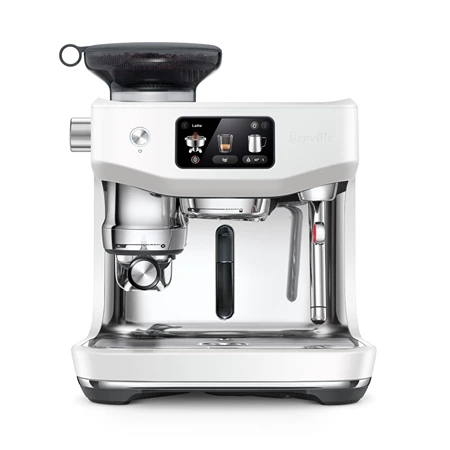
Breville Oracle Jet
Best High-End Option
Premium assisted espresso machine with a built-in grinder, rapid ThermoJet heating, and hands-free milk frothing.
Automation usually removes the portafilter from espresso; the Breville Oracle Jet instead automates everything around it. Select a drink on the large touchscreen and the machine recommends a grind adjustment, doses into a full-size 58mm portafilter, and tamps with a level finish. You still move the handle from grinder to group head, preserving enough of the café workflow to keep the process tactile.
The integrated grinder uses Baratza-designed 40mm conical burrs and 45 settings. It is a meaningful step above many built-in grinders, while the assisted-dialing screen interprets extraction time in plain language and tells a novice which direction to move. Automatic dosing and tamping also keep stray grounds off the counter, though changing beans frequently leaves some retention and makes a separate single-dose grinder more flexible.
The Oracle Jet uses a fast ThermoJet heating system rather than a dual-boiler setup. It starts quickly but brews and steams sequentially instead of simultaneously. That distinction matters for entertaining: one or two drinks arrive rapidly, while a long queue will move more slowly than it would on Breville’s dual-boiler Oracle models.
Auto MilQ measures temperature at the wand and offers different behavior for dairy, oat, almond, and soy milk, with adjustable heat and foam. The resulting texture is impressively repeatable, the wand purges itself, and manual control remains possible. Cold espresso and cold-brew-style programs broaden the menu, although neither should be mistaken for traditionally steeped cold brew.
The Jet is large, expensive, and dependent on electronics that make it less mechanically simple than a conventional prosumer machine. Its front water access, rolling lever, included knock box, guided cleaning, and polished interface nevertheless make daily use unusually pleasant. It is best for someone willing to pay heavily to remove dosing, tamping, and milk guesswork without surrendering the richer texture and control of a real portafilter.
Before buying, price the whole routine rather than the machine alone. A traditional setup needs an espresso-capable grinder and accessories; an integrated machine trades that flexibility for a cleaner counter; every option needs good water, fresh beans, and regular cleaning to remain consistent.
The most satisfying choice is the one whose daily friction matches your patience. Be realistic about how many milk drinks you make in a row, whether you enjoy dialing in coffee, and how much maintenance you will actually perform. Those answers matter more than an impressive feature list once the machine becomes part of an ordinary morning. If you enjoy dialing in, our coffee ratio calculator gives the espresso yield for any dose at the National Coffee Association’s 1:2 starting ratio.