An effective air purifier is a fan moving room air through a particle filter, and its value depends on how much clean air it can deliver at a noise level you will tolerate. A technically powerful machine accomplishes little if it is so loud that you turn it down or off. Clean Air Delivery Rate, room volume, placement, replacement-filter cost, and low-speed performance therefore matter more than a long list of modes.
These machines are best at airborne particles such as smoke, pollen, dust, and some aerosols. Thin carbon sheets may reduce light household odors, but they do not contain enough sorbent for sustained removal of gases or strong VOC sources, and no particle purifier removes carbon dioxide. For useful control during smoke or allergy events, size the unit for roughly four to five air changes per hour, keep doors and windows closed when outdoor air is poor, and run it continuously at the highest comfortable speed.
Best overall
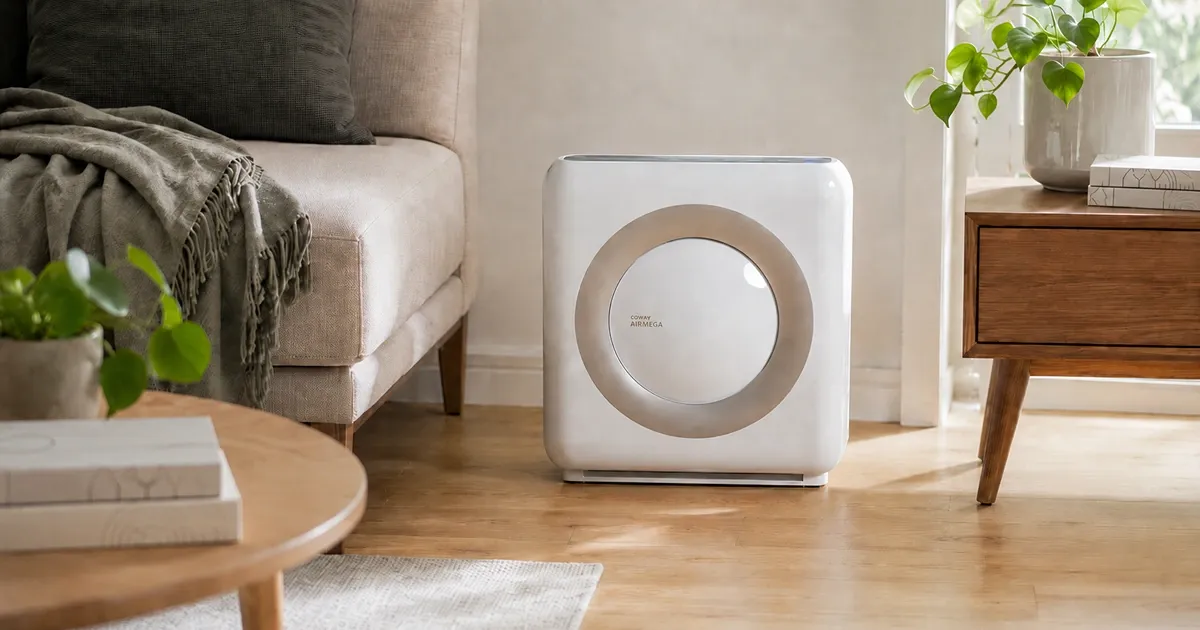
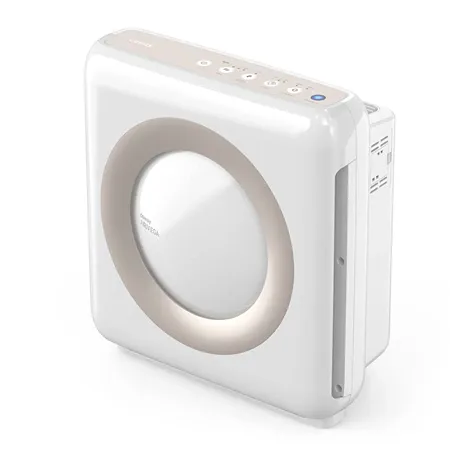
Coway Airmega AP-1512HH
Compact and efficient with four-stage filtration, real-time air quality monitoring, and auto mode.
Longevity is a large part of the Coway Airmega AP-1512HH’s appeal. The compact purifier has remained competitive through years of independent testing because it moves a useful volume of air through a True HEPA filter without requiring an oversized housing or unusually expensive replacements. Its proven record makes it easier to recommend than a newer model built around unverified coverage claims.
Air enters through the front and passes a washable prefilter, a thin deodorization sheet, and the main particle filter before exiting at the top. That sequence catches hair and coarse dust before they load the more expensive media. The carbon layer can soften mild cooking or pet odors, but its small amount of material is not designed for heavy smoke gases or persistent chemical fumes.
With smoke, dust, and pollen CADR figures in the low-to-mid 200 CFM range, the Coway is appropriately sized for a typical bedroom or medium living space at frequent air changes. High speed clears a sudden particle spike quickly, while medium provides a strong compromise between sound and airflow. Turbo is plainly audible, so bedroom users will probably reserve it for daytime or short cleanup periods.
Auto mode uses a built-in particle sensor to change fan speed, and Eco mode can stop the fan after the sensor reports clean air for a sustained period. The colored air-quality light responds quickly to cooking aerosols and smoke, although it is not a laboratory monitor and cannot identify a pollutant. The display can be darkened for sleep, and manual operation remains simple even without an app.
Coway describes the system as four-stage because it includes a Vital Ion function. That ionizer is optional and the purifier performs very well with it switched off, which is how several independent tests have evaluated the machine. Anyone who prefers strictly mechanical operation can leave the button disabled without giving up the HEPA, prefilter, carbon layer, or automatic fan controls.
Maintenance is more nuanced than a single annual change: the washable screen should be cleaned regularly, the deodorization filter typically needs attention sooner, and the HEPA element lasts around a year under ordinary use. Actual life depends heavily on smoke, pets, and fan hours. The AP-1512HH can consume more power and sound rougher on maximum than newer low-wattage competitors, but its strong particle removal, compact footprint, inexpensive ownership, and long reliability history remain an unusually balanced package.
Best for large rooms
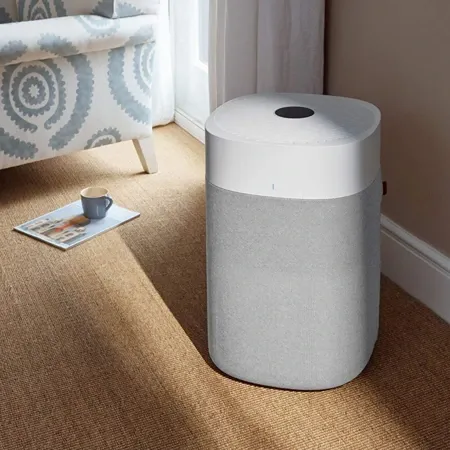
Blueair Blue Pure 211i Max
A powerful and quiet purifier built for large spaces, with smart features, real-time air quality monitoring, and a stylish, washable fabric cover.
Large open rooms need clean-air volume, not just a manufacturer’s enormous one-air-change coverage number. The Blueair Blue Pure 211i Max has the airflow to serve roughly 674 square feet at the far more useful AHAM rate of about 4.8 changes per hour. That makes it a credible choice for a spacious living room, large bedroom, or connected main floor where a small purifier would spend all day at its loudest setting.
Blueair’s HEPASilent design combines porous filter media with electrostatic particle charging, allowing the fan to push air through with less resistance than a dense mechanical-only filter. The high CADR bears that out: it removes particles quickly while using modest power for its capacity. The charging stage is integral rather than a user-selectable mode, a detail worth knowing if you specifically want filtration with no electrostatic assistance.
The cylindrical intake pulls from every side, so the purifier does not need to be aimed toward a pollution source, but it does need open space around its fabric-covered base. That washable outer sleeve captures hair and visible dust before the combination filter. Inside, activated carbon helps with ordinary household smells, though testing consistently shows limited capability against sustained cooking smoke, solvents, or other gaseous pollution.
Four fan levels include a quiet night setting and a high mode that is audible but smooth. At the lower speeds normally used for maintenance, the 211i Max delivers more clean air than many smaller machines can manage without becoming distracting. The control lights can be dimmed or shut off, and a child lock prevents curious hands from changing the settings.
Wi-Fi and the Blueair app add schedules, remote control, historical air-quality information, and access to the onboard PM sensor. Auto mode can raise the fan when particles increase, while RealTrack estimates remaining filter life from fan speed, usage, and pollution rather than a simple calendar. Those features are convenient, but the sensor reports local conditions at the machine and should not be mistaken for a whole-room reference monitor.
The large filter generally lasts six to nine months and costs considerably more than a small purifier’s media, so ongoing expense should be part of the purchase decision. The unit also occupies meaningful floor space and is excessive for a closed small bedroom. When its capacity matches the room, however, the 211i Max’s combination of high airflow, reasonable sound, efficient operation, and genuinely useful automation is difficult to beat.
Best budget
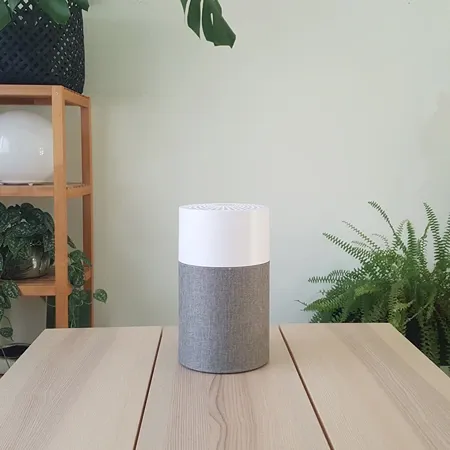
Blueair Blue Pure 511
A compact, ultra-quiet purifier ideal for bedrooms and offices. Offers strong performance, low energy use, and a sleek design that fits anywhere.
Small rooms do not require a costly smart appliance to keep particles under control. The Blueair Blue Pure 511 concentrates on three fan speeds, a compact cylindrical filter, and one top-mounted button. It is light enough to move between a bedroom and office, yet simple enough that there is little setup beyond removing the filter’s protective plastic.
Its practical coverage is around 180 square feet at roughly five air changes per hour. Claims for much larger spaces are based on slower turnover, which may be adequate for background dust but is less reassuring during wildfire smoke or a pollen surge. Used in the intended small room with the door closed, the 511 has repeatedly shown fast particle reduction for its size.
HEPASilent filtration again pairs filter media with built-in electrostatic charging. This reduces airflow resistance and helps the little motor achieve a respectable CADR without high energy use. It also means the 511 is not a purely mechanical purifier, and the charging function cannot be disabled independently of filtration.
The lowest setting produces a faint fan sound suitable for many sleepers, while boost remains quieter than a normal conversation in a calm room. Power consumption is similarly modest, ranging from only a few watts on low to roughly the mid-teens at full speed. With no sensor hunting between fan levels, the sound remains predictable throughout the night.
A washable fabric sleeve serves as the prefilter and can be cleaned when dust becomes visible. The main combination filter is generally replaced around every six months, depending on use and pollution, so the low purchase price should not obscure recurring costs. Placing the unit where its 360-degree intake has clearance will also matter more than trying to hide it tightly against furniture.
There is no app, air-quality display, automatic mode, or separate light control beyond the minimalist interface. That restraint is the point rather than an oversight for many buyers: fewer electronics, low power draw, and enough airflow for one small room. Anyone trying to clean an open living area should buy more capacity, but the 511 is an efficient, unobtrusive way to add dedicated filtration where someone sleeps or works.
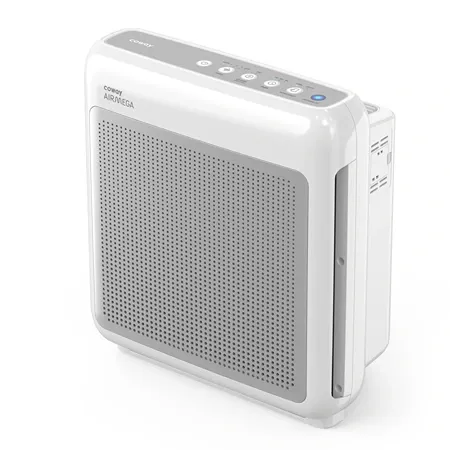
Great alternate
Coway Airmega 200M
Nearly identical to the AP-1512HH with a square design. A great pick if you prefer the style or find it on sale.
Sometimes an alternate model really is the same machine in different clothing. Beneath its square front grille, the Coway Airmega 200M is functionally almost identical to the AP-1512HH. It uses the same replacement-filter set, follows the same front-intake and top-exhaust path, and delivers effectively the same clean-air output, so price and appearance can make the decision.
The reusable prefilter catches hair and lint, followed by a deodorization sheet and True HEPA media for fine particles. That arrangement is excellent for pollen, dust, and smoke particles in a medium room. As with its sibling, the lightweight carbon sheet should be viewed as modest odor assistance rather than serious gas filtration.
Controls include three speeds, automatic response to the particle sensor, a timer, filter indicators, and an Eco behavior that reduces needless fan operation after the air remains clean. The air-quality lamp can be turned off in a bedroom. High speed is noticeable, but the first two levels produce a steadier and more livable sound for continuous use.
The 200M also includes a switchable ionizer, and it does not need to be enabled for strong filtration. Leaving it off retains the complete physical filter path and avoids electrostatic operation for users who do not want it. The sensor and automatic mode continue to function normally either way.
Because the mechanical platform is shared, the same maintenance schedule and limitations apply. Vacuum or rinse the prefilter as instructed, monitor the carbon layer, and expect roughly annual HEPA replacement under ordinary conditions, sooner during heavy smoke. Filter availability is a practical advantage because both Coway models use the same widely sold set.
There is little reason to pay a premium for the 200M over the AP-1512HH, nor is there a meaningful performance penalty for choosing it. Buy whichever genuine unit is less expensive, better matches the room, or is easier to source with authorized warranty coverage. Its square grille simply offers another exterior for one of the category’s most established purifier designs.
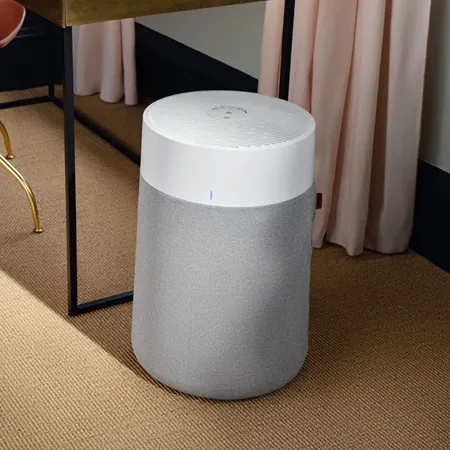
Best balance of power and quiet
Blueair Blue Pure 311i Max
A quiet, energy-efficient purifier with strong performance, smart features, and a sleek design, perfect for medium-sized rooms and everyday use.
Between a tiny bedroom cylinder and a living-room powerhouse sits the Blueair Blue Pure 311i Max. Its useful high-air-change coverage is around 439 square feet, enough for a medium bedroom, office, or den without forcing the fan to its noisiest setting all day. The narrow round footprint also makes placement easier than with a broad rectangular purifier.
Air enters around the washable textile prefilter and passes through Blueair’s combination particle-and-carbon element. HEPASilent technology adds an integrated electrostatic charge to improve capture with less airflow resistance. This contributes to the purifier’s strong CADR-to-watt performance, but the charging stage is inherent to operation and cannot be switched off separately.
Four speeds give the 311i Max a broad usable range. Night mode is quiet enough to fade into many bedrooms, medium settings deliver substantial circulation without dominating conversation, and maximum speed remains below the harsher sound of many similarly capable machines. The open top grille disperses filtered air widely instead of producing a narrow draft.
An onboard particle sensor powers Auto mode and the color air-quality indicator. The Blueair app adds remote fan control, schedules, a child lock, display dimming, and pollution history. Automatic response is useful for cooking or an open door, though consumer-grade sensors can be influenced by placement and should be treated as a fan-control input rather than a precise diagnostic instrument.
RealTrack estimates filter life from actual operation and measured pollution, usually producing a six-to-nine-month replacement interval. That is more informative than a fixed timer, but genuine filters are not cheap and the exterior fabric needs routine vacuuming or washing to protect airflow. The carbon content also remains too limited for a room with a persistent gaseous source.
The 311i Max costs more to maintain than the simplest mechanical purifiers and offers app features some people will never use. It earns its place by pairing strong medium-room airflow with low power consumption, smooth acoustics, and a design that is easy to live beside. For continuous everyday particle removal, that balance can matter more than maximum-speed results alone.
Start with room volume and smoke CADR, then choose a purifier powerful enough to meet the target while running at a tolerable speed. Leave clearance around the intake and outlet, keep the room reasonably closed during outdoor smoke events, and avoid placing the sensor directly beside a vent or cooking source. Two modest purifiers can sometimes distribute clean air through an awkward open plan better than one enormous machine in a corner.
Filters are consumables, so availability and annual cost belong in the buying decision. Clean only the washable prefilter, never wash a HEPA-style main filter unless its manufacturer explicitly instructs you to, and replace loaded media when airflow drops or the indicator calls for it. For combustion gases, carbon monoxide, excessive humidity, or indoor chemical sources, address ventilation and the source itself; a particle purifier is one part of healthy indoor air, not a substitute for either.