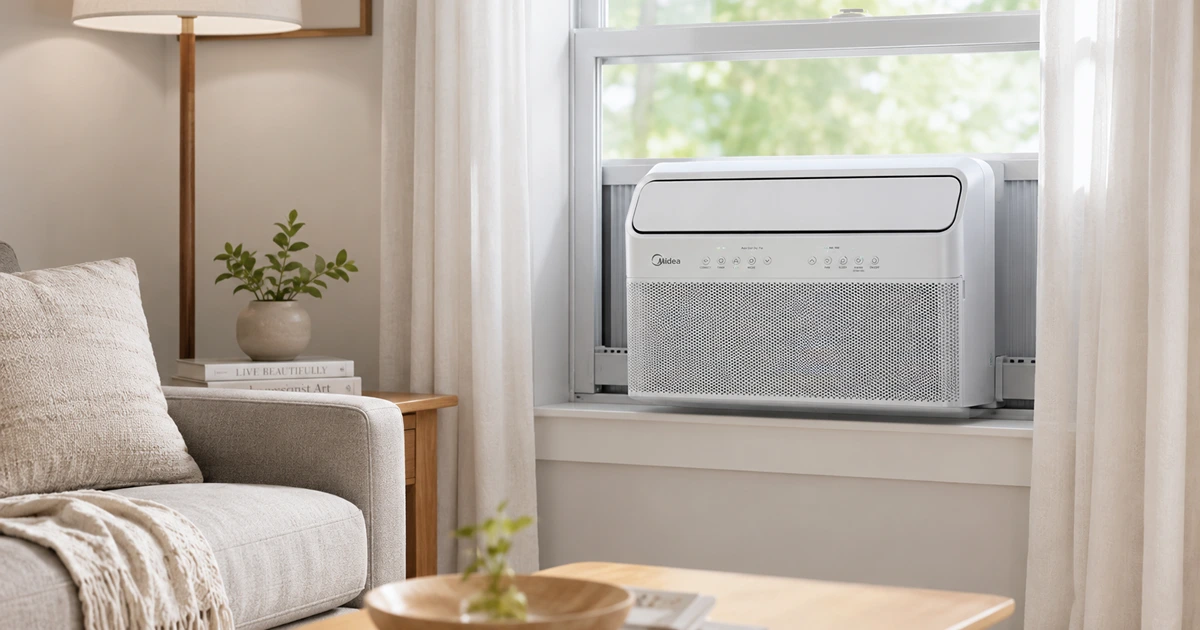

A window air conditioner has to do more than produce cold air. It needs to remove heat and humidity at a useful rate, hold the room near the selected temperature, and do so without turning sleep, conversation, or an electricity bill into a new problem. Inverter compressors have improved that experience considerably because they can slow down once a room is comfortable instead of cycling between silence and a full-power jolt.
Correct sizing matters as much as the machine. Too little capacity leaves the unit running constantly, while an oversized model may cool the air before removing enough moisture, producing a chilly but clammy room. The square-foot recommendations below assume a fairly ordinary ceiling and exposure; strong afternoon sun, high ceilings, open doorways, and heat-producing appliances may justify more capacity. Our BTU calculator works out the size for your room from ENERGY STAR’s chart.
Installation deserves equal attention. Every window and sill has different dimensions, and alternative U-shaped or saddle designs impose stricter depth and clearance requirements than a conventional box. Measure first, confirm that the window is structurally sound, follow the included support instructions, and recruit another person whenever the weight or exterior reach makes a solo lift unsafe.
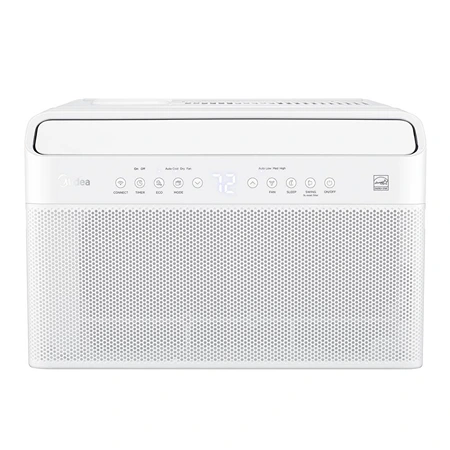
Midea U MAW08V1QWT
Best Overall Air Conditioner
Innovative U-shaped design with 8,000 Btu cooling, smart controls, and quiet inverter tech for rooms up to 350 sq ft.
The Midea U MAW08V1QWT changed what a bedroom window unit could feel like. Its deep center channel lets the sash close between the indoor fan and outdoor compressor, using the window itself as a substantial sound barrier. The result is less mechanical intrusion inside the room and a far better seal than the thin accordion panels supplied with many conventional units.
An 8,000 Btu variable-speed compressor is sized for rooms around 350 square feet under typical conditions. Instead of repeatedly switching fully on and off, the inverter modulates its output to approach and maintain the set temperature. That behavior keeps temperature swings small, reduces disruptive compressor starts, and contributes to the model’s unusually strong efficiency for a room air conditioner.
Noise is where the design pays its clearest daily dividend. At low output, the indoor sound is closer to a smooth fan than the growl of an old window box, making calls and sleep easier. High cooling still produces audible airflow, and a poor installation can transmit vibration into the sash, but repeated testing consistently places the Midea among the quietest high-performing window units.
The included bracket supports the outdoor weight, while the closed sash improves security and allows the window to open when the unit is not running. Wi-Fi, scheduling, voice-assistant support, a remote, and controls for disabling display lights and beeps make it easy to live with in a bedroom. Installation is more involved than dropping a compact chassis on the sill, though, and the bracket’s window-depth requirements should be checked carefully before purchase.
There is an important recall history. In June 2025, the U.S. Consumer Product Safety Commission announced a recall covering roughly 1.7 million Midea U and U+ units sold from March 2020 through May 2025 because pooled water might not drain quickly enough, creating a mold-exposure risk. The affected list includes MAW08V1QWT variants, and the remedy may involve updated drain plugs, a repair kit or technician service, or a prorated refund.
Current post-recall inventory may include revised drainage parts, but buyers should not rely on packaging language alone. Check the complete model and serial number through Midea’s recall lookup, install any required remedy, maintain the specified exterior slope, clean the filter, and inspect the interior if a musty odor develops. With those safeguards addressed, the U shape, quiet inverter operation, and high efficiency remain an excellent combination; without them, its cooling performance does not outweigh the moisture concern.
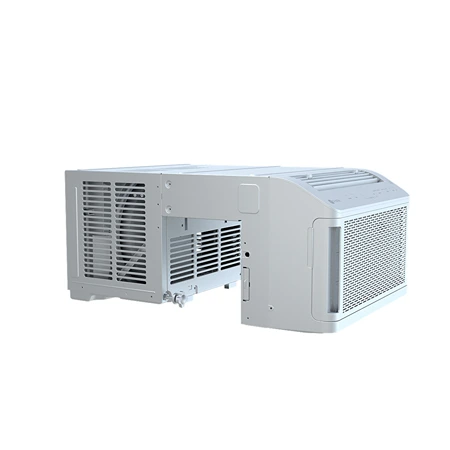
GE Profile ClearView PHNT10CC
Best for Large Rooms
10,000 Btu inverter AC with arch-shaped design that preserves window access while cooling rooms up to 450 sq ft.
Rather than cutting a channel through the middle, the GE Profile ClearView PHNT10CC drops most of its body below the sill. Its inverted-U or saddle profile preserves the view through the glass and leaves the sash nearly closed, a thoughtful solution for a room where the only good cooling window is also an important source of daylight.
Cooling capacity is officially 10,300 Btu for spaces up to about 450 square feet. GE’s adaptive inverter varies compressor speed to maintain temperature more steadily than a fixed-speed unit, and its 14.6 CEER is excellent for this amount of output. It is a good match for larger bedrooms, living rooms, and offices where an 8,000 Btu model would spend too much time at maximum power.
Moving the compressor to the exterior half also helps with sound. Low and Eco operation can settle into unobtrusive fan noise, while the absence of repeated hard starts makes the sound profile less distracting. Some installations develop a low rumble or vibration as the compressor changes speed, so careful leveling, sealing, and preventing contact with loose trim are important to getting the quiet performance the design can provide.
The adjustable bridge accommodates a range of wall and sill depths, and the included kit seals the window more convincingly than flimsy side curtains. Even so, this is not an effortless solo installation. The long chassis has awkward barbell-like weight distribution, much of it must be controlled outside the window, and the area below the sill must remain clear on both sides.
Once installed, the ClearView hangs down outside and projects noticeably into the room. That can conflict with a radiator, deep trim, furniture, or a narrow walkway, and the window must meet GE’s dimensional requirements. The capacitive controls also provide little tactile confirmation, although the remote and SmartHQ app make schedules and temperature changes easier from across the room.
The PHNT10CC costs more and occupies more interior depth than a traditional unit, but its combination of large-room capacity, inverter efficiency, low window obstruction, and restrained noise is hard to reproduce. Measure every relevant clearance and arrange a two-person lift before ordering; in a compatible window, the design gives up far less light and view than most air conditioners with comparable power.
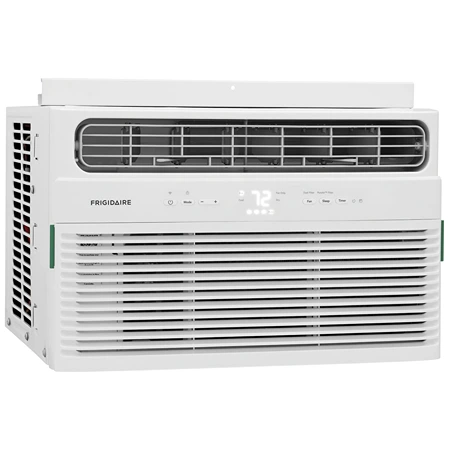
Frigidaire FHWW084TE1
Best Budget Air Conditioner
8,000 BTU Wi-Fi window AC that cools rooms up to 350 sq ft with smart-app controls at a budget-friendly price.
Conventional design is part of the Frigidaire FHWW084TE1’s appeal. It fits into a standard double-hung window without the deep bridge or elaborate exterior bracket required by alternative shapes, and its compact chassis is easier to lift than the premium picks. Renters who remove an air conditioner every fall may value that simplicity as much as the lower purchase price.
Its 8,000 Btu output is intended for a room of roughly 350 square feet. This version uses a fixed-speed compressor, so it cools in more noticeable cycles than an inverter model and cannot trim its power as precisely once the target temperature is near. Within a correctly sized bedroom or office, however, it lowers temperature reliably and offers a respectable efficiency rating for a standard window unit.
Setup is unusually approachable. The side curtains slide into place, the controls are easy to understand, and the manageable weight reduces the need for a second set of hands, though it does not eliminate it. The washable dust filter is accessible from the front, while a clean-filter reminder helps prevent restricted airflow from undermining performance.
Built-in Wi-Fi adds remote temperature control and scheduling through Frigidaire’s app, and the unit can work with common voice assistants. A less expensive non-Wi-Fi sibling may be a better value for anyone who will only use the front panel and remote. Connectivity does not improve cooling, but being able to start the unit before entering a hot room can be genuinely useful.
Frigidaire also supports an optional PureAir RAC-10 filter with higher-grade particle filtration. It can reduce some airborne dust and allergens passing through the unit, but the extra filter costs money, adds airflow resistance as it loads, and does not turn a cycling air conditioner into a full-time room purifier. A dedicated purifier with a published smoke CADR remains the more predictable choice for continuous particle removal.
The compressor start and mechanical airflow are clearly louder than the smooth background sound of the inverter picks, especially at maximum cooling. Temperature also varies more between cycles, and the side curtains block more of the window. Those are fair compromises at this price: the FHWW084TE1 delivers straightforward cooling, easy maintenance, smart scheduling, and a less intimidating installation without pretending to be a premium quiet appliance.
Before choosing capacity, calculate the room rather than estimating by memory, then adjust for sun, ceiling height, occupancy, and connections to adjacent spaces. More Btu is not always better. A properly sized inverter model often feels more comfortable than an oversized machine because it can run gently for longer, removing moisture while holding a steadier temperature.
Whatever design you buy, a careful installation determines noise, drainage, efficiency, and safety. Seal air gaps, maintain the manufacturer’s required slope, clean the filter regularly, inspect drainage paths, and remove or winterize the unit as directed. Smart controls are convenient, but correct sizing and moisture management are what keep a room comfortably cool season after season.