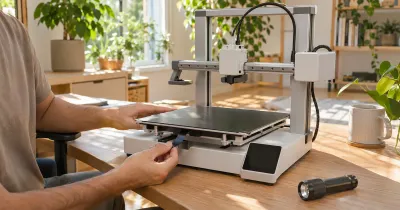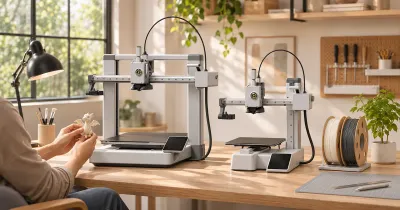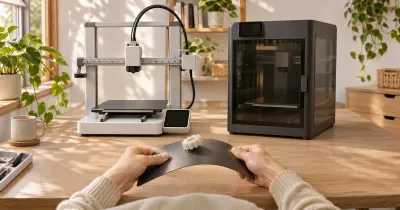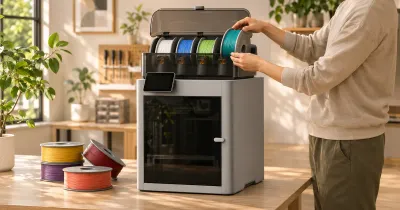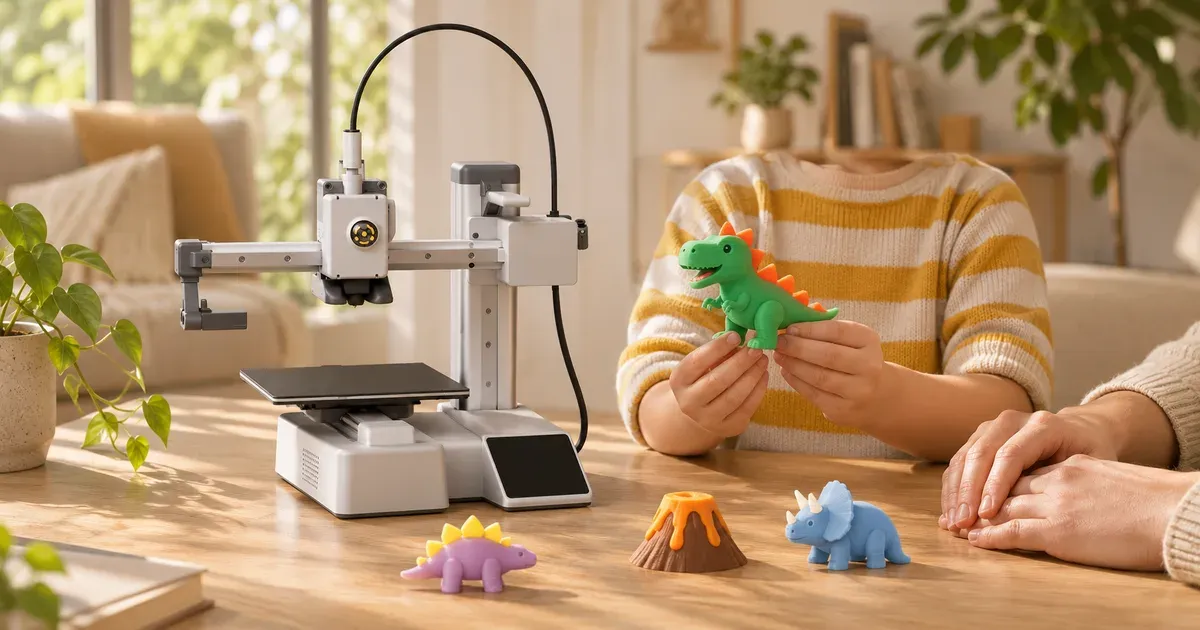
The best 3D printer for most kids is the Bambu Lab A1 mini. It calibrates itself, prints PLA reliably from a phone app, runs at under 48 dB in Silent Mode, and costs $199 in Bambu’s Black Friday sale ($299 with four-color printing). For teenagers, the full-size Bambu Lab A1 ($259) prints bigger projects, like cosplay pieces and organizers. For young children or a house with pets, an enclosed printer such as the Elegoo Centauri Carbon 2 ($319) keeps the hot nozzle and moving parts behind a door.
Our Picks at a Glance
| Printer | Best for | Build volume | Enclosed | Published noise | Price (Black Friday) |
|---|---|---|---|---|---|
| Bambu Lab A1 mini | Kids 8 to 12, small desks | 180 × 180 × 180 mm | No | Under 48 dB (Silent Mode) | $199 ($299 with AMS lite) |
| Bambu Lab A1 | Teens, bigger projects | 256 × 256 × 256 mm | No | Under 48 dB (Silent Mode) | $259 ($359 with AMS lite) |
| Elegoo Centauri Carbon 2 | Younger kids, homes with pets | 256 × 256 × 256 mm | Yes | 45 dB or less (Silent Mode) | $319 ($369 with four colors) |
| Flashforge Adventurer 5M Pro | Classrooms, filtered air | 220 × 220 × 220 mm | Yes, with HEPA and carbon filter | 50 dB (low-noise mode) | About $359 |
What Makes a Good Printer for Kids
- It works the first time. Automatic bed leveling and calibration matter more than anything else. A child who spends the first weekend leveling a bed by hand usually gives up.
- It’s easy to start a print. Printers that take models straight from a phone app and an online library let kids pick something and print it without a computer.
- It prints PLA well. PLA is the easiest filament and gives off the fewest particles. Every printer here handles it.
- It’s quiet enough to run in a shared room during the day.
- The hot parts are guarded, or the child is old enough to keep fingers away. A nozzle runs at about 200 to 220°C for PLA.
Best for Kids: Bambu Lab A1 mini
The A1 mini is the printer most families should start with. It calibrates itself before every print, takes models from the Bambu Handy app and the MakerWorld library, and its 180 mm cube plate is big enough for toys, figures, keychains and fidget prints. Bambu rates it at under 48 dB in Silent Mode. The open frame means an adult should be nearby while it prints, and it’s meant for PLA, PETG and TPU only. The A1 mini Combo adds the AMS lite for automatic four-color prints, which kids love.
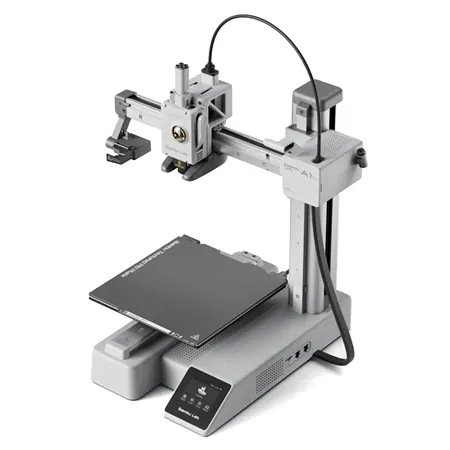
Best for kids
Bambu Lab A1 mini
A small, quiet, self-calibrating printer that prints from a phone app. Amazon's listing adds an LED lamp kit.
Best for Teens: Bambu Lab A1
The A1 is the same printer with a 256 mm plate, about 2.9 times the print volume. That’s the size teenagers grow into: cosplay props, desk organizers, replacement parts and school projects that don’t fit a 180 mm cube. It’s $60 more than the A1 mini in the sale. Our A1 vs. A1 mini comparison covers the trade-offs.
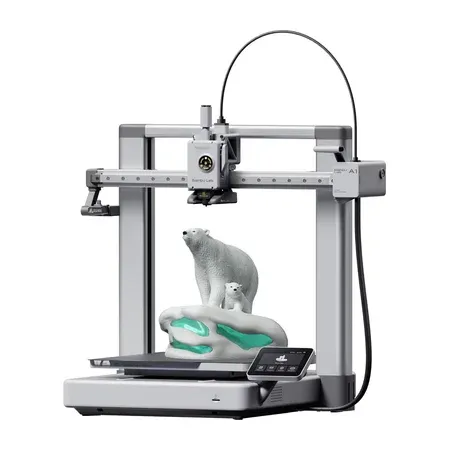
Best for teens
Bambu Lab A1
The same easy printer with a 256 mm plate for bigger projects. Add the AMS lite for four colors.
Best Enclosed: Elegoo Centauri Carbon 2
For younger children, or a printer in a family room with pets, an enclosure keeps curious fingers and paws away from the hot nozzle and moving parts. The Centauri Carbon 2 is the best value enclosed printer: it calibrates itself, Elegoo rates it at 45 dB or less in Silent Mode, and the Combo adds a four-color feeder for $369. The trade-off against the A1 mini is a bigger, heavier machine and a 12-month warranty instead of Bambu’s two years. The Bambu Lab P1S ($349) is the enclosed alternative with Bambu’s app and warranty.
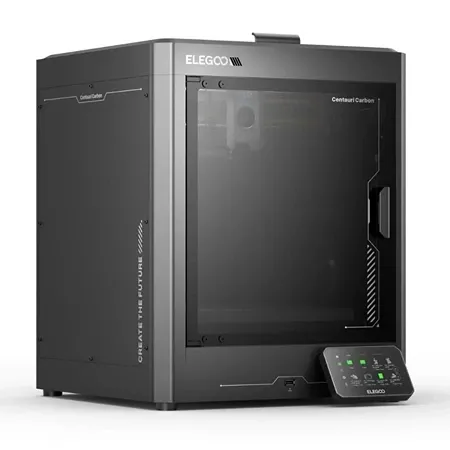
Best enclosed printer for families
Elegoo Centauri Carbon 2 Combo
The hot nozzle stays behind a door. Self-calibrating, rated at 45 dB, with four-color printing.
Best for Classrooms: Flashforge Adventurer 5M Pro
The Adventurer 5M Pro is an enclosed printer with a built-in HEPA and activated carbon filter, the setup NIOSH prefers for schools and makerspaces, and a published noise rating of 50 dB in its low-noise mode. It’s about $359 on Flashforge’s site in its Black Friday sale. The MakerBot Sketch Sprint ($2,399), sold mainly to schools, is also enclosed and filtered, but MakerBot supports only its own PLA and Tough PLA on it.
What Age Can Kids Use a 3D Printer?
There’s no official minimum age. In practice:
- Under 8: a 3D pen or printing together with an adult, choosing models on a tablet.
- 8 to 12: a self-calibrating printer like the A1 mini, with an adult nearby and the printer out of reach of younger siblings.
- 13 and up: independent use, designing their own models and handling maintenance like nozzle changes, with an adult checking on long prints.
Safety and Ventilation
- Print PLA. NIOSH’s guide to safe 3D printing recommends PLA where it does the job, because it gives off fewer particles than ABS. Skip ABS and resin printers for kids.
- Ventilate the room and keep the printer out of the child’s bedroom. NIOSH recommends keeping some distance from running printers and wet-wiping surfaces rather than dry dusting.
- No food or drinks next to the printer.
- Teach the hot spots: the nozzle and the bed. Keep hands out while it runs.
- Use a smoke detector in the room and watch long prints on the camera. See our 3D printer recalls and fire safety page.
What Kids Can Print and Design
Ready-made models. MakerWorld, Printables and Thingiverse have thousands of free toys, puzzles, articulated animals, fidget toys and desk accessories. Starting with print-in-place models (which come off the plate already working) gives quick wins.
Their own designs. Tinkercad, Autodesk’s free browser-based tool, lets kids build models from simple shapes and export them for printing. It’s the usual starting point in schools.
What Else to Buy
- PLA filament: a few 1 kg spools in bright colors. Expect $14 to $30 each.
- Spare build plate (optional): a textured plate makes removing prints easier for small hands.
- A small scraper and flush cutters for removing supports, used by an adult with younger kids.
For more printer options at every budget, see our best 3D printers for beginners and how much a 3D printer costs.
3D Printers for Kids FAQ
What is the best 3D printer for a kid?
The Bambu Lab A1 mini. It calibrates itself, prints from a phone app, runs quietly and costs $199 in Bambu’s Black Friday sale.
What is the best 3D printer for a teenager?
The Bambu Lab A1. It’s as easy as the A1 mini with a 256 mm plate for bigger projects, for $259 on sale.
Are 3D printers safe for kids?
With PLA filament, supervision and a ventilated room, yes. The main risks are burns from the nozzle and bed, and particles from printing, which PLA keeps lowest. An enclosed printer adds a barrier between hands and hot parts.
What age is appropriate for a 3D printer?
Most kids can use a self-calibrating printer from about 8 with an adult nearby, and independently from their early teens. Younger children can choose models and watch with an adult.
Is a resin 3D printer OK for kids?
No. Resin printers use liquid resins that irritate skin and give off vapors, and they need gloves, solvents and good ventilation. Stick with a filament printer and PLA.
Is a 3D printer a good gift for a kid?
Yes, for a child interested in making things, especially paired with a few spools of PLA. Bambu’s A1 mini Combo, with four-color printing for $299, is an easy gift to get right.