The short answer: your fans are loud because the CPU and GPU are pulling a lot of power in a small case, and the laptop’s power mode tells the fans how hard to work. Most of the noise comes from three things you can change: the performance mode (Turbo is loudest), an uncapped frame rate (the GPU runs flat out even in menus), and dust or blocked vents. Loud fans while gaming are normal. Loud fans at idle, or noise that got worse over months, point to a problem.
What’s Normal and What Isn’t
| Situation | Normal? | Likely cause |
|---|---|---|
| Loud during demanding games | Yes | CPU + GPU at high power; Turbo/Performance mode |
| Loud in game menus or older games | Fixable | Uncapped frame rate (hundreds of fps) |
| Loud at the desktop doing nothing | No | Background task, Turbo left on, or dust |
| Louder than it used to be | No | Dust in the heatsink, dried thermal paste |
| Grinding, clicking or rattling | No | Failing fan bearing or debris: get it serviced |
| High-pitched whine that changes with frame rate | Common | Coil whine from power components, not the fans |
8 Fixes, Easiest First
1. Change the power mode
Every gaming laptop has a mode switch in the maker’s app, and it’s the biggest lever on noise:
- ASUS Armoury Crate: Silent, Performance, Turbo, Manual. ASUS says Silent keeps fan noise under a threshold, usually about 35 dBA depending on the model, by limiting CPU and GPU power, and lets the fans stop entirely at low temperatures. Performance is ASUS’s default and recommended mode; Turbo raises power and runs hotter and louder.
- Lenovo Legion Space / Vantage: Quiet, Balanced, Performance (Fn+Q cycles through them on Legion and LOQ models).
- Alienware Command Center: Quiet, Balanced, Performance and custom profiles.
- HP OMEN Gaming Hub, MSI Center, Acer NitroSense / PredatorSense: similar quiet-to-performance presets.
The step from Turbo to Performance costs a few frames per second and is usually much quieter.
2. Cap the frame rate
A GPU rendering 300 fps in an older game or a menu works as hard as one rendering a new game. Set a cap a little under your screen’s refresh rate (for example 141 fps on a 144 Hz panel), in the game or the Nvidia app. Nvidia’s WhisperMode does this automatically for quieter play; at launch Nvidia described caps of 60 fps for competitive games and 40 fps for demanding single-player games.
3. Turn on V-Sync or G-Sync with a cap
Keeping the frame rate at or under refresh stops the GPU from rendering frames you can’t see.
4. Use DLSS or FSR
Upscaling from a lower resolution cuts GPU load, and with it fan speed, at the same frame rate.
5. Give it air
Gaming on a bed, couch or carpet blocks the bottom intakes, so the fans spin faster to move the same air. Use a hard desk; raising the back with a stand or cooling pad can let fans run a bit slower.
6. Clean out the dust
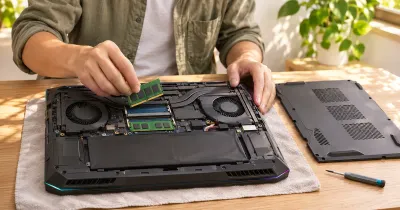
With the laptop off, blow short bursts of compressed air into the intake and exhaust vents. If noise and temperatures have crept up over a year or two, the heatsink fins are likely clogged; a shop (or you, after the warranty) can open the bottom panel and clean them.
7. Check what’s running
Open Task Manager. Game launchers updating in the background, Windows Update, antivirus scans and browser tabs can keep the CPU busy and the fans on at the desktop.
8. Update the BIOS and the maker’s app
Fan curves live in the firmware and the control app. Makers adjust them in updates; Dell, for example, has published support notes about fan behavior in Alienware Command Center quiet mode.
Coil Whine Is a Different Noise
A high, electrical buzz or whine that rises and falls with frame rate comes from inductors on the motherboard or GPU, not the fans. It’s common, isn’t a sign of failure, and usually gets quieter with a frame-rate cap. If it’s very loud on a new laptop, it’s worth a warranty exchange.
The Quietest Laptops Are the Biggest
Thick 16- and 18-inch laptops with large heatsinks move the same heat with slower fans than thin 14-inch models. If noise matters most, see our picks for the quietest gaming laptops.
Loud Gaming Laptop FAQ
Is it bad if my gaming laptop is loud?
No. Loud fans mean the cooling is doing its job. Worry about grinding or rattling noises, or fans that are loud at idle and stay that way.
Why are my laptop fans loud when I’m not gaming?
Usually a background task, a performance mode left on Turbo, or dust. Check Task Manager first, then the power mode.
Does Silent mode hurt gaming performance?
Yes, because it limits CPU and GPU power. Many games stay playable, especially older and esports titles with a frame cap.
Can I turn off the fans on my gaming laptop?
Not safely. Silent modes let fans stop at low temperatures, but the laptop controls that. Forcing fans off risks overheating.
How do I know if my laptop fan is broken?
Grinding, clicking, rattling, or a fan that never spins while the laptop gets hot. Most makers’ apps show fan speed in RPM; a fan stuck at 0 under load needs service.