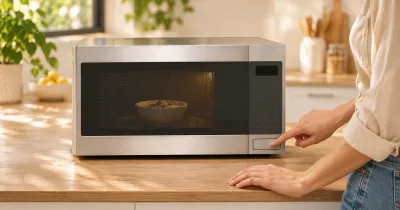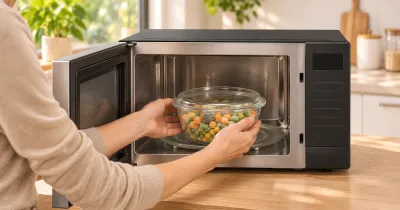
The short answer: choose a countertop microwave unless you need the counter space or already have an over-the-range (OTR) spot. Countertop models cost less, plug into any grounded outlet and sit at a comfortable height. An OTR frees the counter and doubles as the range vent, but it needs a 30-inch gap between upper cabinets, a dedicated outlet in the cabinet above, wall mounting, and a reach over hot burners. On November 19, 2026, GE’s basic 1.6 cu ft OTR (JVM3160RFSS) was $227 on Amazon; GE’s 1.6 cu ft countertop (GCST16S1WSS) was $179.
Prices checked November 19, 2026.
OTR vs. Countertop at a Glance
| Over-the-range microwave | Countertop microwave | |
|---|---|---|
| Where it goes | Under the upper cabinet, above a range up to 36 in wide | Any counter with clearance and an outlet |
| Counter space | None | 1.5–2 sq ft plus clearance |
| Venting | Built-in fan, 220–400 CFM on most models | None |
| Install | Wall bracket, top-cabinet bolts, dedicated outlet, optional ducting | Plug in |
| Electrical | 120 V, 15–20 A; most makers require a dedicated circuit | 120 V grounded outlet; 15–20 A circuit |
| Capacity | Mostly 1.6–2.1 cu ft | 0.7–2.2 cu ft |
| Height | Bottom typically 13–18 in above the cooktop | Counter height |
| Typical price | About $230–$700 (mainstream), plus install | About $90–$300 |
| Replace it | Must fit the same 30-in opening and bracket | Swap in any size that fits |
Price: Same Size, Both Types
| Model | Type | Capacity | Cooking power | Vent | Sensor | Price (Nov 19) |
|---|---|---|---|---|---|---|
| GE JVM3160RFSS | OTR | 1.6 cu ft | 1,000 W | 300 CFM, 2-speed | No | $227.00 on Amazon |
| GE GCST16S1WSS | Countertop | 1.6 cu ft | 1,150 W | — | Yes | $179.00 on Amazon |
| GE JVM6175SKSS | OTR | 1.7 cu ft | 1,000 W | 300 CFM | Yes | $269 at GE (was $499) |
| Toshiba ML-EM45PIT(BS) | Countertop | 1.6 cu ft | 1,250 W, inverter | — | Yes | $179.94 on Amazon |
| GE Profile PVM9005SJSS | OTR | 2.1 cu ft | 1,050 W | 400 CFM, 4-speed | Yes | $399 at GE (was $719) |
| Toshiba ML4-EM22PAIT(SS) | Countertop | 2.2 cu ft | 1,200 W, inverter | — | Yes | $234.34 on Amazon |
At the same capacity, countertop models are cheaper and often have more cooking watts. The OTR premium buys the vent fan and the counter space, and installation is extra unless you do it yourself (see OTR microwave installation).
Venting: The Real Difference
An OTR’s fan pulls cooking steam and smoke from the cooktop and either ducts it outside or filters it and blows it back into the room. Most mainstream OTRs move 300 to 400 CFM (cubic feet per minute); GE’s JVM3160 is 300 CFM, its Profile PVM9005 400 CFM, and Whirlpool’s newer WMH31017AS “Hidden Vent” only 220 CFM.
That’s useful, but an OTR is a compromise as a hood. It’s shallower than most range hoods, so it covers less of the front burners. Broan-NuTone, which makes range hoods, argues on its site that a dedicated hood ventilates better. If you cook a lot of high-heat, smoky food, a range hood plus a countertop or drawer microwave vents better. Ducting outside beats recirculating either way; see recirculating vs. ducted microwave venting.
GE also sets a gas limit: its JVM6175 install manual allows installation over gas or electric cooking “with a combined BTU of 63,000 BTU or less.” High-output pro-style gas ranges need a real hood.
Install Requirements for an OTR
From the makers’ installation instructions:
- Cabinet gap: 30 inches wide between upper cabinets (all makers).
- Height: GE and Frigidaire say 66 inches or more from the floor to the top of the microwave and at least 30 inches from the cooking surface to the bottom of the upper cabinet. Samsung’s minimum gap between range and microwave bottom is 13.5 inches; LG’s label says at least 13-3/4 inches above the cooktop.
- Upper cabinet depth: 12 to 13 inches maximum for standard mounting (GE 13 in, Samsung 12 in, LG 13 in, Whirlpool 12–14 in); deeper cabinets need a bump-out kit.
- Power: GE’s instructions call for a “separate 15- to 20-ampere branch circuit” with the grounded outlet in the cabinet above.
- Not over islands or peninsulas: GE, Samsung and LG all prohibit island or peninsula mounting.
A countertop microwave needs only counter space with its manual’s clearances (Panasonic asks for 3 inches on both sides and 1 inch on top) and a grounded outlet. See microwave clearance requirements.
Ergonomics and Safety
The bottom of an OTR sits roughly at eye level for an average adult, and reaching it means reaching over the cooktop. Shorter users, kids and anyone carrying hot soup are better served by a microwave at or below counter height. Countertop and drawer microwaves avoid lifting hot liquid overhead.
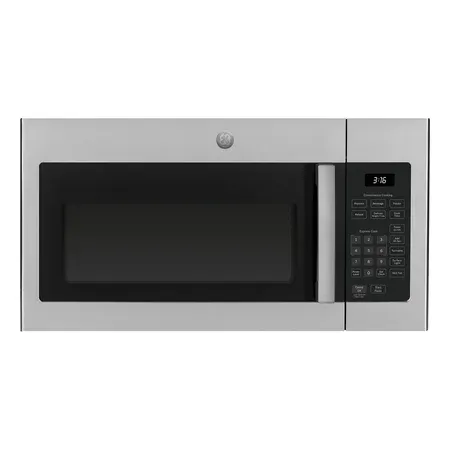
Cheapest Major-Brand OTR
GE JVM3160RFSS
1.6 cu ft, 1,000 W over-the-range microwave with a 300 CFM 2-speed fan; no sensor.
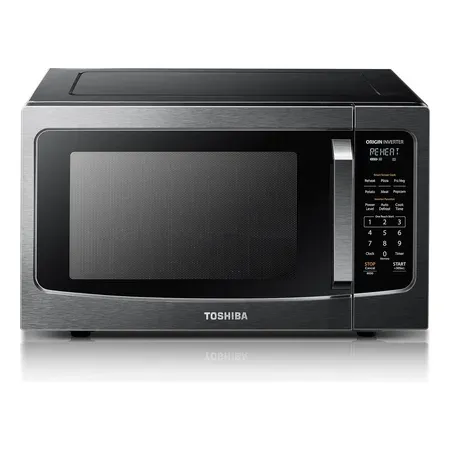
Countertop alternative at the same size
Toshiba ML-EM45PIT
1.6 cu ft, 1,250 W inverter countertop microwave with a humidity sensor and 13.6-inch turntable.
Which Should You Buy?
- Countertop if you rent, have the counter space, want the lowest price and easiest replacement, or have a real range hood. Picks: the best microwaves and the best large microwaves.
- Over-the-range if you’re replacing an existing OTR, the counter is tight, and you don’t have (or want) a separate hood. Picks: the best over-the-range microwaves.
- Neither in a remodel where you want better venting and an easier reach: consider a hood plus a microwave drawer.
FAQ
Is an over-the-range microwave better than a countertop microwave?
Not better at cooking: at the same size, countertop models are often more powerful and cheaper. An OTR is better only for saving counter space and adding a vent fan over the range.
Are over-the-range microwaves worth it?
They’re worth it when counter space is scarce and there’s no range hood, or when you’re replacing an existing OTR. If you have a hood and the counter room, a countertop model costs less and is easier to use.
Can an over-the-range microwave replace a range hood?
It can serve as one, with a 220–400 CFM fan on most models, but it covers less of the front burners than a full-depth hood. Range-hood maker Broan-NuTone recommends a dedicated hood for better ventilation.
Do over-the-range microwaves need a dedicated circuit?
Yes. GE says its “Over-the-Range Microwave models should always be on a dedicated circuit,” and its install manual calls for a separate 15- to 20-amp branch circuit.
Can I put a countertop microwave over my stove?
No. Countertop microwaves aren’t designed to sit above heat sources, and Toshiba’s countertop manual warns: “Do not install oven over a range cooktop or other heat-producing appliance.”
Sources
- GE JVM6175 installation instructions (PDF)
- GE JVM3160RFSS spec sheet (PDF)
- GE PVM9005SJSS spec sheet (PDF)
- GE Appliances: microwave electrical requirements
- Samsung ME21R7051SS installation guide (PDF)
- LG LMH2235ST installation manual (PDF)
- Whirlpool WMH31017 installation instructions (PDF)
- Panasonic NN-SN67KS owner’s manual (PDF)
- Toshiba EM131A5C-BS owner’s manual (PDF)
- Broan-NuTone: importance of a range hood