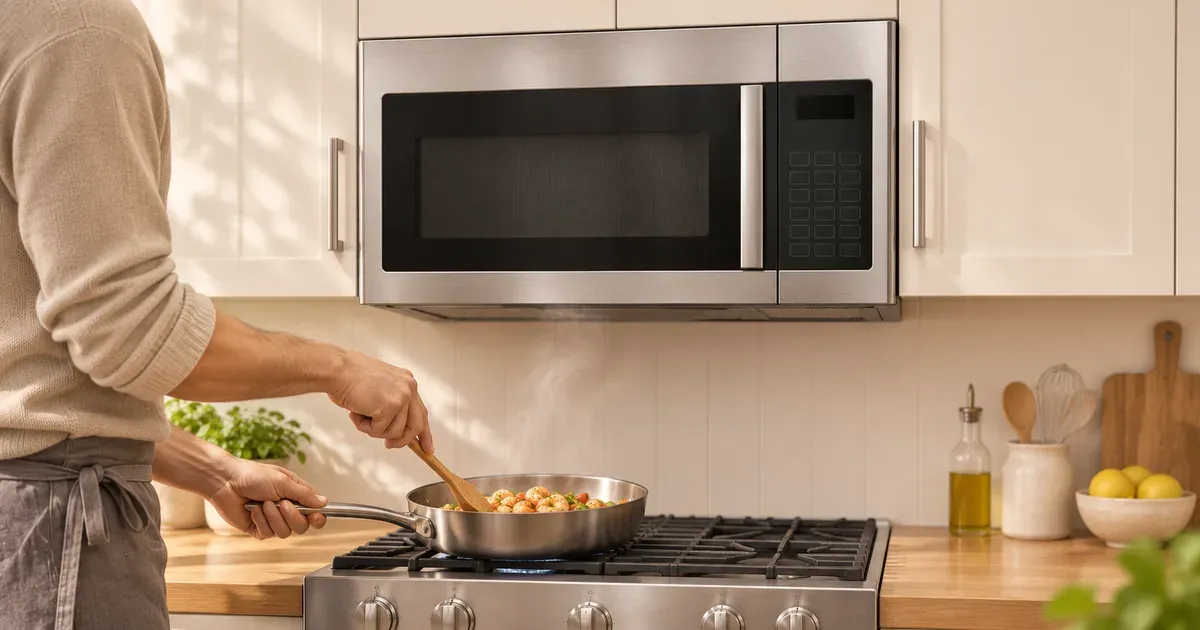
The short answer: duct your over-the-range microwave outside whenever you can. A ducted (external) vent removes smoke, steam, heat and grease from the kitchen. A recirculating (ductless) vent pulls air through a grease filter and a charcoal filter and blows it back into the room: it traps some grease and odor but leaves the moisture and heat. Recirculating is fine for renters, condos and walls with no route outside, if you replace the charcoal filter on schedule. Most OTRs from GE, Whirlpool, Samsung and LG support both.
Ducted vs. Recirculating at a Glance
| Ducted (outside top or outside back) | Recirculating (ductless) | |
|---|---|---|
| Where air goes | Outdoors through a wall or roof cap | Back into the kitchen through the grille above the door |
| Removes smoke and grease | Yes | Partly (grease filter) |
| Removes odors | Yes | Partly (charcoal filter) |
| Removes steam and heat | Yes | No |
| Extra parts | Ductwork, wall or roof cap, damper | Charcoal filter (replaceable) |
| Install effort | Duct run through cabinet, wall or roof | None beyond the microwave |
| Ongoing cost | Clean grease filters | Clean grease filters and replace charcoal filters |
The Three Venting Setups
Over-the-range models are built to be set up one of three ways, chosen during installation:
- Outside top: air goes up through the upper cabinet into a duct to the roof or an exterior wall.
- Outside back: air exits the back of the microwave straight through the wall behind it. GE’s instructions say to align the exhaust with the space between studs.
- Recirculating: no duct; a charcoal filter is fitted and the air is returned through the front grille.
GE, Samsung, LG (MVEL2125X: “roof, wall, room”) and Whirlpool all list these options on their spec sheets or install instructions. Even GE’s JNM7196SKSS, titled “with Recirculating Venting,” lists outside vertical, outside horizontal and recirculating. Some setups require changing the blower orientation before mounting; GE’s instructions include steps to check it and to adapt the blower for recirculation.
Fan Power (CFM) by Model
The fan rating is the same either way, but a long or restrictive duct reduces real airflow, and a charcoal filter adds resistance too.
| Model | Fan |
|---|---|
| Whirlpool WMH31017AS (“Hidden Vent”) | 220 CFM |
| GE JVM3160RFSS | 300 CFM, 2-speed |
| Whirlpool WMH31017HZ | 300 CFM |
| GE JNM7196SKSS | 400 CFM, 4-speed + boost |
| GE Profile PVM9005SJSS | 400 CFM, 4-speed |
| LG MVEL2125X | 400 CFM |
| Samsung ME21DG6300SRAA | 400 CFM |
| KitchenAid KMLS311HSS (low profile) | 500 CFM |
Duct Rules (GE)
From GE’s OTR installation instructions:
- Use 3-1/4 × 10-inch rectangular duct, or round duct with a transition, and “Do not use less than a 6” diameter duct.”
- Keep the total “duct length… should not exceed 140 equivalent feet.”
- Count fittings by equivalent length: a wall cap counts as 40 feet, a roof cap 24 feet, a 90° rectangular elbow 10 feet, a 45° elbow 5 feet, and a rectangular-to-round transition 5 feet.
- Use “the most direct route and with as few elbows as possible,” and make sure dampers swing freely.
So a wall cap plus 3 feet of straight duct and two 90° elbows totals 63 equivalent feet, comfortably inside the limit.
Charcoal Filters for Recirculating
The charcoal (carbon) filter is what makes recirculating work at all, and it can’t be washed. Makers sell model-specific kits; for example, GE lists the JX81C filter kit for the JVM3160 and JVM3162 and WB02X35687 for the JVM6175. Follow your manual’s replacement interval; a saturated charcoal filter stops trapping odors. The metal grease filters in both setups should be cleaned regularly.
Which Should You Choose?
- Ducted if there’s an existing duct, or you can run one through the cabinet above or the wall behind. It’s the only setup that removes moisture and heat, which matters with gas burners, frequent frying and searing.
- Recirculating if you rent, live in a building that doesn’t allow new exterior penetrations, or there’s no path outside. Choose a model with a strong fan and keep up with charcoal filters.
- A dedicated range hood if you cook a lot of high-heat food: range-hood maker Broan-NuTone argues a hood ventilates better than an OTR. Pair it with a countertop or drawer microwave.
For models, see the best over-the-range microwaves; for mounting steps, over-the-range microwave installation.
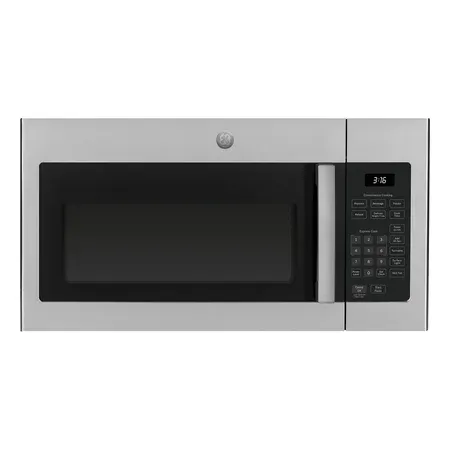
Budget OTR that vents either way
GE JVM3160RFSS
1.6 cu ft, 1,000 W over-the-range microwave with a 300 CFM fan; outside or recirculating venting.
FAQ
Is it better to vent a microwave outside or recirculate?
Outside. A ducted vent removes smoke, grease, odor, steam and heat; recirculating filters some grease and odor and returns the air, leaving the moisture and heat in the kitchen.
Do recirculating microwaves need a charcoal filter?
Yes. The charcoal filter is what traps odors in recirculating mode, and it must be replaced rather than washed. GE’s JX81C kit fits the JVM3160 and JVM3162, for example.
Can you convert an over-the-range microwave from recirculating to ducted?
Usually, since most OTRs support outside-top, outside-back and recirculating setups. You need a duct route through the cabinet or wall, and you may need to reorient the blower per the installation instructions.
What size duct does an over-the-range microwave need?
GE specifies 3-1/4 × 10-inch rectangular duct, or round duct no smaller than 6 inches with a transition, with a total of no more than 140 equivalent feet including fittings.
How many CFM should an over-the-range microwave have?
Most models are 300 to 400 CFM. Whirlpool’s WMH31017AS is 220 CFM; GE’s JNM7196 and Profile PVM9005, LG’s MVEL2125X and Samsung’s ME21DG6300 are 400 CFM.
Sources
- GE JVM6175 installation instructions (PDF)
- GE JVM3160RFSS spec sheet (PDF)
- GE JNM7196SKSS spec sheet (PDF)
- GE PVM9005SJSS spec sheet (PDF)
- Whirlpool WMH31017AS and WMH31017HZ
- KitchenAid KMLS311HSS
- LG MVEL2125X product page
- Samsung ME21DG6300 spec sheet (PDF)
- Broan-NuTone: importance of a range hood