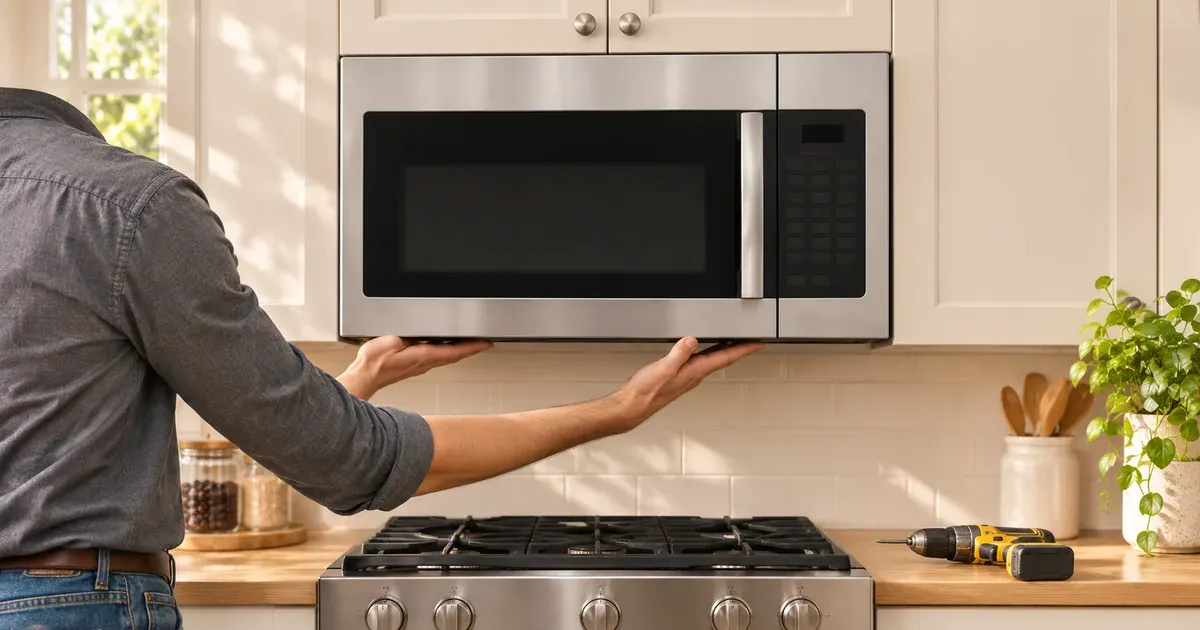
The short answer: mount an over-the-range (OTR) microwave so its top is at least 66 inches from the floor, with at least 30 inches between the cooktop and the bottom of the upper cabinet, in a 30-inch-wide gap. That typically leaves the microwave’s bottom about 13 to 18 inches above the cooktop (LG’s minimum is 13-3/4 inches; Samsung shows 13.5). You can install one yourself if you’re replacing an existing OTR and have a second person: GE’s units weigh 63 to 85 pounds and the job “requires basic mechanical and electrical skills.” Hire help if you need a new circuit, new ductwork or cabinet changes.
Height and Space Requirements by Maker
| Requirement | GE | Whirlpool | Samsung | LG | Frigidaire |
|---|---|---|---|---|---|
| Height from floor | 66 in or more to the top of the microwave | 66 in minimum installation height | — | 66 in minimum | 66 in or more to the top of the microwave |
| Cooktop to upper-cabinet bottom | 30 in or more | 30 in “typical” | 30 in or more | 30 in minimum | 30 in |
| Cooktop to microwave bottom | — | — | 13.5 in shown (codes may require more) | At least 13-3/4 in | — |
| Cabinet gap width | 30 in | 30 in min | 30 in | 30 in min | 30 in |
| Max upper-cabinet depth | 13 in (15 in with JX15BUMP kit) | 12–14 in (bump-out kit for 14–15 in) | 12 in | 13 in | 13 in (deeper: space out from the wall) |
| Range width allowed | Up to 36 in | Up to 36 in | Up to 36 in | 36 in or less | — |
| Island or peninsula | Not allowed | — | Not allowed | Not allowed | Not allowed |
GE also limits gas cooking below its OTRs to “a combined BTU of 63,000 BTU or less,” and GE and Frigidaire want at least 2 inches between the microwave bottom and the top of the backsplash.
Electrical
- GE: “120 volts AC, 60 Hertz, 14.5 amps and 1.7 kilowatts… separate 15- to 20-ampere branch circuit single grounded outlet… in the cabinet above.” GE’s support page adds that OTR models “should always be on a dedicated circuit.”
- Samsung: the same 14.5 A, 1.7 kW rating, on a separate 15 A minimum, 20 A maximum circuit.
- LG: “DEDICATED 120V, 60Hz, AC only, 15 or 20A, fused electrical supply.”
- Whirlpool: “A 120 V, 60 Hz, AC only, 15 or 20 A electrical supply,” separate circuit recommended.
The outlet goes inside the upper cabinet, and the cord feeds up through a hole you drill in the cabinet bottom using the maker’s template. If there’s no outlet there, an electrician needs to add one. More in microwave electrical requirements.
Can You Install It Yourself?
Replacing an existing OTR of the same width: yes, for most handy owners. The outlet and venting are usually already in place, and many new units line up with similar mounting points, though you’ll generally drill new holes for the new wall plate and top-cabinet bolts using the supplied templates.
First-time install where a range hood was: moderate. You remove the hood, check the cabinet depth and height against the table above, add an outlet in the cabinet if there isn’t one, and adapt the ductwork. GE’s JX36 filler panels fill a 36-inch opening.
Get help if you need a new circuit, the wall has no stud where the plate must go, the upper cabinet is too deep or too low, or you’re converting from recirculating to ducted through an exterior wall.
GE’s warning applies either way: “To avoid the risk of personal injury… you will need two people to install this microwave oven.” The mounting surface must hold the cabinet plus the oven and “additional oven loads of up to 50 pounds or a total weight of 113–135 pounds.”
Tools
From GE’s installation instructions: a drill with bits for the toggle-bolt, top-cabinet and cord holes, a stud finder, a level, a tape measure, screwdrivers, safety glasses, masking tape, and tin snips if you cut ductwork. GE also lists a saw (saber, hole or keyhole) and gloves.
Installation Steps (Summary of Maker Instructions)
- Shut off power and remove the old unit (or the range hood). Support it while a helper removes the top-cabinet bolts.
- Check the opening: 30 inches wide, cabinet bottom level, cabinet depth within the maker’s limit, and height per the table above.
- Choose the exhaust type: outside top (through the cabinet), outside back (through the wall) or recirculating. GE’s instructions have you check the blower orientation and, for recirculating, adapt the blower before hanging the unit.
- Find the studs and tape the rear wall template in place. GE: “THE MICROWAVE MUST BE CONNECTED TO AT LEAST ONE WALL STUD.”
- Mount the wall plate with wood screws into the stud(s) and the supplied toggle bolts elsewhere, and check it’s level.
- Tape the top cabinet template under the cabinet and drill the bolt holes and the power-cord hole.
- Lift the microwave onto the plate (two people), tilt it up against the cabinet, feed the cord through, and bolt it through the cabinet with the supplied screws.
- Connect the duct (for outside venting) or fit the charcoal filter (for recirculating), install grease filters, plug in and test the fan and light.
Venting Choices
GE’s ducting rules: use 3-1/4 × 10-inch rectangular duct or round duct no smaller than 6 inches, keep the total “140 equivalent feet” or less, and count fittings by their equivalent length (a wall cap counts as 40 feet, a roof cap 24, a 90° rectangular elbow 10, a 45° elbow 5). Recirculating installs need a charcoal filter (GE’s JX81C fits the JVM3160/3162). See recirculating vs. ducted.
What Drives the Cost
Swapping one OTR for another in a ready opening is the cheapest job. The price climbs with each of these:
- A new dedicated circuit and outlet in the cabinet (an electrician’s job).
- New exterior ducting through a wall or roof.
- Cabinet work: shortening a cabinet that sits lower than 30 inches above the cooktop, or adding a bump-out kit for deep cabinets.
- Haul-away of the old unit.
Retailers that sell OTRs quote installation at checkout, and that quote usually covers a straight swap only. Get the electrical and duct work priced separately if you need them.
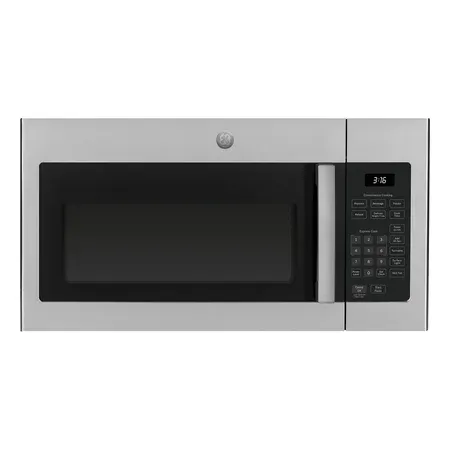
Simple OTR swap
GE JVM3160RFSS
1.6 cu ft, 1,000 W over-the-range microwave with a 300 CFM fan; $227 on Amazon Nov 19, 2026.
For picks, see the best over-the-range microwaves. If the height rules don’t work in your kitchen, compare over-the-range vs. countertop.
FAQ
How high should an over-the-range microwave be installed above the stove?
GE, Frigidaire and LG call for the top of the microwave to be at least 66 inches from the floor and at least 30 inches between the cooktop and the upper-cabinet bottom. LG’s minimum from cooktop to microwave is 13-3/4 inches; Samsung shows 13.5 inches and notes local codes may require more.
Can you install an over-the-range microwave yourself?
Yes, if you’re replacing an existing OTR and have a helper. GE says the job requires “basic mechanical and electrical skills” and two people, since its units weigh 63 to 85 pounds. Hire help for new circuits, new ducting or cabinet changes.
Does an over-the-range microwave need a dedicated circuit?
Yes. GE: OTR models “should always be on a dedicated circuit,” a separate 15- to 20-amp branch circuit with the outlet in the cabinet above. LG and Samsung say the same.
How wide is the space for an over-the-range microwave?
30 inches between the upper cabinets. GE sells JX36 filler panels for a 36-inch opening.
Can you install an over-the-range microwave over a gas range?
Yes, within the maker’s limits. GE allows gas or electric cooking with a combined 63,000 BTU or less and up to 36 inches wide; Whirlpool, Samsung and LG allow gas or electric ranges up to 36 inches wide.
Sources
- GE JVM6175 installation instructions (PDF)
- GE Appliances: microwave electrical requirements
- GE JVM3160RFSS spec sheet (PDF)
- Whirlpool WMH31017 installation instructions (PDF)
- Samsung ME21R7051SS installation guide (PDF)
- LG LMH2235ST installation manual (PDF)
- LG MVEL2125X Pro Builder spec sheet (PDF)
- Frigidaire FMOS1846BS installation instructions (PDF)