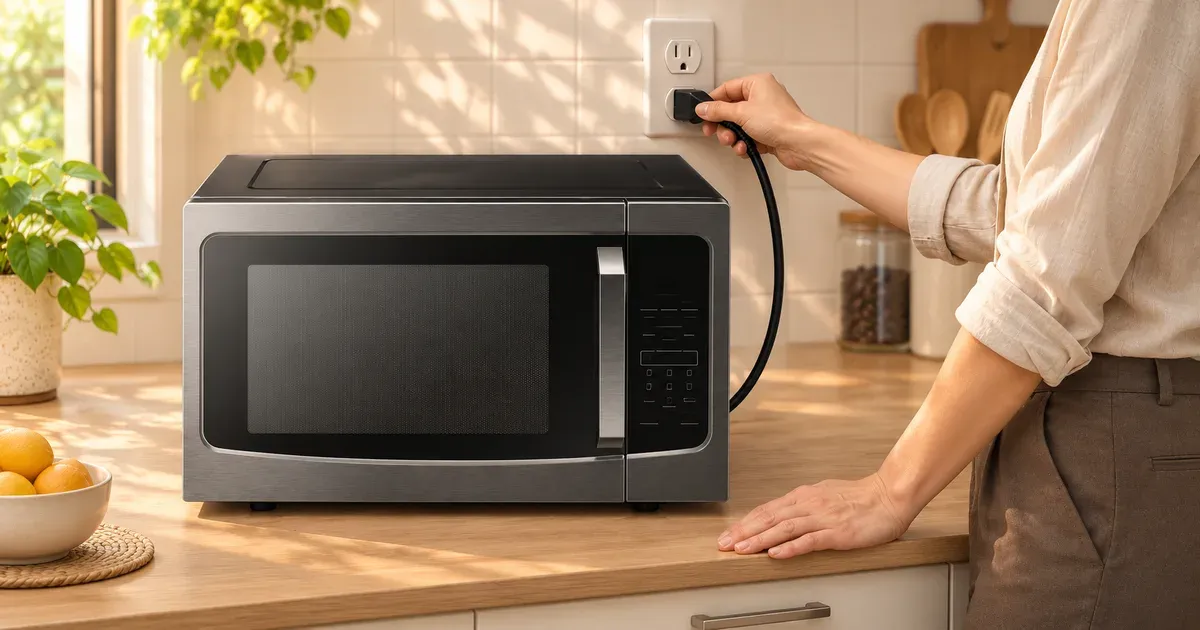
The short answer: a household microwave draws about 8 to 15 amps at 120 volts, and makers call for a grounded outlet on a 15 or 20 amp circuit. Over-the-range models need a dedicated circuit; GE says they “should always be on a dedicated circuit.” Panasonic asks for a dedicated circuit for its countertop models too, and many of its manuals require at least a 20 A outlet. If your microwave trips the breaker, something else on the same circuit (a kettle, toaster or coffee maker) is usually the cause.
Amps by Model
Amps come from the maker’s rated input (the power drawn from the outlet), not the cooking watts. Where the maker gives amps, they’re quoted; otherwise they’re input watts ÷ 120 V.
| Model | Type | Cooking power | Input power | Amps |
|---|---|---|---|---|
| LG MSER0990S | Countertop 0.9 cu ft | 1,000 W | 1,040 W | 8.7 A (LG) |
| LG MSER1590S | Countertop 1.5 cu ft | 1,200 W | 1,250 W | 10.4 A (LG) |
| Breville BMO850 | Countertop 1.2 cu ft | 1,200 W | 1,250 W | About 10.4 A |
| Panasonic NN-SN67KS | Countertop 1.2 cu ft | 1,200 W | 1,480 W | 12.4 A (Panasonic) |
| Panasonic NN-SD78LS | Countertop 1.6 cu ft | 1,250 W | 1,460 W | 12.3 A (Panasonic) |
| Toshiba EM131A5C | Countertop 1.2 cu ft | 1,100 W | 1,550 W | About 12.9 A |
| Hotpoint RVM1435WK | Over-the-range | 950 W | 1,500 W | 13.0 A (GE) |
| GE JVM6175 family | Over-the-range | 1,000 W | 1.7 kW | 14.5 A (GE) |
| Frigidaire FMOS1846BS | Over-the-range | 1,000 W | 1.6 kW | 15 A (Frigidaire) |
| GE Profile Advantium PSB9120SFSS | Built-in speed oven, 120 V | 950 W | 1,800 W | 15 A (GE) |
A typical microwave uses most of a 15 A circuit on its own. Add a 1,500 W kettle (about 12.5 A) on the same circuit and you’re over 25 A, which trips a 15 or 20 A breaker.
Does a Microwave Need a Dedicated Circuit?
What the makers say:
| Maker | Requirement |
|---|---|
| GE (countertop and OTR) | “120 volt, individual, properly grounded branch circuit with a 3 prong grounding type receptacle protected by a 15 or 20 amp circuit breaker or time-delay fuse. Over-the-Range Microwave models should always be on a dedicated circuit.” |
| Panasonic (countertop) | “The oven must be operated on a SEPARATE (dedicated) CIRCUIT. No other appliance should share the circuit with the microwave oven.” Plugged into a 15 or 20 A, 120 V grounded outlet; the NN-SN67KS manual says “at least a 20 A, 120 V, 60 Hz GROUNDED OUTLET.” |
| Breville (BMO850) | “A 120 volt, 60 Hz, AC only, 15-20 amp electrical supply… We also recommend a separate circuit dedicated to serving only” the microwave. |
| LG (OTR) | “DEDICATED 120V, 60Hz, AC only, 15 or 20A, fused electrical supply.” Countertop MSER2090: “Minimum Circuit Rating 15 Amp.” |
| Samsung (OTR) | Separate branch circuit “of at least 15 A and max of 20 A.” |
| Whirlpool (OTR) | “A 120 V, 60 Hz, AC only, 15 or 20 A electrical supply”; separate circuit recommended. |
| Sharp (drawer) | “120 volt 60 Hz, AC only, 15 amp. or more”; separate circuit recommended. |
So: over-the-range and drawer microwaves get their own circuit, as their install instructions require. Countertop microwaves work on a shared kitchen counter circuit, but Panasonic and Breville ask for a dedicated one, and sharing is what causes nuisance trips. Panasonic’s page also notes that “beginning in 2017, all new construction and all renovated single family homes must have at least a 20 A, 120 VOLT, 60 Hz GROUNDED OUTLET.”
15 Amp vs. 20 Amp
Most microwaves are rated to run on either. A 20 A circuit leaves headroom for the microwave’s draw plus a small appliance, and some manuals (Panasonic’s NN-SN67KS among them) require 20 A outright. If your kitchen counters are on 15 A circuits and the microwave keeps tripping them, move it to an outlet on a different circuit before blaming the microwave.
Grounding, Extension Cords and Adapters
- Every manual here requires a grounded three-prong outlet. Panasonic: where a two-prong outlet exists, “it is the personal responsibility and obligation of the consumer to have it replaced with a properly grounded three-prong” outlet.
- Breville: “Do not, under any circumstances, modify the power plug or use an adapter.”
- Panasonic allows a three-wire grounded extension cord only if its “marked rating… should be equal to or greater than the electrical rating of the appliance.” A light-duty cord rated below about 13 A shouldn’t run a full-size microwave.
- Panasonic also warns that “using a lower voltage will cause slow cooking,” which matters on long cords, generators and weak RV hookups.
Generators, Inverters and RVs
Size a generator or power inverter to the microwave’s input watts, not its cooking watts. A 1,000-watt-output microwave can draw 1,500 W or more (Hotpoint’s 950 W OTR draws 1,500 W). Lower-wattage 700 W models draw less. See the best microwaves for RVs and the wattage guide.
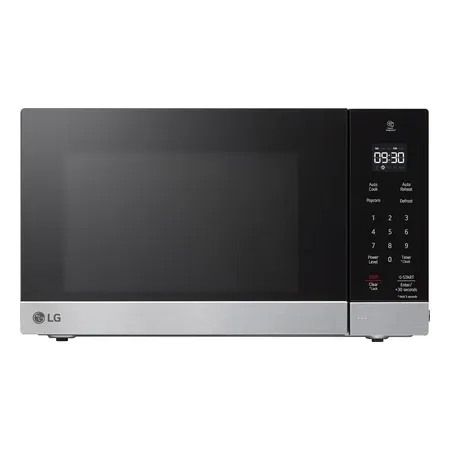
Low-Draw countertop pick
LG MSER0990S
0.9 cu ft, 1,000 W inverter that LG rates at just 8.7 A and 1,040 W input; $159 at LG on Nov 19, 2026.
FAQ
How many amps does a microwave use?
About 8 to 15 amps at 120 V. LG’s 0.9 cu ft MSER0990S is rated 8.7 A; Panasonic’s 1.2 cu ft NN-SN67KS 12.4 A; GE’s over-the-range JVM6175 14.5 A.
Does a microwave need a dedicated circuit?
Over-the-range and drawer microwaves do, per their installation instructions. For countertop models, GE accepts a 15 or 20 A individual branch circuit, and Panasonic and Breville recommend a dedicated circuit.
Can a microwave be on a 15 amp circuit?
Yes, most are rated for 15 or 20 A. Some manuals, including Panasonic’s NN-SN67KS, call for at least a 20 A outlet. On a 15 A circuit, avoid running another high-draw appliance at the same time.
Why does my microwave trip the breaker?
Usually because another appliance on the same circuit is running; a microwave plus a kettle or toaster exceeds 15 or 20 A. If it trips on a dedicated circuit, the microwave may have a fault and should be serviced.
Can I plug a microwave into an extension cord?
Panasonic allows a three-wire grounded extension cord rated at or above the microwave’s electrical rating. A plug-in power strip or a light-duty cord isn’t suitable, and Breville says not to use adapters.
Sources
- GE Appliances: microwave electrical requirements and breaker size
- Panasonic: recommended electrical requirements for microwaves
- Panasonic NN-SN67KS owner’s manual (PDF)
- Panasonic NN-SD78LS owner’s manual (PDF)
- Breville BMO850 manual (PDF)
- Toshiba EM131A5C-BS owner’s manual (PDF)
- LG MSER0990S, MSER1590S, MSER2090D spec sheet (PDF)
- GE JVM6175 installation instructions (PDF)
- Hotpoint RVM1435WK specifications
- Samsung ME21R7051SS installation guide (PDF)
- LG LMH2235ST installation manual (PDF)
- Whirlpool WMH31017 installation instructions (PDF)
- Frigidaire FMOS1846BS installation instructions (PDF)
- Sharp drawer installation manual (PDF)
- GE Profile Advantium PSB9120SFSS specifications