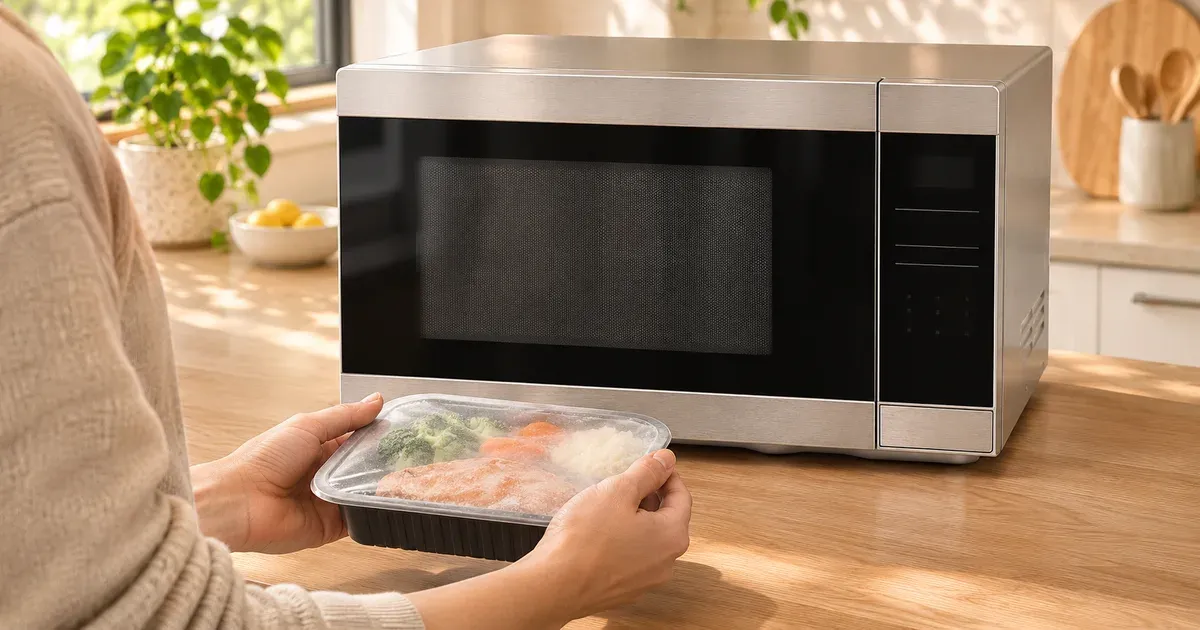
The short answer: cooking time scales roughly with the inverse of wattage, so a 700-watt microwave needs about 1.43 times as long as a 1,000-watt one, and a 1,200-watt microwave about 0.83 times as long. A 1,000 vs. 1,200 W difference saves about 20 seconds per minute of package time; the jump from 700 to 1,000 W is the one you’ll notice. For most kitchens, 1,000 to 1,250 W is the right range. Start with the shorter time, then check that the food reaches a safe temperature (165°F for leftovers, per USDA).
Conversion Chart: From a 1,000 W Package Time
New time ≈ package time × (package watts ÷ your watts). These are estimates from that ratio, rounded to the second.
| Package says (1,000 W) | 700 W | 800 W | 900 W | 1,000 W | 1,100 W | 1,200 W | 1,250 W |
|---|---|---|---|---|---|---|---|
| 1 min | 1:26 | 1:15 | 1:07 | 1:00 | 0:55 | 0:50 | 0:48 |
| 2 min | 2:51 | 2:30 | 2:13 | 2:00 | 1:49 | 1:40 | 1:36 |
| 3 min | 4:17 | 3:45 | 3:20 | 3:00 | 2:44 | 2:30 | 2:24 |
| 4 min | 5:43 | 5:00 | 4:27 | 4:00 | 3:38 | 3:20 | 3:12 |
| 5 min | 7:09 | 6:15 | 5:33 | 5:00 | 4:33 | 4:10 | 4:00 |
| 8 min | 11:26 | 10:00 | 8:53 | 8:00 | 7:16 | 6:40 | 6:24 |
Conversion Chart: From an 1,100 W Package Time
Many frozen meals list times for an 1,100 W oven.
| Package says (1,100 W) | 700 W | 800 W | 900 W | 1,000 W | 1,100 W | 1,200 W | 1,250 W |
|---|---|---|---|---|---|---|---|
| 1 min | 1:34 | 1:22 | 1:13 | 1:06 | 1:00 | 0:55 | 0:53 |
| 2 min | 3:09 | 2:45 | 2:27 | 2:12 | 2:00 | 1:50 | 1:46 |
| 3 min | 4:43 | 4:08 | 3:40 | 3:18 | 3:00 | 2:45 | 2:38 |
| 4 min | 6:17 | 5:30 | 4:53 | 4:24 | 4:00 | 3:40 | 3:31 |
| 5 min | 7:51 | 6:52 | 6:07 | 5:30 | 5:00 | 4:35 | 4:24 |
| 8 min | 12:34 | 11:00 | 9:47 | 8:48 | 8:00 | 7:20 | 7:02 |
Quick multipliers from 1,000 W: 700 W × 1.43; 800 W × 1.25; 900 W × 1.11; 1,100 W × 0.91; 1,200 W × 0.83; 1,250 W × 0.80.
Why the Chart Is an Estimate
The ratio assumes the food absorbs energy in proportion to the oven’s output, which is close for typical portions but not exact. Small portions, very dense food, frozen centers and different cavity sizes all shift the real time. USDA’s rules for this:
- “If a range of time is given, start with the fewest minutes recommended. Add cooking time if necessary to reach a safe internal temperature.”
- “Use the minimum cooking time given for high wattage ovens; use the maximum cooking time for slow ovens. The minimum cooking time may need to be reduced for very high wattages.”
- After microwaving, allow “standing time of at least 3 minutes” and check the temperature: 165°F for poultry and leftovers, 160°F for ground meat and egg dishes, 145°F for fish.
Find Your Microwave’s Wattage
USDA says to look “on the inside of the oven’s door, on the serial number plate on the back of the oven, or in the owner’s manual.” Use the cooking power (also labeled output or “IEC” watts), not the input or power-consumption figure. Examples from maker documents:
| Model | Cooking (output) power | Input power |
|---|---|---|
| Panasonic NN-SN67KS | 1,200 W | 1,480 W |
| Panasonic NN-SD78LS | 1,250 W | 1,460 W |
| Toshiba EM131A5C | 1,100 W | 1,550 W |
| Breville BMO850 | 1,200 W | 1,250 W |
| Hotpoint RVM1435WK (OTR) | 950 W | 1,500 W |
Toshiba’s EM131A5C product page says “1000 Watts,” while its manual says 1,100 W output and 1,550 W input. Labels like “1,450 W” on convection models (Sharp SMC1585KS) are often the heating element; that microwave is 900 W.
USDA’s time-to-boil test
If the label is gone, USDA’s test estimates it: put 1 cup of ice-cold water (ice removed) in a 2-cup glass measure, microwave on high for up to 4 minutes, and watch for boiling.
| Water boils in | Approximate wattage (USDA) |
|---|---|
| Under 2 minutes | 1,000 W or more |
| About 2½ minutes | About 800 W or more |
| About 3 minutes | 650–700 W or more |
| Over 3 minutes, or not by 4 | 300–500 W |
How Makers Rate Wattage
Output power is measured with the IEC 60705 procedure (“Household microwave ovens – Methods for measuring performance”). GE lists “Microwave Watts (IEC-705)” and Panasonic lists “Cooking Power” with “IEC Test procedure.” Input power is what the oven draws from the outlet; it’s higher because the magnetron isn’t 100% efficient (Panasonic’s NN-SN67KS turns 1,480 W in into 1,200 W of cooking power). Use input power for electrical and energy math; see microwave electrical requirements.
Power Levels Are Percentages
On a conventional microwave, power level 5 isn’t half the watts; it’s full power half the time. GE: “Power level 7 is microwave energy 70% of the time.” Inverter microwaves can instead run continuously at reduced output. Either way, a recipe’s “50% power” means about half the average energy. More in inverter vs. non-inverter.
What Wattage Do You Need?
| Wattage | Good for | Examples |
|---|---|---|
| 600–700 W | Dorms, offices, RVs on limited power; reheating only | GE GCST07N1WSS (700 W), COMFEE EM720CPL-PMB (700 W) |
| 900–1,000 W | Small households; most frozen foods at package times or a little longer | Toshiba ML-EM09PA (900 W), LG MSER0990S (1,000 W) |
| 1,100–1,250 W | Families, daily cooking, larger portions | Toshiba ML-EM45PIT (1,250 W), Panasonic NN-SN67QS (1,250 W) |
Low wattage is a feature in some places: dorm rules and RV power systems often cap what you can run. See the best microwaves for RVs and the best small microwaves. For everyone else, the best 1,000-watt microwaves and the best microwaves cover the useful range.
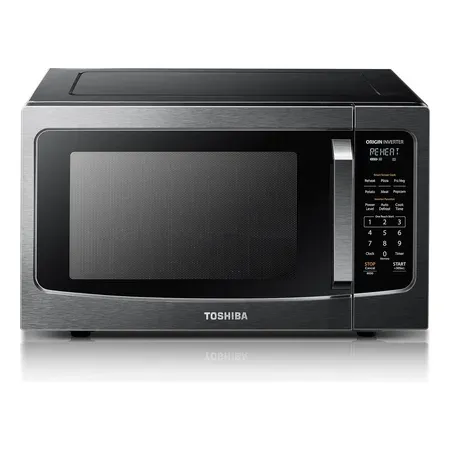
1,250 W for under $200
Toshiba ML-EM45PIT
1.6 cu ft, 1,250 W inverter microwave with a humidity sensor; $179.94 on Amazon Nov 19, 2026.
FAQ
How do I convert microwave cooking times for different wattages?
Multiply the package time by the package wattage and divide by your microwave’s wattage. Example: 3 minutes at 1,000 W becomes about 4 minutes 17 seconds at 700 W (3 × 1,000 ÷ 700). Start with the shorter estimate and check the food.
How much longer does a 700-watt microwave take than a 1,000-watt?
About 43% longer: multiply the 1,000 W time by 1.43. Two minutes at 1,000 W is about 2 minutes 51 seconds at 700 W.
Is there a big difference between 1,000 and 1,200 watts?
A modest one. A 1,200 W microwave needs about 0.83 times the 1,000 W time, so a 5-minute frozen meal takes about 4 minutes 10 seconds. It adds up for large portions and daily cooking.
What wattage microwave do I need?
For most homes, 1,000 to 1,250 W. Choose 700 to 900 W only where power or space is limited (dorms, offices, RVs) or you mostly reheat drinks and small portions.
How do I find my microwave’s wattage?
Check the label inside the door or on the back, or the owner’s manual, and use the cooking (output) watts. If there’s no label, use USDA’s time-to-boil test: 1 cup of ice-cold water boiling in under 2 minutes means about 1,000 W or more.
Sources
- USDA FSIS: Cooking with Microwave Ovens
- GE Appliances: microwave power levels
- Panasonic: tips on cooking evenly
- IEC 60705:2024, household microwave ovens performance
- Panasonic NN-SN67KS owner’s manual (PDF)
- Panasonic NN-SD78LS owner’s manual (PDF)
- Toshiba EM131A5C-BS owner’s manual (PDF)
- Breville BMO850 manual (PDF)
- Hotpoint RVM1435WK specifications