The short answer: an inverter microwave can run at a steady low power, while a non-inverter microwave makes “50%” by switching full power on and off. The difference shows up at low power levels: defrosting, softening butter, melting chocolate, and gently reheating dense food. At full power (power level 10), both kinds work the same way. An inverter is worth paying for when the gap is small: Toshiba’s 1.6 cu ft inverter model cost $25.36 more than the same-size model without one on November 19, 2026.
Prices checked November 19, 2026. Amazon prices unless noted.
Inverter vs. Non-Inverter at a Glance
| Inverter microwave | Non-inverter (conventional) microwave | |
|---|---|---|
| How it makes 50% power | Magnetron runs continuously at a reduced output | Magnetron runs at full power 50% of the time, off 50% |
| Full power (level 10) | Same as conventional | Same as inverter |
| Defrosting | Steady low energy; less chance of cooked edges | Bursts of full power; edges can start to cook |
| Low-power jobs (butter, chocolate, custards) | Better control | Works, but in pulses |
| Typical price premium | $0–$50 at the same size from the same brand | — |
| Examples | Panasonic NN-SN67QS, Toshiba ML-EM45PIT, LG MSER1590S, Breville BMO850 | Toshiba ML-EM45P, GE GCST16S1, Toshiba EM131A5C |
How Each Type Delivers Power
A microwave’s magnetron produces the microwaves. In a conventional microwave, its power supply has one setting: full. Lower power levels are made with a timer that turns it on and off. USDA’s microwave guidance describes it this way: “medium power (50%) means that the oven produces microwaves 50% of the time and is off 50% of the time.” GE’s support pages say the same thing in GE’s terms: “Power level 7 is microwave energy 70% of the time.”
An inverter power supply can drive the magnetron at a reduced output continuously. At power level 3, the food gets a steady trickle of energy instead of short blasts of full power followed by rests.
That is the whole difference. An inverter doesn’t add power at the top end: a 1,200-watt inverter microwave and a 1,200-watt conventional microwave heat a cup of water at about the same rate on high.
Where an Inverter Helps
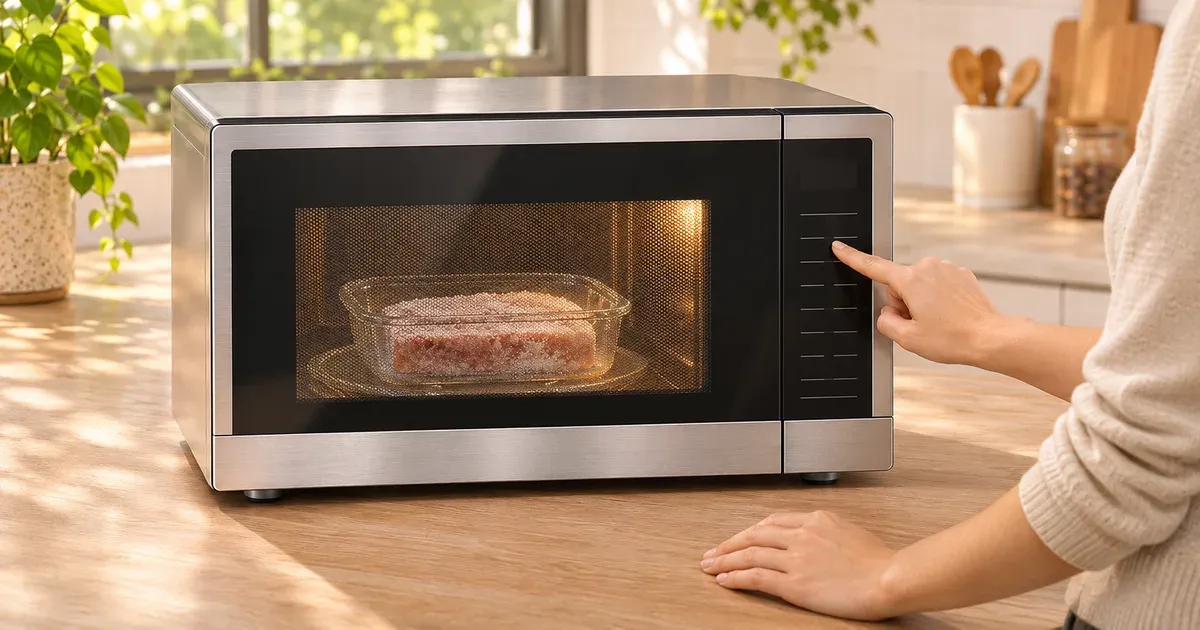
- Defrosting. USDA tells you to defrost on “the ‘defrost’ setting or 30% power” and to cook the food right away because “some areas of the frozen food may begin to cook during the defrosting time.” Full-power bursts are what start cooking the thin edges of a steak while the middle stays frozen; a steady low output reduces that.
- Low-power jobs. Melting butter without it spattering, softening cream cheese, melting chocolate, and poaching eggs all go better with continuous low power.
- Dense leftovers at reduced power. Reheating a thick casserole at 50% to 70% lets the heat spread inward. With an inverter, that happens without pulses that overheat the edges.
Where It Doesn’t Matter
- Anything on high. Coffee, soup, popcorn, frozen dinners cooked at full power: identical.
- Evenness on full power. Even heating at full power comes from the cavity design, the turntable or rotating antenna, and stirring. USDA still says to “stir, rotate, or turn foods upside down” midway, turntable or not.
- Sensor cooking. A humidity or steam sensor decides when food is done. It is separate from the inverter; plenty of non-inverter microwaves have one (the Toshiba ML-EM45P and EM131A5C do).
Same Size, With and Without an Inverter
The clearest way to price an inverter is to compare models that differ only in that part.
| Model | Capacity | Cooking power | Inverter | Sensor | Turntable | Amazon price (Nov 19) |
|---|---|---|---|---|---|---|
| Toshiba ML-EM45P(BS) | 1.6 cu ft | 1,200 W | No | Humidity sensor | 13.6 in | $154.58 |
| Toshiba ML-EM45PIT(BS) | 1.6 cu ft | 1,250 W | Origin Inverter | Humidity sensor | 13.6 in | $179.94 |
| Toshiba EM131A5C-SS | 1.2 cu ft | 1,100 W (manual) | No | Humidity sensor | 12.4 in | $119.99 |
| Panasonic NN-SN67QS | 1.2 cu ft | 1,250 W | Inverter | Genius sensor | Not published | $199.95 |
The Toshiba pair is the fair fight: same 1.6 cu ft cavity, same 13.6-inch turntable, same sensor, and $25.36 apart. At that gap the inverter is worth it for anyone who defrosts meat. The 1.2 cu ft Panasonic costs $80 more than the 1.2 cu ft Toshiba, but that gap pays for Panasonic’s sensor and build as well as the inverter.
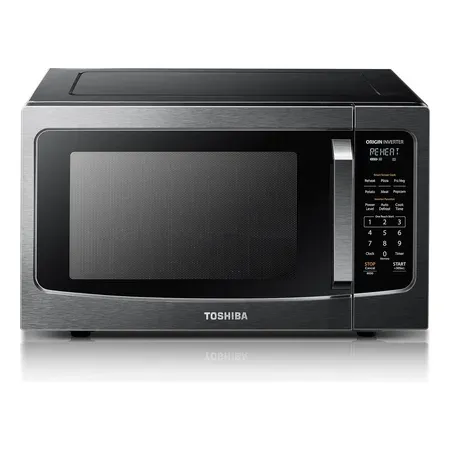
Cheapest way to get an inverter at 1.6 cu ft
Toshiba ML-EM45PIT
1.6 cu ft, 1,250 W Origin Inverter, humidity sensor and a 13.6-inch turntable; $25 more than the non-inverter ML-EM45P.
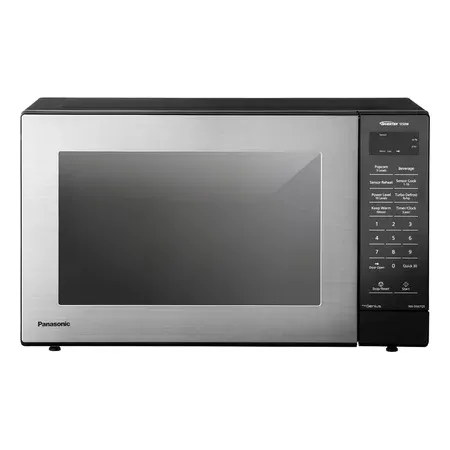
Best 1.2 cu ft inverter microwave
Panasonic NN-SN67QS
1.2 cu ft, 1,250 W inverter with Panasonic's Genius steam sensor and Inverter Turbo Defrost, sold by Amazon.
Do Inverter Microwaves Cook Faster or Use Less Power?
Not on high. Cooking speed follows output watts, and an inverter model rated 1,250 W heats about as fast as a conventional model rated 1,250 W. At reduced power, the conventional oven’s average output over a minute is the same percentage of full power, so the total energy into the food is similar; the inverter just delivers it more evenly over time.
Energy use is close. Both kinds draw roughly their rated input watts while the magnetron is on. Panasonic’s NN-SN67KS manual lists 1,480 W input for 1,200 W cooking power. Toshiba’s EM131A5C manual lists 1,550 W input for 1,100 W out. Efficiency differs more between models than between the two technologies, and DOE regulates only standby power for microwaves, with no cooking-efficiency test. Our microwave electricity guide does the cost math.
Are Inverter Microwaves Less Reliable?
No maker publishes failure rates by power-supply type. What makers do publish is the warranty. LG gives 10 years on the inverter magnetron (parts only), and Panasonic gives 5 years on the magnetron part. Toshiba’s US warranty is 1 year with no separate magnetron term, for inverter and non-inverter models alike. An inverter board is a more complex part than a transformer, so an out-of-warranty repair can cost more; on a $180 to $250 countertop microwave, most owners replace rather than repair either kind.
Which Should You Buy?
- Buy an inverter if you defrost meat often, cook at low power, or the inverter version costs $50 or less extra at the same size.
- Skip it if you mostly reheat coffee and leftovers on high and the inverter model costs $80 or more extra. Put the money toward a sensor, a bigger turntable, or more watts instead.
For picks, see the best inverter microwaves and the best microwaves overall.
FAQ
What is the difference between an inverter and a non-inverter microwave?
An inverter microwave can run its magnetron continuously at reduced output. A non-inverter microwave makes lower power levels by switching full power on and off: USDA describes 50% power as microwaves produced “50% of the time and is off 50% of the time.” On full power, the two work the same.
Is an inverter microwave worth it?
It is worth it if you defrost or cook at low power regularly and the premium is small. Toshiba’s 1.6 cu ft ML-EM45PIT cost $25.36 more than the non-inverter ML-EM45P on November 19, 2026, which is an easy yes. For reheating on high, an inverter makes no difference.
Does an inverter microwave heat more evenly?
At reduced power, yes: steady low output avoids the bursts that overcook edges while defrosting. At full power, evenness depends on cavity design and the turntable, not the inverter, and USDA still advises stirring and turning food halfway.
Do inverter microwaves use less electricity?
Not meaningfully. Both draw close to their rated input watts while heating. The bigger energy difference is between models (Panasonic’s NN-SN67KS turns 1,480 W of input into 1,200 W of cooking power; Toshiba’s EM131A5C turns 1,550 W into 1,100 W).
Which brands make inverter microwaves?
Panasonic (most of its countertop line), Toshiba (Origin Inverter models with “IT” in the model number, such as ML-EM45PIT), LG (Smart Inverter MSER models), Breville (Smooth Wave BMO850 and Combi Wave BMO870) and Sharp (several K-series models such as the SMC1464KS and the flatbed SMC1174KS).
Sources
- USDA FSIS: Cooking with Microwave Ovens
- GE Appliances: Microwave power levels
- Toshiba ML-EM45PIT product page
- Toshiba ML-EM45P product page
- Panasonic NN-SN67KS owner’s manual (PDF)
- Toshiba EM131A5C-BS owner’s manual (PDF)
- LG countertop microwave warranty (PDF)
- Panasonic microwave warranty