The short answer: the Panasonic NN-SN67QS is the best inverter microwave, and an inverter is worth it when it costs $25 to $50 more, not $100. The Panasonic pairs a 1,250-watt inverter with a steam sensor for $199.95. The Toshiba ML-EM45PIT gives you 1.6 cubic feet and an inverter for $179.94, only $25 more than the same Toshiba without one. An inverter mainly helps with defrosting and low-power jobs like softening butter; for reheating coffee and leftovers, a good sensor matters more.
Prices checked November 19, 2026. Amazon prices unless noted.
Inverter Microwaves Compared
| Model | Capacity | Cooking power | Inverter name | Sensor | Price (Nov 19) |
|---|---|---|---|---|---|
| Panasonic NN-SN67QS | 1.2 cu ft | 1,250 W | Inverter | Genius sensor | $199.95 |
| Toshiba ML-EM45PIT | 1.6 cu ft | 1,250 W | Origin Inverter | Humidity sensor | $179.94 |
| Panasonic NN-SN76LS | 1.6 cu ft | 1,250 W | Cyclonic Wave inverter | Genius sensor | $289.95 |
| Breville Smooth Wave BMO850 | 1.2 cu ft | 1,200 W | Power Smoothing Inverter | Sensor iQ | $399.95 (Breville) |
| LG MSER0990S | 0.9 cu ft | 1,000 W | Smart Inverter | 7 sensor programs | $159 (lg.com) |
| Toshiba ML4-EM22PAIT | 2.2 cu ft | 1,200 W | Origin Inverter | Sensor | $234.34 |
How an Inverter Microwave Works
A conventional microwave has only one real power level: full. To give you “50%,” it runs the magnetron at full power half the time and switches it off the other half. USDA describes it the same way: “medium power (50%) means that the oven produces microwaves 50% of the time and is off 50% of the time.” GE’s support pages put it as power levels being “a percentage of ‘on time’ for the magnetron tube which cycles on and off.”
An inverter power supply lets the magnetron run continuously at a reduced output instead. At a low setting, food gets a steady trickle of energy rather than bursts at full power.
Is an Inverter Microwave Worth It?
Where it helps:
- Defrosting. Steady low power thaws a block of ground beef with fewer cooked edges than bursts at full power.
- Delicate jobs. Softening butter, melting chocolate and warming sauces at 20% to 40% power.
- Poaching and simmering in the microwave at medium power.
Where it doesn’t change much: reheating at full power. At 100%, inverter and conventional microwaves both run flat out. Independent lab testing of dozens of microwaves has found inverter models aren’t consistently more even at full-power reheating, and that a sensor program and stirring halfway through matter more.
What it costs: Toshiba makes the clearest comparison. The ML-EM45PIT (inverter, 1,250 watts) was $179.94 on November 19, and the ML-EM45P (no inverter, 1,200 watts) with the same 1.6 cubic feet and 13.6-inch turntable was $154.58, about $25 more for the inverter. At that gap it’s worth it. If an inverter model costs $100 more than a comparable one, put the money toward a sensor or more capacity instead.
Best Overall: Panasonic NN-SN67QS
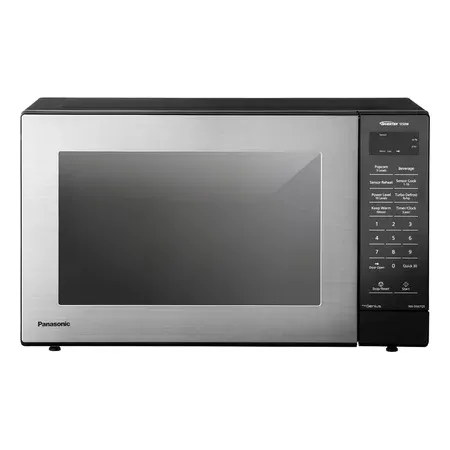
Best inverter microwave
Panasonic NN-SN67QS
1.2 cu ft, 1,250 W Panasonic inverter with Genius Sensor Reheat and Cook and Turbo Defrost by weight.
The NN-SN67QS is the best-value inverter model in Panasonic’s lineup. It’s 1.2 cubic feet and 1,250 watts, with Sensor Reheat, Sensor Cook and Turbo Defrost by weight, all listed in the owner’s manual. Amazon sold it directly for $199.95. Panasonic’s warranty adds five years on the magnetron part to the standard one year.
The older Panasonic NN-SN686S is the same size at 1,200 watts. It’s long been a top pick in this category, but it cost more ($207.95, from a third-party seller) on November 19.
Best Value: Toshiba ML-EM45PIT
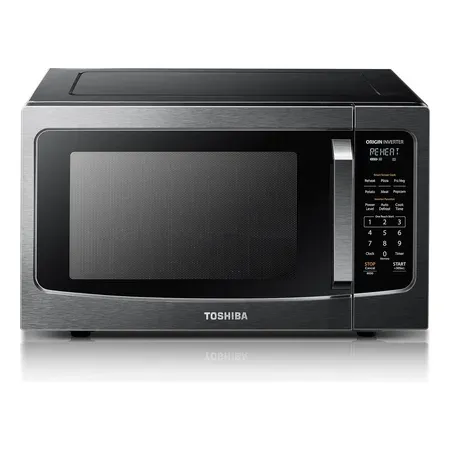
Best value inverter
Toshiba ML-EM45PIT
1.6 cu ft, 1,250 W Origin Inverter with a humidity sensor, weight defrost and a 13.6-inch turntable.
The Toshiba ML-EM45PIT is the cheapest way into a mid-size inverter microwave: 1.6 cubic feet, 1,250 watts output (1,350 watts input, per the manual), a humidity sensor and a 13.6-inch turntable, for $179.94 in black stainless. The stainless version was $212.99. Its manual includes weight defrost, time defrost and a buzzer on/off setting. It’s 21.8 × 19.2 × 13 inches.
Best Mid-Size Panasonic: NN-SN76LS
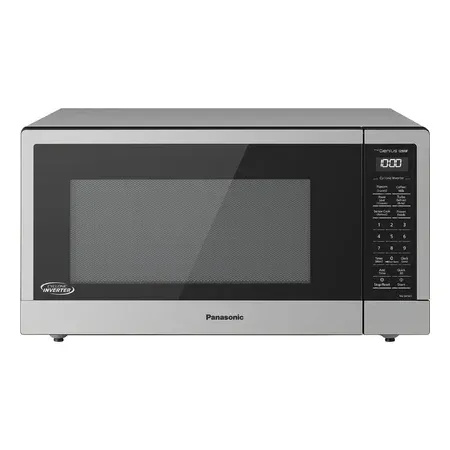
Best Mid-Size panasonic
Panasonic NN-SN76LS
1.6 cu ft, 1,250 W Cyclonic Wave inverter microwave with Genius sensor and Turbo Defrost.
The Panasonic NN-SN76LS is Panasonic’s 1.6-cubic-foot Cyclonic Wave inverter model, rated at 1,250 watts with the Genius sensor. Its cavity is 15 11/16 inches wide and 18 1/2 inches deep, and the outside is 21 7/8 × 19 7/16 × 11 15/16 inches. It was $289.95 at both Amazon and Panasonic (regular $329.95). There is no “NN-SN75LS”; the black and white versions are the NN-SN75LB and NN-SN75LW.
Best Premium: Breville Smooth Wave
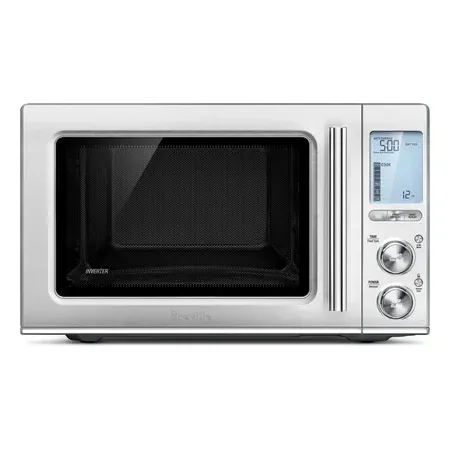
Best premium inverter
Breville Smooth Wave BMO850
1.2 cu ft, 1,200 W Power Smoothing Inverter with Sensor iQ, 15 presets, dial controls and a mute button.
The Breville Smooth Wave wraps an inverter in the easiest controls here: two dials, an LCD, Sensor iQ programs, an A Bit More button and a mute button. The manual rates it at 1,200 watts output and 1,250 watts input. It’s $399.95 from Breville and isn’t sold on Amazon.
Best Small Inverter: LG MSER0990S
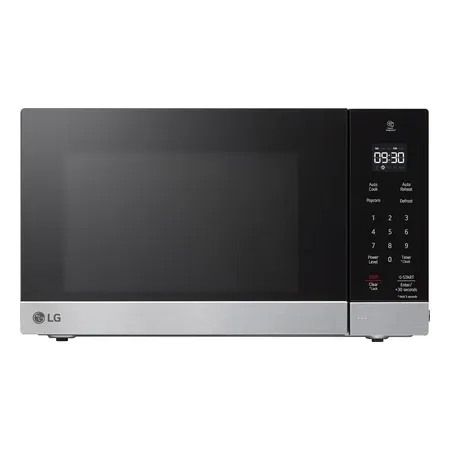
Best small inverter
LG MSER0990S
0.9 cu ft, 1,000 W Smart Inverter microwave, 18 inches wide, with a 10-year inverter magnetron part warranty.
The LG MSER0990S is the smallest inverter model here: 0.9 cubic feet and 1,000 watts in an 18 × 14.5 × 11-inch body, with seven sensor programs. LG sells it for $159 and warrants the inverter magnetron for 10 years (part only). For a bigger LG with the same features, the MSER1590S is 1.5 cubic feet and 1,200 watts for $229.
For a 2.2-cubic-foot inverter model, see the Toshiba ML4-EM22PAIT and Panasonic NN-SN97JS in our large microwaves guide.
FAQ
What is the best inverter microwave?
The Panasonic NN-SN67QS is the best inverter microwave for most people: 1.2 cubic feet, 1,250 watts and a Genius steam sensor for $199.95 on Amazon on November 19, 2026.
Is an inverter microwave worth it?
Yes, if it costs about $25 to $50 more than a comparable model and you defrost or cook at low power often. At full power, inverter and conventional microwaves both run flat out, so an inverter does little for reheating coffee or leftovers on high.
What is the difference between inverter and non-inverter microwaves?
A non-inverter microwave makes lower power settings by switching the magnetron fully on and off. An inverter microwave runs the magnetron continuously at reduced output, which heats more gently at low settings.
Do inverter microwaves cook faster?
Not at full power. A 1,250-watt inverter model heats at about the same rate as a 1,250-watt conventional one on high. Cooking speed depends on the rated wattage.
Is the Panasonic NN-SN686S still a good buy?
It’s still sold and has the same 1.2-cubic-foot inverter and sensor features, rated at 1,200 watts. The newer NN-SN67QS is rated 1,250 watts and was cheaper on Amazon on November 19, 2026.