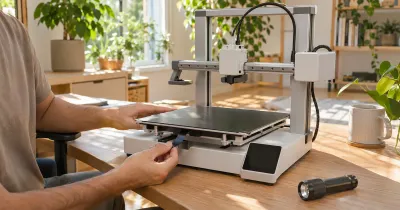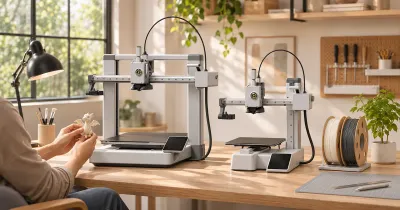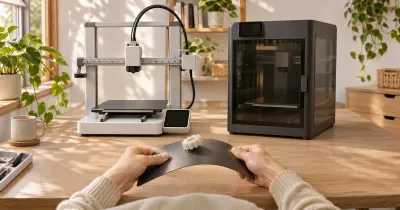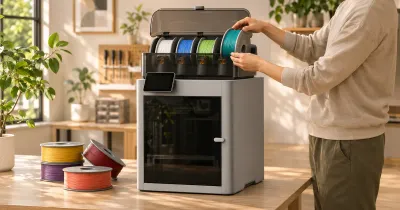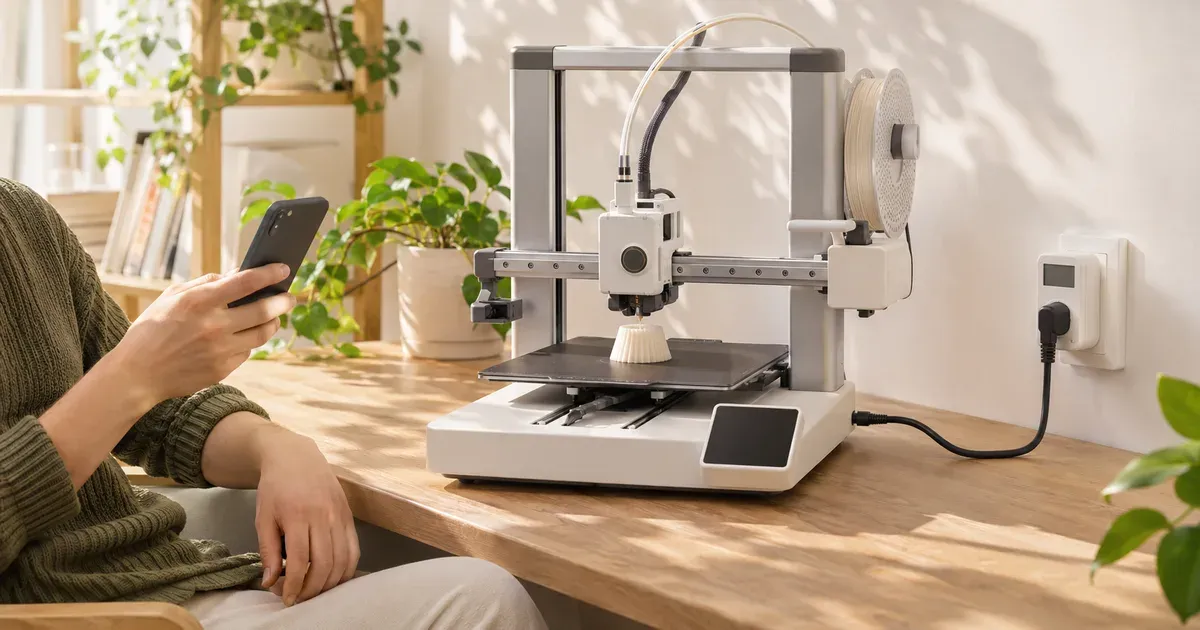
A home 3D printer uses about 80 to 250 watts while printing PLA, which costs about 1.5 to 4.6 cents an hour at the US average electricity price. A small open-frame printer like the Bambu Lab A1 averages 95 watts; a large enclosed printer with a heated chamber like the Bambu Lab X2D averages 250 watts. Printing polycarbonate or other high-temperature filaments roughly doubles that, to as much as 550 watts. Printing four hours a day, an A1 adds about $2 a month to an electric bill, or about $2.65 counting standby.
Costs below use the US average residential price of 18.31 cents per kWh (U.S. Energy Information Administration, July 2026). Our 3D printing cost calculator works it out for your own rate and print.
Power Use and Cost by Printer
Average power while printing, as measured and published by Bambu Lab on its power parameters page.
| Printer | PLA | Cost per hour (PLA) | High-temp filament | Standby (Wi-Fi on) |
|---|---|---|---|---|
| Bambu Lab A1 mini | 80 W | 1.5¢ | n/a | 6 to 7 W |
| Bambu Lab A1 | 95 W | 1.7¢ | 200 W (ABS) | 4 to 5 W |
| Bambu Lab P1S | 105 W | 1.9¢ | 140 W (ABS) | about 6 W |
| Bambu Lab A2L | 145 W | 2.7¢ | n/a | about 5 W |
| Bambu Lab H2D | 197 W | 3.6¢ | 395 W (PC) | 25 to 27 W |
| Bambu Lab P2S | 200 W | 3.7¢ | not published | about 8 W |
| Bambu Lab H2S | 200 W | 3.7¢ | 330 W (PC) | about 27 W |
| Bambu Lab H2C | 200 W | 3.7¢ | 294 W (PC) | 26 to 29 W |
| Bambu Lab H3C | 240 W | 4.4¢ | 540 W (PC) | about 12 W |
| Bambu Lab X2D | 250 W | 4.6¢ | 550 W (PC) | about 8 W |
Other makers’ printers of the same type draw similar amounts: open-frame printers sit at the low end, and printers with heated chambers at the high end.
What a Month of Printing Costs
At 18.31¢ per kWh, with the printer left on standby the rest of the time:
| Printer and use | Energy per month | Cost per month |
|---|---|---|
| A1, PLA, 1 hour a day | about 6 kWh | about $1.15 |
| A1, PLA, 4 hours a day | about 14 kWh | about $2.65 |
| P2S, PLA, 4 hours a day | about 29 kWh | about $5.30 |
| X2D, PLA, 4 hours a day | about 35 kWh | about $6.40 |
| X2D, polycarbonate, 4 hours a day | about 71 kWh | about $13 |
| H2S, PLA, 8 hours a day (print farm duty) | about 60 kWh | about $11 |
For comparison, a 1 kg spool of PLA costs $14 to $30. For most people, filament costs several times more than electricity. See how much a 3D printer costs for the full running costs.
What Uses the Power
The heated bed and nozzle. Most of a printer’s energy goes into keeping the bed (55 to 65°C for PLA, up to 110°C for ABS) and the nozzle (around 200 to 300°C) hot. That’s why ABS and polycarbonate, which need hotter beds and nozzles, draw more.
The chamber heater. Printers that actively heat the chamber to 65°C, like the X2D and H2 series, use the most power for engineering filaments. Bambu’s figures show the X2D at 250 W for PLA and 550 W for polycarbonate.
Heat-up. Printers draw far more while heating than while printing. Bambu rates the A1’s maximum draw at 350 W on a 110 V supply and the H2 series at 1,250 W, but only for a few minutes at the start of a print.
Standby. A printer left on between prints draws 4 to 8 W for most Bambu models and about 25 to 29 W for the H2 series. Left on all month, an H2D uses about 19 kWh, roughly $3.40, which is more than an A1 uses printing PLA for an hour every day.
Filament dryers. The AMS 2 Pro uses about 80 W while drying filament and the AMS HT about 170 W. A six-hour drying session in an AMS HT uses about 1 kWh, or 18 cents.
How to Use Less Electricity
- Turn the printer off between print sessions, especially an H2-series printer.
- Print PLA when it does the job. It needs the lowest temperatures of any common filament.
- Keep the room warm in winter, or use an enclosure for ABS: a cold room makes the bed and chamber heaters work harder.
- Batch small parts on one plate so the printer heats up once instead of several times.
- Use a printer’s Low Power Mode if it has one. Bambu’s H2 series limits peak draw to about 860 W in Low Power Mode, which also helps on shared circuits.
Can You Run a 3D Printer on a Power Station or Solar?
Yes, if the station’s inverter covers the heat-up peak, not just the average. An A1 averages 95 W but can briefly draw 350 W on a 110 V supply, so a power station with a continuous output of at least 500 W and about 1 kWh of capacity runs it through a typical 5 to 8 hour print. Large heated-chamber printers need a much bigger inverter. Check the maximum power on your printer’s spec sheet. Our mAh to Wh calculator helps compare battery capacities.
3D Printer Electricity FAQ
How many watts does a 3D printer use?
About 80 to 250 watts on average while printing PLA, depending on the printer. Bambu Lab measures the A1 mini at 80 W, the A1 at 95 W, the P1S at 105 W, the P2S at 200 W and the X2D at 250 W. High-temperature filaments like polycarbonate push large printers to about 300 to 550 W.
How much does it cost to run a 3D printer for an hour?
About 1.5 to 4.6 cents for PLA at the US average of 18.31 cents per kWh. A 10-hour print on an A1 costs about 17 cents in electricity.
Does a 3D printer use a lot of electricity?
No. A small printer printing PLA uses about as much as a desktop computer, and a month of regular use usually adds $1 to $6 to an electric bill.
How much power does a 3D printer use on standby?
Bambu’s A-series and P-series printers draw about 4 to 8 watts on standby. The H2 series draws about 25 to 29 watts, which adds up to about $3.40 a month if it’s left on all the time.
Does a heated bed use the most power?
Usually, along with the nozzle heater. On printers that heat the chamber, the chamber heater is the biggest load when printing engineering filaments.
How much does it cost to run a 3D printer 24/7?
An A1 printing PLA nonstop uses about 68 kWh a month, roughly $12.50 at the US average rate. An X2D printing PLA nonstop uses about 180 kWh, roughly $33.