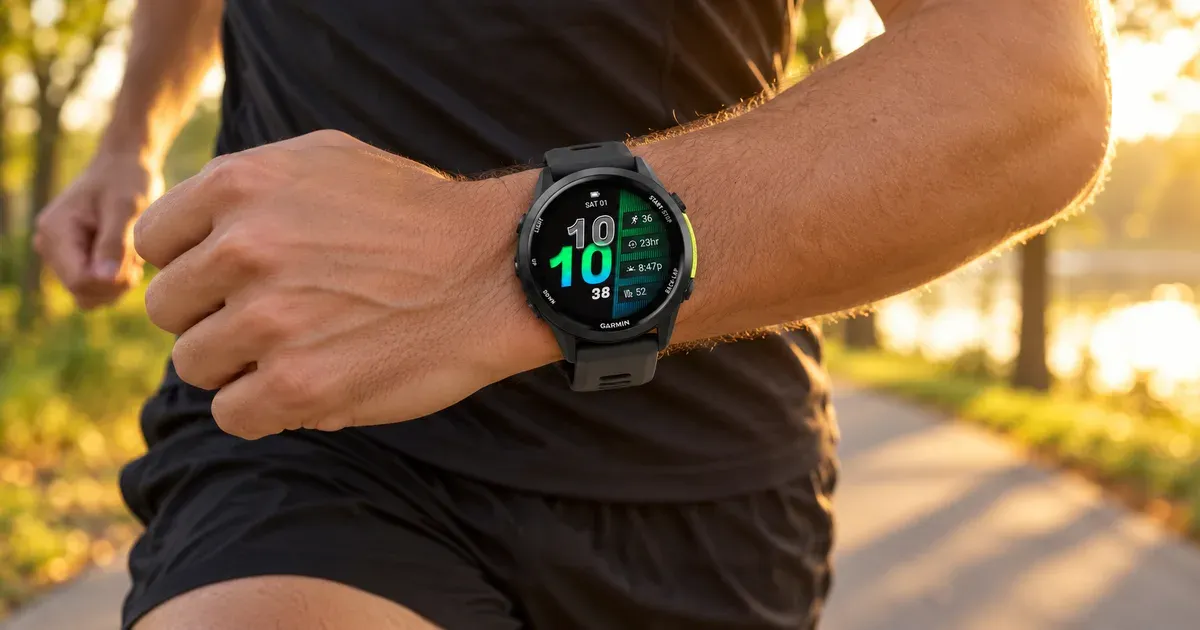
The Garmin Forerunner 970 is the watch I use for my daily run training and for racing. I upgraded from a Forerunner 945, and it was a big upgrade. I rely on the AMOLED screen, the dual-band GPS, the training metrics, and the maps, and I rarely think about the battery. I don’t have any complaints, and I’d buy it again.
The short answer: at $749.99, it’s a lot to spend on a running watch, but if you train seriously and want one watch that does everything, this is the one I’d buy.
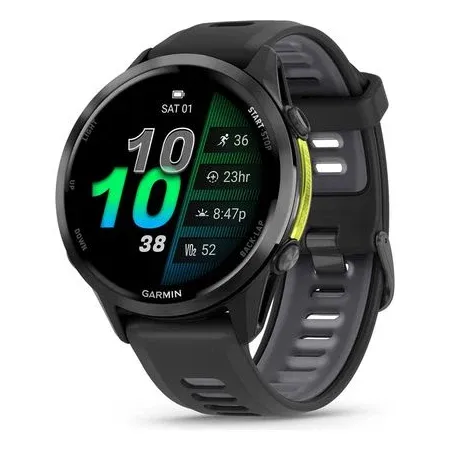
Best running watch for serious training
Garmin Forerunner 970
A premium GPS running watch with a bright AMOLED screen, maps, and great battery life.
Garmin Forerunner 970 Review: Quick Verdict
I’ve put hundreds of miles on this watch, and it does everything I want from a running watch. Coming from an older Forerunner, the difference was obvious.
Garmin Forerunner 970 specs
| Spec | Value | Note |
|---|---|---|
| Price | $749.99 | |
| Case size | 47mm | |
| Display | 1.4-inch AMOLED touchscreen | 454 x 454 pixels |
| Materials | Sapphire lens and titanium bezel | |
| Weight | 56g | |
| Smartwatch battery | Up to 15 days | |
| GPS battery | Up to 26 hours | GPS only |
| Multi-band GPS battery | Up to 21 hours | Up to 12 hours with music |
| Storage | Up to 32GB | |
| Extras | LED flashlight, speaker, microphone, and ECG app |
What I Rely On
The AMOLED screen. This is the most obvious change from my 945. Garmin calls it its brightest smartwatch display, and at 454 x 454 pixels, it has far more resolution than my old watch’s 240 x 240 memory-in-pixel screen.
Dual-band GPS. I use it every day for training and in races, so I need to be able to trust the pace and distance. That’s why I rely on it.
Training metrics. The Forerunner 970 has Training Readiness, training load, HRV status, and running dynamics, and these are a real part of how I use it. It also adds running tolerance, which recommends a weekly maximum mileage.
Maps and navigation. It has full-color built-in maps. Garmin’s dynamic round-trip routing can also build a new route to get you back to the same mileage if you go off the path.
Battery life. I rarely think about it, and that’s the best thing I can say about any watch’s battery. Garmin rates it at up to 15 days in smartwatch mode.
The watch also has a built-in flashlight, a speaker and microphone for calls, and an ECG app, for people who want those extras.
Forerunner 970 vs. Forerunner 945
For me, this was a big upgrade. If you’re still on a 945, here’s what changes.
Garmin Forerunner 970 and 945 specs
| Spec | Forerunner 970 | Forerunner 945 |
|---|---|---|
| Display | 1.4-inch AMOLED touchscreen | 1.2-inch memory-in-pixel |
| Resolution | 454 x 454 | 240 x 240 |
| Weight | 56g | 50g |
| Smartwatch battery | Up to 15 days | Up to 2 weeks |
| GPS battery | Up to 26 hours | Up to 36 hours |
| Multi-band GPS | Yes | No |
| Flashlight | Yes | No |
| Speaker and microphone | Yes | No |
One thing is worth knowing: the 945 actually has the higher GPS battery rating on paper. That hasn’t been an issue for me, since the 970’s battery is something I rarely think about, but if you do very long ultras, you should plan around the 970’s lower number.
Forerunner 970 vs. 965 vs. 570
I haven’t used either of these, so this comes from Garmin’s specs.
Compared with the Forerunner 965, Garmin says the 970 has a brighter display, a sapphire lens instead of Gorilla Glass, and more battery in multi-band mode: up to 21 hours instead of 19. It also adds the flashlight and newer running features. If you already own a 965, the jump won’t be as large as mine was.
Compared with the Forerunner 570, which costs $549.99, you’re paying $200 more. Garmin lists the sapphire lens, titanium bezel, flashlight, running tolerance, running economy, step speed loss, and ECG app as exclusive to the 970, and its smartwatch battery is rated at 15 days instead of 11. If you don’t need those, save the money. For a broader comparison, see my guide to Garmin vs. Apple Watch.
How Much Should You Trust the Training Metrics?
I use them, but I treat them as guidance rather than lab results. Garmin itself describes Training Readiness data as a close estimate.
The research points the same way. A 2022 meta-analysis of consumer wearables found that exercise-based VO2 max estimates had almost no average bias across groups, but the error for any one person could be large, with limits of agreement of about 10 ml/kg/min in either direction. I couldn’t find a systematic review of Garmin’s Training Readiness or running tolerance scores.
So it’s better to watch your trends over time, and not to worry about one number on one morning.
Is the Garmin Forerunner 970 Worth It?
For me, yes. I have no complaints, and I’d buy it again. I use it every day, and it’s a major step up from the watch I had before.
Buy it if you train and race regularly, you want maps and a bright screen on one watch, or you’re coming from an older Forerunner like the 945.
Skip it if you run casually, you already own a 965, you don’t need the 970’s exclusive features, or you’d rather spend less on a Forerunner 570.
Garmin Forerunner 970 FAQ
How much does the Garmin Forerunner 970 cost?
It’s $749.99 at both Garmin and Amazon.
Is the Forerunner 970 worth upgrading from a 945?
It was for me. It was a big upgrade, particularly for the AMOLED screen, dual-band GPS, and newer training features.
How long does the Forerunner 970 battery last?
Garmin rates it at up to 15 days in smartwatch mode, 26 hours in GPS-only mode, and 21 hours with all systems and multi-band. In my use, I rarely have to think about it.
Does the Forerunner 970 have maps?
Yes. It has full-color built-in maps, and I rely on them along with its navigation features.
What size is the Forerunner 970?
It has a 47mm case and a 1.4-inch display, and it weighs 56g.
What’s the difference between the Forerunner 970 and 570?
The 970 costs $200 more and adds a sapphire lens, titanium bezel, flashlight, running tolerance, running economy, step speed loss, and an ECG app.
Does the Forerunner 970 have a flashlight?
Yes. It has a built-in LED flashlight that you can control from the display.