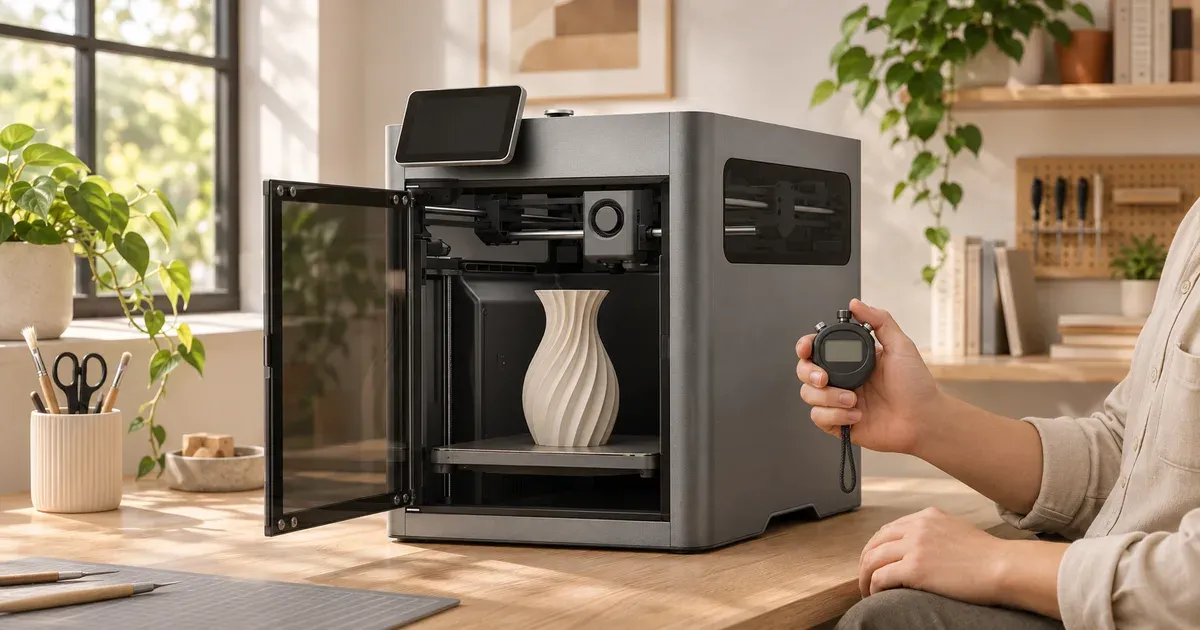
The fastest consumer 3D printer by published top speed is the Bambu Lab H3C, rated at 1,400 mm/s with 25,000 mm/s² acceleration. It’s a $2,499 toolchanger that Bambu announced on November 3, 2026, and it’s backordered, with Bambu’s store estimating shipment around November 30. Among printers you can buy today, the Bambu Lab X2D, H2S, H2D and H2C are rated at 1,000 mm/s, and the Sovol SV08 has the highest acceleration of any consumer printer at 40,000 mm/s², for $529.
Top speed is the least useful of these numbers. Most prints never reach it, because the printer spends its time speeding up and slowing down for corners and because the hotend can melt only so much plastic per second. Acceleration and hotend flow decide how long a real print takes.
Fastest 3D Printers by Published Speed
Makers’ rated top speed and acceleration. Prices are Black Friday prices on each maker’s US store.
| Printer | Top speed | Acceleration | Type | Price |
|---|---|---|---|---|
| Bambu Lab H3C | 1,400 mm/s | 25,000 mm/s² | Enclosed toolchanger | $2,499 |
| Bambu Lab H2C, H2D, H2S | 1,000 mm/s | 20,000 mm/s² | Enclosed CoreXY | $1,049 to $1,899 |
| Bambu Lab X2D | 1,000 mm/s | 20,000 mm/s² | Enclosed CoreXY | $589 |
| QIDI Max4 | 800 mm/s | 30,000 mm/s² | Enclosed CoreXY | $1,049 |
| Sovol SV08 and SV08 Max | 700 mm/s | 40,000 mm/s² | Open CoreXY | $529 / $1,049 |
| Creality K2 Plus | 600 mm/s | 30,000 mm/s² | Enclosed CoreXY | $899 |
| Creality K2, K2 Pro, K1C, K1 Max | 600 mm/s | 20,000 mm/s² | Enclosed CoreXY | $399 to $549 |
| Bambu Lab P2S | 600 mm/s | 20,000 mm/s² | Enclosed CoreXY | $449 |
| QIDI Plus5, Plus4, Q2 | 600 mm/s | 20,000 mm/s² | Enclosed CoreXY | $449 to $699 |
| Anycubic Kobra S1, S1 Max | 600 mm/s | 20,000 mm/s² | Enclosed CoreXY | $499 / $699 |
| Anycubic Kobra 4, Kobra X | 600 mm/s | 20,000 mm/s² | Open frame | $279 / $299 |
| Bambu Lab P1S | 500 mm/s | 20,000 mm/s² | Enclosed CoreXY | $349 |
| Elegoo Centauri Carbon 2 | 500 mm/s (250 recommended) | 20,000 mm/s² | Enclosed CoreXY | $319 |
| Bambu Lab A1, A1 mini, A2L | 500 mm/s | 10,000 mm/s² | Open bed slinger | $199 to $439 |
| Flashforge AD5X | 300 mm/s printing (600 travel) | 20,000 mm/s² | Open CoreXY | $319 |
| Creality Ender-3 V3 SE | 250 mm/s | 2,500 mm/s² | Open bed slinger | $199 |
Prusa publishes no acceleration figures, and the only speed figure is the CORE One L+‘s 500 mm/s travel speed.
Why Top Speed Is Misleading
The printer rarely gets there. A print head that needs 1,000 mm/s has to accelerate to it and slow down again before the next corner. On a small part with short moves, it spends most of its time accelerating. That’s why a printer with high acceleration often finishes small parts faster than one with a higher top speed.
The hotend sets a ceiling. At 600 mm/s, a standard 0.4 mm nozzle laying a 0.45 mm wide, 0.2 mm tall line has to melt 54 cubic millimeters of plastic every second (0.45 × 0.2 × 600). Most hotends can’t melt standard filament that fast, so the slicer slows the print to what the hotend can handle, whatever the printer’s rated speed. Makers publish this as maximum volumetric flow, but few publish it consistently, so it’s rarely on spec sheets.
Cooling sets another. PLA has to cool before the next layer lands on it. On small parts the printer slows down or pauses so each layer can set.
Speed costs quality. Most printers print outer walls more slowly than infill for a clean surface. The fastest settings are fine for prototypes and test fits, not for parts people will look at.
What Speed Means for Print Times
The jump that matters is from an older bed slinger to any modern CoreXY or tuned bed slinger. Between current printers rated at 500, 600 and 1,000 mm/s, the difference on typical prints is minutes, not hours. It grows on large parts with long straight moves, like big vases and panels.
Fastest Printers by Budget
Under $300: Bambu Lab A1. Its 500 mm/s and 10,000 mm/s² aren’t the highest numbers here, but it tunes its vibration compensation automatically, and it’s $259. The Ender-3 V3 SE is cheaper but far slower.
Under $600: Bambu Lab X2D or Sovol SV08. The X2D ($589) is rated at 1,000 mm/s with a heated chamber and two nozzles. The SV08 ($529) has the highest acceleration of any consumer printer, 40,000 mm/s², and a 350 mm build volume, but it’s an open frame without an enclosure.
Large and fast: Creality K2 Plus or QIDI Max4. Both accelerate at 30,000 mm/s² with heated chambers: the K2 Plus with a 350 mm cube for $899, the Max4 with a 390 × 390 × 340 mm volume for $1,049.
Fastest overall: Bambu Lab H3C. Rated at 1,400 mm/s and 25,000 mm/s², with nine tools for multicolor and multi-material printing, for $2,499.
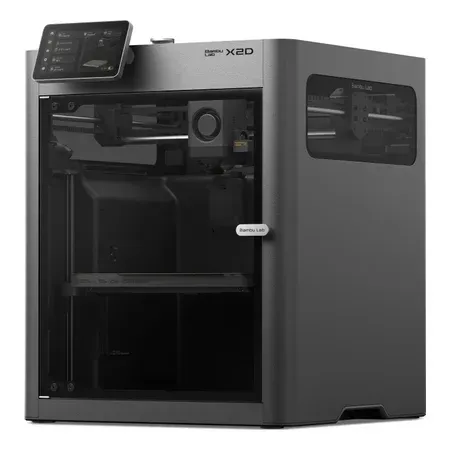
Fastest under $600
Bambu Lab X2D
Rated at 1,000 mm/s with 20,000 mm/s² acceleration, two nozzles and a 65°C heated chamber.
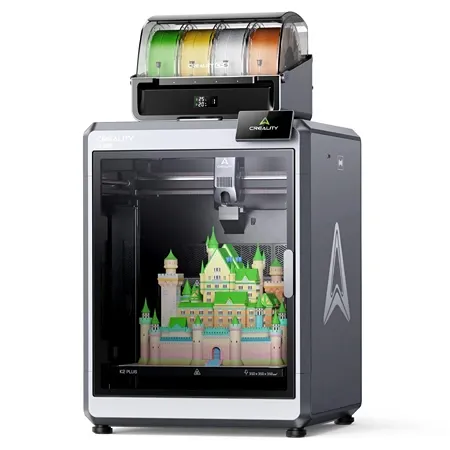
Fast and large
Creality K2 Plus Combo
30,000 mm/s² acceleration and a 350 mm build volume, with a 60°C heated chamber and four-color CFS.
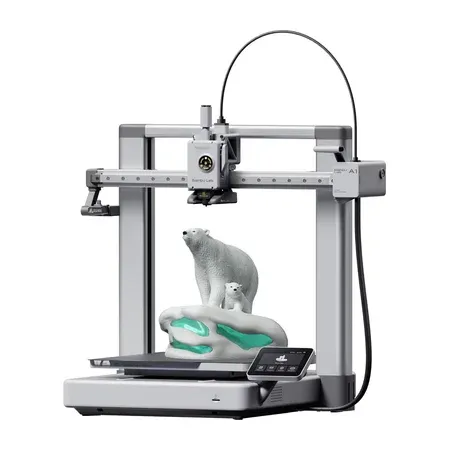
Fastest under $300
Bambu Lab A1
500 mm/s and 10,000 mm/s² with automatic tuning, on a 256 mm open-frame printer.
For how CoreXY printers reach higher accelerations than bed slingers, see CoreXY vs. bed slinger.
Fast 3D Printers FAQ
What is the fastest 3D printer?
By published top speed, the Bambu Lab H3C at 1,400 mm/s. By acceleration, the Sovol SV08 at 40,000 mm/s². Among widely available printers, Bambu’s X2D and H2 series are rated at 1,000 mm/s.
Is a faster 3D printer worth it?
The jump from an older printer to any current CoreXY printer is worth it: prints take a fraction of the time. Between current printers rated at 500 and 1,000 mm/s, the difference on most prints is small.
Why doesn’t my printer reach its rated speed?
Because it slows down for corners, short moves, cooling time and the limit of how much plastic its hotend can melt per second. Most prints never reach rated top speed.
Is acceleration or speed more important?
Acceleration, for most prints. Small and detailed parts are made of short moves, and high acceleration gets the print head up to speed on each one.
Does printing faster reduce quality?
It can. Fast printing can cause ringing, weaker layer bonding and rougher surfaces. Slicers print outer walls more slowly than infill to keep visible surfaces clean.