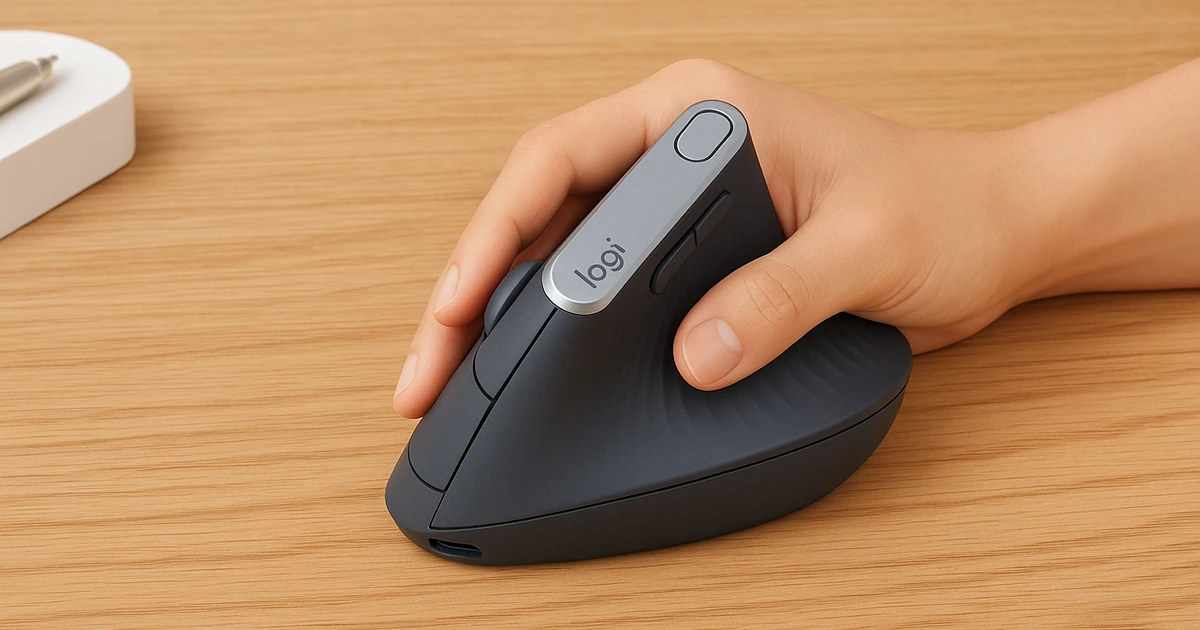

A vertical mouse changes forearm rotation; it does not diagnose or cure wrist pain. Hand size, desk height, grip, keyboard position, and how often the mouse must be lifted all affect whether the upright shape feels relieving or simply unfamiliar.
We compared fit, button reach, tracking, connectivity, battery design, software, noise, and long-term owner feedback. Persistent pain, numbness, weakness, or tingling deserves professional medical or ergonomic assessment rather than relying on a peripheral purchase alone.
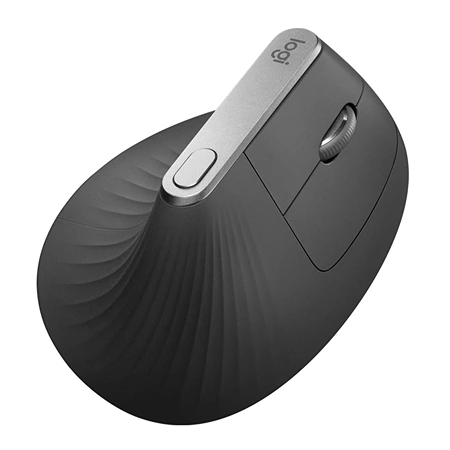
Logitech MX
Best Overall Option
Reduces wrist strain with a natural handshake position, durable build, and versatile connectivity in a sleek ergonomic design.
The Logitech MX Vertical Wireless Mouse fills a medium-to-large right hand with a tall 57-degree grip. That posture reduces forearm pronation for many users, while the broad thumb shelf and rubberized surface keep the hand supported instead of pinching the mouse from its sides.
Its optical sensor adjusts from 400 to 4,000 DPI, enough for productivity and multi-monitor work rather than competitive gaming. A top button changes pointer speed, and four primary controls can be customized through Logi Options+. The ordinary notched wheel lacks the free-spinning and horizontal features associated with Logitech’s MX Master line.
Bluetooth and the included Unifying receiver support wireless use, and the mouse can switch among three computers. USB-C charging allows continued corded operation, with Logitech claiming up to four months from the small internal battery. That battery is not designed for easy user replacement, an ownership disadvantage beside AA-powered alternatives.
The large sculpted body is comfortable only when it fits. Small hands may stretch for buttons, fingertip grippers can find it cumbersome, and left-handed users are excluded. At 135 grams it also feels slow to lift repeatedly, although broad PTFE feet help it glide across a suitable pad.
MX Vertical remains polished and versatile, but it is an old design sold at a premium and carries only a one-year U.S. warranty. It makes sense for a right-handed user who can try the fit and values USB-C, multi-device switching, and mature software. The smaller Lift is safer when hand size is uncertain.
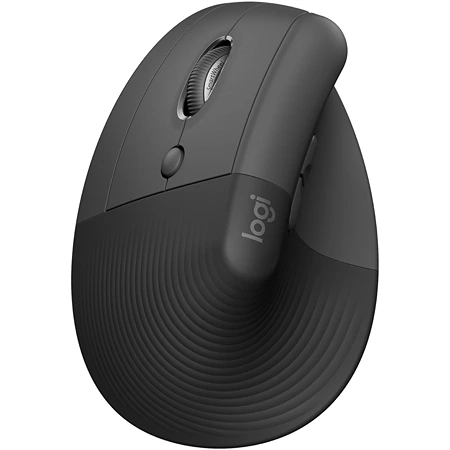
Logitech Lift
Second Best Option
Designed for small to medium hands with a comfortable natural grip, quiet buttons, smooth scroll wheel, and flexible connectivity.
Smaller hands are the design center of the Logitech Lift, which retains a 57-degree posture in a shorter, lighter body. Logitech sells both right- and left-handed versions, an important distinction in a category that too often treats left-handed users as an afterthought.
The six controls include quiet primary clicks, back and forward buttons, and a SmartWheel that changes scrolling behavior with speed. Tracking ranges from 400 to 4,000 DPI and feels precise for office tasks. Button travel and the relatively low report rate are designed for productivity, not high-level competitive games.
Logi Options+ provides per-app assignments, gestures, pointer adjustment, and Flow between supported computers. Bluetooth and the Logi Bolt receiver pair with up to three devices, with a button underneath selecting channels. Bolt is not compatible with the older Unifying receiver despite their similar appearance.
Subscribe to Product Bible
Stay updated with the latest product reviews, buying guides, and expert recommendations. Fresh advice on the best things we've researched, tested, and reviewed, sent to your inbox weekly.
Want to know more about how we handle your data or opt out of marketing emails? Check out our Privacy Policy. If you have any questions, we're always here to help.
A single AA battery is rated for up to 24 months and is easy to replace, avoiding an aging sealed cell. The 125-gram weight includes that battery and remains manageable on a good mouse pad. Users who constantly lift and recenter may still struggle to grip the sloped outer side.
Lift is approachable, quiet, and broadly compatible, but fit remains personal: large hands can curl uncomfortably and a vertical posture can shift strain rather than remove it. Buy from a seller with a useful return window. For small-to-medium hands and shared office spaces, its size and replaceable power source are unusually well judged.
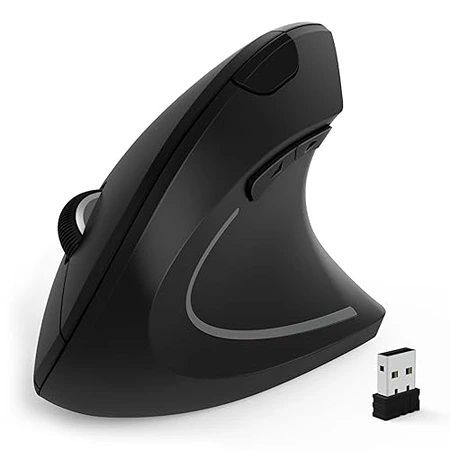
Anker 2.4G
Best Budget Option
Solid ergonomic support at an affordable price with a comfortable vertical design, responsive optical tracking, and plug-and-play setup.
Experimenting with an upright grip costs little with the Anker 2.4G Wireless Vertical Ergonomic Optical Mouse. Its narrow handshake shape supports many medium and large right hands, and the plug-in receiver avoids accounts, pairing menus, and background configuration software.
Three preset sensitivity levels, commonly 800, 1,200, and 1,600 DPI, are selected from a button rather than tuned precisely. Tracking is adequate for documents and browsing but can feel inconsistent on difficult surfaces. Click latency is high beside gaming mice, making it a poor competitive choice despite having useful back and forward buttons.
The mouse uses two AAA batteries and sleeps to conserve them. Power is easily replaced, but batteries are generally not included and there is no wired mode when they fail. The tiny 2.4GHz receiver stores inside the mouse for travel, although Bluetooth-only tablets cannot connect without an adapter.
Build quality is respectable for the price, with a light plastic shell and basic wheel rather than premium materials. Buttons are not fully programmable, left-handed support is absent, and the tall body occupies more bag space than a conventional travel mouse. Fit can also leave smaller fingers short of the main buttons.
Anker’s value is diagnostic as much as practical: it lets someone test whether a vertical posture helps before spending heavily. If the shape works, its simple design can remain a perfectly usable office mouse. Users who need multi-device pairing, silent clicks, precise software, or a smaller shell should upgrade.
Lenovo Go
Affordable Ergonomic Option
Ergonomic vertical grip with textured sides for control and reliable wireless connectivity, a solid budget-friendly choice.
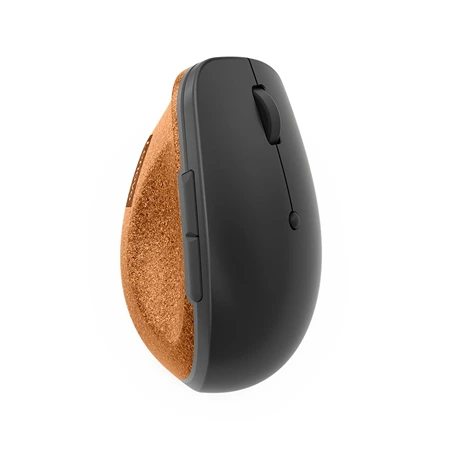
Cork-textured material makes the Lenovo Go Vertical Mouse feel unlike the black rubber common to ergonomic peripherals. Its approximately 45-degree angle is less upright than the Logitech models, offering a gentler transition for users who dislike a full handshake posture.
The compact right-handed body favors small-to-medium hands and a relaxed palm or claw grip. Six buttons cover ordinary productivity, while adjustable sensitivity reaches up to 2,400 DPI. The wheel and clicks are functional rather than luxurious, and there is no advanced gaming sensor or high report-rate mode.
Connection is limited to the included 2.4GHz USB receiver. There is no Bluetooth, wired fallback, or multi-device switching, so a laptop with only USB-C needs an adapter. The receiver stores within the body, and one AA battery provides straightforward replaceable power.
Lenovo’s software allows basic button and DPI changes on supported systems, but it is less extensive than Logi Options+. The cork-like finish is comfortable and distinctive, though long-term appearance depends on hand oils and cleaning. As always, exact bundle and regional software support should be checked.
This mouse is attractive when a 57-degree design feels too extreme and a single computer is all that matters. Its modest price, compact size, and replaceable battery are practical. Limited connectivity makes it harder to recommend for a multi-device desk despite the refined exterior.
Treat the first week as an adaptation period, not a test of endurance. Alternate with the old mouse, keep the pointer sensitivity high enough to reduce large arm movements, and place the device close to the keyboard so reaching does not undermine the intended posture.
No shape is universally ergonomic. Return a mouse that creates new thumb, shoulder, or finger discomfort, and address chair height, forearm support, keyboard width, and breaks at the same time. An input device helps most when the entire workstation allows a relaxed neutral position.