A cold garage is hard to work in. Tools are freezing, paint and glue won’t cure, and your hands go numb. The fix depends on how you use the space. An attached two-car garage you work in on winter weekends needs a very different heater from a detached shop you use every day.
There are three main types:
- 240-volt electric heaters are the best choice for most attached garages: safe, clean, quiet, and controlled by a thermostat. They need a dedicated circuit.
- Vented gas unit heaters, running on natural gas or propane, are the cheapest to run in large, cold, or heavily used garages, but cost more to install.
- Portable heaters, propane or 120-volt electric, warm you up for an hour of work with no installation.
Our top pick is the Dr. Infrared Heater DR-966 (about $176). It’s a 240-volt, 6,000-watt fan heater that mounts on a wall or ceiling, has a built-in thermostat, and warms a typical insulated two-car garage. For big or uninsulated garages, the Mr. Heater Big Maxx 50,000 BTU gas heater is the most powerful choice. And for occasional use, the portable Mr. Heater Big Buddy propane heater needs no installation at all.
Our Picks at a Glance
| Heater | Best for | Power | Heat output | Price |
|---|---|---|---|---|
| Dr. Infrared DR-966 | Most attached garages | 240 V, hardwired | Up to 6,000 W (about 20,500 BTU) | About $176 |
| Mr. Heater Big Maxx | Large or uninsulated garages, shops | Natural gas or propane, vented | 50,000 BTU | About $450 |
| Mr. Heater Big Buddy | Occasional use, no installation | Propane | Up to 18,000 BTU | About $145 |
| Dr. Infrared Indoor-Outdoor Heater | Spot heating a workbench | 120 V plug-in | 1,500 W (about 5,100 BTU) | About $153 |
Best Overall: Dr. Infrared DR-966
Best overall
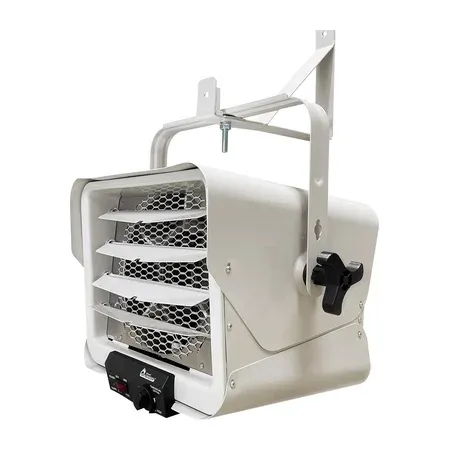
Dr. Infrared Heater DR-966
A 240-volt, 3,000/6,000-watt wall or ceiling heater with an adjustable thermostat and louvers.
The Dr. Infrared DR-966 is a simple, sturdy 240-volt fan-forced heater for garages and workshops. Despite the brand name, it’s not an infrared heater: a heating element warms air and a fan blows it into the room through adjustable louvers you can aim at your workbench or the middle of the floor. It runs at 3,000 or 6,000 watts, and an adjustable thermostat cycles it on and off to hold the temperature you set.
At 6,000 watts, it produces about 20,500 BTU an hour, enough for an insulated two-car garage of roughly 400 to 600 square feet. It’s UL listed and comes with a bracket for wall or ceiling mounting; mount it high and out of the way, angled down toward where you work. It has more than 4,300 Amazon ratings averaging 4.3 stars.
It’s hardwired: there’s no plug or cord, so it needs a dedicated 240-volt circuit. At 6,000 watts it draws 25 amps, which typically means a 30-amp double-pole breaker and appropriately sized wire. Unless you’re comfortable with electrical work, hire an electrician.
Buy it if you have an attached or insulated garage and want steady, safe, thermostat-controlled heat.
Best Gas: Mr. Heater Big Maxx 50,000 BTU
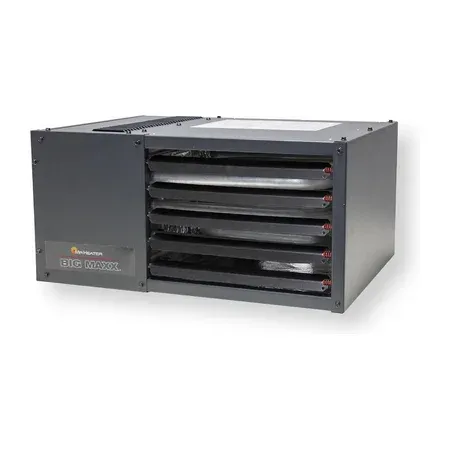
Best gas heater
Mr. Heater Big Maxx 50,000 BTU
A vented, ceiling-hung natural gas or propane unit heater for garages up to about three cars.
For a large, detached, or poorly insulated garage, or a shop you heat every day, gas is usually cheaper to run than electricity. The Mr. Heater Big Maxx is a ceiling-hung unit heater that burns natural gas or propane and sends its exhaust outside through a vent, so combustion gases don’t build up in the garage. Mr. Heater says its 50,000 BTU output heats up to about 1,667 square feet, roughly a three-car garage.
It works with a standard 24-volt wall thermostat, including Wi-Fi models, sold separately. It has a flame sensor and a high-temperature safety shutoff. It needs a ceiling at least 10 feet high with 8 feet of clearance below the heater, a gas line, a vent through the wall or roof, and an electrical outlet for the blower. Installation should be done by a licensed professional, which can cost as much as the heater. An 80,000 BTU version is available for bigger spaces.
Buy it if you have a big or cold garage or shop with gas available and want the lowest running cost.
Best Portable: Mr. Heater Big Buddy
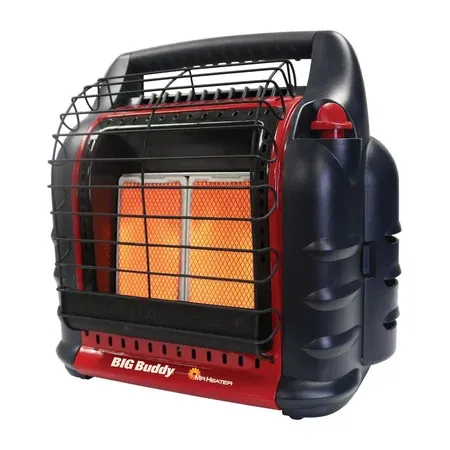
Best portable heater
Mr. Heater Big Buddy 18,000 BTU
A portable propane radiant heater rated for indoor use, with three heat settings up to 18,000 BTU.
If you only need heat a few times a month, the Mr. Heater Big Buddy is the easiest option. It’s a portable propane radiant heater you can carry to wherever you’re working, with 4,000, 9,000, and 18,000 BTU settings, enough to warm about 450 square feet. It runs on one or two 1-pound propane cylinders, or a 20-pound tank with an adapter hose.
It’s one of the few propane heaters approved for indoor use. It has a low-oxygen sensor that shuts it off if oxygen in the room drops, and a tip-over switch. Indoor use still requires some ventilation; the manual specifies a minimum opening to fresh air, such as a window or garage door cracked open. Any fuel-burning heater produces carbon monoxide, so use a CO alarm in the garage and keep the heater well away from gasoline, solvents, and paint.
It has more than 5,700 Amazon ratings averaging 4.6 stars. Running on 1-pound cylinders gets expensive; a bulk tank is much cheaper per hour.
Buy it if you heat the garage occasionally and don’t want to install anything.
Best Plug-In: Dr. Infrared Indoor-Outdoor Heater
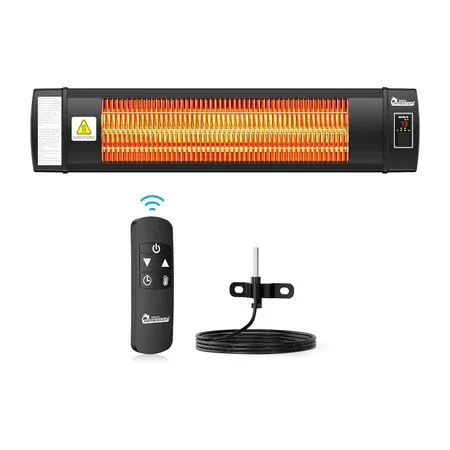
Best Plug-In heater
Dr. Infrared Indoor-Outdoor Infrared Heater
A 120-volt, 1,500-watt infrared heater that mounts above a workbench and warms you directly.
A standard 120-volt outlet can only deliver about 1,500 watts, roughly 5,100 BTU, which isn’t enough to warm a whole cold garage. It can keep you warm, though, if the heat is infrared. Infrared heaters warm people and objects in front of them directly, like sunlight, rather than heating the air, so you feel warm at a workbench even when the rest of the garage is cold.
This Dr. Infrared heater mounts on a wall or ceiling, or hangs from a chain, above where you work. It has 1,000 and 1,500-watt settings, a remote, a digital display, and a corded temperature probe for automatic control, and it’s rated IP55 for damp spaces and outdoor patios. It has more than 6,000 Amazon ratings averaging 4.3 stars.
Plug it into a heavy-duty outlet on its own circuit, not a long, thin extension cord.
Buy it if you work at one spot in the garage and don’t have a 240-volt circuit.
How Big a Heater Do You Need?
A quick rule for electric heaters is about 10 watts per square foot for an insulated garage in a moderate climate, and more for uninsulated garages or very cold regions.
| Garage | Size (approx.) | Electric, insulated | Gas or propane |
|---|---|---|---|
| One-car | 250 sq ft | 2,500 to 4,000 W | 15,000 to 20,000 BTU |
| Two-car | 400 to 600 sq ft | 4,000 to 6,000 W | 25,000 to 35,000 BTU |
| Three-car | 600 to 900 sq ft | 6,000 to 10,000 W | 45,000 to 60,000 BTU |
One watt equals about 3.4 BTU per hour, so a 6,000-watt heater produces about 20,500 BTU. Increase the size if your garage is uninsulated, has high ceilings, or you live somewhere with very cold winters. Our BTU calculator gives a more precise estimate for your space.
Electric vs. Gas vs. Propane
| 240 V electric | Vented gas | Portable propane | |
|---|---|---|---|
| Upfront cost | Low, plus electrician | High, plus pro install | Low |
| Running cost | Moderate to high | Lowest | High |
| Heat output | Up to about 10,000 W | 30,000 to 80,000+ BTU | Up to about 18,000 BTU |
| Indoor air | No combustion gases | Vented outside | Some combustion gases, needs ventilation |
| Best for | Attached, insulated garages | Big, cold, or daily-use shops | Occasional use |
Running costs depend on local prices. Electric heat converts all of its energy into heat but electricity costs more per BTU than natural gas in most of the US. Propane in small cylinders is the most expensive way to heat.
Garage Heater Safety
- Carbon monoxide. Never use a heater that isn’t rated for indoor use, like a torpedo or kerosene construction heater, in a closed garage, and never warm up a car with the garage door closed. Put a CO alarm in any garage with a fuel-burning heater.
- Flammable vapors. Gasoline, paint thinner, and solvents give off heavier-than-air vapors that collect near the floor. Keep any heater with a flame or glowing element well away from them, and store fuels in approved containers.
- Clearance. Keep heaters at least three feet from anything that can burn, and follow the manual’s mounting clearances.
- Wiring. Use the right breaker and wire size for 240-volt heaters, and don’t run space heaters on extension cords. The National Fire Protection Association reports that space heaters account for about a third of home heating fires and most heating-fire deaths.
Insulate First
A heater works far better in a garage that holds heat. The biggest gains come from an insulated garage door or a door insulation kit, weatherstripping around the door and along the bottom seal, and insulating the walls and ceiling if they’re open. Even a few of these can cut the heater size you need and the cost to run it.
For keeping warm in the house, see our guide to the best heated blankets.
How We Chose
We compared garage heaters across electric, vented gas, and portable propane types on heat output and coverage, controls and thermostats, safety features and certifications, installation requirements, running cost, owner ratings, and price. We excluded unvented torpedo and kerosene heaters, which aren’t meant for enclosed garages.
Garage Heater FAQ
What is the best heater for a two-car garage?
A 240-volt electric heater of about 5,000 to 6,000 watts, like the Dr. Infrared DR-966, for an insulated two-car garage. For an uninsulated or very cold garage, a vented gas heater of 30,000 to 50,000 BTU is more effective.
Is it cheaper to heat a garage with gas or electric?
Natural gas is usually cheaper to run, but costs more to install. Electric is cheaper to install and simpler, and often the better value if you only heat the garage occasionally.
Can I use a propane heater in a closed garage?
Only one rated for indoor use, like the Mr. Heater Big Buddy, and still with some fresh air and a carbon monoxide alarm. Never use outdoor-only propane, kerosene, or torpedo heaters in a closed garage.
Can a 120-volt heater heat a garage?
Not a whole cold garage. A 1,500-watt heater produces only about 5,100 BTU, enough to keep you warm at a workbench, especially with an infrared heater, but not to raise the temperature of an entire two-car garage much.
Do I need an electrician to install a garage heater?
For a hardwired 240-volt heater, usually yes, since it needs a dedicated circuit, breaker, and correctly sized wire. Gas heaters need a licensed installer for the gas line and venting.
How warm should I keep my garage?
About 50°F to 60°F is comfortable for working in a jacket and keeps most paints, glues, and tools usable. Keeping it above freezing protects water lines and stored liquids.