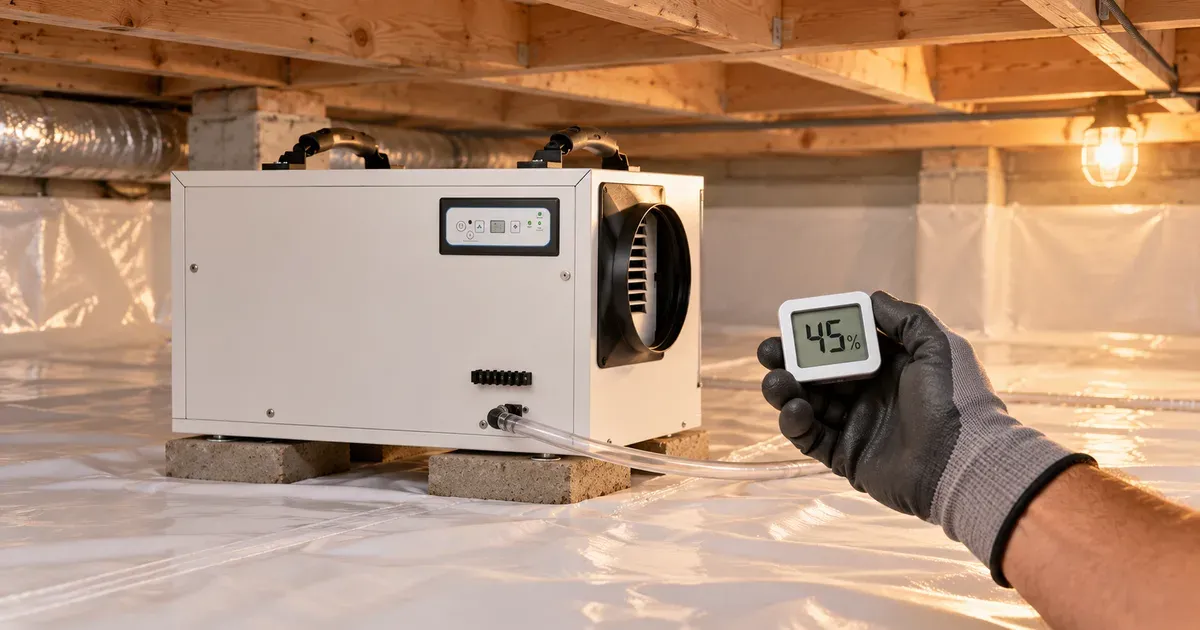
A damp crawl space causes problems you eventually notice upstairs: musty smells, cupping hardwood floors, mold on the joists, and pests that love moisture. Keeping the air down there below about 60% relative humidity stops most of that, and in a sealed crawl space, a dehumidifier is how you do it.
Crawl space dehumidifiers are different from the portable units you’d put in a basement. They’re built to run in cool, damp air without freezing up, they drain continuously so you never empty a bucket, they’re compact and low enough to fit under floor joists, and they’re tough enough to sit on a vapor barrier for years with little attention. Most have metal housings, automatic defrost, and long warranties.
Our top pick is the AlorAir Sentinel HD55S (about $486). It removes up to 55 pints a day at the standard AHAM test condition (120 pints in saturated air), handles crawl spaces up to about 1,300 square feet, defrosts itself in cold air, and has a six-year warranty. If water has to be pumped up and out of the crawl space, the Sentinel HDi65S adds a built-in condensate pump. For a premium unit that’s quieter and widely installed by contractors, the Santa Fe Compact70 is the step up.
Our Picks at a Glance
| Dehumidifier | Best for | Removal (AHAM / saturation) | Coverage | Price |
|---|---|---|---|---|
| AlorAir Sentinel HD55S | Most crawl spaces with a drain | 55 / 120 pints a day | Up to 1,300 sq ft | About $486 |
| AlorAir Sentinel HDi65S | No floor drain nearby | 55 / 120 pints a day | Up to 1,300 sq ft | About $605 |
| Santa Fe Compact70 | Long-term, contractor-grade | 70 pints a day (Santa Fe’s rating) | Up to about 2,200 sq ft | About $1,690 |
| AlorAir 70-Pint | Small crawl spaces | 35 / 70 pints a day | Up to 1,000 sq ft | About $345 |
Best Overall: AlorAir Sentinel HD55S
Best overall
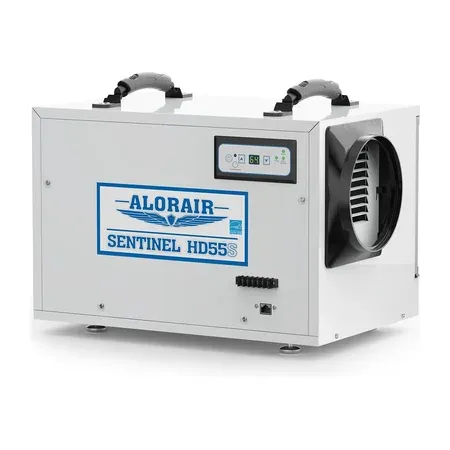
AlorAir Sentinel HD55S
An Energy Star crawl space dehumidifier with auto defrost, gravity drain, a metal case, and a six-year warranty.
AlorAir’s Sentinel line is one of the most common crawl space dehumidifiers, and the HD55S is the model most homes need. It removes up to 55 pints a day under AHAM test conditions and up to 120 pints in saturated air, enough for crawl spaces up to about 1,300 square feet. It’s Energy Star certified, which matters for a machine that may run for hours a day, year-round.
It’s built for crawl spaces. A metal housing stands up to damp and dirt, automatic defrost pauses the compressor and keeps the fan running if frost forms on the coils in cool air, and it restarts on its own after a power outage. It drains by gravity through a hose, so it needs a floor drain, sump, or a path downhill to the outside. A basic MERV-1 filter protects the coils, and optional remote monitoring is available.
AlorAir backs it with a six-year limited warranty and it’s ETL listed for safety. It has more than 1,400 Amazon ratings averaging 4 stars. Like most compressor dehumidifiers, it’s loud enough that you’ll hear it through the floor in a quiet room above.
Buy it if you have a sealed crawl space with a drain or a downhill path for water.
Best With a Pump: AlorAir Sentinel HDi65S
Best with a pump
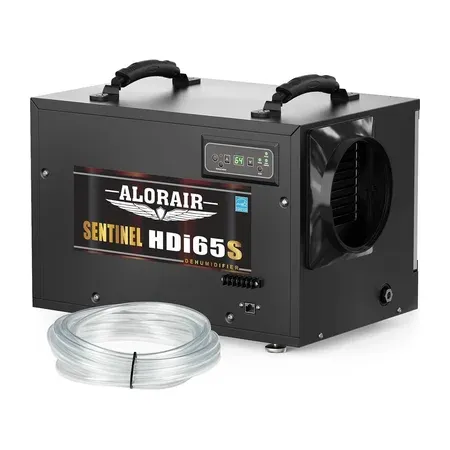
AlorAir Sentinel HDi65S
The Sentinel's capacity with a built-in condensate pump that lifts water up to about 19 feet.
Many crawl spaces have no drain, and the only way out is up through a rim joist or to a sink. The Sentinel HDi65S has the same 55-pint (AHAM) and 120-pint (saturation) capacity and 1,300-square-foot coverage as the HD55S, plus a built-in condensate pump that lifts water up to about 19.6 feet to a window, sink, or exterior drain. You can also use gravity drainage if you prefer.
It’s Energy Star certified, has auto defrost and a metal case, and carries the same six-year warranty, for about $120 more. A built-in pump is simpler and more reliable than adding a separate one.
Buy it if water has to go up to leave your crawl space.
Best Premium: Santa Fe Compact70
Best premium
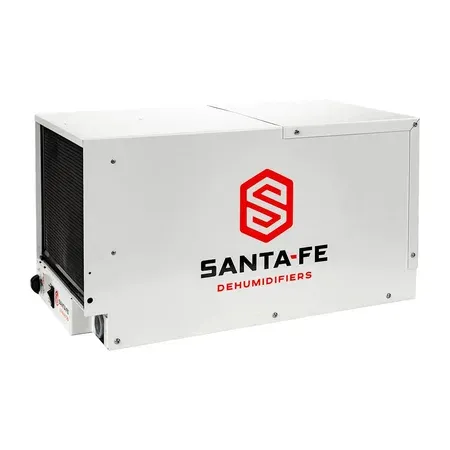
Santa Fe Compact70
A contractor-grade crawl space dehumidifier built for low temperatures, with a six-year warranty.
Santa Fe dehumidifiers, made by Therma-Stor, are what many crawl space contractors and encapsulation companies install. The Compact70 is a compact, low-profile unit engineered for the cool temperatures and restricted airflow of crawl spaces. It operates down to about 49°F, defrosts automatically when frost forms, restarts after power outages, and runs at about 58 to 63 decibels from six feet away.
A simple dial sets the target humidity from 20% to 80%, and it’s built to run for years with little more than filter changes. It has a six-year warranty and more than 100 Amazon ratings averaging 4.5 stars.
It costs more than three times as much as the AlorAir, and it’s sold without a pump (Santa Fe sells pump kits). For many homeowners, the value is a long track record in professional installations. AprilAire’s E070 (about $1,800) is a similar 70-pint contractor-grade option that can also be ducted or hung from the joists.
Buy it if you want a premium, proven unit to run for a decade.
Best for Small Crawl Spaces: AlorAir 70-Pint
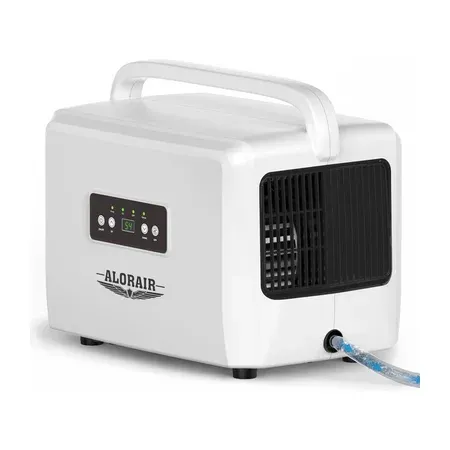
Best for small crawl spaces
AlorAir 70-Pint Crawl Space Dehumidifier
A compact, Energy Star crawl space dehumidifier for up to 1,000 square feet, with auto defrost and a drain hose.
Smaller crawl spaces don’t need a full Sentinel. This compact AlorAir removes 35 pints a day at AHAM conditions (70 pints at saturation) for spaces up to about 1,000 square feet, for about $345. It has auto defrost, auto restart, a continuous drain hose, a quieter rating below 52 decibels, and AlorAir’s six-year warranty, and it’s Energy Star certified.
It’s a newer model with far fewer owner reviews than the Sentinels, so it has less of a track record.
Buy it if your crawl space is under about 1,000 square feet and already sealed.
Why Not a Regular Dehumidifier?
You can put a portable basement dehumidifier in a crawl space, and many people do, but they tend to fail there:
- Cold air. Crawl spaces are often in the 50s or low 60s Fahrenheit. Ordinary dehumidifiers ice up and stop removing water. Crawl space units are designed to defrost and keep working.
- Buckets. You can’t empty a bucket under the house every day. Crawl space units drain continuously.
- Height and durability. Crawl space units are low and rugged, with metal housings that survive dirt, damp, and years of running.
- Restart. After a power outage, a crawl space unit restarts on its own; some portable units wait for you to press a button.
Seal the Crawl Space First
A dehumidifier works only in a closed, sealed crawl space. In a traditional vented crawl space, humid summer air flows in through the vents, and a dehumidifier just dries the neighborhood. Building scientists and the Department of Energy’s building guidance favor sealed (encapsulated) crawl spaces in most climates: a heavy vapor barrier over the dirt floor and up the walls, sealed vents and openings, and insulated walls instead of an insulated floor above.
Encapsulation is often done by professionals and can cost several thousand dollars, but it’s what makes a dehumidifier effective. Also fix any water problems first: grade soil away from the foundation, extend downspouts, and repair plumbing leaks.
How Big a Dehumidifier Do You Need?
| Crawl space size | Dehumidifier (AHAM pints/day) |
|---|---|
| Up to 1,000 sq ft | About 35 pints |
| 1,000 to 1,300 sq ft | About 55 pints |
| 1,300 to 2,200 sq ft | 70 pints or more |
| Larger, or very wet | Two units, or a larger commercial unit |
Dehumidifiers advertise two numbers. The AHAM rating is measured in standard test conditions; the saturation rating, often more than double, is measured in hot, extremely humid air. Compare models by the AHAM number. A crawl space that’s very wet, or has standing water after storms, needs its water problem fixed before a bigger dehumidifier will help.
Installation Tips
- Set it to about 50% to 55% relative humidity, and check with a separate hygrometer you can read remotely.
- Raise it off the floor, on blocks or a stand, or hang it from the joists, so it doesn’t sit in water and pulls in drier air.
- Plan the drain. Gravity to a floor drain or sump is simplest; otherwise use a model with a pump. Make sure the drain line can’t freeze.
- Use a dedicated outlet with a GFCI, as most codes require in crawl spaces.
- Clean or replace the filter a few times a year. A clogged filter cuts performance and stresses the compressor.
- Check it seasonally. Watch your remote hygrometer; if humidity creeps up, look for new leaks or a failing unit.
What It Costs to Run
A 55-pint crawl space dehumidifier typically draws about 500 to 700 watts while running. If it runs 8 hours a day at 600 watts, that’s about 4.8 kWh a day, or roughly $0.80 a day at 17 cents per kilowatt-hour. Run time drops a lot once the crawl space is sealed and dry, and Energy Star models use less electricity for the same amount of water.
For basement and room dehumidifiers, see our guide to the best dehumidifiers, and for mold, the best air purifiers for mold.
How We Chose
We compared crawl space dehumidifiers on rated removal capacity at AHAM conditions, coverage, low-temperature performance and defrost, drainage and pump options, build quality, energy efficiency, warranty length, noise, owner ratings, and price. We focused on units designed for crawl spaces rather than portable basement models.
Crawl Space Dehumidifier FAQ
Do I need a dehumidifier in my crawl space?
If your crawl space is sealed and its humidity stays above about 60%, yes. Signs include musty smells upstairs, damp insulation, mold on joists, and cupping wood floors. In a vented crawl space, seal it first.
What size dehumidifier do I need for a crawl space?
About 35 pints a day (AHAM rating) for up to 1,000 square feet, and about 55 pints for up to 1,300. Larger or wetter spaces need 70 pints or more.
What humidity should a crawl space be?
Below 60%, ideally around 50% to 55%. That’s dry enough to stop mold and wood rot.
Can I use a regular dehumidifier in a crawl space?
You can, but most ice up in cool air, need their buckets emptied, and aren’t built for dirt and damp. Crawl space models defrost automatically, drain continuously, and last longer.
Where should the water from a crawl space dehumidifier go?
To a floor drain, sump pit, or outside through a gravity line. If water has to go up, use a model with a built-in condensate pump.
How long do crawl space dehumidifiers last?
Often seven to 10 years or more with filter maintenance. Many come with six-year warranties.