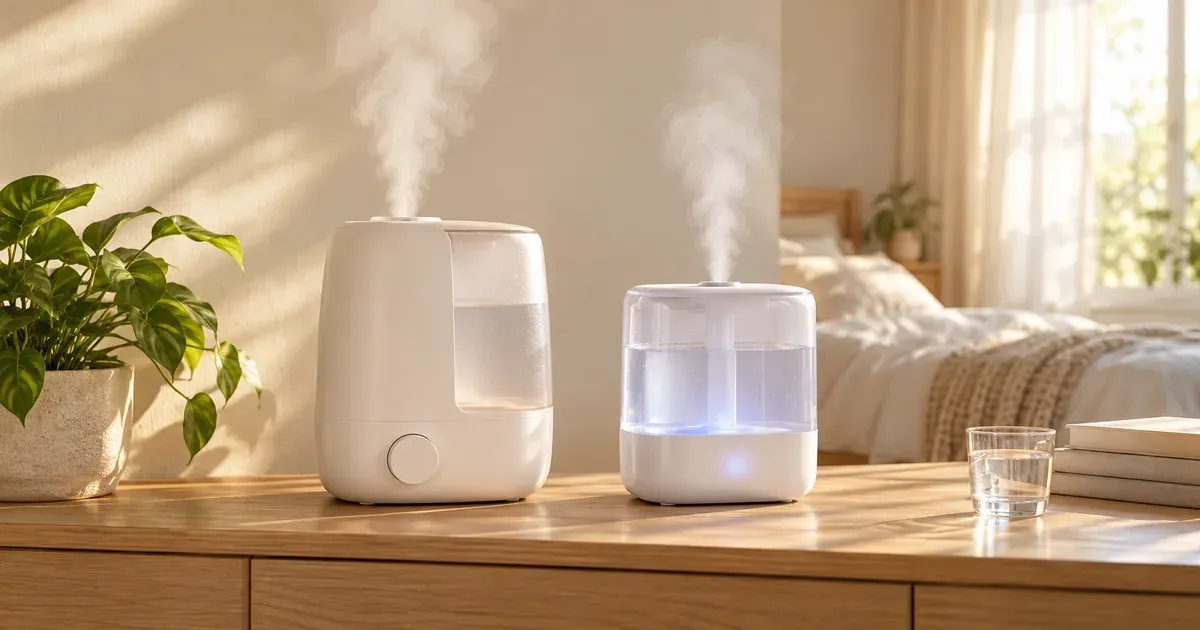
A warm mist humidifier boils water and releases steam. A cool mist humidifier adds moisture without heat, either by shaking water into a fine mist with ultrasonic vibrations or by blowing air through a wet wick. Both raise the humidity in a room. The differences are in safety, cleanliness, upkeep, and running cost.
The short answer: for most people, and always for a child’s room, a cool mist humidifier is the better choice. It has no hot water to spill, uses a fraction of the electricity, and the FDA, Mayo Clinic, and the American Academy of Pediatrics all point parents to cool mist. A warm mist humidifier makes sense in an adult’s bedroom if you want filter-free operation, cleaner output from tap water, and the slight warmth of steam on a cold night.
Warm vs. cool mist at a glance
| Spec | Warm mist (steam) | Cool mist |
|---|---|---|
| How it works | Heats water to boiling and releases steam | Ultrasonic vibration, a spinning disk, or a fan blowing through a wet wick |
| Burn risk | Yes: boiling water and hot steam | None |
| For kids | Not recommended | Recommended by the AAP, FDA, and Mayo Clinic |
| Minerals and germs in the air | Few, since minerals stay behind when water boils | Ultrasonic: the most of any type. Evaporative: few |
| Filters | None | Ultrasonic: optional cartridges. Evaporative: wick every 1–2 months |
| Power use | Hundreds of watts | About 26 to 30 watts |
| Noise | Quiet bubbling, no fan | Ultrasonic: near silent. Evaporative: fan hum |
| Price | $20 to $50 | $40 to $160 |
The Types of Humidifiers
There are really four kinds, and “cool mist” covers three of them:
- Steam (warm mist). A heating element boils water, and the steam mixes with room air as it leaves the unit. Classic models like the Vicks Warm Mist Humidifier have no fan at all.
- Ultrasonic (cool mist). A vibrating plate breaks water into a fine visible mist. These are the most common humidifiers sold today because they’re quiet and cheap to run.
- Evaporative (cool mist). A fan blows air through a wet wick filter, and the water evaporates into the room invisibly. Nothing comes out that you can see.
- Impeller (cool mist). A fast-spinning disk flings water into a mist. These are less common now.
Hybrid “warm and cool” models like the Levoit LV600S are ultrasonic humidifiers with a heater. They warm the water but don’t boil it: Levoit’s manual for a similar model puts the mist at about 104°F on low and 140°F on high. That’s warm enough to feel, but because the mist is still ultrasonic, it carries minerals the way a regular ultrasonic humidifier does.
Colds, Congestion, and Kids
Both add the same moisture. Mayo Clinic says warm and cool mist humidifiers are equally effective at humidifying the air, because by the time the water vapor reaches your lower airways, it’s the same temperature either way. The steam from a warm mist humidifier also cools before it leaves the machine.
For colds, health agencies lean toward cool mist. The CDC suggests a clean humidifier or cool mist vaporizer for cold symptoms. Mayo Clinic says cool mist may help with coughing and congestion from a cold, though more research is needed, and that some research found heated humidifiers don’t help cold symptoms. The FDA, in its advice on children’s colds, goes further and says not to use warm mist humidifiers because they can make nasal passages swell.
For children, every major source says cool mist. The American Academy of Pediatrics says cool mist humidifiers are generally considered safer for young children than warm mist humidifiers or steam vaporizers because there’s no risk of burns, and it recommends placing the humidifier near your child but out of reach. Mayo Clinic says to always use cool mist humidifiers for children, and not to buy a steam vaporizer if you have children.
The burn risk is real. Steam vaporizers boil water, and their steam is hot enough to cause severe burns. A study of children treated at an Australian hospital for vaporizer steam burns found most were toddlers who burned their hands, and half needed surgery.
Germs, Minerals, and White Dust
This is where warm mist has its main advantage.
When water boils, its minerals and most microbes stay behind in the unit. The EPA says steam and evaporative humidifiers disperse little, if any, of either. Ultrasonic and impeller humidifiers are different: they turn the water itself into mist, so whatever is in the water goes into the air. The EPA says they generally disperse the most microorganisms and minerals. With hard tap water, that shows up as a fine white dust on furniture and electronics.
The fix for ultrasonic humidifiers:
- Use distilled water. The EPA specifically says bottled water labeled “distilled.” Spring, artesian, and mineral water still contain minerals.
- Or use a demineralization cartridge if your humidifier supports one.
- Never add disinfectants or additives to the water. In South Korea, chemical humidifier disinfectants caused a deadly outbreak of lung injury and were pulled from the market in 2011.
Evaporative humidifiers avoid the white dust problem without distilled water, because the minerals stay in the wick. The trade-off is buying replacement wicks.
Cleaning and Maintenance
Every humidifier needs regular cleaning, or it can grow mold and bacteria and spread them into the air. The EPA’s advice for portable humidifiers:
- Every day: empty the tank, wipe it dry, and refill with fresh water.
- Every third day: clean the unit. The EPA suggests 3% hydrogen peroxide, unless the manufacturer says otherwise, then rinse well.
Each type adds its own chores:
- Warm mist: minerals build up as scale on the heating element. Vicks says to descale its Warm Mist Humidifier weekly by soaking it in a cup of white vinegar for 20 minutes, and not to pour vinegar directly onto the heating element of some models.
- Ultrasonic: clean weekly and descale with vinegar. Levoit sells descaling pads that last two to four weeks, depending on water hardness.
- Evaporative: replace the wick. Honeywell says to change the HCM-350’s wicking filter every 30 to 60 days. A three-pack costs about $29 on Amazon.
Energy Use
Boiling water takes a lot of power. Levoit rates its hybrid LV600S at 280 watts with the heat on, and Dreo rates its hybrid HM713S at 26 watts in cool mode and 280 watts in warm mode. Ultrasonic humidifiers like the Dreo HM311S and Levoit Classic 300S are rated at 26 watts, and Levoit’s evaporative Superior 6000S at 30 watts.
Run overnight for 8 hours at 16 cents per kWh, a humidifier drawing 280 watts costs about 36 cents a night, roughly $11 a month. A 26-watt ultrasonic costs about 3 cents a night. Warm mist units do add a little heat to a room, but a humidifier is an expensive way to heat one.
Noise
Classic warm mist humidifiers have no fan, so you’ll hear only quiet bubbling as the water boils. Ultrasonic humidifiers are the quietest: Levoit and Dreo rate theirs at 26 to 30 decibels on low, close to a whisper. Evaporative humidifiers have a fan, so they hum. Some people like it as white noise, and Honeywell describes the HCM-350’s sound as a soft, fan-like noise for a bedroom.
How Much Humidity You Want
Aim for 30% to 50% indoor humidity. The EPA, Mayo Clinic, and the American Lung Association all recommend that range, and the EPA says not to go above 50%. Too much humidity leads to condensation on windows, dust mites, and mold. A humidifier with a built-in humidistat, or a cheap hygrometer, keeps you in range.
Which Should You Buy?
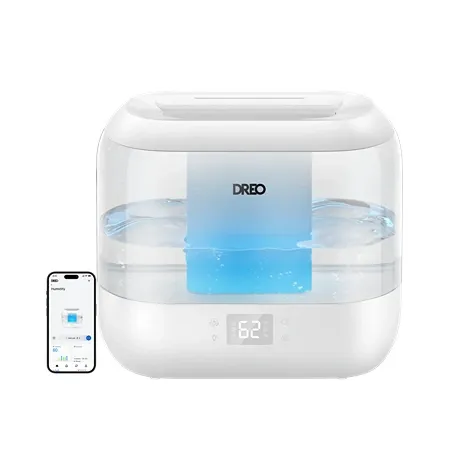
Best cool mist humidifier
Dreo HM311S Cool Mist Humidifier
A quiet 4-liter ultrasonic humidifier with auto humidity control, top filling, and app and voice control.
The Dreo HM311S is the cool mist humidifier for most bedrooms. Its 4-liter tank fills from the top, it runs up to 32 hours per fill according to Dreo, and it draws just 26 watts at a rated 28 decibels. Auto mode holds the humidity level you set using its built-in sensor, and the app and voice controls let you adjust it from bed. It has more than 12,000 Amazon ratings at 4.4 stars and costs about $42. Use distilled water or Dreo’s demineralization cartridge to avoid white dust.
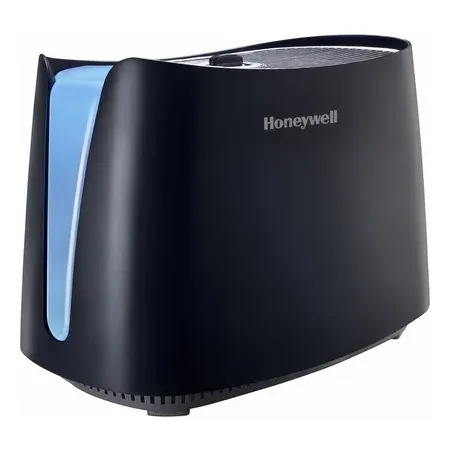
Best for kids' rooms
Honeywell HCM-350 Cool Moisture Humidifier
An evaporative cool mist humidifier with a UV light, no visible mist, no white dust, and a 1-gallon tank.
The Honeywell HCM-350 is the pick for a nursery or child’s room. It’s evaporative, so there’s no hot water, no visible mist, and no white dust even with tap water, because the wick traps the minerals. A UV light treats the water in the unit, and the 1-gallon tank runs up to 24 hours. Its fan makes a soft hum that doubles as white noise. Budget for a new wick every one to two months.
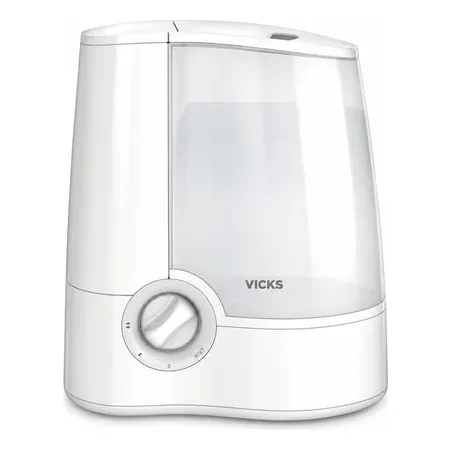
Best warm mist humidifier
Vicks Warm Mist Humidifier (V745A)
A filter-free 1-gallon steam humidifier that runs up to 12 hours, with automatic shut-off.
The Vicks Warm Mist Humidifier is the classic steam humidifier, with more than 27,000 Amazon ratings, and it costs about $44. It boils water, so it has no filter to replace and puts out mineral-free steam even with tap water. It has no fan, shuts off when empty, and runs up to 12 hours on a 1-gallon tank. Keep it in an adult’s room only: Vicks says to place it at least four feet from the bed and out of reach of children and pets, and to let it cool for 20 minutes before handling.
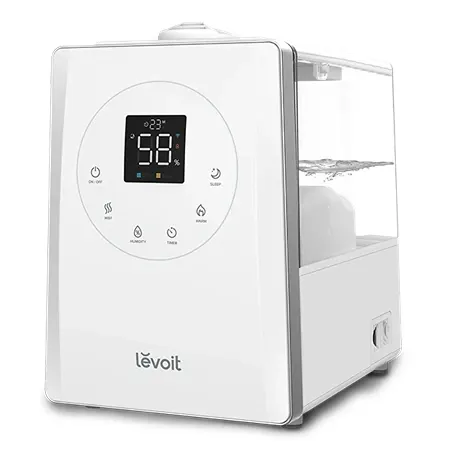
Best with both modes
Levoit LV600S Warm and Cool Mist Humidifier
A 6-liter hybrid ultrasonic humidifier with warm and cool mist, auto mode, and coverage up to 753 sq. ft.
The Levoit LV600S gives you both. Use cool mist most of the year and switch on warm mist on the coldest nights. Its 6-liter tank runs up to 50 hours, it covers rooms up to 753 square feet, and auto mode uses a built-in sensor to hold your target humidity. Remember that its warm mode is heated ultrasonic mist, not steam, so it still needs distilled water to avoid white dust, and it draws up to 280 watts with the heat on.
For more picks, including larger evaporative models, see our guide to the best humidifiers. If your home is too damp rather than too dry, see the best dehumidifiers.
Warm vs. Cool Mist FAQ
Is warm or cool mist better for a cold?
Cool mist, according to the CDC, FDA, and Mayo Clinic. Both add the same moisture to the air, but the FDA advises against warm mist for children’s colds, and Mayo notes that some research found heated humidifiers don’t help cold symptoms.
Which is better for a baby?
Cool mist. The American Academy of Pediatrics, Mayo Clinic, and MedlinePlus all recommend cool mist humidifiers for children because there’s no risk of burns. An evaporative model also avoids white dust.
Is warm mist cleaner than cool mist?
It puts fewer minerals and germs into the air than ultrasonic cool mist, because boiling leaves them behind. Evaporative cool mist humidifiers are similarly clean. Any humidifier can grow mold if you don’t empty and clean it regularly.
Does a warm mist humidifier heat the room?
Slightly. The steam adds a little warmth, but at a few hundred watts, a warm mist humidifier is no substitute for a space heater.
Can I use tap water?
In a steam (warm mist) or evaporative humidifier, yes. In an ultrasonic humidifier, tap water causes white dust, so use distilled water or a demineralization cartridge.