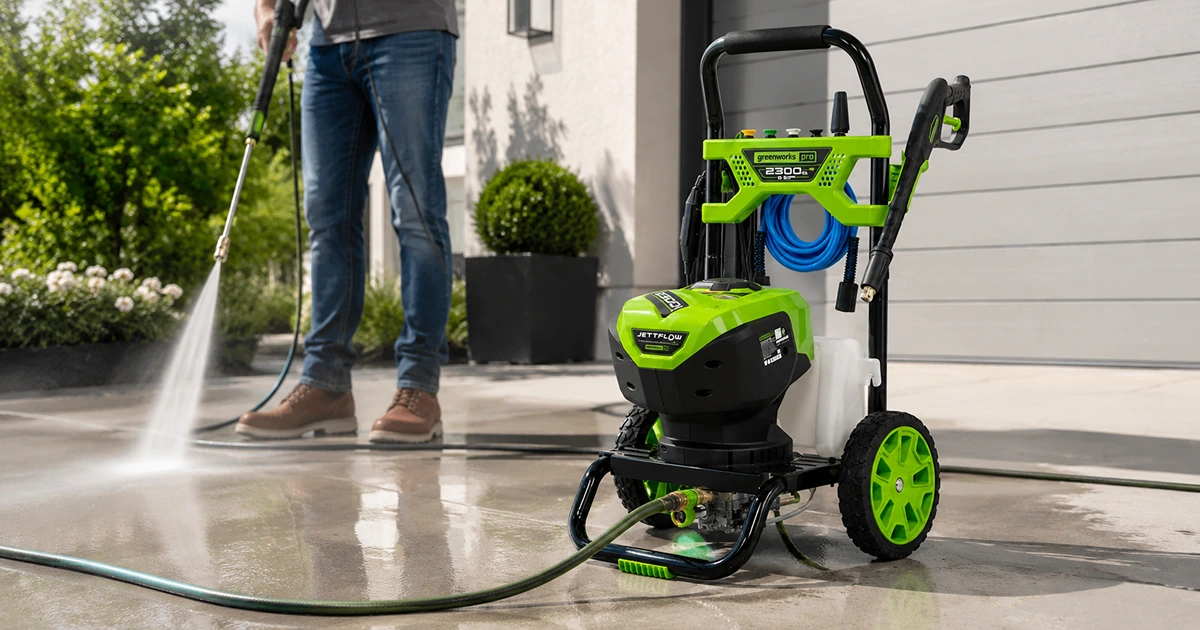

Pressure washers are one of those tools where the spec sheet can be oddly misleading. PSI tells you how hard the stream hits, GPM tells you how much water it moves, and cleaning units give a rough combined score, but the day-to-day experience depends just as much on hose stiffness, nozzle storage, wheel size, pump behavior, detergent handling, and whether the machine is annoying to drag out for a 20-minute job.
For most homes, electric pressure washers remain the sweet spot. They are quieter than gas models, start with a switch instead of a pull cord, do not need fuel stabilizer or oil changes, and are strong enough for cars, patio furniture, decks, siding, pavers, fences, and routine driveway work. Gas washers still win for heavy concrete restoration and commercial pace, but they are more machine than many homeowners want to maintain.
The best models are the ones that make cleaning feel repeatable instead of theatrical. A pressure washer should be powerful enough to make visible progress, gentle enough to control around painted or softer surfaces, and simple enough to pull out on a normal Saturday without turning setup and storage into their own project.
Greenworks 2300 PSI
Best Overall Option
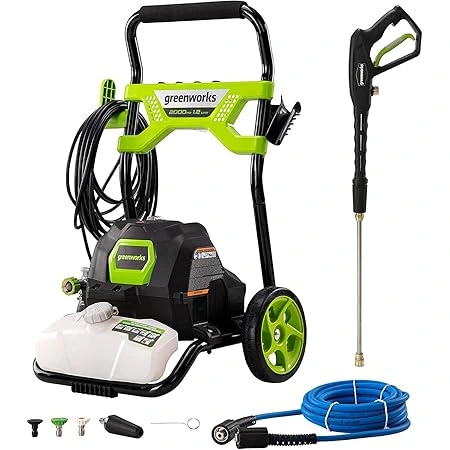
The Greenworks 2300 PSI TruBrushless delivers powerful cleaning performance with its 2.3 GPM output, quiet brushless motor, and user-friendly design.
The Greenworks 2300 PSI Electric Pressure Washer is the model to buy if you want one pressure washer that can handle the broad middle of homeowner cleaning: dingy concrete, green deck boards, weathered patio furniture, vinyl siding, trash bins, outdoor rugs, and vehicles when paired with the right nozzle and distance. The appeal is not just that it reaches the 2300 PSI class; it is that it wraps that power in an electric package that is easier to live with than a gas washer.
Greenworks sells several 2300 PSI variants, and current official listings emphasize 2300 PSI with a 1.2 GPM rated flow, while some retail and older model copy refer to higher max-flow figures depending on the nozzle and test standard. That distinction matters because electric pressure washers are often advertised at their best-case PSI or flow rather than their most useful working output. In practical terms, the Greenworks sits in the stronger electric class without crossing into the bulk, upkeep, and noise of a gas unit.
The brushless motor is the other reason this model earns the top slot. Brushless designs are generally more efficient and less wear-prone than basic universal motors, and the Greenworks feels better suited to repeated seasonal cleaning than the cheapest electric washers. It also tends to feel less strained during longer cleaning sessions, which matters when you are moving from the driveway to the siding to the patio instead of doing one quick rinse.
The accessory setup is practical for the way people actually clean. The quick-connect tips make it easy to move from broad rinsing to more concentrated cleaning, and the turbo nozzle is the one you will reach for when concrete or pavers need more bite. The trade-offs are familiar for this category: the hose can feel stiff, the machine is not as compact as a cube-style washer, and you still need to respect softer surfaces. For a deck, fence, or car, start wide and keep the wand moving. For driveways and stone, it has enough muscle to make slow, visible progress without turning pressure washing into a maintenance project of its own.
DEWALT DWPW2400
Second Best Option
2400 PSI of strong cleaning power with a durable build and a compact frame.
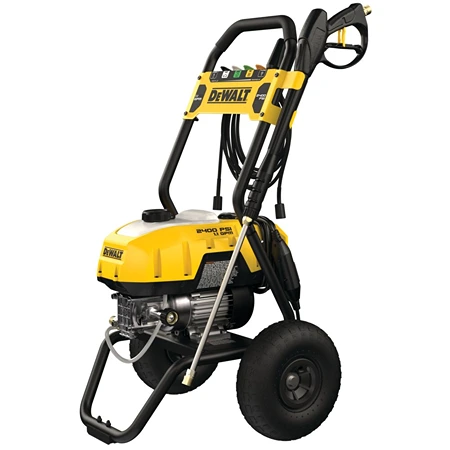
The DeWalt DWPW2400 2400 PSI Electric Pressure Washer is the closest alternative to the Greenworks, and for some buyers it will be the better machine. DeWalt’s current product page lists it at 2400 max PSI and 1.1 GPM, with CETA certification, a 25-foot kink-resistant hose, a 35-foot power cord, five nozzles, integrated soap tank, onboard storage, and 10-inch pneumatic wheels. That combination makes it feel more like a small jobsite washer than a delicate garage appliance.
The big advantage here is mobility over bad ground. Many electric pressure washers have hard plastic wheels that are fine on a driveway and miserable on gravel, mulch, roots, or rough lawn. The DWPW2400’s pneumatic tires are much more forgiving, and the low, roll-bar-style frame gives the unit a stable stance when you tug the hose. The included nozzle set is also more complete than what you get with many budget washers: turbo, 15-degree, 25-degree, 40-degree, and soap tips are enough for most common cleaning without immediately shopping for accessories.
It is also a good match for people who use detergent regularly. The integrated soap tank keeps the washer self-contained, and the included soap nozzle makes it straightforward to lay down cleaner before switching to a rinsing or pressure tip. That is helpful for siding, outdoor furniture, trash bins, and vehicle pre-washes, where detergent and dwell time often do more good than simply blasting harder.
The compromise is size and tidiness. At more than 55 pounds assembled, the DWPW2400 is not the one you casually lift onto a shelf, and its cord and wand storage are less elegant than the best compact designs. It is also not meaningfully more forceful than the Greenworks in real household use, despite the slightly higher PSI number. Buy it if you value the rugged frame, tire quality, and integrated soap setup. Skip it if your pressure washer will live in a tight garage corner and mostly be used for cars or patio furniture.
Sun Joe SPX3000
Best Budget Option
Up to 2030 PSI of cleaning power in a compact, affordable package for light to medium-duty tasks.
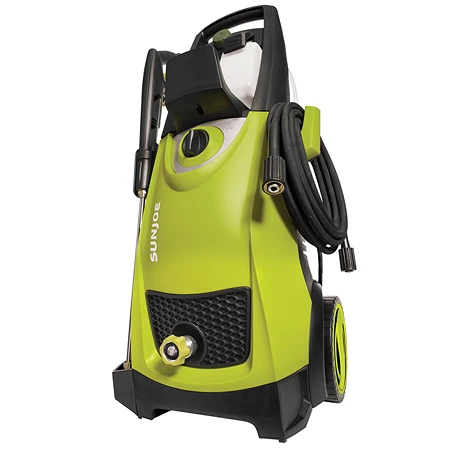
The Sun Joe SPX3000 Electric Pressure Washer is the budget pick because it gets the basics right at a price that often undercuts the sturdier machines by a wide margin. It is one of the most widely owned electric pressure washers in the category, and recent testing roundups continue to praise it for value, manageable weight, and broad usefulness around the house. Sun Joe’s current product naming now emphasizes a certified 2030 PSI rating with 1.2 GPM rated flow, while older and retailer listings often mention 1.76 GPM max flow. Either way, it is best understood as a light-to-medium-duty washer, not a concrete-restoration beast.
The SPX3000’s best feature is its flexibility for the money. You get a 14.5-amp electric motor, five quick-connect spray tips, a wand, and dual onboard detergent tanks. Those two tanks sound like a gimmick until you use one cleaner for a car and another for siding or patio work, then switch without emptying and rinsing a single reservoir. It also has a Total Stop System that shuts the pump off when the trigger is not engaged, which reduces needless pump wear and noise during start-stop cleaning.
This is also the easiest model here to justify if you are new to pressure washing. It gives you enough nozzle variety to learn what each spray pattern does, enough power to make grimy surfaces look obviously better, and enough detergent capacity to experiment with soap-assisted cleaning. For renters, first-time homeowners, or anyone who only cleans outdoors a handful of times per year, that balance is more important than owning the most durable frame or strongest motor.
What you give up is polish. The hose is shorter and less pleasant than the better hoses on premium electric models, the wheels are small, and the upright body can feel tippy when you pull from the wrong angle. The motor is louder and less refined than a brushless or induction-style unit, and the plastic-heavy build is more “weekend tool” than “buy it for the next decade.” Still, for occasional cleaning of patio sets, grills, bikes, trash cans, small decks, cars, and lightly stained walkways, the SPX3000 remains hard to beat. It is the washer to buy when you want real pressure-washer usefulness without paying for heavier-duty hardware you may only use once a year.
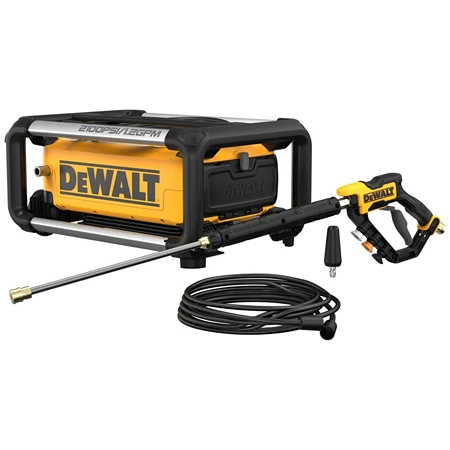
DeWalt DWPW2100
Most Portable Option
Portable 2100 PSI cleaning with accessory storage and a compact roll-cage frame.
The DeWalt DWPW2100 2100 Max PSI Electric Pressure Washer is the best choice when storage is the problem you are actually trying to solve. DeWalt’s current specs list it at 2100 max PSI and 1.2 GPM from a 13-amp electric motor, with a 25-foot kink-resistant hose, 35-foot cord, CETA certification, a 3-year limited warranty, and a 30.8-pound assembled weight. DeWalt also describes the closed design as dramatically smaller than the DWPW2400, with vertical or horizontal storage.
The design is genuinely different from the usual upright pressure washer. The frame acts like a protective cage, the handle retracts, the wheels are built into the compact body, and the wand, hose, cord, and nozzles all have dedicated storage. That matters if you have a crowded garage, a small shed, a work van, or a shelf where a tall wheeled washer simply will not fit. It also makes the DWPW2100 easier to load, carry, and store without accessories dangling off the side.
That organized shape changes how the washer fits into daily life. A conventional pressure washer often needs floor space, a loose hose loop, and a place where the wand will not get knocked over. The DWPW2100 behaves more like a boxed tool: carry it out, connect it, use it, coil everything back into its assigned spot, and slide it away. If you hate messy storage, that is a real feature rather than a cosmetic one.
The DWPW2100 is not the fastest cleaner here, and that is the catch. Its output is enough for vehicles, tools, outdoor furniture, railings, small patios, and maintenance cleaning, but it will not chew through dirty concrete as quickly as the Greenworks or the larger DeWalt. The hose can also be stiff, which is more noticeable on a lighter machine because the washer may shift if you pull too aggressively. Even so, it is the rare pressure washer that feels designed for the part after cleaning: putting everything away. If compact storage is what decides whether you use the washer regularly, this is the one that makes the most sense.
The right pressure washer depends less on the biggest PSI number and more on what you will actually clean. For most homeowners, the Greenworks 2300 PSI model is the best all-around pick because it has enough power for the messy outdoor jobs people put off, while still behaving like a convenient electric tool. The DeWalt DWPW2400 is the tougher-feeling alternative, especially if you need pneumatic wheels, a sturdier frame, and a built-in soap tank. The Sun Joe SPX3000 is still the value play for occasional cleaning, and the DeWalt DWPW2100 is the smartest answer for tight storage.
If you mostly wash cars, bikes, furniture, and trash bins, do not overbuy. A lighter washer with good nozzle control is easier to handle and less likely to damage paint, wood, or seals. If you are cleaning concrete, pavers, brick, or old mildew on a deck, prioritize the stronger Greenworks or DWPW2400 and use the turbo nozzle carefully. If you know the machine will be wedged between holiday bins and lawn tools, the DWPW2100’s storage design may matter more than raw cleaning speed.
Whichever model you choose, the best upgrade is good technique: start with a wide nozzle, test an inconspicuous spot, keep the wand moving, and let detergent do some of the work instead of carving into the surface with pressure alone. A good electric pressure washer should make outdoor cleaning feel quick enough that you actually do it, and each of these models earns its place by solving a different version of that problem.