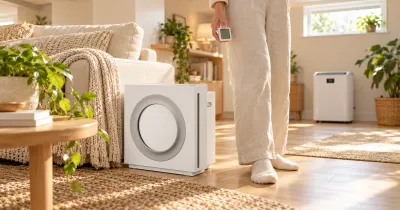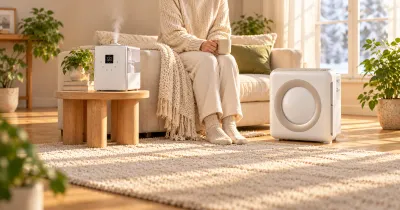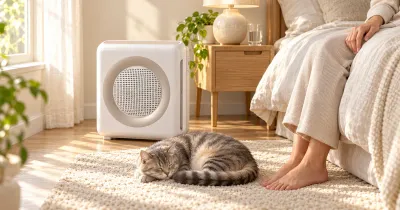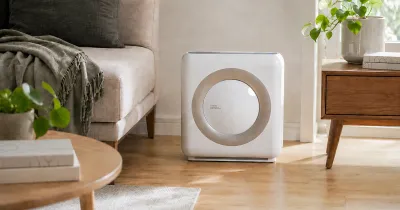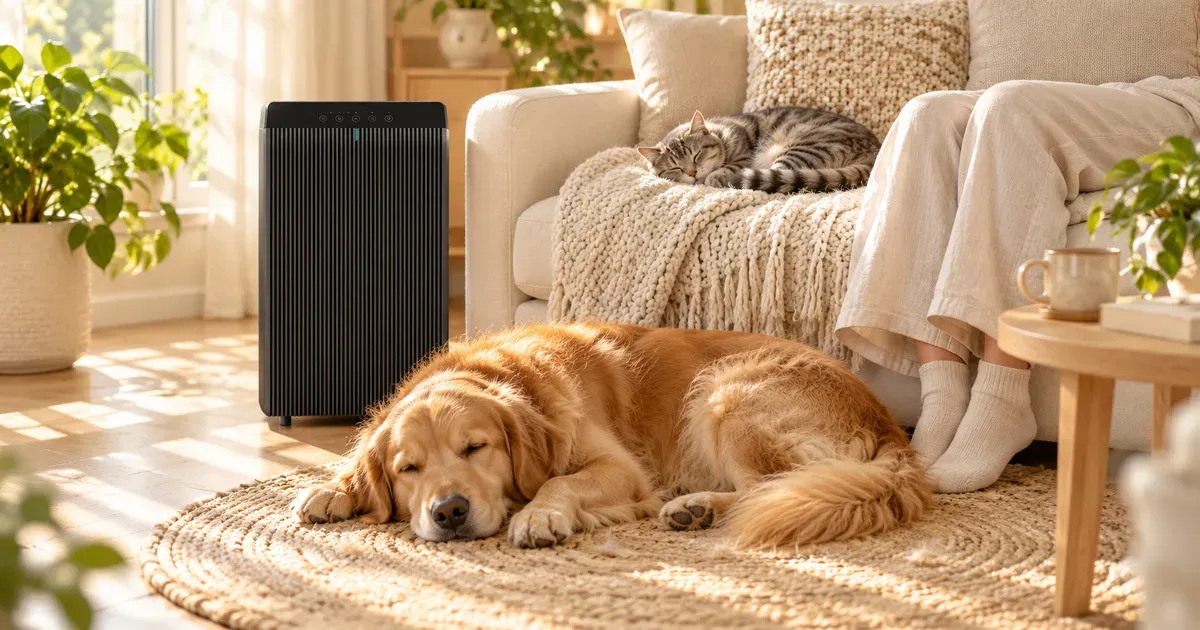
Pets put three different things into the air: dander, the tiny flakes of skin and dried saliva that cause most pet allergies; hair and fur, which floats around and collects in corners; and odor, from litter boxes, wet dogs, and pet beds. An air purifier handles each one differently. A true HEPA filter catches dander, a pre-filter catches hair before it clogs the HEPA, and activated carbon absorbs some smells.
Our top pick is the Winix 5510. It pairs a true HEPA filter with a washable pre-filter and one of the stronger carbon filters in its price range, cleans a 392-square-foot room about five times an hour, and costs about $180. For a bedroom, the Levoit Vital 100S-P ($120) has a washable pre-filter, a wide intake designed to pull in pet hair, and a Pet Mode. The Levoit Core 300 ($90) is the cheapest good option, and Levoit sells a pet-allergy filter for it.
Our Picks at a Glance
| Air purifier | Best for | Smoke CADR | Room size (about 5 air changes/hr) | Price |
|---|---|---|---|---|
| Winix 5510 | Dander and odor in living rooms | 253 CFM | 392 sq ft | About $180 |
| Levoit Vital 100S-P | Bedrooms, pet hair | 143 CFM | 222 sq ft | About $120 |
| Levoit Core 300 | Small rooms, budgets | 143 CFM | 222 sq ft | About $90 |
| Levoit Core 600S-P | Open-plan spaces, multiple pets | 391 CFM | About 600 sq ft | About $260 |
Best Overall: Winix 5510
Best overall
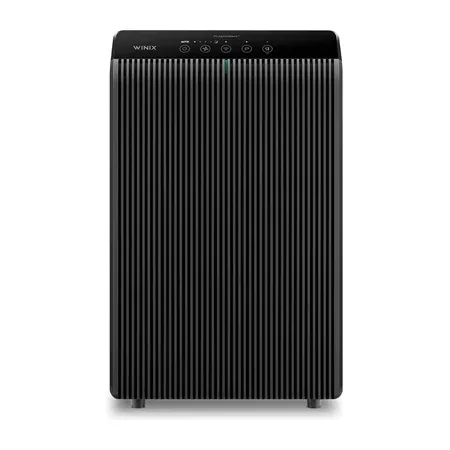
Winix 5510
True HEPA, a washable pre-filter, and an odor-control carbon filter with a CADR around 250 CFM.
The Winix 5510 is the newest version of the Winix 5500-2, one of the best-selling air purifiers for years, and it’s well suited to a home with pets. Air passes through three layers: a washable fine-mesh pre-filter that catches hair and fur, an activated carbon filter for pet and cooking odors, and a true HEPA filter for dander, dust, and pollen.
Its AHAM-verified clean air delivery rate is about 250 cubic feet per minute for smoke, dust, and pollen, enough to clean the air in a 392-square-foot room about five times an hour, a good target for allergies. An air-quality sensor raises the fan when it detects particles, such as when your dog shakes off or you brush the cat, and a light sensor drops it into a quiet sleep mode when the room goes dark. On its lowest setting it’s about 23.5 decibels, close to silent. The 5510 adds app control to the 5500-2’s design.
It also has PlasmaWave, Winix’s ionizer feature, which you can switch off. We’d leave it off; the HEPA and carbon filters do the real work.
Its genuine replacement, Winix Filter Q, combines the HEPA and carbon layers and costs about $47; Winix rates it for about a year. More than 32,000 Amazon ratings average 4.6 stars.
Buy it if you want one purifier that handles dander, hair, and odor in a living room or large bedroom.
Best for Bedrooms: Levoit Vital 100S-P
Best for bedrooms
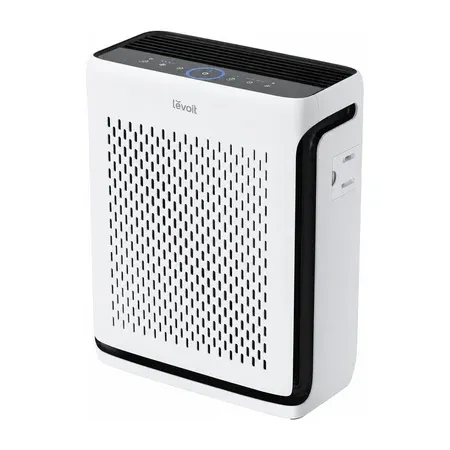
Levoit Vital 100S-P
A quiet bedroom purifier with a washable pre-filter, a wide intake for pet hair, and Pet Mode.
If pet allergies keep you up at night, the most effective place for a purifier is your bedroom, with the pet kept out. The Levoit Vital 100S-P is designed for that. Its wide, U-shaped intake draws in air from three sides to catch floating hair and large particles, and the washable pre-filter rinses clean under the tap, which keeps fur from clogging the main filter.
The main filter combines HEPA-grade media with activated carbon. Its AHAM-verified CADR is 143 CFM for smoke, 161 for dust, and 173 for pollen, enough to clean a 222-square-foot bedroom about five times an hour. Pet Mode, set in Levoit’s VeSync app, tunes the fan for pet hair and dander, and a light sensor dims the display at night. In sleep mode it runs at about 25 decibels.
It’s not powerful enough for a large living room, and its carbon layer is thinner than the Winix’s, so it’s better for dander and hair than for strong litter-box smells. It has more than 11,000 Amazon ratings averaging 4.6 stars.
Buy it if you want to breathe easier at night in a bedroom up to about 220 square feet.
Best Budget: Levoit Core 300
Best budget
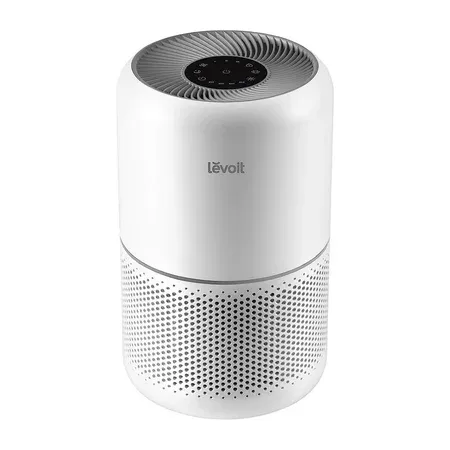
Levoit Core 300
A compact, quiet HEPA purifier with a 143 CFM CADR and an optional Pet Allergy filter.
The Levoit Core 300 is one of the best-selling air purifiers ever, with more than 100,000 Amazon ratings averaging 4.7 stars, and it’s the cheapest purifier we’d recommend for pet allergies. It’s a small cylinder that pulls in air all the way around, with the same 143 CFM smoke CADR as the Vital 100S-P, for about $90.
Levoit sells several replacement filters for it, including a Pet Allergy filter (about $36) with extra activated carbon for odors. It’s quiet, simple, and has no app or sensor, so you choose the fan speed yourself, and it doesn’t have a separate washable pre-filter, so you’ll vacuum the outside of the filter to clear hair.
Buy it if you want a solid purifier for a small bedroom or office on a budget. Levoit’s smart Core 300S-P adds an air-quality sensor, auto mode, and app control for a little more.
Best for Large Rooms: Levoit Core 600S-P
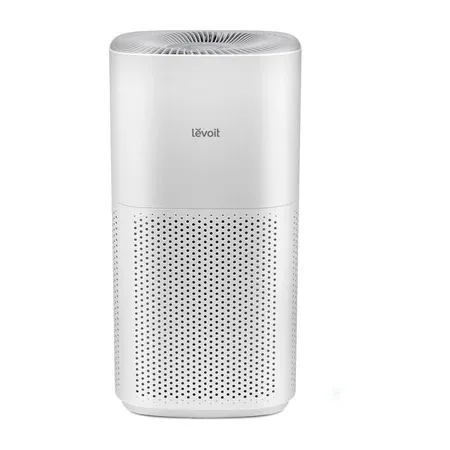
Best for large rooms
Levoit Core 600S-P
Levoit's most powerful purifier, with a 391 CFM CADR for open-plan rooms and multi-pet homes.
Homes with several pets, or an open-plan kitchen and living room where the dog sleeps, need much more air flow. The Levoit Core 600S-P is Levoit’s most powerful purifier, with a CADR of 391 CFM, enough to clean about 600 square feet five times an hour. It has a pre-filter for hair, a HEPA-grade main filter with activated carbon, a laser PM2.5 sensor with an auto mode, and app and voice control.
It’s tall, costs about $260, and its filters cost more than the smaller models’. On high it’s loud, but in auto mode it spends most of its time on a lower speed.
Buy it if you have a large, open room or multiple shedding pets. For more large-room options, including the Coway Airmega and Blueair 211i Max, see our guide to the best air purifiers.
How Big a Purifier Do You Need?
The number to look at is CADR, the clean air delivery rate, measured by AHAM in cubic feet per minute. For allergies, aim for about four to five air changes per hour. A quick rule: multiply the purifier’s smoke CADR by about 1.5 to get the room size it can handle at that rate, for a standard 8-foot ceiling.
| Room size | Minimum smoke CADR |
|---|---|
| 150 sq ft (small bedroom) | 100 CFM |
| 250 sq ft (large bedroom) | 165 CFM |
| 400 sq ft (living room) | 265 CFM |
| 600 sq ft (open plan) | 400 CFM |
Ignore the “up to 1,700 square feet” claims on many boxes. Those figures assume the purifier cleans the air just once an hour, which is too slow to make a difference to allergies.
Do Air Purifiers Help With Pet Allergies?
They remove pet allergens from the air, but by themselves they don’t fix pet allergies.
- They catch airborne dander. Cat allergen in particular is very light and stays in the air for hours, which is why a purifier can catch it. In a 1998 placebo-controlled trial, HEPA air cleaners in the bedrooms of cat-allergic people who lived with cats lowered airborne cat allergen, but didn’t measurably improve their nasal or asthma symptoms over three months (Wood et al., 1998).
- Results in homes are mixed. In a year-long trial of 36 asthmatic children sensitized to cats or dogs, HEPA cleaners in the living room and bedroom captured pet allergens but didn’t change medication use or allergen levels in carpet dust, with only a trend toward less airway sensitivity (Sulser et al., 2009).
- They help during heavy exposure. In a 2025 randomized trial in an allergen exposure chamber, cat-allergic people with asthma had fewer and later asthma reactions and about half the nasal and eye symptoms when an air cleaner was running, and the cleaner cut airborne cat allergen from about 80 to 14 nanograms per cubic meter (Gherasim et al., 2025).
The takeaway: a purifier works best as one part of a plan. Pet allergen also settles into carpets, sofas, and bedding, where no air purifier reaches it.
Other Ways to Reduce Pet Allergens
- Keep pets out of the bedroom. You spend a third of your life there. This is the single most effective step.
- Vacuum often with a sealed HEPA vacuum, and wash pet beds, throws, and your bedding weekly in hot water.
- Bathe and brush pets regularly, ideally outdoors or by someone without allergies.
- Choose hard floors and washable covers where you can; carpet holds dander.
- Talk to an allergist about medication or allergy shots if symptoms persist.
What About Odor?
Activated carbon absorbs some odor molecules, and a purifier with more carbon, like the Winix 5510, does noticeably more than one with a thin carbon-coated sheet. But carbon fills up, and no purifier can keep up with a dirty litter box. Scoop daily, change litter regularly, and use the purifier to handle what’s left. Place it near, but not right next to, the litter box, so it doesn’t blow litter dust around.
Are Air Purifiers Safe for Pets?
HEPA and carbon purifiers are safe for cats and dogs. Avoid ozone generators, sometimes sold as “air purifiers,” which deliberately produce ozone, a lung irritant for people and animals. If you keep birds, which are especially sensitive to airborne irritants, stick to plain HEPA and carbon models and turn off any ionizer feature. Keep cords out of reach of chewers, and choose a stable purifier that a curious dog or cat can’t easily knock over.
Filter Care With Pets
- Clean the pre-filter every week or two. Pet hair clogs it fast. Vacuum it or rinse it if it’s washable, and let it dry completely.
- Expect to replace the main filter sooner than the box says, often every 6 to 9 months rather than 12, in homes with shedding pets.
- Budget for filters. They cost about $25 to $60 each for these models, so check the price before you buy the purifier.
How We Chose
We compared popular air purifiers on AHAM-verified CADR, true HEPA or HEPA-grade filtration, washable pre-filters for hair, the amount of activated carbon for odor, noise, sensors and auto modes, filter cost and availability, and owner ratings. We avoided models that rely on ozone. For more on what purifiers can and can’t do, see are air purifiers worth it.
Air Purifiers for Pets FAQ
Do air purifiers help with pet dander?
Yes. A true HEPA filter catches dander floating in the air, especially from cats. It won’t remove dander that has settled into carpets and furniture, so combine it with vacuuming, washing bedding, and keeping pets out of the bedroom.
Do air purifiers remove pet hair?
They catch hair that’s floating in the air on a pre-filter, which helps with tumbleweeds of fur. They don’t replace brushing your pet or vacuuming floors and furniture.
Will an air purifier get rid of litter box smell?
It can reduce it, especially a model with plenty of activated carbon like the Winix 5510. Daily scooping and fresh litter matter more.
Where should I put an air purifier for pets?
In the room where you spend the most time, usually the bedroom, with the pet kept out. Leave a foot or two of space around it, and keep it away from corners and behind furniture.
Are air purifiers safe for cats and dogs?
HEPA and carbon purifiers are safe. Avoid ozone generators, and turn off ionizers if you keep birds.
How often should I change the filter with pets?
Clean the pre-filter every week or two and replace the main filter every 6 to 12 months, sooner if the purifier’s filter indicator says so or airflow drops.