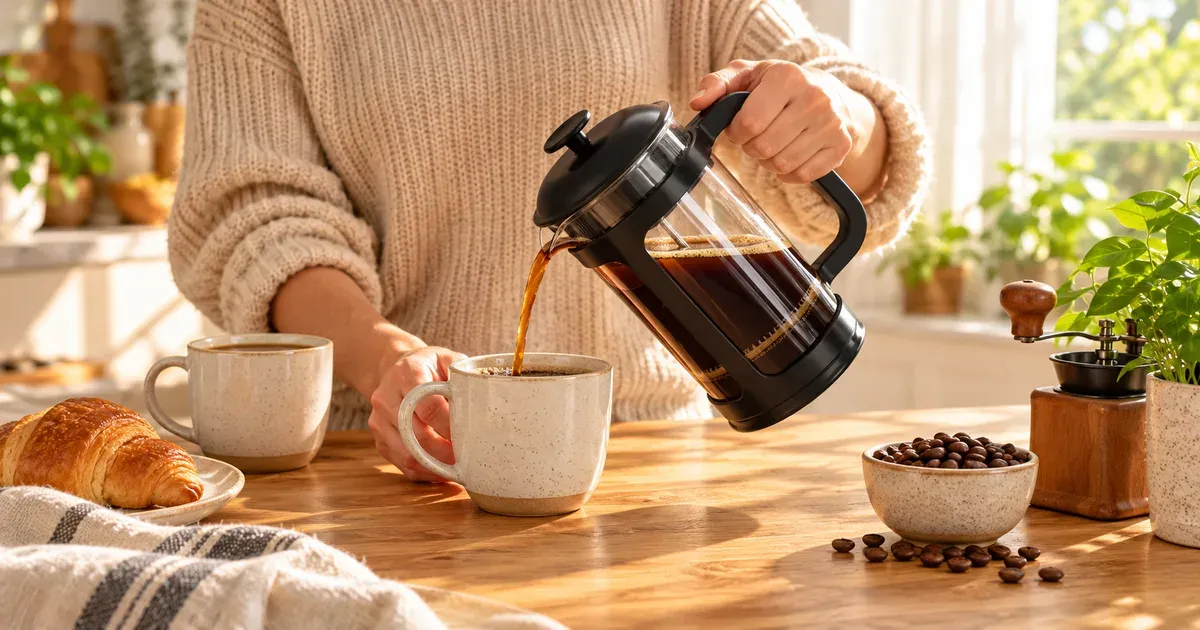
A French press is the simplest way to make great coffee. You steep coarse grounds in hot water for about four minutes, press a mesh filter down, and pour. There’s no paper filter, so the coffee keeps its natural oils and has a heavier, richer body than drip coffee. There’s also no electricity, no pods, and almost nothing to break, which is why a press makes such a good, inexpensive gift.
The one complaint about French press coffee is sediment: the fine grit and sludge in the last few sips. The best presses deal with that, and with how quickly coffee cools in a glass carafe.
Our top pick is the Espro P3 (about $40). Its double micro-filter leaves far less sediment than a standard press and slows extraction once you’ve plunged, so the second cup doesn’t turn bitter. If you want coffee to stay hot, the double-walled stainless Fellow Clara ($99.95) is the nicest press you can buy. And for a classic glass press on a budget, the Bodum Brazil costs about $32. Prefer a cleaner, lighter cup? We also cover the best pour-over brewers below.
Our Picks at a Glance
| Brewer | Best for | Capacity | Price |
|---|---|---|---|
| Espro P3 | Less sediment, glass | 32 oz | About $40 |
| Fellow Clara | Keeping coffee hot, gifts | 24 oz | $99.95 |
| Bodum Brazil | A simple classic press | 34 oz | About $32 |
| Hario V60 Starter Set | Learning pour-over | 1 to 4 cups | About $27 |
| Chemex 6-Cup | Clean, bright coffee for a few people | 30 oz | About $47 |
Best Overall: Espro P3
Best overall
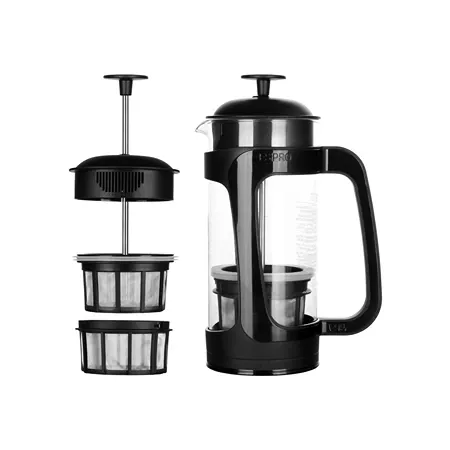
Espro P3 French Press, 32 oz
A glass French press with a dual micro-filter that leaves much less sediment in the cup.
A standard French press has a single metal screen, and plenty of fine particles slip around its edges. The Espro P3 uses two nested micro-filter baskets with a fine stainless steel mesh, sealed against the walls of the carafe with a flexible gasket. It catches far more of the fine grit, so the coffee keeps the full body of a French press without the muddy last sip.
The seal has a second benefit. A normal press keeps extracting as long as coffee sits on the grounds, so a second cup poured 15 minutes later tastes bitter. The P3’s filter separates most of the brewed coffee from the coffee bed, which slows extraction after you plunge. Espro also includes a few paper filters that fit the basket, for a cleaner, pour-over-like cup when you want one.
The carafe is thick borosilicate glass held in a plastic frame. It’s a little more work to clean, since the two filter baskets come apart for rinsing, and it works best with at least 24 ounces, so it’s better for two people than for one small mug. Replacement glass and filters are sold separately.
Buy it if you like French press coffee but hate the sludge.
For drip machines, cold brew makers, and other brewers, see our guide to the best coffee makers.
Best Insulated: Fellow Clara
Best insulated
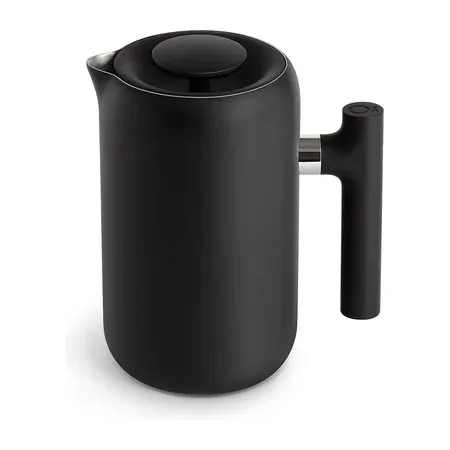
Fellow Clara French Press
A double-walled stainless steel press with fine filtration, fill lines, and an any-direction pour lid.
Glass presses lose heat quickly, so coffee is lukewarm by the second cup. The Fellow Clara is a double-walled stainless steel press that keeps coffee hot far longer and won’t shatter if you knock it into the sink. It’s also beautifully designed, which is why it’s such a popular gift.
The details make it easier to brew well. Fill lines inside the carafe show how much coffee and water to add, an included stick helps you stir the grounds, and the lid pours in any direction, so you don’t have to line up a spout. Fellow’s fine filtration mesh leaves noticeably less sediment than a basic press, and the interior has a nonstick finish that rinses clean. It holds 24 ounces, about two large mugs.
At $99.95, it costs more than twice the Espro, and its opaque body means you can’t watch the coffee brew.
Buy it if you sip slowly, want coffee that stays hot, or need a gift for a coffee lover.
Best Budget: Bodum Brazil
Best budget
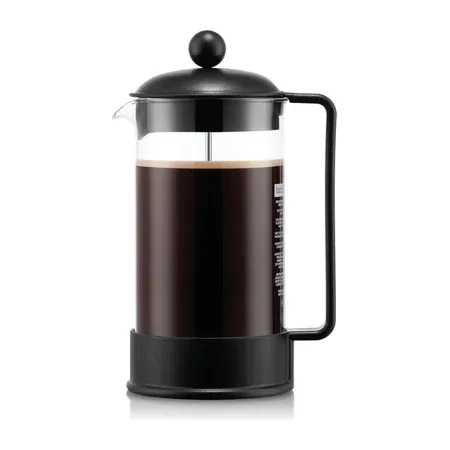
Bodum Brazil French Press, 34 oz
A classic 8-cup glass French press with a stainless steel filter, made by the brand that popularized the press.
Bodum made the French press a household item, and the Brazil is its simplest version: a borosilicate glass carafe in a plastic frame with a three-part stainless steel mesh filter. The 34-ounce, 8-cup size makes coffee for three or four people, for about $32. It has nearly 1,800 Amazon ratings averaging 4.6 stars.
It does the basics well. Like any single-screen press, it leaves some sediment, so pour gently and leave the last half inch in the carafe, and pour all the coffee out as soon as it’s done brewing. Replacement glass carafes are inexpensive if you break one. Bodum’s Chambord is the classic chrome-framed version of the same press, if you want something nicer-looking.
Buy it if you want a dependable French press for as little as possible.
French Press vs. Pour-Over
| French press | Pour-over | |
|---|---|---|
| How it works | Grounds steep in water, then a mesh filter is pressed | Water is poured slowly over grounds in a paper filter |
| Taste | Heavy, rich body; more oils | Clean, bright, and lighter; highlights fruity and floral notes |
| Sediment | Some | None |
| Effort | Easy and forgiving | Takes practice and attention |
| Equipment | Just the press | Dripper, filters, and ideally a gooseneck kettle |
| Batch size | Up to 4 or more cups at once | Usually 1 to 4 cups |
If you like dark roasts and rich, chocolatey coffee, a French press is the easier choice. If you buy lighter roasts and want to taste their nuances, try pour-over. Many coffee lovers own both.
Best Pour-Over Kit: Hario V60 Starter Set
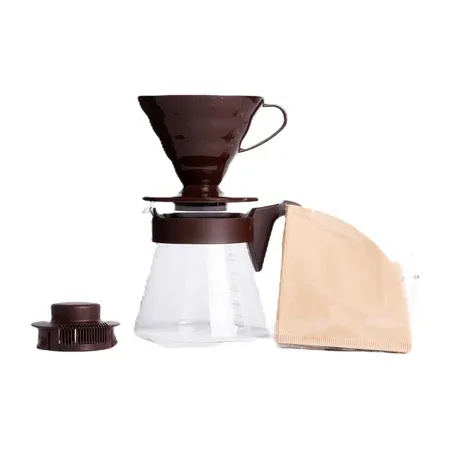
Best Pour-Over kit
Hario V60 Pour Over Starter Set
A V60 size 02 dripper, glass server, and paper filters: everything you need to start pour-over.
The Hario V60 is the pour-over dripper most baristas learned on. Its cone has spiral ribs and one large hole at the bottom, so how fast you pour controls how long the water stays in contact with the coffee: pour quickly for a lighter cup, slowly for a richer one. That makes it very responsive once you get the hang of it.
This starter set includes a plastic size 02 dripper, which brews one to four cups, a heatproof glass server, and 40 paper filters, for about $27, with more than 11,000 Amazon ratings averaging 4.8 stars. A gooseneck kettle makes the slow, steady pour much easier, so budget for one if you don’t have it.
Buy it if you want to learn pour-over and taste what light-roast coffee can do.
Best Pour-Over for Sharing: Chemex 6-Cup
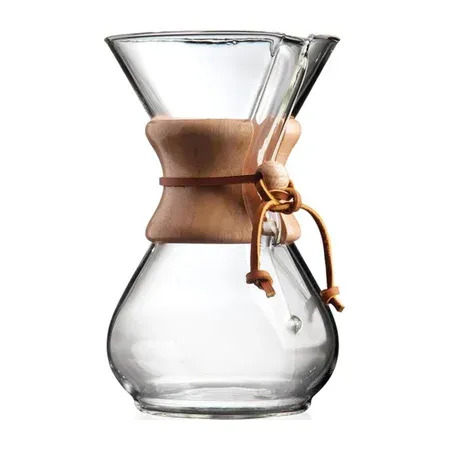
Best Pour-Over for sharing
Chemex Classic 6-Cup
The classic glass pour-over brewer with a wooden collar, for very clean coffee for two or three people.
The Chemex is a one-piece glass brewer and carafe with a wooden collar, designed in 1941 and still on display in design museums. Its thick bonded paper filters are heavier than most, so they remove nearly all of the oils and fine particles and produce an exceptionally clean, bright cup. The 6-cup size holds 30 ounces (Chemex counts 5 ounces as a cup), enough for two or three people.
It’s slower and less forgiving than a V60, you need Chemex’s own filters, which cost more than standard ones, and the narrow neck makes the glass a little awkward to clean by hand. It has nearly 7,000 Amazon ratings averaging 4.8 stars.
Buy it if you want a beautiful brewer that makes the cleanest coffee for a small group.
How to Make French Press Coffee
- Grind coarse. Use a coarse, even grind, like breadcrumbs or sea salt. Fine, pre-ground coffee slips through the filter and turns muddy. A burr grinder helps more than anything else.
- Use the right ratio. Start with about 1 gram of coffee to 15 grams of water, roughly 60 grams of coffee, or about 8 to 9 tablespoons, for a liter (34 oz) of water. Our coffee ratio calculator does the math for any size.
- Heat the water to just off the boil, about 200°F (93°C). Pour it all in and start a timer.
- Stir or break the crust at about one minute, then put the lid on with the plunger up.
- Steep four minutes, then press slowly and steadily.
- Pour everything out right away. Coffee left in a standard press keeps extracting and turns bitter. Decant extra coffee into a thermos.
Leaving the last bit of coffee in the carafe, rather than pouring it all, keeps most of the sludge out of your cup.
Is French Press Coffee Bad for Cholesterol?
It can raise it slightly. Coffee beans contain oily compounds called cafestol and kahweol that raise LDL cholesterol. Paper filters catch most of them; metal French press filters don’t. A meta-analysis of 14 trials found that unfiltered coffee raised total and LDL cholesterol, while filtered coffee caused very little increase (Jee et al., 2001), and a later meta-analysis of 12 trials reached the same conclusion (Cai et al., 2012).
If you’re watching your cholesterol and drink several cups a day, a pour-over or drip brewer with paper filters is the better daily choice. The Espro P3’s optional paper filters are another way around it.
How We Chose
We compared popular French presses on how well their filters control sediment, heat retention, durability, capacity, ease of cleaning, design, owner ratings, and price, and added two classic pour-over brewers for readers who want a cleaner cup. We favored presses with readily available replacement parts.
French Press FAQ
What is the best French press?
The Espro P3 for most people. Its double micro-filter leaves much less sediment than a standard press, and it costs about $40. For coffee that stays hot, the Fellow Clara is the best insulated press.
Is a glass or stainless steel French press better?
Glass lets you watch the coffee brew and costs less, but it loses heat quickly and can break. Double-walled stainless steel keeps coffee hot much longer and is nearly unbreakable.
How do I get less sludge in French press coffee?
Use a coarse, even grind from a burr grinder, press slowly, leave the last half inch in the carafe, and consider a press with a finer filter like the Espro P3.
How much coffee do I use in a French press?
About 1 gram of coffee per 15 grams of water: roughly 60 grams, or 8 to 9 tablespoons, for a 34-ounce press. Adjust to taste.
Is pour-over better than French press?
Neither is better. Pour-over makes a cleaner, brighter cup and takes more technique; French press makes a richer, heavier cup and is easier.
Can you make cold brew in a French press?
Yes. Steep coarse grounds in cold water in the fridge for 12 to 18 hours, then press and pour. Use about twice as much coffee as for hot coffee and dilute to taste.