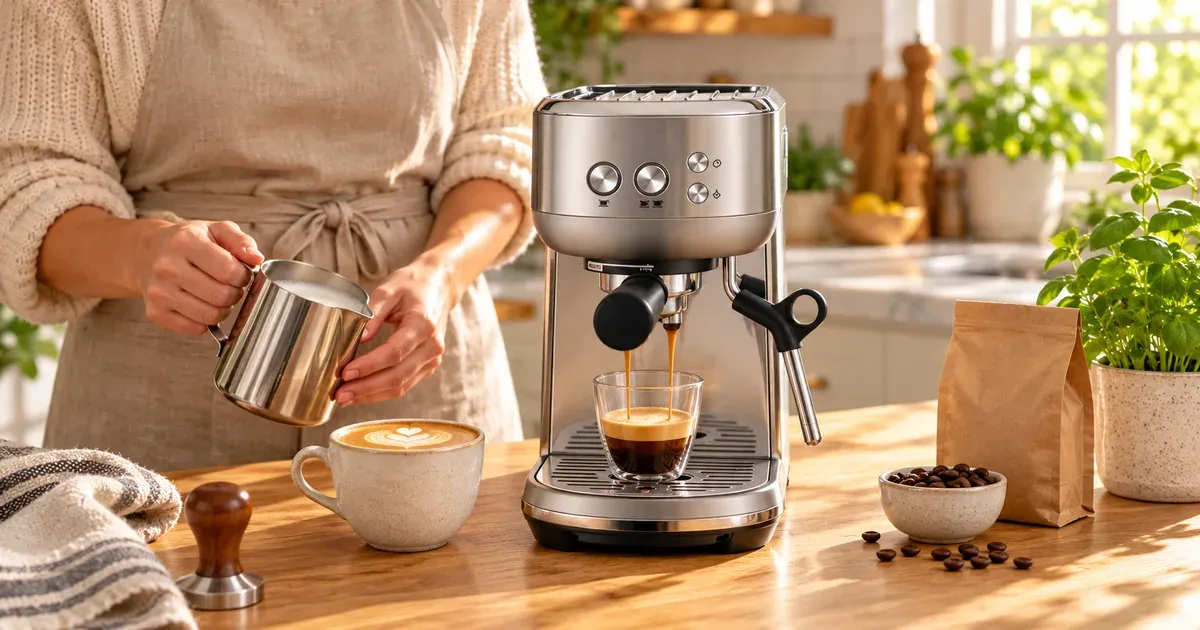
You don’t need to spend $1,000 to make good espresso at home. A few hundred dollars buys a machine that pulls a proper shot and steams milk for lattes and cappuccinos, and at a café price of $5 to $6 a drink, a cheap machine can pay for itself within a few months.
What you give up at the low end is speed, consistency, and room to improve. The cheapest machines use pressurized baskets that make decent, forgiving espresso from pre-ground coffee but can’t produce the richest shots. Better budget machines add precise temperature control, standard baskets, and a steam wand strong enough for latte art.
Our top pick is the Breville Bambino ($299.95). It heats up in about three seconds, keeps brewing temperature steady with a PID controller, and comes with both pressurized and standard baskets, so it works with pre-ground coffee now and fresh-ground later. Under $200, the De’Longhi Stilosa ($149.95) is the cheapest machine we’d buy. With up to $500 to spend, the Bambino Plus makes latte foam automatically, and the Gaggia Classic is the enthusiast’s choice for straight espresso.
Our Picks at a Glance
| Machine | Best for | Portafilter | Price |
|---|---|---|---|
| Breville Bambino | Most beginners | 54 mm, pressurized and standard baskets | $299.95 |
| De’Longhi Stilosa | The tightest budgets | 51 mm, pressurized baskets | $149.95 |
| Breville Bambino Plus | Easy lattes and cappuccinos | 54 mm | $499.95 |
| Gaggia Classic | Straight espresso, tinkerers | 58 mm commercial | About $450–$500 |
| Baratza Encore ESP | The grinder to pair with any of them | 40 mm steel burrs | $199.95 |
Best Overall: Breville Bambino
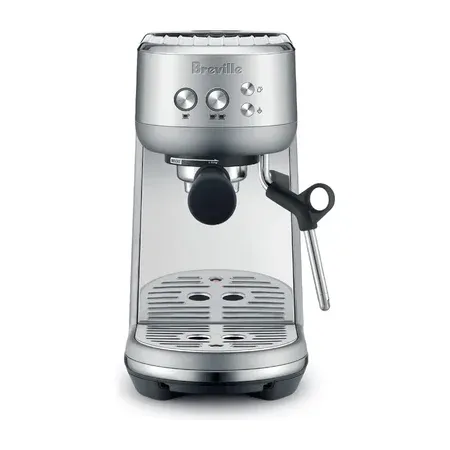
Best overall
Breville Bambino
A compact machine with 3-second ThermoJet heat-up, PID temperature control, pre-infusion, and a 54 mm portafilter.
The Breville Bambino has features that used to cost much more. Its ThermoJet heater reaches brewing temperature in about 3 seconds, so you can pull a shot almost as soon as you switch it on, instead of waiting 10 to 20 minutes like many boiler machines. PID digital temperature control holds the water steady, which is one of the biggest factors in how a shot tastes, and low-pressure pre-infusion gently wets the coffee before full pressure to reduce channeling and uneven extraction.
It uses a 54 mm portafilter and comes with both dual-wall (pressurized) and single-wall (standard) baskets. Start with the dual-wall baskets and pre-ground coffee; when you add a grinder, switch to the single-wall baskets for richer, more nuanced shots. A manual steam wand handles milk for lattes and cappuccinos, and Breville includes a milk jug and tamper.
The Bambino is narrow and fits on almost any counter. Its drip tray and water tank are small, so you’ll empty and refill them often, and the included tamper is basic enough that many owners upgrade it. It has a very large online community, which makes it easy to find dial-in guides.
Buy it if you want the best balance of price, speed, and espresso quality, and want a machine you can grow into.
Best Under $200: De’Longhi Stilosa
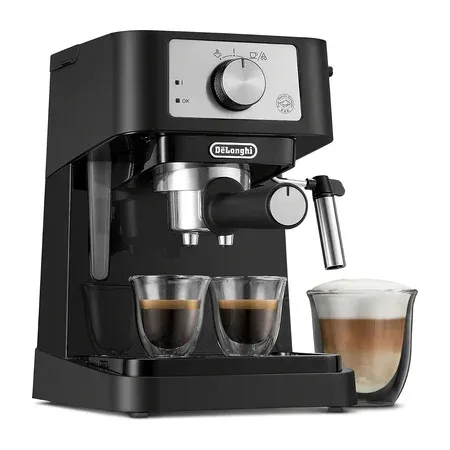
Best under $200
De'Longhi Stilosa
A 15-bar pump machine with a stainless steel boiler, manual steam wand, and forgiving pressurized baskets.
The De’Longhi Stilosa is the cheapest espresso machine worth buying, and one of the most popular, with nearly 14,000 Amazon ratings. It has a 15-bar pump, a stainless steel boiler, a manual steam wand, and a 51 mm portafilter with pressurized baskets.
Pressurized baskets are the key to how it works. They build pressure even when the coffee isn’t ground finely or tamped evenly, so the Stilosa makes a decent, crema-topped shot from supermarket pre-ground espresso. That’s ideal for beginners and for milk drinks, where the milk hides small differences in the shot.
The trade-offs: it takes longer to heat up and to switch from brewing to steaming than the Bambino, the plastic tamper is flimsy, and pressurized baskets cap how good the espresso can get. Fine-tuning shots with a better grinder won’t make much difference on this machine.
Buy it if you want lattes and cappuccinos at home for as little as possible. The Casabrews CM5418 (about $140) is a similar alternative with a pressure gauge and a 20-bar pump.
Best Under $500 for Lattes: Breville Bambino Plus
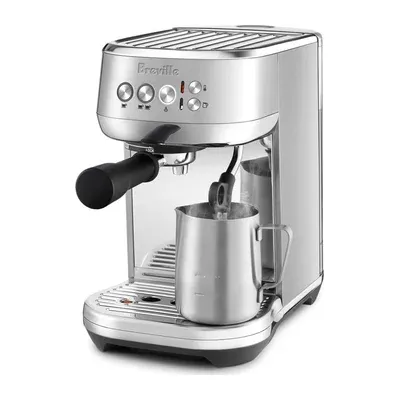
Best under $500 for lattes
Breville Bambino Plus
The Bambino with an automatic steam wand that textures milk to the temperature and foam you choose.
Steaming milk well is the hardest skill for new home baristas. The Bambino Plus takes it off your plate. It’s the Bambino, with the same 3-second heat-up, PID control, and pre-infusion, plus an automatic steam wand: set the jug on the drip tray, choose a milk temperature and foam level, and the wand textures the milk and shuts off on its own. The result is smooth, glossy microfoam for lattes and flat whites with no practice.
At $499.95 it costs $200 more, so it’s worth it mainly if you drink milk drinks every day. For a full comparison with Breville’s grinder-equipped machine, see Bambino Plus vs. Barista Express.
Buy it if you mostly drink lattes and cappuccinos and want them easy and consistent.
Best Under $500 for Espresso: Gaggia Classic
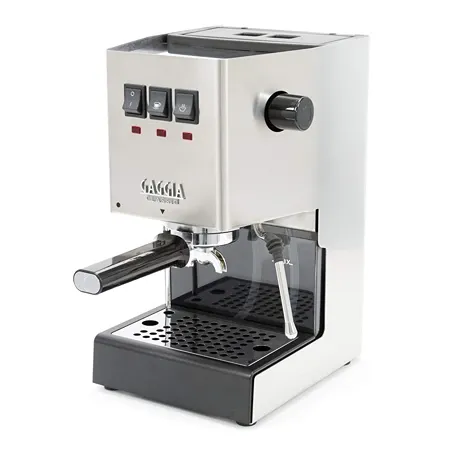
Best under $500 for espresso
Gaggia Classic E24
An Italian-made steel machine with a 58 mm commercial portafilter, 9-bar brewing, and a commercial steam wand.
The Gaggia Classic has been made in Italy for decades, and it’s the budget machine espresso enthusiasts buy when they want café-style hardware. The current version, the Classic E24, has a solid steel body, a heavy 58 mm commercial portafilter, the same size most café machines use, brewing set to 9 bar (the pressure espresso is traditionally brewed at), a three-way solenoid valve that dries the coffee puck after each shot, and a commercial-style steam wand.
It’s a hands-on machine. It doesn’t have PID temperature control or pre-infusion, so it rewards a good grinder and some practice, and it takes several minutes to heat up. Because it’s simple and widely used, parts are easy to find, and many owners modify it with upgrades like PID kits.
At about $450 to $500 on Amazon, it’s the most espresso-focused machine you can buy under $500, but it’s not as beginner-friendly as the Bambino.
Buy it if you mostly drink straight espresso and want a durable machine you can learn on and upgrade. For more machines at higher prices, see our guide to the best home espresso machines.
The Grinder: Baratza Encore ESP
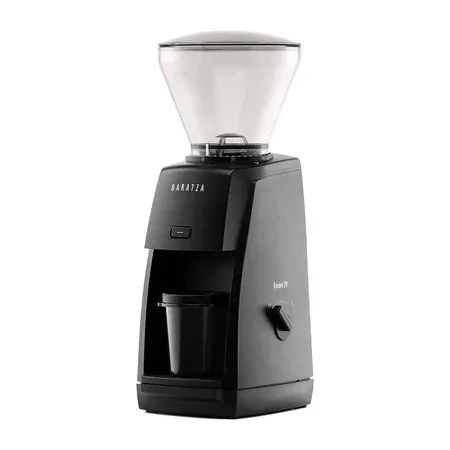
Best budget espresso grinder
Baratza Encore ESP
A burr grinder with fine micro-steps for espresso and coarser settings for drip and pour-over.
Espresso is more sensitive to grind than any other brewing method. Fresh beans ground just before brewing make a bigger difference than the machine itself, and the fine, even grind espresso needs is beyond blade grinders and most cheap burr grinders. The Baratza Encore ESP is the most affordable grinder that does it well. Its first 20 settings are fine micro-steps for dialing in espresso, and settings 21 to 40 cover drip and pour-over, so it also works for other coffee.
It has 40 mm hardened steel burrs, the burr pops out for cleaning without tools, and Baratza is known for selling replacement parts and supporting repairs. It’s a bit loud and slower than pricier grinders.
Buy it if you buy the Bambino, Bambino Plus, or Gaggia and want to get the most out of it. With the Stilosa’s pressurized baskets, a grinder helps less.
Do You Need a Grinder?
Not to start. Pre-ground espresso works fine with pressurized baskets, which come with the Stilosa and the Bambinos. But pre-ground coffee goes stale within days of opening, and it can’t be adjusted, so shots will be inconsistent. If you want to switch to standard baskets and make noticeably better espresso, a burr grinder is the best upgrade you can buy. Budget about $150 to $200.
What About Machines Under $100?
Amazon is full of espresso machines under $100 with big “20-bar” claims. Pressure figures on these machines mostly describe the pump’s maximum, not brewing pressure, and nine bar is the traditional target. Many of the cheapest models use steam rather than a pump, which can’t make true espresso at all. If $100 is the limit, a Moka pot or AeroPress makes strong, espresso-style coffee for much less, and a pod machine like Nespresso is the easiest option. See Nespresso vs. Keurig for pod machines and espresso vs. coffee for the differences.
What It Costs Per Cup
A double shot uses about 14 to 18 grams of coffee. With good beans at about $16 to $20 a pound, that’s roughly 50 to 80 cents a shot, plus milk. Even with a $300 machine and a $200 grinder, daily lattes at home pay off the equipment in a few months compared with buying them at a café.
How We Chose
We compared popular espresso machines under $500 on temperature control and heat-up time, portafilter size and baskets, steam wand performance, build quality, ease of use for beginners, room to improve, parts and community support, and owner ratings. We left out machines under $100 whose pressure claims and steam-based brewing can’t produce real espresso, and included one grinder because it matters as much as the machine.
Cheap Espresso Machine FAQ
What is the best cheap espresso machine?
The Breville Bambino at $299.95. It heats up in seconds, holds a steady brewing temperature, and comes with baskets for both pre-ground and fresh-ground coffee. Under $200, the De’Longhi Stilosa is the best choice.
Is a $150 espresso machine worth it?
Yes, if you mostly make milk drinks. The De’Longhi Stilosa makes decent espresso from pre-ground coffee and steams milk well enough for lattes. It won’t match a better machine for straight espresso.
What is the best espresso machine under $500?
The Breville Bambino Plus for lattes and cappuccinos, thanks to its automatic milk wand, or the Gaggia Classic for straight espresso and long-term tinkering.
Do cheap espresso machines make real espresso?
Pump-driven machines like the Stilosa, Bambino, and Gaggia do. Many machines under $100 use steam pressure or exaggerated pump ratings and make strong coffee rather than true espresso.
What are pressurized baskets?
Filter baskets with a second wall and a small hole that builds pressure even with uneven grinding or tamping. They make espresso easier with pre-ground coffee but limit how good it can get.
Do I need a separate milk frother?
No. Every machine here has a steam wand. The Bambino Plus textures milk automatically; the others need a little practice.