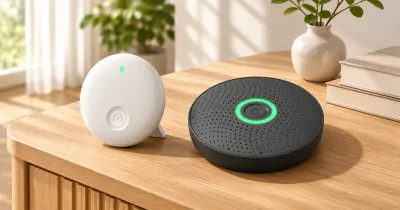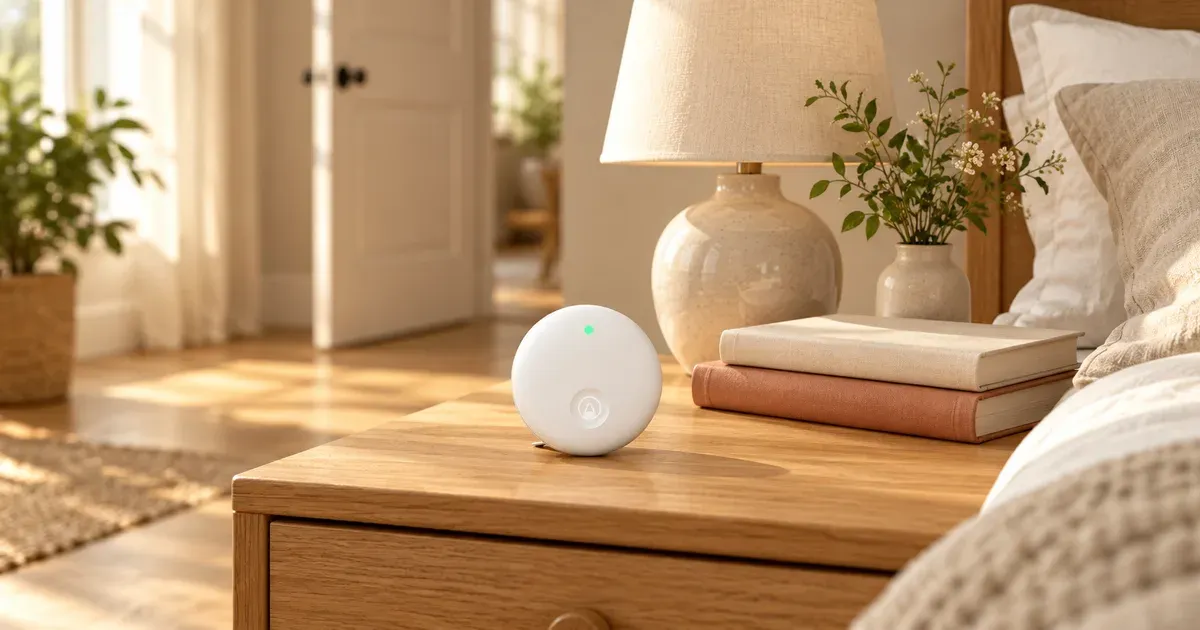
I bought the Airthings Wave Enhance out of curiosity about the air in my home, and it changed how I set up my bedroom at night. It showed me something I hadn’t considered: with the door closed, CO2 was climbing to somewhere between 1,500 and 2,500 ppm overnight.
Now I sleep with the door open, and my overnight readings have come down. After months of daily use, I have no real complaints, and I’d buy it again. For most homes, I think it’s worth it.
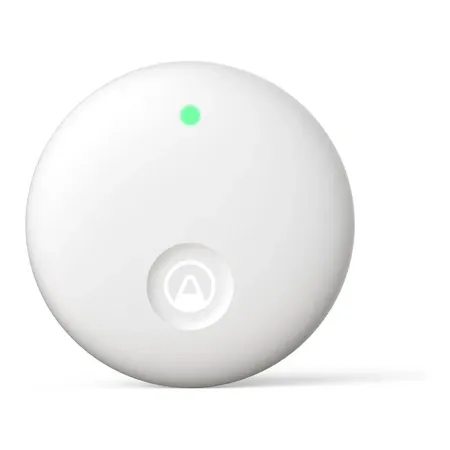
Best bedroom air quality monitor
Airthings Wave Enhance
A small battery-powered monitor for CO2, VOCs, temperature, humidity, pressure, noise, and light, with an NDIR CO2 sensor.
Airthings Wave Enhance Review: Quick Verdict
The Wave Enhance does one thing very well: it shows you what’s happening in a room that you can’t see or smell. It’s small enough to disappear on a bedside table, runs on two AA batteries, and tracks trends over time in the app.
It’s only a monitor, so it won’t clean anything itself. The value comes from acting on what it tells you, and in my case, that took one free change and one purifier.
Airthings Wave Enhance specs
| Spec | Value | Note |
|---|---|---|
| Price | $159.99 from Airthings | Amazon has sold it for about $130 |
| Air sensors | CO2, VOCs, humidity, temperature, pressure | |
| Other sensors | Ambient noise and light | It measures sound levels and does not record audio |
| CO2 sensor | NDIR, 400 to 5,000 ppm | Rated ±50 ppm ±5% between 500 and 2,000 ppm |
| Sampling | Every 5 minutes | Air sensors |
| Battery | 2 AA, included | Up to 14 months on Bluetooth, up to 17 on SmartLink |
| Size and weight | 3.15 in wide, 1.06 in thick, 3.4 oz | Includes batteries |
| Warranty | 5 years |
What It Showed Me About My Bedroom
I wasn’t chasing a specific problem when I bought this. I just wanted to know what my air was like. The most useful finding was how much CO2 built up in my closed bedroom overnight.
The readings gave me an easy test: open the door and compare. Keeping it open at night brought my overnight CO2 down. That costs nothing, and I wouldn’t have thought to try it without the data.
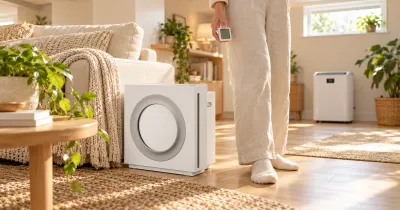
I also added a Coway Airmega AP-1512HH because of the VOC readings, and those came down too. Since I made both changes, I can’t credit either one alone for the VOC drop. An open door lets in fresh air, and the Coway’s carbon filter is a thin one. Carbon sheets like that have limits with gases, as we explain in our guide to whether air purifiers are worth it. A purifier won’t do anything for CO2, so fresh air is what fixes that.
Does Bedroom CO2 Affect Sleep?
Airthings markets the Wave Enhance around sleep, so it’s worth looking at the evidence. I couldn’t find a systematic review of bedroom ventilation and sleep, so the best evidence here comes from small field studies. They do point the same way:
- Open or closed door. In a study of 17 healthy young adults, CO2 averaged 717 ppm with a window or door open and 1,150 ppm with both closed. Self-reported sleep depth was better with them open.
- More or less ventilation. A study of two small dormitory experiments found better measured sleep, less next-day sleepiness, and better concentration when average CO2 was about 660 to 835 ppm rather than about 2,400 to 2,600 ppm.
- A blinded home test. In a four-week study in 29 bedrooms, participants got less deep sleep at lower ventilation rates, though their cognitive test scores didn’t change.
These are small studies, and better ventilation changes more than CO2. They support trying an open door or window if your readings are high. They don’t prove that a monitor will improve your sleep.
Using the Wave Enhance With Home Assistant
I use the app, but I’ve also connected the monitor to Home Assistant, where it does two things:
- It runs my purifier. An automation turns on the Coway when VOC readings pass a set level.
- It feeds a dashboard. I can see my stats at a glance without opening the app.
Home Assistant has an Airthings BLE integration that supports the Wave Enhance. It needs your Home Assistant host, or a Bluetooth proxy, within range of the monitor, and the monitor has to use Bluetooth rather than SmartLink. No Airthings hub is required for this route.
That’s a real advantage. By itself, the Wave Enhance only syncs to the Airthings app when your phone is within about 30 feet with the app open. Live remote readings and integrations like IFTTT and Alexa require linking it to a View series monitor, which works as an Airthings hub.
Where to Put It
A bedside table is a good spot, and it’s where Airthings suggests keeping it in a bedroom. It has a fold-out stand, or you can mount it on a wall. Airthings recommends placing it 40 to 70 inches above the floor, and at least 3 feet from vents, fans, windows, and doors, because they can skew the readings.
Give the VOC sensor about a week to settle after setup. CO2, humidity, temperature, and pressure are ready from day one.
Wave Enhance vs. Wave Plus vs. View Plus
The Wave Enhance doesn’t measure radon or particles. If you live in a radon-prone area and haven’t tested, or wildfire smoke is your main concern, consider one of Airthings’ other monitors.
Wave Enhance and Wave Plus specs
| Spec | Wave Enhance | Wave Plus |
|---|---|---|
| Airthings price | $159.99 | $249.99 |
| CO2 and VOCs | Yes | Yes |
| Radon | No | Yes |
| Particles (PM2.5) | No | No |
| Noise and light | Yes | No |
The View Plus costs $329.99 and adds PM2.5 and radon sensing. It can also act as the hub for a Wave Enhance. For a bedroom where CO2 is the main question, the Wave Enhance is the cheaper way to get the answer.
Is the Airthings Wave Enhance Worth It?
Yes, for most homes. It costs more than a basic sensor, but it taught me something useful about the room I sleep in and led to a change that costs nothing. It has kept earning its place since then by feeding my Home Assistant setup.
Buy it if you’re curious about your indoor air, you sleep with your bedroom door closed, you want a real CO2 sensor without a bulky device, or you use Home Assistant.
Skip it if you need radon or PM2.5 readings, want numbers on a screen you can read from across the room, or aren’t likely to change anything based on what you see.
Airthings Wave Enhance FAQ
Does the Airthings Wave Enhance measure radon?
No. It measures CO2, VOCs, humidity, temperature, pressure, noise, and light. Airthings sells the Wave Plus, View Plus, and Corentium Home models for radon.
Does the Airthings Wave Enhance work with Home Assistant?
Yes. I use mine with Home Assistant, and the Airthings BLE integration supports the Wave Enhance as long as Home Assistant or a Bluetooth proxy is within range and the monitor is set to Bluetooth.
Does the Wave Enhance need a hub?
Not for basic use. The app syncs over Bluetooth when you’re nearby. You need a View series monitor as a hub for live readings away from home and integrations like IFTTT and Alexa.
How high is too high for CO2 in a bedroom?
There’s no single sleep cutoff, but the studies above found better sleep at averages under about 850 ppm than at roughly 1,150 ppm and above. My room reached 1,500 to 2,500 ppm with the door closed.
Will an air purifier lower CO2?
No. Air purifiers filter the air in a room but don’t remove CO2. Opening a door or window, or adding ventilation, is how you bring it down. Our best air purifiers guide covers what purifiers can do well.
How long do the batteries last?
Airthings rates the two included AA batteries at up to 14 months on Bluetooth and up to 17 months through SmartLink.
Does the Wave Enhance record sound?
No. Airthings says the sensor only measures sound levels, in decibels, and doesn’t record audio.