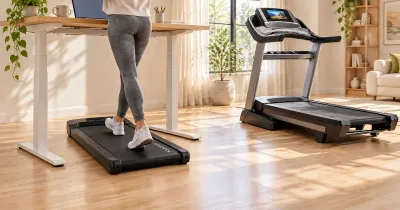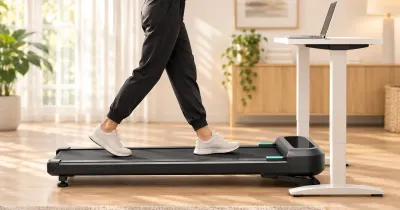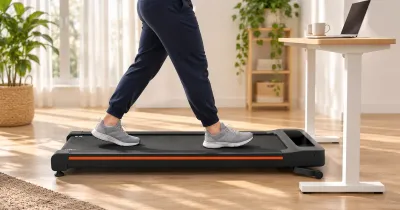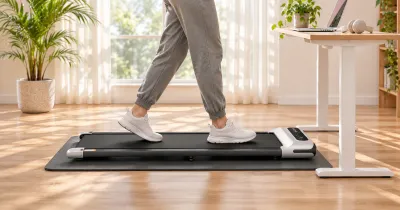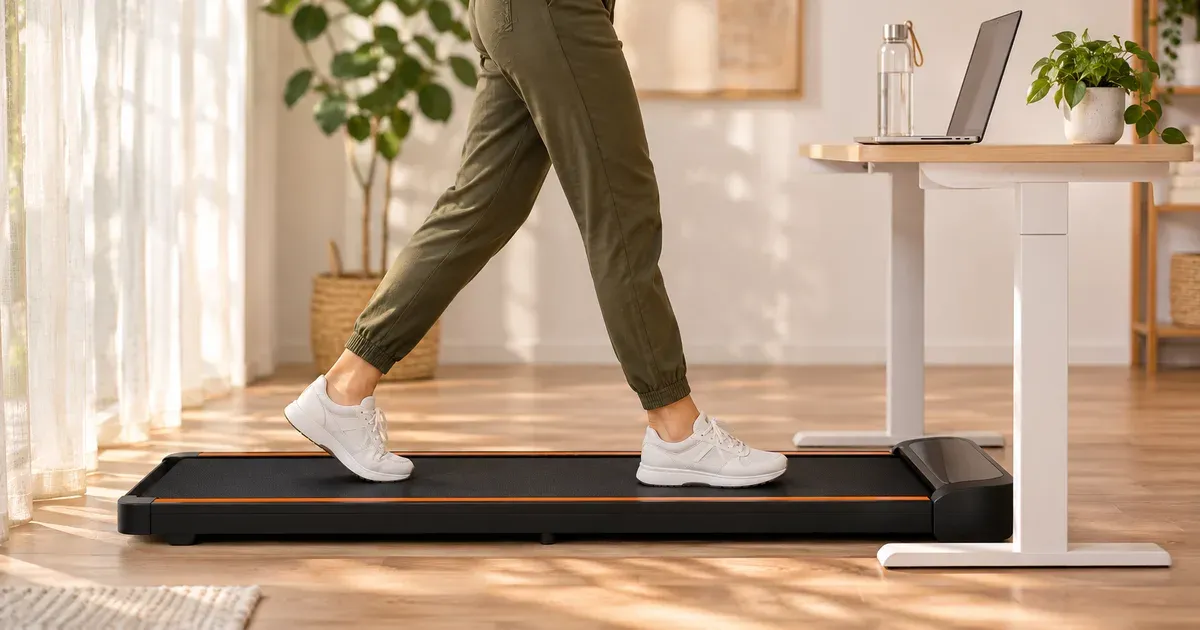
Yes, a walking pad is worth it if you will actually walk on it for an hour or more on most workdays. Research on treadmill desks shows they burn about 105 more calories an hour than sitting and cut the time you spend sitting. They won’t, on their own, lower your blood pressure, fix your cholesterol or cause much weight loss, and they slow your typing. If you mostly need to sit less, a standing desk does that for less money.
A good walking pad costs about $200 to $300, fits under a standing desk, and slides under a couch when you’re done. It’s a poor buy if you have no standing desk and no plan to get one, if your work is mostly fast typing and mouse work, or if small children and pets have free run of the room it would sit in.
The Short Answer
| Question | What the evidence says |
|---|---|
| Does it burn more calories? | Yes. About 105 kcal an hour more than sitting (13 studies, 351 people) |
| Does it cut sitting time? | Yes, modestly. About 1.7 fewer minutes of sitting per hour across the day in workplace studies |
| Does it add steps? | Yes. 1,622 more steps a day at work in one randomized trial |
| Will you lose weight? | A little, at best. About 3 pounds in a year in the only year-long trial |
| Does it improve blood pressure, cholesterol or BMI? | No clear effect in pooled studies |
| Does it hurt your work? | Typing and mouse speed drop. Reading, attention and long-term productivity don’t |
| How strong is the evidence? | Low. Small, short studies, many in labs |
What a Walking Pad Does for Your Health
Most of the research is on treadmill desks: a slow treadmill under a standing desk, which is exactly how most people use a walking pad. The best summary is a 2021 systematic review and meta-analysis in BMC Public Health that pooled 13 studies with 351 adults in sedentary jobs, seven in labs and six in real workplaces.
Calories burned
In lab studies, walking at a treadmill desk raised energy use by 105 kcal per hour compared with sitting (95% confidence interval 90 to 120). It is the most consistent finding in the research.
To put it in daily terms: two hours of desk walking is about 210 extra calories. Three hours a day, five days a week, is about 1,575 extra calories a week. Walking faster or adding an incline burns much more; at 10% incline, a 2 mph walk roughly doubles the burn of a flat one. Run your own numbers with our treadmill calorie calculator.
A separate 2021 meta-analysis of 22 cycle-desk and treadmill-desk studies found the same direction: large increases in energy expenditure and heart rate, with lower blood glucose and insulin during use. The authors flagged very high heterogeneity (I² of 95% for energy use), meaning the studies measured things in very different ways.
Sitting time
In the workplace studies of the BMC review, treadmill-desk users sat about 1.73 fewer minutes per hour over a 24-hour period (95% CI 0.17 to 3.3). Spread across a waking day, that’s roughly half an hour less sitting. It’s real but small, and the confidence interval runs from almost nothing to about an hour a day.
Other reviews are less impressed. A 2018 Cochrane review of 34 workplace studies found that sit-stand desks cut sitting at work by about 100 minutes a day in the first three months (low-quality evidence), while treadmill and cycling desks had “unclear or inconsistent” effects. A 2023 network meta-analysis of 23 randomized trials with 1,428 office workers found treadmill desks reduced work sitting time when paired with prompts and encouragement to use them, but rated the overall certainty of the evidence as low.
The pattern across these reviews: a treadmill desk that sits unused does nothing. The people who benefit are the ones who build it into a routine.
Steps
No systematic review pools step counts for treadmill desks, so the numbers come from single trials:
- In a 3-month randomized trial of 41 overweight office workers sharing treadmill desks, users took 1,622 more steps a day than the control group during work hours.
- In a 9-month study of 12 overweight and obese office workers with their own treadmill desks, median daily steps rose from 4,351 to 7,080.
You can do much better on your own if you use it a lot. At 2 mph, an average adult takes about 96 steps a minute, or close to 5,800 steps in an hour. Our steps to miles calculator converts your steps to distance.
Weight loss
This is where the evidence is thinnest. The BMC review found no significant change in BMI or body fat in workplace studies, though the authors noted most outcomes leaned in the right direction and the studies were small.
The only year-long study is a 2013 trial of 36 office workers who swapped their desks for treadmill desks. Average weight loss was 1.4 kg (about 3 pounds) over the year, and 2.3 kg (about 5 pounds) for participants with obesity. There was no control group. A 2019 systematic review of active workstations in people with overweight or obesity found the treadmill desk was the only type of active workstation with reported weight and body-composition benefits, but it didn’t pool the results into an effect size.
So a walking pad can help with weight if you use it daily and don’t eat back the calories. Don’t expect it to do the job alone.
Blood pressure, cholesterol and blood sugar
Neither the BMC review nor the cycle-and-treadmill-desk review found an effect on blood pressure. The BMC review found no significant changes in fasting glucose, HDL, triglycerides or total cholesterol in workplace studies. The 9-month study above did report lower LDL (down 16 mg/dL) and smaller waists (down 5.5 cm), but it had only 12 people and no control group. No systematic review shows that a walking pad improves long-term heart health markers.
Can You Work on a Walking Pad?
Yes, but some tasks get slower. Two meta-analyses agree on the trade-off:
- A 2016 meta-analysis found active workstations didn’t affect selective attention, processing speed, speech quality, reading comprehension or transcription accuracy. They did slow typing (effect size −0.55) and, more sharply, mouse clicking (−1.10).
- A 2020 meta-analysis of 18 studies found treadmill desks reduced typing speed by a large standardized amount (−0.8). Attention tests were unaffected, and recall slightly improved. The authors concluded that the slowdown comes from the motor task, not from thinking less clearly.
Over longer periods, the picture is better. A 2018 systematic review found three studies that tracked workplace productivity for 12 to 52 weeks, and none found a significant drop. The year-long trial above also found no change in work performance.
In practice, most people walk during calls, reading, email and video meetings, and sit or stand still for focused typing, spreadsheets and design work. Keep the speed low, around 1 to 2 mph, while you work.
Is a Walking Pad Safe?
For most adults at walking speeds, yes, but treadmills cause real injuries, and walking pads have no handrails to grab.
- Injury numbers. A study of national emergency-room data estimated 4,929 treadmill-related head injuries in adults from 1997 to 2014, with a more than tenfold rise over that period and a 14 times higher risk of hospital admission for people over 50.
- The Sperax warning. In April 2026, the CPSC told owners of four Sperax walking pads to stop using them immediately. It had 201 reports of sudden speed changes and abrupt stops, including at least 66 falls or injuries, plus 573 reports of overheating and fires. Our Sperax walking pad warning explains what owners should do.
- Children and pets. In 2021, Peloton recalled its Tread+ after a 6-year-old was pulled under the rear of the machine and died. Any moving belt can catch small hands and paws.
To use one safely:
- Buy from a brand that supports its products. Search cpsc.gov/Recalls for the brand first; it covers recalls and warnings.
- Start slow. Step on at the lowest speed and build up. Walking while looking at a screen changes your gait, so stay near the center of the belt.
- Make sure you can stop it fast. Keep the remote within reach and use the safety key or clip if your pad has one.
- Leave clear space behind the pad so you can step off safely, and keep cords out of your path.
- Unplug it when you’re done and keep children and pets out of the room while it runs.
- Wear shoes. Socks slip on a moving belt.
What Does a Walking Pad Cost?
| Item | Typical cost |
|---|---|
| Basic flat walking pad | About $100 to $150 |
| Brushless pad with incline (our picks) | About $200 to $330 |
| Premium slim incline pad | About $400 to $480 |
| Standing desk, if you don’t have one | A few hundred dollars and up |
| Treadmill mat | Optional; helps with noise and floors |
Compared with a full treadmill, which often runs well over $1,000, a walking pad is the cheaper experiment. Our walking pad vs. treadmill comparison covers the full trade-off, and the best standing desks guide covers the desk half of the setup.
Cheap pads cut corners on the parts that wear out. Look for a brushless motor, a weight rating comfortably above your weight, and a brand with a real warranty and parts support. If you weigh over 300 pounds, see our guide to the best walking pads for heavy people.
How Much Space and Noise?
Space. A typical incline walking pad measures about 48 to 50 inches long, 20 to 22 inches wide and 6 inches tall, and weighs 50 to 70 pounds. It slides under most beds and couches, but it’s heavy to carry upstairs. The deck raises you about 4.5 to 6.5 inches, so your standing desk has to go that much higher. Our desk height calculator gives you the target height.
Noise. Brushless pads are rated at about 35 to 40 dB, around library level, and cheaper brushed pads at about 45 dB. The motor is rarely the problem. Your footsteps are, especially if someone lives below you. A mat, soft shoes and a slower pace help more than a quieter motor. See our list of the quietest walking pads.
Who a Walking Pad Is Worth It For
Worth it if you:
- Work from home at a standing desk, or will buy one.
- Spend a lot of the day on calls, meetings, reading or email.
- Want more daily steps or light activity without blocking off workout time.
- Will walk at least an hour on most workdays.
Not worth it if you:
- Have no standing desk and nowhere to set one up.
- Spend most of the day typing fast, coding, or doing detailed mouse work.
- Want serious cardio or running. Get a treadmill or go outside.
- Have toddlers or pets you can’t keep out of the room.
- Live above someone and have a hard floor and no room for a mat.
Consider these instead:
- Just a standing desk. The strongest evidence for sitting less is for sit-stand desks, about 100 fewer sitting minutes a day in the short term.
- An under-desk bike or elliptical. You can pedal while seated, which is easier for typing. See under-desk bike vs. elliptical.
- A mini stepper. About $50 for short, hard bursts. See stepper vs. walking pad.
Which Walking Pad Should You Buy?
If you decide a walking pad is worth it for you, these three cover most budgets. All three have a motorized incline, which makes a slow desk walk burn a lot more without speeding up. For more options, see the best under-desk treadmills and the best walking pads with incline.
Best Overall: Merach NovaWalk W50
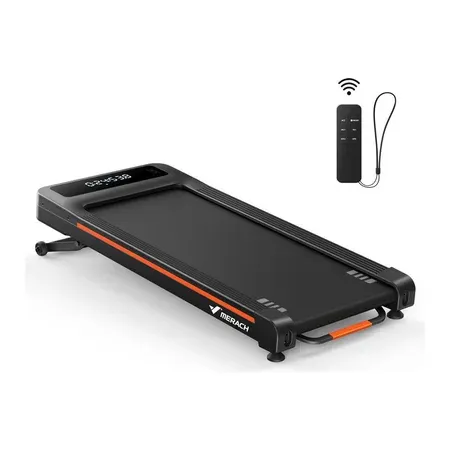
Best overall
Merach NovaWalk W50
A brushless walking pad with a 12% motorized incline, 400 lb rating, and 41.3-inch belt.
The Merach NovaWalk W50 costs about $300 to $330 and has a 12% motorized incline, a quiet brushless motor rated under 40 dB, a 41.3-inch belt and a 400-pound rating. It tops out at 4 mph and weighs about 68 pounds. Our Merach walking pad review has the full specs.
Best Value: UREVO SpaceWalk 5L
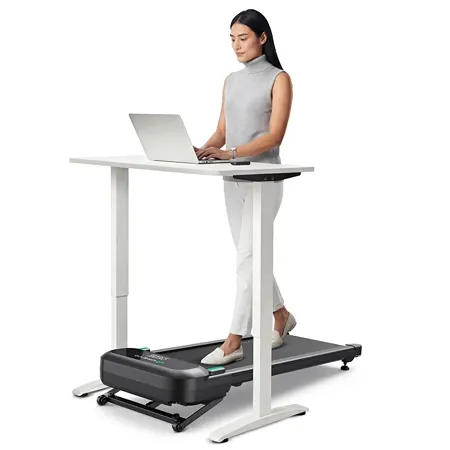
Best value
UREVO SpaceWalk 5L
A 6.1-inch-tall brushless walking pad with a 9% auto incline, app, and remote.
The UREVO SpaceWalk 5L is about $270 for a 2.5 HP brushless motor, a 9% auto incline, an app and a remote. It’s 6.1 inches tall and tops out at 4 mph. UREVO rates it for 400 pounds. Read our SpaceWalk 5L review.
Best Budget: DeerRun Z10
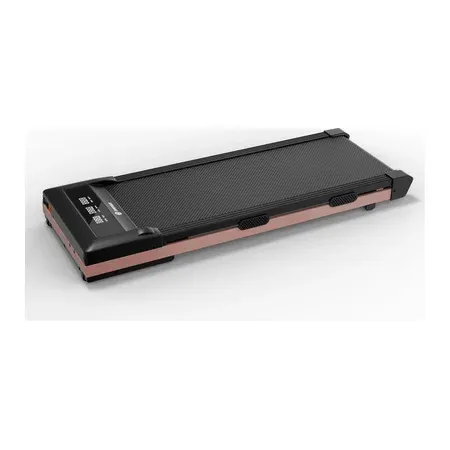
Best budget
DeerRun Z10
A slim walking pad with a 12% motorized incline, 300 lb rating, and remote, for about $200.
The DeerRun Z10 brings a 12% motorized incline down to about $200. It’s rated for 300 pounds and up to 45 dB, with a shorter belt, a 3.8 mph top speed and a one-year warranty. It’s the cheapest way to try desk walking without buying a bare-bones pad. See our DeerRun review.
Is a Walking Pad Worth It? FAQ
Is a walking pad worth it for weight loss?
Only as part of a bigger plan. A treadmill desk burns about 105 extra calories an hour, but the one year-long trial found average weight loss of about 3 pounds, and pooled studies show no significant change in BMI.
How many calories does a walking pad burn?
About 105 more calories an hour than sitting at a slow desk pace, based on a 2021 meta-analysis. Faster walking and incline raise that a lot; use our treadmill calorie calculator for your weight and speed.
Is 30 minutes on a walking pad enough?
It adds roughly 50 extra calories and about 2,900 steps at 2 mph, which is a good start. Most of the benefits in studies came from people who used treadmill desks for an hour or more on workdays.
Can you lose belly fat on a walking pad?
No exercise targets belly fat. One small 9-month study found waist size fell by 5.5 cm in 12 treadmill-desk users, but it had no control group, and pooled studies show no significant change in body fat.
Is a walking pad better than a standing desk?
It burns more calories, but a standing desk has stronger evidence for cutting sitting time, about 100 fewer minutes a day in the short term. A walking pad works best added to a standing desk, not instead of one.
Does walking while working hurt productivity?
Typing and mouse work get slower, but reading, attention and long-term productivity don’t decline in studies lasting up to a year. Walk during calls and reading, and stand still for detailed typing.
Are walking pads bad for your knees?
Slow walking is low-impact, and walking pads usually run at 1 to 4 mph. Start at a low speed and incline, wear supportive shoes, and build up gradually; steep inclines can strain tight calves and Achilles tendons.
Are walking pads safe?
Generally yes for adults at walking speeds, but buy from a brand that supports its products, keep children and pets away, and unplug it after use. The CPSC has told Sperax owners to stop using their pads after reports of sudden stops and overheating.