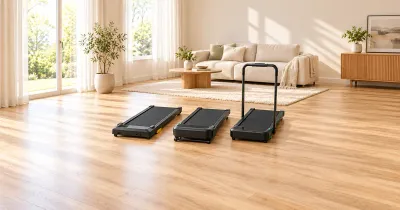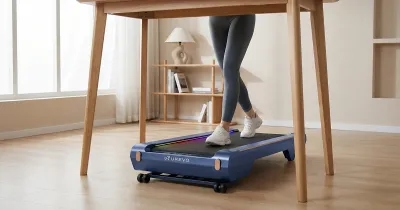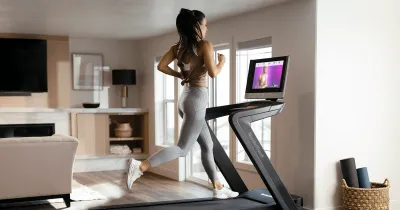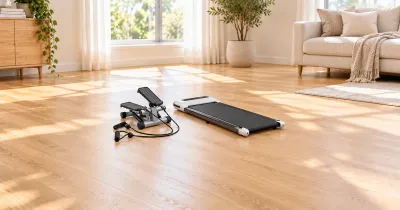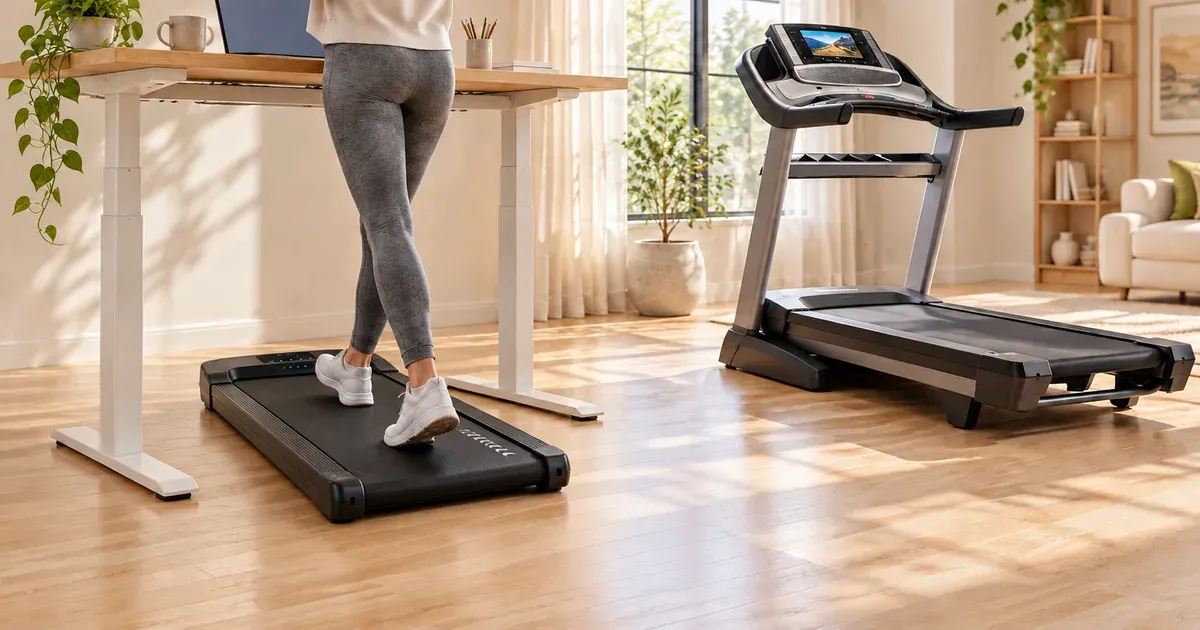
A walking pad and a treadmill do the same basic thing, but they are built for different days. A walking pad is a low, compact belt with no console or handrails, designed for slow walking under a standing desk or in front of the TV. A treadmill is a full machine with a long deck, handrails, a stronger motor, and enough speed to run.
I walk on an UPLIFT Inclining Walking Pad during calls and after lunch, so the walking pad side of this comparison draws on my own use.
The short answer: buy a walking pad if you want more steps during the workday and need something you can slide away when you are done. Buy a treadmill if you want to run, train for races, or walk faster than about 4 mph, and you have a permanent spot for it. If you want a bit of both, a foldable 2-in-1 model sits in between.
Walking pad vs. treadmill specs
| Spec | Walking pad | Full treadmill |
|---|---|---|
| Top speed | Usually 4 mph; 2-in-1 models reach about 6 to 7.6 mph | 12 to 14 mph is common (NordicTrack 2450: 14 mph) |
| Incline | Flat on budget pads; 7% to 14% on incline models | Up to 12% or more, often with decline (2450: -3% to 12%) |
| Belt size | About 35 to 41 in. long and 15 to 16.5 in. wide | Around 60 x 22 in. on running models |
| Machine weight | About 37 to 60 lb | Often 250 lb or more (2450: 332 lb) |
| Height | About 4 to 6 in. | Over 5 ft with the console (2450: 63.4 in.) |
| User weight rating | Mostly 220 to 300 lb | 300 to 400 lb (2450: 400 lb) |
| Handrails and console | None; controlled by a remote or app | Handrails, console, often a touchscreen |
| Storage | Slides under a couch or bed, or stands on end | Needs a permanent spot; some fold upright |
| Warranty | Often 1 year (UPLIFT, TRAILVIBER, GoYouth) | Varies by brand; usually longer on the frame and motor |
Space and Storage
This is the biggest practical difference, and for most people it decides the question.
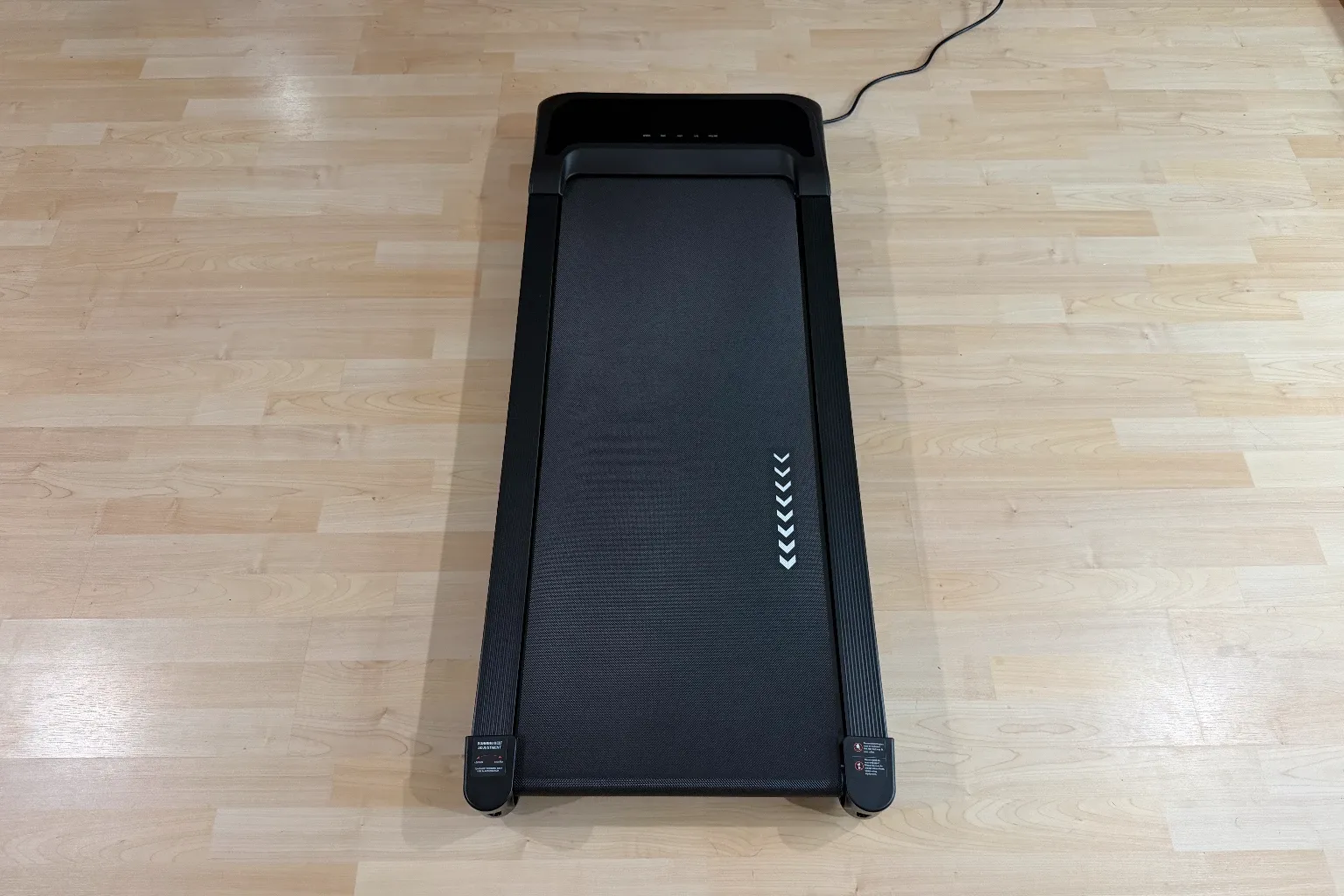
My UPLIFT pad measures 48 by 20.25 inches and is 5.25 inches tall. It rolls on two front wheels, weighs 47.4 pounds, and parks against a wall when I need the floor space back. That ease of moving it is what has kept it in use. If moving a machine is a chore, it tends to stay put away.
The walking pads we have reviewed weigh between 36.6 pounds (the UREVO SpaceWalk E1L) and about 60 pounds (the UREVO SpaceWalk 5L). Any of them can be moved by one person.
A full treadmill is furniture. The NordicTrack 2450 has a 77.3-by-37-inch footprint, stands 63.4 inches tall, and weighs 332 pounds. Folding treadmills help, but even folded they need a dedicated corner, and moving one between rooms is a two-person job.
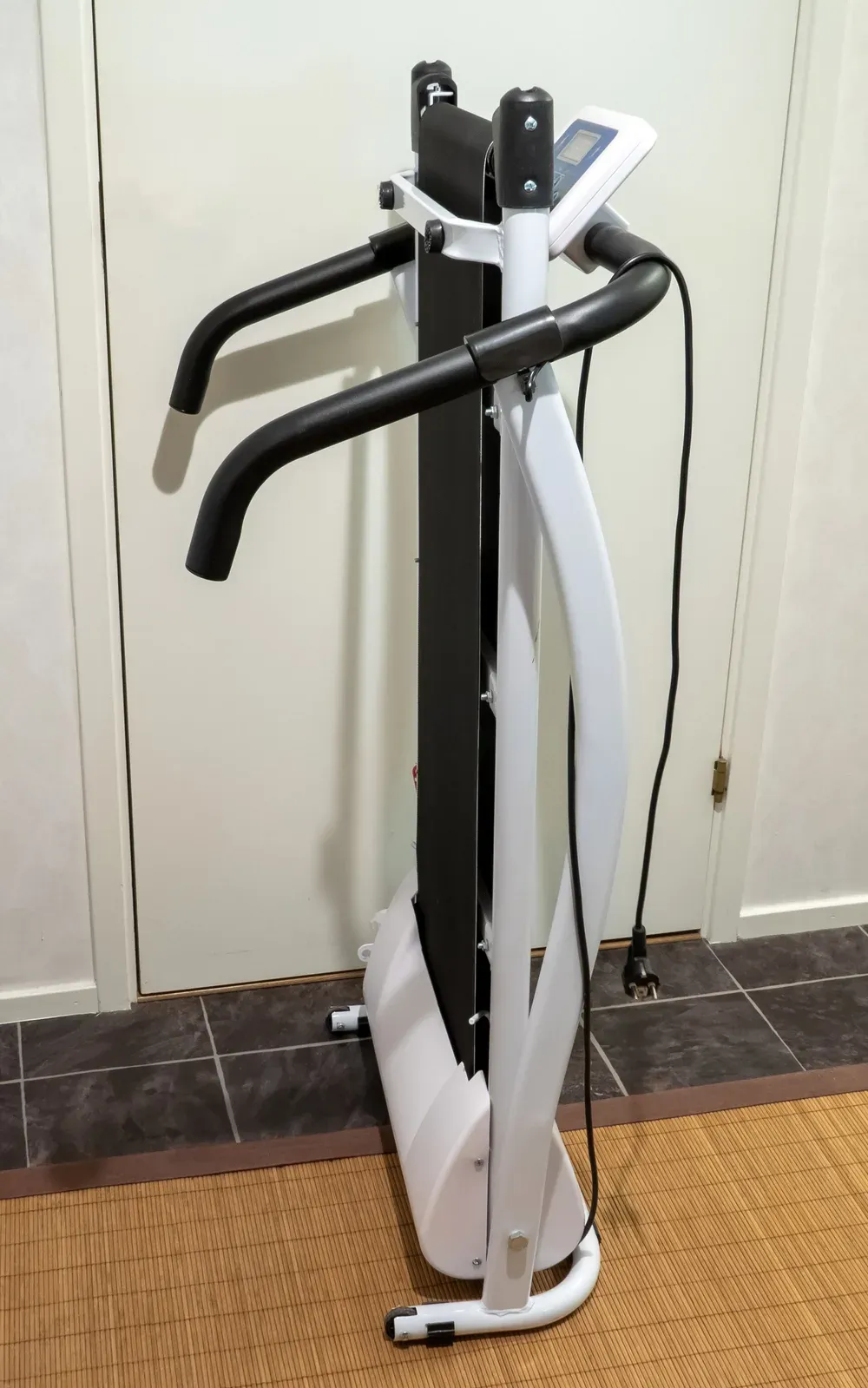
If you rent, live in an apartment, or work in a room that has to stay a room, a walking pad is the realistic choice. If you have a garage, basement, or spare room, a treadmill’s footprint matters much less.
Speed: Walking Pads Are for Walking
Most walking pads top out at 4 mph. That includes the SpaceWalk 5L, the SpaceWalk E1L, the TRAILVIBER, and my UPLIFT. That is a brisk walk, but not a jog. The short deck and lack of handrails also leave little margin for a running stride.
A running treadmill goes much faster, usually 12 to 14 mph, on a deck around 60 inches long. That length is the point. At running speed your stride gets longer, and a 40-inch walking pad belt simply runs out of room.
In between are 2-in-1 foldable treadmills: walking pads with a handlebar that flips up for faster sessions. The UREVO Strol 2E goes from 4 mph in walking mode to 6.2 mph with its handle raised, and the UREVO FoldiMix 5L reaches 7.6 mph. They handle light jogging, but not training runs. Our guide covers whether you can run on a walking pad in more detail.
Incline Closes Much of the Gap
Incline is where walking pads have improved the most. Budget pads like the SpaceWalk E1L and GoYouth 2-in-1 are flat, but newer incline models lift the deck while you walk. My UPLIFT reaches 7%, the SpaceWalk 5L reaches 9%, and the TRAILVIBER reaches 12%, which matches the NordicTrack 2450’s top incline.
Incline matters more on a walking pad than on a treadmill. At a desk, you cannot raise the speed much before typing and mouse work get harder. Raising the incline adds effort without changing the pace. On my UPLIFT, the remote changes the incline while the belt is moving, and the deck rises and lowers smoothly enough that it does not break my rhythm.
What walking pads lack is decline. Treadmills like the 2450 can tilt downhill (to -3%), which matters mainly if you are training for hilly races.
Calories and Weight Loss
The machine does not decide how many calories you burn. Your speed, incline, body weight, and time on the belt do. A walking pad and a treadmill at the same settings burn the same energy.
Here is what our treadmill calorie calculator estimates for a 180-pound person over one hour. These figures include about 86 calories you would burn sitting still.
| Setting | Works on | Calories per hour |
|---|---|---|
| 2 mph, flat (typical desk walking) | Walking pad or treadmill | About 240 |
| 2 mph, 7% incline | Incline walking pad or treadmill | About 370 |
| 4 mph, flat (brisk walk) | Walking pad or treadmill | About 450 |
| 3 mph, 12% incline | 12% incline pad or treadmill | About 680 |
| 6 mph, flat (running) | Treadmill or 2-in-1 | About 870 |
Two things stand out. Adding a 7% incline to a slow desk walk burns about half again as many calories without speeding up. And a steep incline walk gets surprisingly close to a run.
Running burns the most per hour, but the main advantage of a walking pad is time on the belt. Two or three hours of slow walking spread across a workday adds up to more than a half-hour run, and many people find it easier to keep doing. Our steps to miles calculator shows how a day’s steps add up.
Noise and Working While You Walk
Walking pads are built to be used while you do something else. My UPLIFT pad is quiet enough at call speeds that the motor has not been a problem, and I use it while watching TV after lunch. The bigger sound is footfall, which depends on your floor and shoes more than on the machine. A treadmill mat helps with both.
The one thing to watch on video calls is motion, not noise. People can see the gentle bob in your camera even if they cannot hear the belt. Calls where you mostly listen are a natural fit. Presentations, where a steady frame matters, may not be.
A treadmill is louder at running speed, simply because running is louder, and its console and handrails make it awkward to pair with a desk. If you want to walk while you work, a walking pad is the better tool.
Durability, Weight Ratings, and Warranty
Walking pads use smaller motors and lighter frames. Most of the pads we have reviewed are rated for 220 to 300 pounds. The TRAILVIBER lists 450, and my UPLIFT is rated for 243. The UPLIFT, TRAILVIBER, and GoYouth each carry a one-year warranty, which is common for the category but short for a motorized machine.
Full treadmills are built for heavier daily use. The NordicTrack 2450 has a 4.25 CHP motor and a 400-pound rating. One caution on motor numbers: walking pad makers often quote peak horsepower, while treadmill brands quote continuous horsepower (CHP), so a “2.5 HP” walking pad is not stronger than a 4.25 CHP treadmill.
Both need routine care. UPLIFT recommends lubricating my pad’s belt with silicone every three months to a year, depending on how much you use it. Treadmills follow similar schedules.
Price
Walking pads cost a fraction of a full treadmill. Most of the pads we cover sell for a few hundred dollars, while running treadmills like NordicTrack’s Commercial series typically cost well over $1,000. Many also rely on a subscription, such as iFIT, for their guided workouts.
If you are not sure you will use either one, a walking pad is the cheaper experiment. If you already run regularly, a cheap walking pad is not a substitute, and a treadmill is the better value.
Which Should You Buy?
Choose a walking pad if:
- You want to walk while you work, read, or watch TV.
- You have a standing desk, or plan to get one.
- You need to store it away when you are done.
- You walk slower than about 4 mph and do not plan to run.
Choose a treadmill if:
- You run, or want to start.
- You want to walk fast, or do serious incline and decline training.
- You weigh more than about 300 pounds and want more headroom than most pads offer.
- You have a permanent spot for it.
Choose a 2-in-1 foldable treadmill if you want to walk at your desk on workdays and jog lightly on weekends, and can live with a short deck for both.
Our Picks
If you have decided on a walking pad, the UREVO SpaceWalk 5L is our top pick for its 9% incline and quiet brushless motor. If your standing desk is the center of your setup, my UPLIFT Inclining Walking Pad is the one I use. For more options, see our guide to the best walking pads and under-desk treadmills.
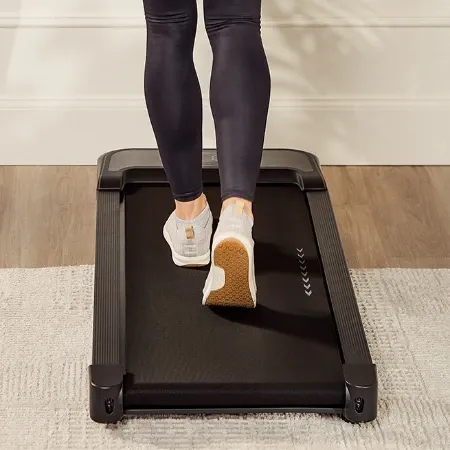
Best walking pad
UREVO SpaceWalk 5L
Features 9% auto incline, a quiet brushless motor, app tracking, and remote control.
Best for standing desks
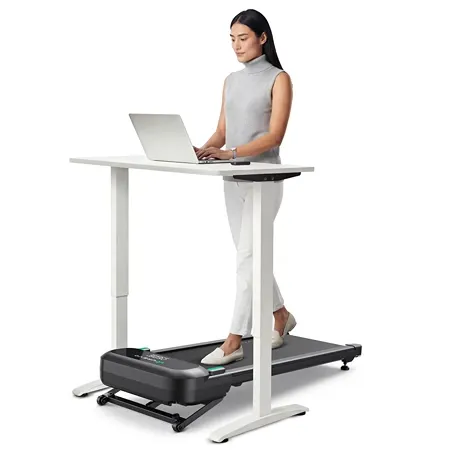
UPLIFT Inclining Walking Pad
A compact under-desk treadmill with remote-controlled 7% incline, speeds up to 4 mph, and built-in transport wheels.
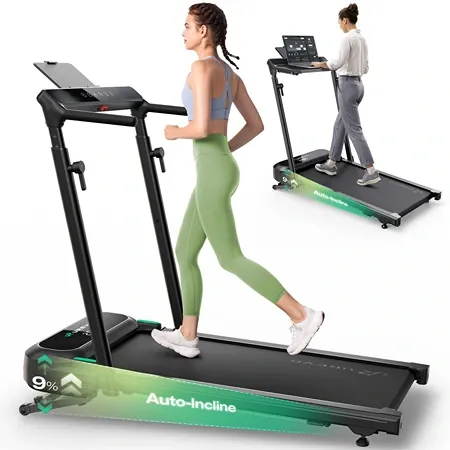
If you want one machine for desk walking and light jogging, the UREVO FoldiMix 5L reaches 7.6 mph with its handlebar up.
Best 2-in-1
UREVO FoldiMix 5L
9% incline, dual brushless motors, app controls, and a 7.6 mph top speed.
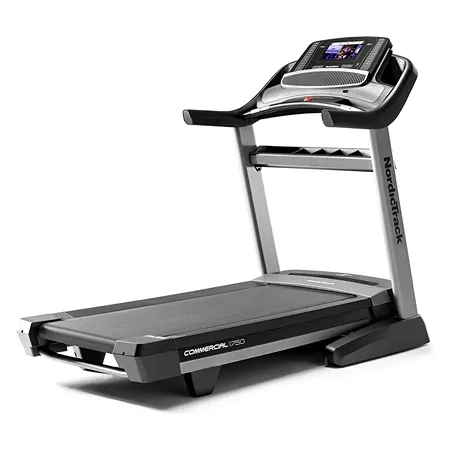
If you want to run, the NordicTrack Commercial 1750 is our top full-size treadmill, with a cushioned deck and a folding frame. See our guide to the best treadmills for more.
Best treadmill for running
NordicTrack Commercial 1750
A versatile treadmill with a cushioned deck, large touchscreen, and iFIT integration for guided workouts.
FAQ
Can a walking pad replace a treadmill?
For walking, yes. A walking pad handles slow and brisk walking, and an incline model can make those walks much harder. It cannot replace a treadmill for running, fast walking above about 4 mph, or decline training.
Is a walking pad worth it?
It is worth it if you will use it during time you would otherwise spend sitting, such as calls, email, reading, or TV. For me, it added a third option between sitting and standing at my desk, and the short walk after lunch has become a habit. It is not worth it if you would rather go for a walk outside, or if it would end up living in a closet.
Is a walking pad good for weight loss?
A walking pad helps the same way any walking does: by adding movement to your day. Slow walking burns fewer calories per hour than running, but it is easy to do for hours while you work. An incline pad adds noticeably more effort at the same speed. Try our treadmill calorie calculator with your weight, speed, and incline.
Do you need a standing desk for a walking pad?
Not necessarily. Many people use a walking pad in front of the TV. To walk while you work, though, you need a desk that rises high enough to cover the belt height. My pad raises me about 3.75 inches, so your desk has to go that much higher than your normal standing height. Our desk height calculator helps you check.