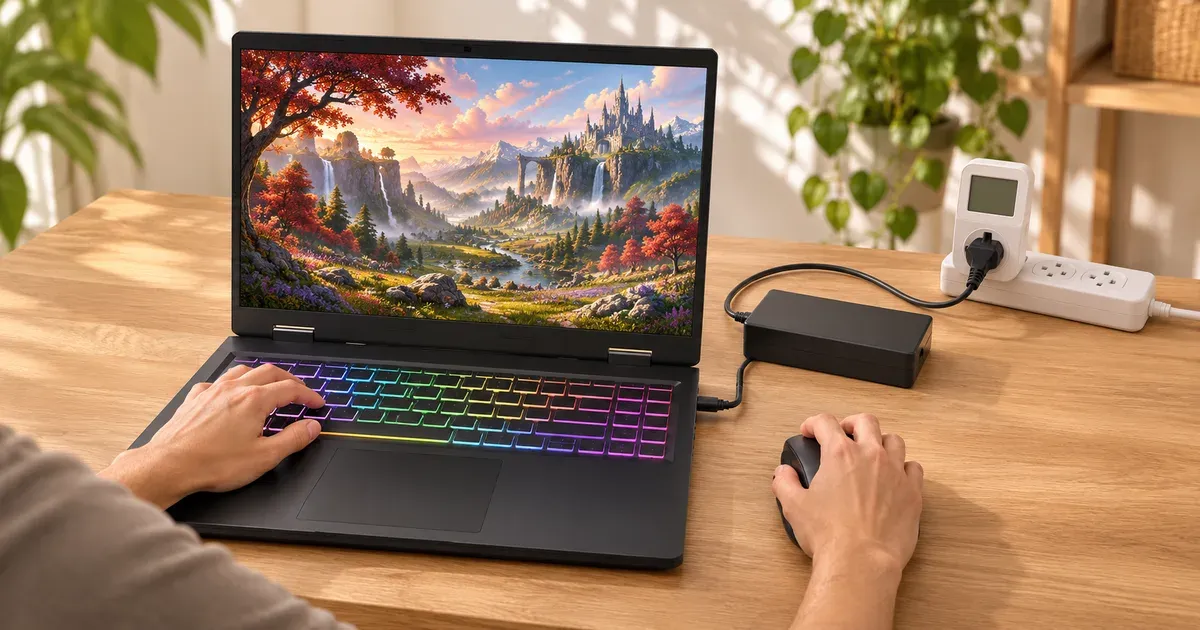
The short answer: a gaming laptop’s charger is rated anywhere from about 150 W (budget models) to 400–450 W (top RTX 5090 machines), and while gaming it typically pulls a large share of that; at the desktop it uses a small fraction. At the US average residential electricity rate (18.16¢ per kWh in August 2026, per the EIA), a laptop averaging 250 W for 2 hours a day costs about $2.72 a month. Even a heavy player’s bill is usually a few dollars a month.
Charger Size by Model
The charger rating is the maximum the laptop can draw from the wall (CPU, GPU, screen and charging the battery at once).
| Laptop | GPU | Charger |
|---|---|---|
| ASUS TUF Gaming 16 (2026) | RTX 5050–5070 at 85 W | 150 W |
| Alienware 16 Aurora | RTX 5050–5070 | 130 or 180 W |
| ASUS ROG Zephyrus G14 (2026) | up to RTX 5080 | 200 or 250 W |
| Lenovo LOQ 15 / Legion 5i / 5a / 7a (Gen 11) | up to RTX 5060–5070 | 245 W |
| ASUS ROG Zephyrus G16 (2026) | up to RTX 5090 | 250 W |
| Alienware 16X Aurora | up to RTX 5070 Ti | 180 or 280 W |
| ASUS ROG Strix G16 / G18 (2026) | up to RTX 5080 at 175 W | 280 or 380 W |
| HP HyperX OMEN MAX 16 | up to RTX 5090 | up to 300 W combined CPU + GPU in its top mode |
| Alienware 16 / 18 Area-51 | up to RTX 5090 | 360 W |
| Lenovo Legion Pro 7i Gen 10 | up to RTX 5090 at 175 W | 400 W |
| ASUS ROG Strix Scar 18 (2026) | RTX 5080 / 5090 at 175 W | 450 W |
The GPU is the biggest single load: Nvidia’s RTX 50 laptop GPUs run anywhere from 35 W (lowest RTX 5050 setting) to 150 W, and makers add up to 25 W of Dynamic Boost on top, for 175 W in the biggest machines.
What It Draws in Practice
| Activity | Rough draw |
|---|---|
| Asleep / off but charging done | A few watts |
| Browsing, video (Nvidia GPU off) | Tens of watts |
| Light or esports games with a frame cap | Well under the charger rating |
| Demanding games in Performance/Turbo mode | Much of the charger rating |
| Gaming while the battery charges | Highest |
These depend heavily on the power mode. Silent or Quiet modes cap CPU and GPU power; Turbo raises it. To know your own number, measure it at the outlet with a plug-in meter.
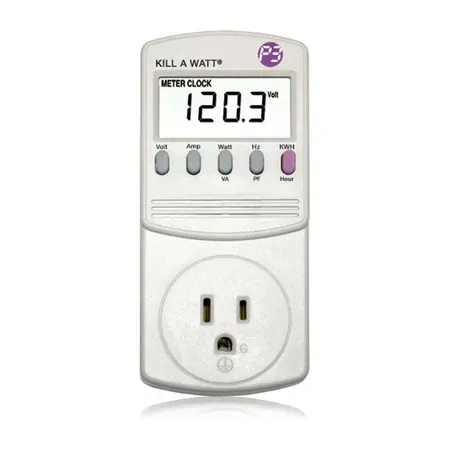
Measure your laptop's real draw
P3 Kill A Watt P4400
Plug-in meter that shows watts and cumulative kWh for anything on a standard outlet. $29.99 on Nov 20.
Cost to Run per Month
At the EIA’s August 2026 US average residential rate of 18.16¢ per kWh:
| Average draw | 2 hours a day | 4 hours a day | 4 hours a day, per year |
|---|---|---|---|
| 30 W (browsing) | $0.33/month | $0.65 | $7.95 |
| 100 W | $1.09 | $2.18 | $26.51 |
| 150 W | $1.63 | $3.27 | $39.77 |
| 200 W | $2.18 | $4.36 | $53.03 |
| 250 W | $2.72 | $5.45 | $66.28 |
| 300 W | $3.27 | $6.54 | $79.54 |
| 350 W | $3.81 | $7.63 | $92.80 |
By hours of gaming per day
Most gaming laptops average 150–300 W from the wall during demanding games (less than the charger rating, which covers charging the battery at the same time). Monthly cost at 18.16¢ per kWh:
| Gaming per day | 150 W average | 200 W average | 300 W average |
|---|---|---|---|
| 1 hour | $0.82 | $1.09 | $1.63 |
| 2 hours | $1.63 | $2.18 | $3.27 |
| 4 hours | $3.27 | $4.36 | $6.54 |
| 6 hours | $4.90 | $6.54 | $9.81 |
| 8 hours | $6.54 | $8.72 | $13.08 |
So 4 hours of gaming every day on a midrange laptop adds about $3–$7 to a monthly bill, and 8 hours on a high-end one about $13. Time spent browsing or watching video adds little: at 30 W, 4 hours a day is $0.65 a month.
Formula: watts × hours per day × 30 ÷ 1,000 = kWh per month; multiply by your rate (it’s on your bill). Rates vary a lot by state: New England’s August 2026 average was 28.31¢.
Gaming Laptop vs. Desktop
A gaming laptop uses less power than a desktop with the same GPU name, because laptop GPUs are smaller, lower-power chips: the desktop RTX 5070 is rated at 250 W total graphics power on its own, while the laptop RTX 5070 runs at 50 to 100 W (plus boost). It also delivers less performance. See gaming laptop vs. gaming desktop.
Gaming Laptop Power FAQ
How many watts does a gaming laptop use while gaming?
Up to most of its charger rating in demanding games at full power. That’s a 150–250 W charger on most budget and midrange models and 300–450 W on the biggest RTX 5080/5090 laptops; frame caps and quieter modes cut it a lot. A plug-in meter shows the real number.
How much does it cost to run a gaming laptop per month?
At the US average rate of 18.16¢ per kWh, about $3–$7 a month for 4 hours of gaming a day, and $1.60–$3.30 for 2 hours. A high-end laptop gaming 8 hours a day costs about $13.
How much does it cost to run a gaming laptop per hour?
About 3 to 5 cents an hour while gaming (150–300 W at 18.16¢ per kWh), and under 1 cent an hour for browsing.
Is a gaming laptop cheaper to run than a gaming desktop?
Yes. The desktop RTX 5070 alone is rated at 250 W total graphics power, before the CPU and the rest of the system, while the whole laptop often averages 150–250 W. The yearly difference is tens of dollars, not hundreds.
Does a gaming laptop use a lot of electricity?
Not compared with heating, cooling or a clothes dryer. A 250 W laptop running 4 hours a day uses about 30 kWh a month.
Can I use a smaller charger?
A smaller USB-C charger can run light tasks and slowly charge some laptops, but not full-power gaming. See can you charge a gaming laptop with USB-C.
Does a gaming laptop use power when off and plugged in?
A little, while it finishes charging and to power the charger itself. Unplug the charger if you’re away for long periods.
Sources
- EIA Electric Power Monthly, Table 5.6.A (August 2026)
- Nvidia laptop GPU comparison
- Nvidia GeForce RTX 5070 family (desktop)
- ASUS TUF Gaming 16 (2026) specifications
- ASUS ROG Strix G16 (2026) specifications
- ASUS ROG Strix Scar 18 (2026) specifications
- ASUS ROG Zephyrus G16 (2026) specifications
- Alienware 16 Aurora, 16X Aurora, 18 Area-51
- Lenovo Legion Pro 7i Gen 10 PSREF (PDF)
- Lenovo Legion CES 2026 announcements
- HP HyperX OMEN MAX 16 (2026)