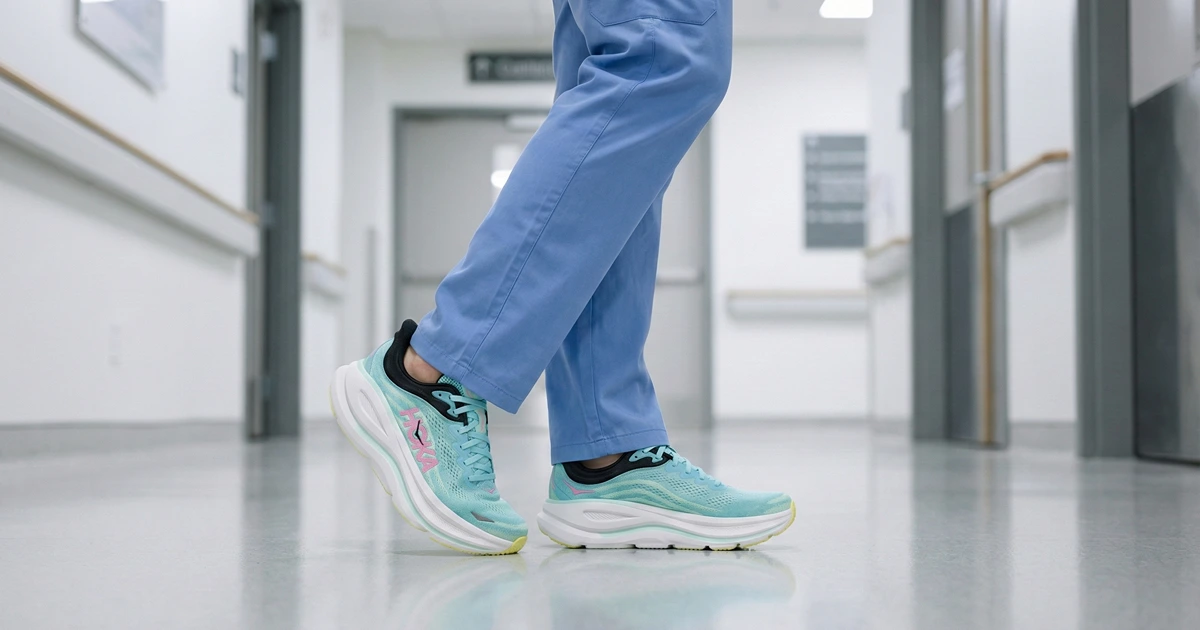

Standing all day is a different test of a shoe than taking a short walk or going for a run. On a long shift, cushioning has to remain comfortable without turning unstable, the upper needs enough room for feet to swell, and the outsole has to cope with hour after hour of tile, concrete, or pavement. A shoe that feels wonderful for five minutes in a store can become tiring once its foam compresses or its fit starts creating pressure points.
For this guide, we weighed those real-world demands alongside fit, construction, long-term wear, and the consistent strengths and drawbacks reported by people who have spent serious time in each model. Comfort remains personal, particularly if you use orthotics or need motion control, but the right balance of shock absorption, support, and secure fit can make a long day on your feet feel far more manageable.
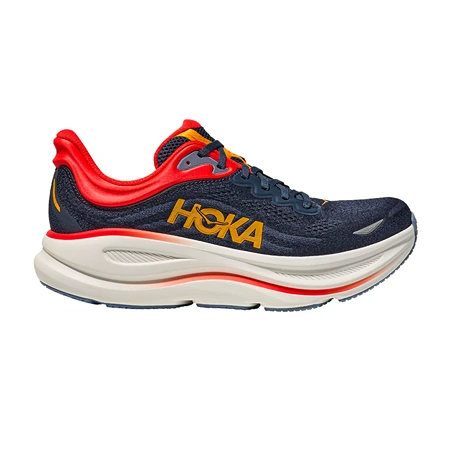
Hoka Bondi 9
Best Overall Option
Maximum cushioning and a stable base deliver unmatched comfort for long days on your feet.
Few shoes make their purpose as obvious as the Hoka Bondi 9. Its exceptionally deep midsole puts a generous layer of foam between your feet and an unyielding floor, while the broad footprint keeps that height from feeling as precarious as it looks. That combination makes it our most convincing all-around option for people who alternate between standing in place and walking throughout a shift.
Hoka replaced the denser midsole material used in the previous version with supercritical EVA. The result is still more protective than springy, but it feels lighter and livelier underfoot than the Bondi’s imposing profile suggests. A 5 mm heel-to-toe drop and the brand’s curved MetaRocker geometry help the foot roll forward, reducing the flat, slapping sensation that some maximal shoes develop when you start moving.
Amy Johnson, a food service manager with more than a decade of experience, came to the Bondi 9 after years of finishing shifts with sore, tired feet. Colleagues urged her to try Hokas, and the difference was most apparent on the restaurant’s hard flooring. The thick sole softened the repeated trips between the kitchen, front counter, and storage rooms, and she noticed less discomfort in her feet and knees at closing time.
During hectic lunch rushes, Amy valued the Bondi’s wide base just as much as its softness. It gave her a planted feeling when changing direction on tile, without the side-to-side wobble that can come from tall, yielding foam. The raised sidewalls also cradle the foot, adding guidance without turning the Bondi 9 into a corrective stability shoe.
The engineered-mesh upper is comfortably padded and allows useful airflow in a warm kitchen, though it is not as breezy as a thin performance upper. Amy never found the shoe unreasonably heavy, but wearers coming from a low-profile sneaker will notice its bulk. Fit is generally secure and true to size; people who need more forefoot room should take advantage of the available wide and extra-wide versions rather than assuming the standard toe box will stretch.
Durabrasion rubber protects the highest-wear areas of the outsole, and the newer foam has held up well in extended testing, but this remains a road shoe rather than certified slip-resistant work footwear. That distinction matters in kitchens or clinical settings with specific safety requirements. For everyone else, the Bondi 9’s blend of deep cushioning, natural stability, and smooth walking geometry is unusually well suited to long hours on hard indoor surfaces.
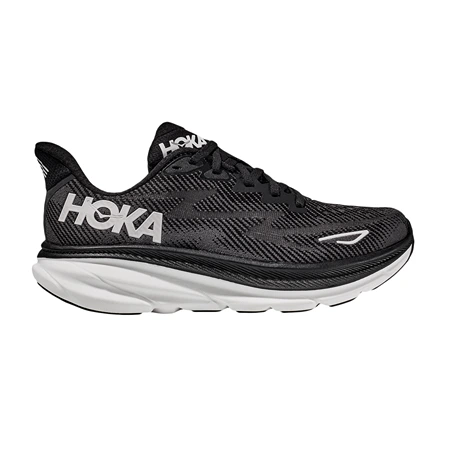
Hoka Clifton 10
Best Runner Up
Lightweight, cushioned, and responsive: a top daily trainer for all-day comfort.
Where the Bondi feels substantial and protective, the Hoka Clifton 10 feels easier to forget about. It delivers plenty of underfoot depth in a notably lighter package, which is valuable for jobs that involve thousands of steps rather than hours at a fixed station. The ride is cushioned but not trampoline-soft, with enough firmness to keep the shoe from feeling vague as the day goes on.
This version adds more foam under the heel and raises the drop to 8 mm, a meaningful change from earlier Cliftons. Heel strikers tend to benefit most from the extra rearfoot protection, while the MetaRocker shape smooths the transition toward the toes. The wide platform and midsole sidewalls give this neutral shoe more inherent stability than its tall stack initially suggests, although people who are sensitive to high shoes may still need time to adjust.
Julia Vasquez, a nurse at Stanford Hospital, started wearing Hokas after her podiatrist recommended a shoe with a squarer toe box following bunion surgery. She had spent years working in Crocs, but wanted softer cushioning with a more secure upper. The Clifton 10 became her favorite for long hospital shifts because it relieved the pressure she had been experiencing without making her feel slowed down during trauma calls and patient care.
Subscribe to Product Bible
Stay updated with the latest product reviews, buying guides, and expert recommendations. Fresh advice on the best things we've researched, tested, and reviewed, sent to your inbox weekly.
Want to know more about how we handle your data or opt out of marketing emails? Check out our Privacy Policy. If you have any questions, we're always here to help.
For Julia, the jacquard-knit upper was a practical advantage in a fast-moving clinical environment. It felt smooth around the foot, breathed well enough through long days, and held the heel more securely than her old shoes. A double lace lock helps keep the tongue centered, while the flared heel collar reduces rubbing around the Achilles. The bright color options also gave her a welcome bit of personality against navy scrubs.
The Clifton 10 fits slightly roomier than older versions, and wide and extra-wide options make it accessible to more foot shapes, but it can run a touch long. Trying it on is worthwhile if you fall between sizes. The generous heel cushioning also will not suit everyone: people who prefer a flat, grounded stance for prolonged stationary work may feel more balanced in a firmer, lower shoe.
Outsole life is the clearest compromise. Rubber covers the main impact zones, but exposed foam can show abrasion quickly, and long-term reports vary considerably depending on gait and surface. The Clifton 10 makes the most sense for someone who prioritizes low weight, an easy rolling stride, and immediate comfort over maximum work-shoe toughness. For mixed walking and standing, it is an agile alternative to the Bondi rather than a lesser version of it.
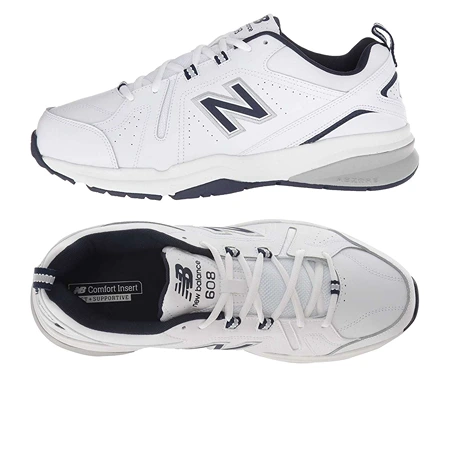
New Balance 608 V5
Best Budget Option
Firm cushioning and durable leather upper, a reliable budget choice for long shifts.
Not every long shift calls for a towering stack of modern running foam. The New Balance 608 V5 takes a more traditional approach: firm cushioning, a structured leather upper, and a broad, grounded shape at a price that makes replacing a well-used pair less painful. It is neither sleek nor especially light, but its straightforward construction is a strength in punishing everyday environments.
Under the heel, ABZORB material combines cushioning with resistance to compression, so the shoe feels protective without collapsing deeply under body weight. An internal midsole shank adds structure through the arch, and the firm platform resists twisting better than many soft running shoes. That support can be especially welcome when standing in one area, where excessive softness may make the small stabilizing muscles work harder.
Marcus Lee, an inventory manager at a large grocery distribution warehouse, chose the 608 V5 after athletic sneakers repeatedly wore out on the concrete floor. His days involve moving boxes, climbing ladders, and crossing long aisles, so he needed something that could take abuse as well as cushion it. The 608’s sturdy feel helped reduce the foot and lower-back fatigue he had come to expect by the end of a shift.
The leather upper is easier to wipe clean and more resistant to scuffs than an open mesh trainer. Dual-density foam around the collar adds soft padding at the ankle, while the secure midfoot keeps the foot from sliding inside the shoe. New Balance also sells the model in a broad range of widths, one of the main reasons it works for people who struggle to fit a conventional standard-width sneaker.
That durability has an obvious tradeoff: the 608 V5 runs warmer and feels heavier than the other shoes in this guide. Marcus actually welcomed the insulation while working in refrigerated storage areas, but anyone stationed in a hot kitchen may prefer a mesh upper. The cushioning is also more workmanlike than plush, so shoppers expecting a soft, floating sensation could find it dated at first try-on.
A durable rubber outsole gives the 608 dependable everyday grip and holds up well on abrasive floors, but the standard version should not be confused with a certified slip-resistant work shoe. Check the exact model and workplace requirements if oil, water, or other contaminants are routine hazards. Within those limits, the 608 V5 is a stable, easy-to-clean, orthotic-friendly value that earns its place through toughness rather than flash.
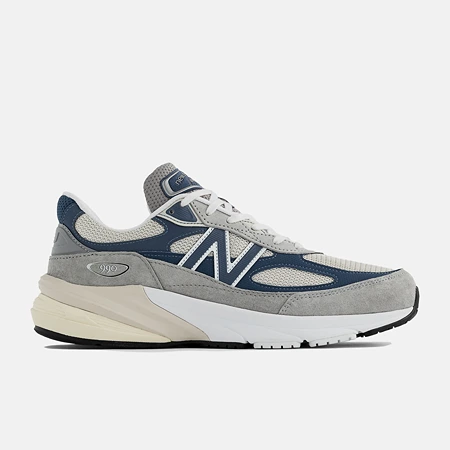
New Balance 990v6
Best Upgrade Option
Premium cushioning, stability, and timeless style deliver unmatched all-day support.
The appeal of the New Balance 990v6 goes beyond the familiar gray suede. It is a lifestyle shoe built with genuine performance cushioning, and that distinction becomes clear after several hours: the sole feels supportive rather than merely padded, the upper holds its shape, and the design looks appropriate in settings where a brightly colored running shoe might feel out of place.
FuelCell foam gives the heel and forefoot a gentle sense of propulsion, while the ENCAP construction surrounds lightweight cushioning with a durable polyurethane rim. Together they create a soft-but-controlled platform that is easier to walk in than the firmer midsoles of earlier 990s. The shoe is heavier than a daily running trainer, yet its weight is well distributed and rarely feels cumbersome in normal use.
I wore the 990v6 throughout a month in Rome, often covering miles of cobblestones, uneven pavement, and hard museum floors in a single day. The cushioning took the sting out of those surfaces without making my footing uncertain on slick marble or broken streets. My feet still felt good at the end of long sightseeing days, and the shoes retained both their comfort and their polished appearance through the trip.
The upper is a large part of that versatility. Mesh panels let heat escape, while pigskin suede and synthetic overlays provide more structure and abrasion resistance than an all-mesh shoe. It is breathable enough for everyday wear rather than genuinely airy in hot weather, but the material quality and restrained silhouette let the 990v6 move naturally from a day of walking to a casual dinner.
Fit deserves special attention before spending this much. The v6 tends to run long, while its midfoot and toe box can feel slimmer than the length implies; many wearers size down, but that is not the right solution for every wide foot. Multiple width options help, and the shoe may soften slightly with use, though nobody should rely on a painful pair eventually breaking in.
The premium price pays for a difficult combination: durable materials, stable cushioning, everyday style, and enough comfort for serious mileage. Some pairs show faster wear at the softest outsole sections, especially on rough pavement, and this is not the plushest choice for someone who stands motionless on concrete. As an upgrade for days that combine commuting, walking, standing, and social plans, however, the 990v6 is unusually complete.
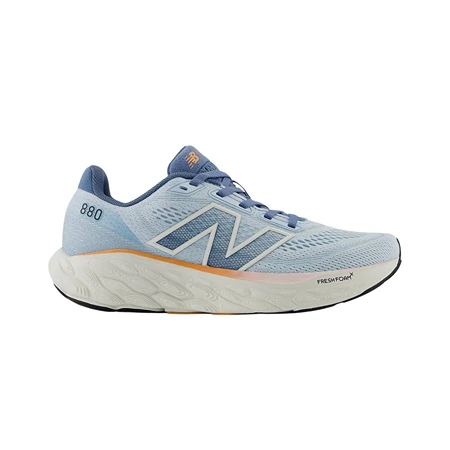
New Balance 880v14
Best for Breathability
Breathable mesh and dual-layer cushioning keep feet cool and supported.
Hot feet can make an otherwise comfortable shoe unbearable before a shift is over. The New Balance Fresh Foam X 880v14 addresses that problem with a one-piece engineered-mesh upper that allows far more air movement than leather work sneakers while still providing the padding expected from an everyday trainer. It is a particularly sensible choice for warm indoor spaces and days split between standing and steady walking.
The Fresh Foam X midsole is moderately soft rather than pillowy, a balance that works well over long periods. With an 8 mm drop and a relatively conventional stack, the 880 keeps the heel protected without lifting the foot excessively far from the ground. Its broad sole, supportive sidewalls, and average torsional stiffness give this neutral shoe a stable, predictable character.
Comfort comes from the upper’s flexibility as much as its airflow. The material gives slightly as feet expand, and generous padding around the tongue and collar prevents the stripped-down feeling common to highly ventilated running shoes. New Balance offers narrow, standard, wide, and extra-wide fits, making it easier to get secure heel and midfoot hold without squeezing the forefoot.
Subscribe to Product Bible
Stay updated with the latest product reviews, buying guides, and expert recommendations. Fresh advice on the best things we've researched, tested, and reviewed, sent to your inbox weekly.
Want to know more about how we handle your data or opt out of marketing emails? Check out our Privacy Policy. If you have any questions, we're always here to help.
Breathability still needs to be kept in perspective. The padded upper moves moisture and heat better than leather, but controlled lab testing places its ventilation closer to average than class-leading. People who prioritize the absolute coolest possible shoe may want a thinner performance upper; the 880v14’s advantage is that it combines useful airflow with enough structure and cushioning for all-day wear.
NDurance rubber covers the outsole and has proven impressively resistant to abrasion, with a lightly patterned tread that can manage pavement and mild packed surfaces. The shoe feels smoother and less aggressively rockered than many maximal trainers, so it works well for natural walking and stationary tasks. On the other hand, it is not waterproof or certified slip resistant, and the mesh offers limited protection from spills.
Because the 880v14 is a neutral model, it does not provide the corrective guidance required by everyone with significant overpronation or prescribed support needs. Its removable insole and accommodating width range make it a useful candidate for orthotics, but fit should be checked with the insert in place. For most neutral-footed wearers, the durable outsole, balanced Fresh Foam X cushioning, and comfortable mesh upper make it a dependable warm-shift workhorse.
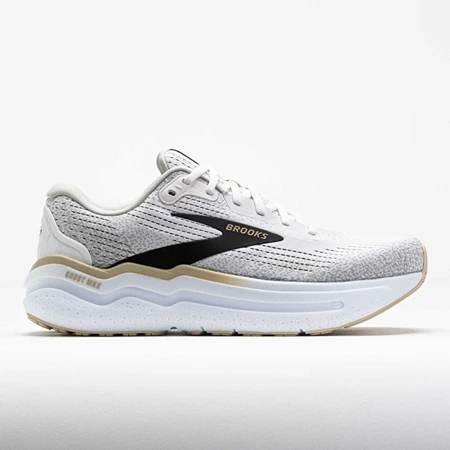
Brooks Ghost Max 3
Best for Hard Surfaces
Ultra-soft cushioning, a smooth ride, and breathable upper deliver plush comfort.
Concrete exposes the limits of thin or tired cushioning quickly. The Brooks Ghost Max 3 counters it with a high stack of nitrogen-infused DNA LOFT v3 foam, spreading pressure across a substantial platform and softening repeated heel and forefoot impact. The sensation is plush and protective, particularly for people who walk as much as they stand.
Brooks shapes that foam around a 6 mm drop and its GlideRoll Rocker, which encourages the foot to move from landing to toe-off without demanding much flex through the forefoot. The geometry makes long corridors and warehouse aisles feel smoother, though it can seem awkward during quick lateral movements. A notably wide base adds inherent stability, but this remains a neutral shoe rather than a dedicated motion-control model.
The updated double-jacquard mesh upper has more internal volume than before and accommodates a wider range of foot shapes. Padding through the tongue and collar creates a comfortable hold, while the roomy forefoot allows for normal swelling late in the day. Wide sizes are available, and the removable insole plus generous interior make the shoe particularly friendly to many orthotics.
All that material comes with weight. The Ghost Max 3 is heavier than several competing max-cushion shoes, and some wearers find the rear of the shoe clunky until they settle into its rolling stride. It is built for protection and easy movement, not nimble footwork or a close connection to the floor, so workers who climb ladders frequently or pivot in tight spaces should try it carefully.
RoadTack rubber in the high-wear zones provides solid road and indoor-floor traction and protects the softer midsole from premature abrasion. The airy upper also manages heat well for such a padded shoe. As with the other running models here, however, it is not a substitute for certified nonslip footwear where workplace rules require it.
The Ghost Max 3 carries an APMA Seal of Acceptance, but the best reason to choose it is simpler: it places a great deal of resilient foam between the foot and a hard floor without feeling excessively squishy. People who need strong medial guidance should consider a true stability shoe, and those who dislike rockers may prefer a flatter platform. For neutral-footed wearers facing miles of polished concrete or tile, its pressure relief and smooth transitions are difficult to dismiss.
No shoe can compensate for a poor fit, and the most expensive model is not automatically the most comfortable. Leave enough room for toes to move, account for the swelling that happens late in a shift, and try work shoes with the same socks or orthotics you plan to wear. A secure heel and a stable platform matter just as much as the softness you notice when first stepping in.
Pay attention to the conditions of the job as well as the hours involved. Running shoes can be excellent on dry, hard floors, but kitchens, workshops, and clinical environments may demand certified slip resistance, waterproofing, or protective toes. Once those requirements are covered, the right fit and a cushioning level that matches your stride will do more for lasting comfort than any single feature or brand name.