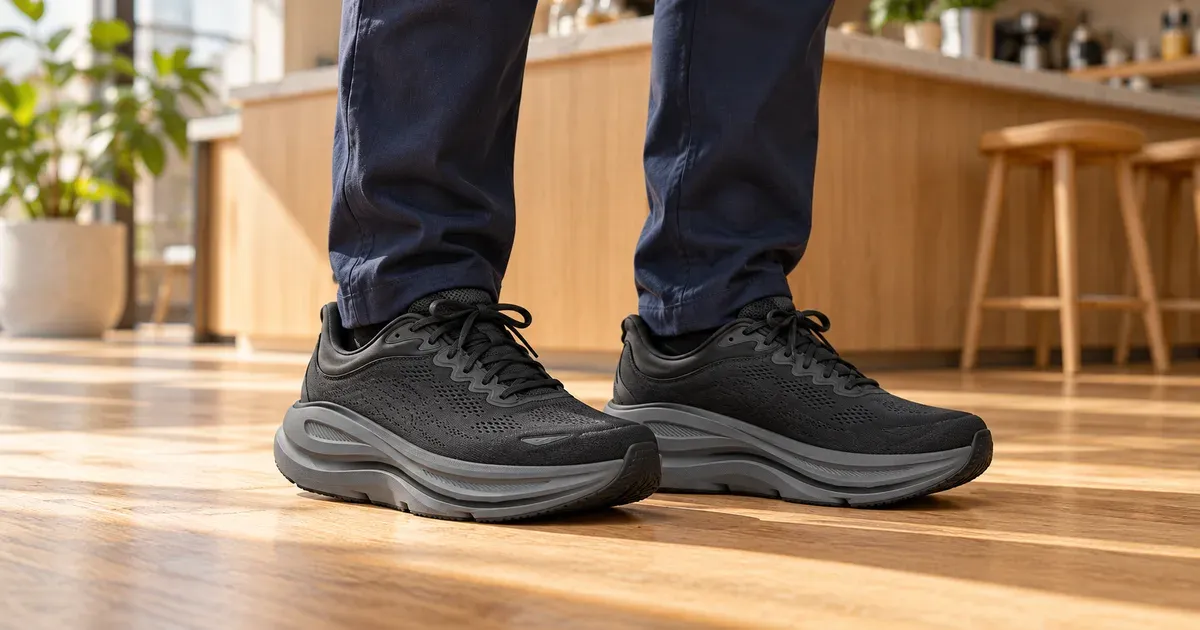
Hoka has become the default shoe for nurses, teachers, retail workers, and anyone else who spends the day on hard floors. The reason is simple: Hoka builds thick, wide midsoles with a rocker shape, which puts a lot of foam between your feet and the concrete and keeps that height stable.
Not every Hoka suits a long shift, though. Some are built for fast running, some are trail shoes, and only two have the slip-resistant outsoles that many kitchens and hospitals require.
The short answer: the Bondi 9 is the best Hoka for standing all day. It’s Hoka’s most cushioned road shoe, with a wide base and a low 5 mm drop. If your workplace has wet or greasy floors, get the Bondi SR, its slip-resistant leather version. If your feet roll inward or you have flat feet, the Gaviota 6 adds Hoka’s stability frame to a similarly plush ride.
Our Picks at a Glance
| Shoe | Best for | Type | Drop | Weight (men’s) | Widths | Price |
|---|---|---|---|---|---|---|
| Bondi 9 | Most people, hard floors | Neutral, max cushion | 5 mm | 10.5 oz | Regular, Wide, X-Wide | $175 |
| Bondi SR | Kitchens, hospitals, wet floors | Neutral, slip-resistant leather | 6 mm | 14.0 oz | Regular, Wide | $180 |
| Gaviota 6 | Flat feet, overpronation | Stability, max cushion | 6 mm | 10.25 oz | Regular, Wide, X-Wide | $180 |
| Arahi 9 | Lighter stability shoe | Stability | 8 mm | 10.0 oz | Regular, Wide, X-Wide | $155 |
| Clifton 11 | Lots of walking, lighter feel | Neutral | 8 mm | 9.9 oz | Regular, Wide, X-Wide | $155 |
Prices are Hoka’s list prices; Amazon is often a little cheaper depending on size and color.
Best Overall: Hoka Bondi 9
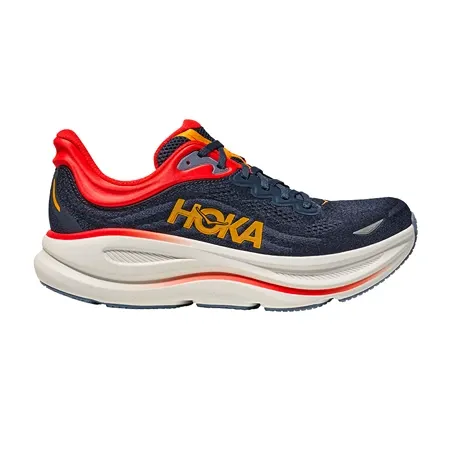
Best overall
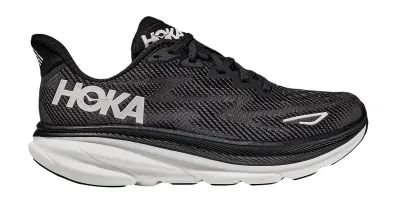
Hoka Bondi 9
Hoka's most cushioned road shoe, with a wide, stable base and a low 5 mm drop for long days on hard floors.
The Bondi 9 is the shoe most people mean when they ask which Hoka to wear for standing. It has the tallest cushioning in Hoka’s road lineup, about 43 mm at the heel and 38 mm at the forefoot, so there’s a thick layer of foam under the ball of your foot, where standing pressure builds up. The base is wide and the foam rises up around the sides of the foot, which keeps that height steady when you shift your weight or turn.
Two details make it especially good for standing rather than running:
- A low 5 mm drop. Your heel sits only slightly higher than your forefoot, so you stand closer to level than in most cushioned shoes.
- Firmer, more supportive foam. The Bondi 9 moved to a supercritical EVA midsole that feels resilient rather than mushy. Very soft foam can feel great for five minutes and then sink in over a long shift. The Bondi protects you by being thick and broad, not by being squishy.
It carries the American Podiatric Medical Association (APMA) Seal of Acceptance, comes in three widths, and has more than 3,500 Amazon ratings averaging 4.5 stars in both men’s and women’s versions. The knit upper breathes reasonably well, and Durabrasion rubber covers the high-wear areas of the outsole.
The trade-offs are bulk and weight. At 10.5 ounces for men’s and 9.3 ounces for women’s, it’s not heavy for its size, but it looks and feels like a lot of shoe. Some wearers find the standard width a little snug in the toe box, so consider the wide version if your feet swell during a shift.
Buy it if you stand or walk on hard floors for hours and want the most cushion Hoka makes. For a detailed comparison with Hoka’s other bestseller, see our Bondi vs. Clifton guide.
Best for Work: Hoka Bondi SR
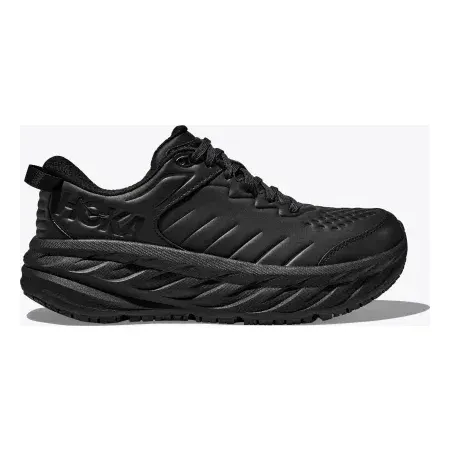
Best for slippery floors
Hoka Bondi SR
A Bondi with a water-resistant leather upper and a slip-resistant, full-contact rubber outsole for kitchens and hospitals.
The Bondi SR (“slip-resistant”) is Hoka’s work shoe. It takes the Bondi shape and swaps the parts that don’t hold up in a kitchen or a hospital:
- A slip-resistant rubber outsole with full ground contact, so there’s grippy rubber across the whole bottom instead of exposed foam.
- A water-resistant leather upper that wipes clean and shrugs off spills better than mesh.
- A memory foam collar around the ankle and Hoka’s early-stage MetaRocker, which helps your foot roll forward as you walk.
It also has the APMA Seal, comes in regular and wide, and has a 6 mm drop. The midsole is standard compression-molded EVA rather than the Bondi 9’s newer supercritical foam, and the leather and rubber make it heavier, about 14 ounces per men’s shoe. It also runs warmer than the mesh Bondi 9.
If your employer requires slip-resistant footwear, check whether it asks for a specific test standard or a label on the shoe before you buy. Many food-service and healthcare jobs accept any shoe sold as slip-resistant, but some require a rating.
If you need stability as well as grip, the Arahi SR ($165) is the slip-resistant version of the Arahi, with Hoka’s H-Frame stability system, a water-repellent textile upper, a quick-lace system, and a heel that flexes so you can step in without untying.
Buy it if you work on wet, greasy, or freshly mopped floors, or your workplace requires slip-resistant shoes.
Best for Flat Feet: Hoka Gaviota 6
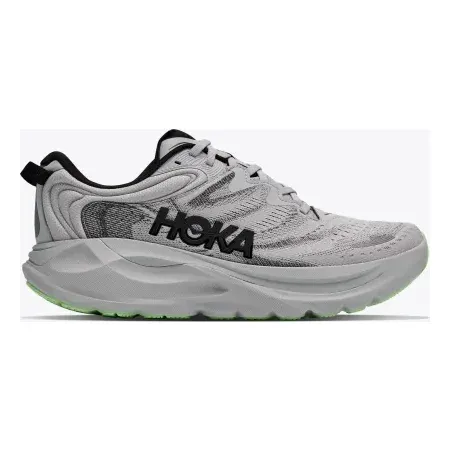
Best stability
Hoka Gaviota 6
Hoka's most cushioned stability shoe, with an H-Frame that limits inward roll.
The Gaviota 6 is the stability counterpart to the Bondi: plush, max-cushion, and built for people whose feet roll inward (overpronate) or who have low arches. Instead of a hard plastic post, Hoka uses an enhanced H-Frame, firmer foam on both sides of the heel and midfoot that resists excessive inward roll without forcing your foot into a fixed position.
The sixth version added a plusher collar, a softer engineered-mesh upper, and an internal lacing system that holds the midfoot snugly. It has a 6 mm drop, weighs about 10.25 ounces in men’s sizes, and comes in regular, wide, and extra-wide, with men’s sizes up to 16.
Stability shoes are a fit question, not an upgrade. If you have neutral feet, the Bondi 9 will feel more natural; if your arches collapse or your ankles roll in by the end of the day, the Gaviota’s guidance can make long shifts more comfortable. If you wear custom orthotics, bring them when you try shoes on, because a stability shoe plus an orthotic can be more correction than you need.
Buy it if you have flat feet or overpronate and want Bondi-level cushioning.
Best Lighter Stability Shoe: Hoka Arahi 9
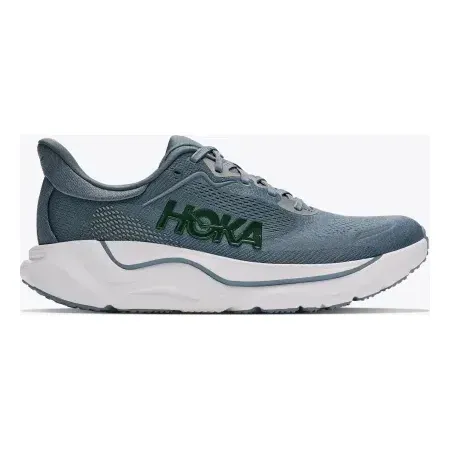
Best lighter stability shoe
Hoka Arahi 9
A lighter, lower stability shoe with the H-Frame and an APMA Seal, for walking-heavy days.
The Arahi 9 uses the same enhanced H-Frame as the Gaviota in a lighter, less bulky shoe. It has a dual-density foam midsole, an 8 mm drop, and an engineered mesh upper that’s tighter on the inner side of the foot for extra support. It weighs about 10 ounces in men’s sizes and costs $25 less than the Gaviota.
It has less foam underfoot than the Gaviota, so it’s the better choice if your job involves more walking than standing still: retail floors, warehouses, or school hallways. It carries the APMA Seal and comes in three widths.
Buy it if you want stability but find the Gaviota too tall or heavy.
Best for Walking: Hoka Clifton 11
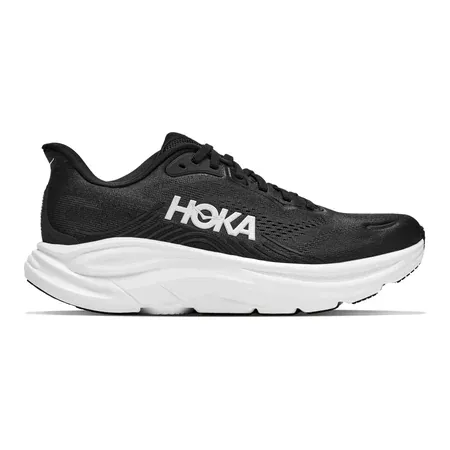
Best lightweight
Hoka Clifton 11
A lighter, softer daily trainer that handles easy runs, walks, and all-day wear.
The Clifton 11 is Hoka’s bestselling all-rounder and the lightest shoe here at about 9.9 ounces. It has slightly less forefoot cushioning than the Bondi (34 mm versus 38 mm), a higher 8 mm drop, and a softer feel as you sink into the foam.
That makes it a better match for shifts with a lot of walking. If you cover miles on a hospital floor or a big store, the lighter weight is noticeable by the end of the day. For standing in one spot, the Bondi’s thicker, broader base is more protective. The Clifton comes in regular, wide, and extra-wide, and a Clifton 11 GTX ($175) adds a waterproof Gore-Tex upper for outdoor work in the rain.
Buy it if you walk more than you stand, or you also want a shoe for running. Our Clifton 9 vs. 10 comparison covers how the Clifton has changed.
How to Choose a Hoka for Standing
Neutral or stability. Most people do best in a neutral shoe like the Bondi or Clifton. Choose a stability model (Gaviota, Arahi) if a podiatrist has told you that you overpronate, your arches flatten when you stand, or your old shoes wear heavily on the inner edge.
Cushion height. For standing in one place, more forefoot cushioning matters most, since that’s where pressure builds. The Bondi and Gaviota have the most. For mixed walking and standing, a lighter shoe like the Clifton or Arahi can feel less tiring.
Drop. Drop is how much higher the heel sits than the forefoot. The Bondi’s 5 mm keeps you nearly level, while the Clifton and Arahi’s 8 mm is closer to a typical sneaker. Neither is right for everyone, but if you’re switching from flat shoes, a lower drop usually feels more natural.
Width. Feet swell over a long shift. If a shoe feels snug in the morning, it will feel tight by evening. Every pick here comes in a wide size, and three come in extra-wide. Try shoes on later in the day.
Floors and rules. Mesh running shoes have foam exposed on the outsole and aren’t designed for wet or oily floors. If your workplace is slippery or requires slip-resistant shoes, choose the Bondi SR or Arahi SR.
When to Replace Them
Thick foam wears out before it looks worn. Running-shoe makers generally put a cushioned trainer’s life at roughly 300 to 500 miles. Standing compresses foam without adding miles, so full-time workers should watch for signs instead:
- Creases in the midsole foam, especially along the inner side
- Outsole rubber worn smooth or foam showing through
- The shoe leaning to one side when it’s set on a table
- Aching feet, knees, or back at the end of shifts that used to feel fine
Many people who stand all day replace their work shoes every six to twelve months. Rotating two pairs gives the foam time to recover between shifts and makes each pair last longer.
FAQ
Is the Bondi or Clifton better for standing all day?
The Bondi. It has more forefoot cushioning, a wider base, and a lower drop, which all help when you’re on your feet in one place. The Clifton is lighter and better if your day is mostly walking.
Which Hoka do nurses wear?
The Bondi 9, Clifton 11, and Bondi SR are the most common. The Bondi SR is the one designed for healthcare: it has a slip-resistant outsole and a leather upper that wipes clean.
Are Hokas good for plantar fasciitis?
Many people with heel pain find thick, rockered shoes like the Bondi comfortable, and several Hokas carry the APMA Seal of Acceptance. But no shoe treats plantar fasciitis, and the right choice depends on your foot. If you have heel pain, see a podiatrist or physical therapist before relying on a new shoe.
Are Hokas slip-resistant?
Only the SR models: the Bondi SR and Arahi SR. Hoka’s regular road shoes have exposed foam on the outsole and aren’t sold as slip-resistant.
More Shoe Guides
For non-Hoka options, including budget picks and leather work shoes, see our guide to the best shoes for standing all day. Comparing brands? Read Hoka vs. Brooks and Hoka vs. On Cloud.