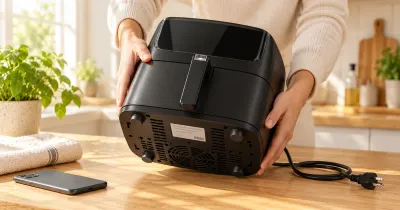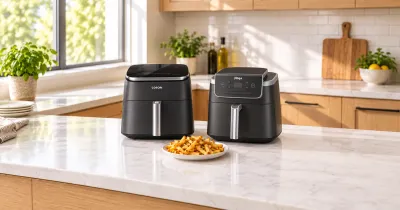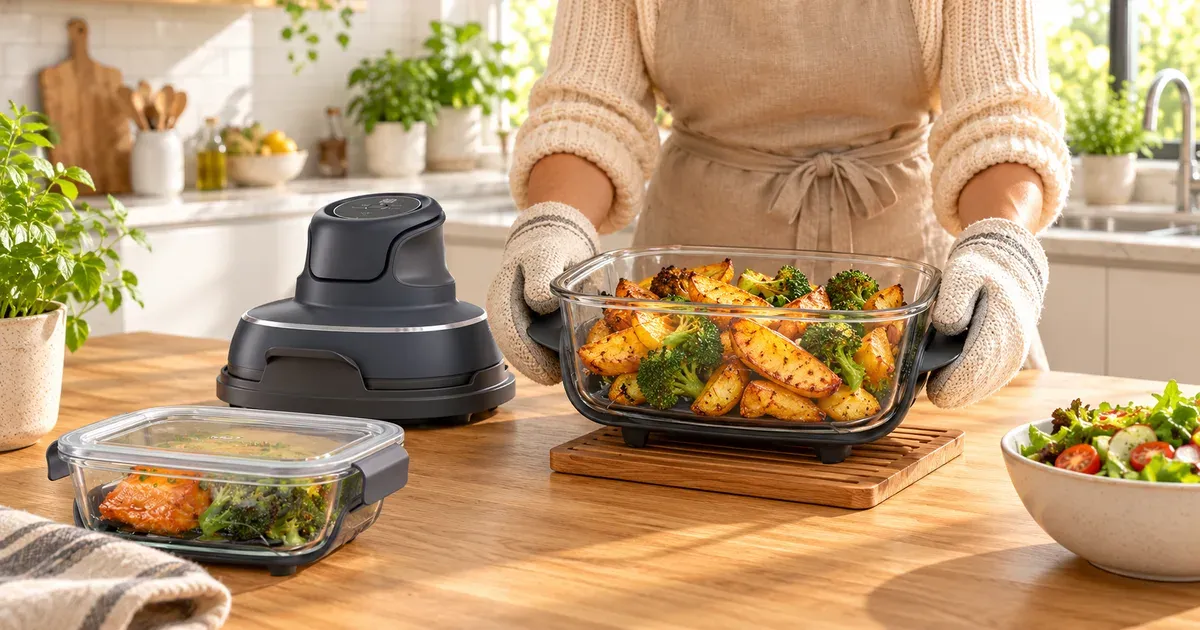
Most air fryers have a basket coated with PTFE, the nonstick plastic best known as Teflon. PTFE belongs to a large family of chemicals called PFAS, sometimes called “forever chemicals” because they persist in the environment and the body for years. That’s why many people now look for a “non-toxic” air fryer. In practice, that means one whose cooking surfaces are made of glass, stainless steel, or a PFAS-free ceramic coating instead.
The good news is that you no longer have to give up convenience to get one. Our top pick is the Ninja Crispi ($179.95): you cook in borosilicate glass containers that double as storage, and Ninja says its cooking surfaces are free of PFAS and PTFE. If you’d rather have a conventional basket air fryer, the Cosori TurboBlaze ($99.99) has a PFAS-free ceramic coating and nearly 22,500 Amazon ratings averaging 4.8 stars. For a countertop oven that air fries, the Our Place Wonder Oven ($185) is made without PFAS inside.
Our Picks at a Glance
| Air fryer | Best for | Cooking surface | Price |
|---|---|---|---|
| Ninja Crispi | Avoiding coatings entirely | Borosilicate glass | $179.95 |
| Cosori TurboBlaze | A classic basket fryer, budgets | PFAS-free ceramic coating | $99.99 |
| Our Place Wonder Oven | Toasting, baking, and air frying | Made without PFAS | $185 |
Best Overall: Ninja Crispi
Best overall
Ninja Crispi
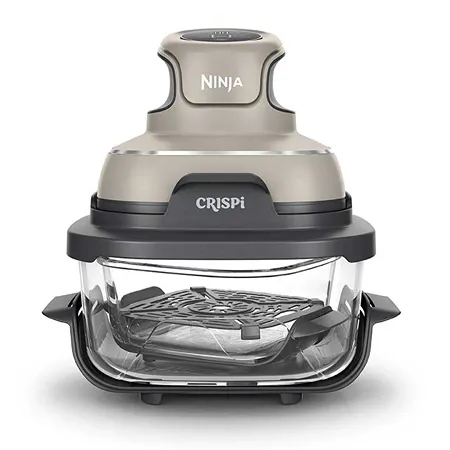
A portable air fryer that cooks in borosilicate glass containers you can also use for storage.
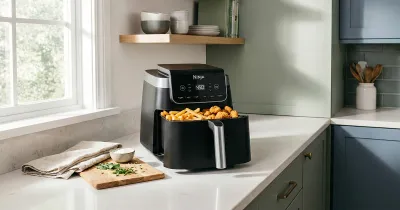
The Ninja Crispi gets rid of the coated basket altogether. The heating element and fan live in a small PowerPod that sits on top of a borosilicate glass container, the same heat-resistant glass used in lab and oven glassware. Food cooks in the glass, which doesn’t react with food or shed coatings, and you can see it browning without opening anything. When you’re done, snap on a lid and put the same dish in the fridge.
It comes with a 4-quart container, big enough for a 4-pound chicken, and a 6-cup container for a single portion, plus storage lids. Ninja says the containers and cooking surfaces are free of PFAS and PTFE. The crisper plate that lifts food off the bottom of the glass is aluminum with a ceramic-based coating that Ninja also describes as free of PFAS and PTFE. Everything except the PowerPod is dishwasher safe.
Glass has trade-offs: it’s heavier than a basket, it gets very hot, and it can break if dropped. The 4-quart container is a bit small for big families, and the PowerPod has only four modes. For a larger version with more functions, the Crispi Pro costs more. Our Ninja Crispi review covers it in detail.
Buy it if you want to avoid coated cooking surfaces and like cooking and storing in the same dish.
Best Basket Air Fryer: Cosori TurboBlaze
Best basket air fryer
COSORI TurboBlaze
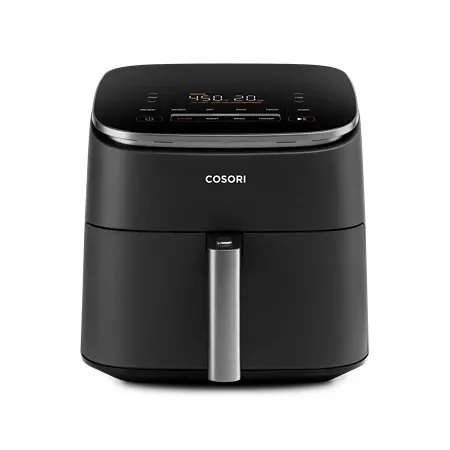
A 6-quart basket air fryer with a PFAS-free ceramic coating, 450°F max, and a quiet five-speed fan.
If you want a familiar drawer-style air fryer, the Cosori TurboBlaze is the one we’d pick. Its basket and crisper plate have a PFAS-free ceramic nonstick coating instead of PTFE. It’s also simply a very good air fryer: a 6-quart square basket, a fast fan with five speeds, temperatures from 90°F to 450°F, and a quiet motor rated under 53 decibels.
Ceramic coatings are made mostly from silica, the main ingredient in sand and glass, applied as a thin layer and cured with heat. They release food well when new, but they lose their slickness faster than PTFE, especially with metal utensils, abrasive scrubbers, or cooking sprays that build up a sticky film. Use silicone or wooden tools, wash by hand when you can, and replace the basket if the coating chips or wears through.
The TurboBlaze isn’t part of the large 2023 Cosori recall; see our Cosori air fryer recall guide for the affected models. For a stainless steel body with the same kind of ceramic basket, Cosori’s Iconic costs about $249.
Buy it if you want a conventional basket air fryer without a PTFE coating, for about $100.
Best Air Fryer Oven: Our Place Wonder Oven
Best air fryer oven
Our Place Wonder Oven
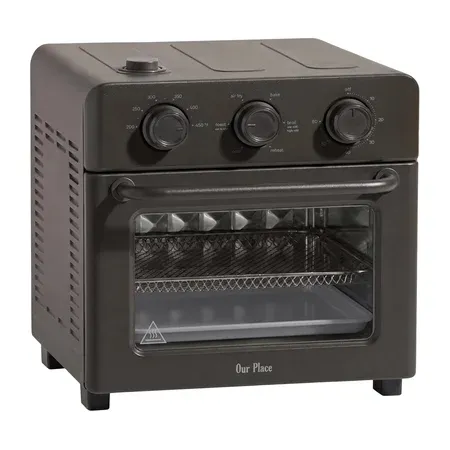
A compact 6-in-1 toaster oven and air fryer that Our Place says is made without PFAS inside.
An air fryer oven has metal racks and pans instead of a coated basket, which makes it easier to avoid nonstick coatings. The Our Place Wonder Oven is a compact countertop oven that air fries, bakes, roasts, toasts, broils, and reheats, from 200°F to 450°F. Our Place says the interior and included accessories are made without PFAS, including PTFE: the oven body and crumb tray are stainless steel, the air fryer basket and wire rack are chromed steel, and the bake pan has a ceramic nonstick coating. Our Place reports that an accredited lab found no detectable PFAS on those cooking surfaces.
It has two rack positions and fits a 4.5-pound chicken, with a wire rack, air fry basket, bake pan, and crumb tray included. A steam feature uses a teaspoon or two of water to revive stale bread and leftovers. It’s attractive enough to leave on the counter, and it preheats much faster than a full-size oven.
Air fryer ovens don’t crisp food quite as quickly or evenly as a basket fryer, because the air has more space to move. For a bigger family, Our Place sells a larger 30-quart version.
Buy it if you want one appliance to replace a toaster oven and an air fryer.
What “Non-Toxic” Means for Air Fryers
“Non-toxic” isn’t a regulated term, so it’s worth knowing what you’re avoiding.
- PTFE (Teflon) is the classic nonstick coating. It’s a type of PFAS. On its own, cured PTFE is very stable and passes through the body if swallowed in flakes, and US regulators allow it in cookware.
- PFOA, a PFAS once used to manufacture PTFE, is the chemical behind many health concerns. US manufacturers phased it out under an EPA program completed in 2015, so modern nonstick isn’t made with it.
- The remaining concern is the PFAS family as a whole: making and disposing of fluoropolymers can release other PFAS into the environment, and scratched coatings shed small particles. Minnesota banned intentionally added PFAS in cookware starting in 2025, and several other states have passed similar laws.
- Overheating. PTFE starts to break down and give off fumes above about 500°F (260°C). Those fumes can cause flu-like “polymer fume fever” in people and can kill pet birds. Most air fryers top out around 400°F to 450°F, so normal use stays below that, but never run an empty coated air fryer at maximum heat for long.
If you’d rather avoid fluoropolymers entirely, choose glass, stainless steel, or a ceramic coating from a brand that states it’s PFAS-free.
Glass vs. Ceramic vs. Stainless Steel
| Glass | Ceramic coating | Stainless steel | |
|---|---|---|---|
| PFAS-free | Yes | Yes, if the brand says so | Yes |
| Nonstick | No; use a little oil or parchment | Yes, when new | No |
| Durability | Breaks if dropped | Coating wears over time | Lasts for decades |
| Cleaning | Dishwasher safe, easy | Hand wash to extend life | Needs soaking for stuck food |
| See food cooking | Yes | No | No |
What About Plastic?
Nearly every air fryer has a plastic housing and handle. Those parts don’t touch food, and many brands say they’re BPA-free. A new air fryer often smells “plasticky” the first few times; run it empty at a high temperature for 10 to 15 minutes in a ventilated kitchen before cooking, as most manuals suggest. If the smell persists after several uses, return it.
Is Air Frying Healthier?
Air frying uses far less oil than deep frying, and that also affects acrylamide, a compound that forms when starchy foods like potatoes are browned at high heat. In one lab study, air-fried potatoes had about 90% less acrylamide than deep-fried ones (Sansano et al., 2015). Cooking to golden rather than dark brown keeps acrylamide lower with any method.
How to Use Any Air Fryer More Safely
- Don’t preheat an empty coated basket for long at the highest setting.
- Use wooden or silicone utensils, and replace baskets with scratched or peeling coating.
- Skip aerosol cooking sprays, which leave a sticky film on coatings; brush or toss food with oil instead.
- Use parchment liners made for air fryers if you want a barrier between food and the basket. Keep them weighed down with food so they don’t fly into the heating element.
- Keep pet birds out of the kitchen when using any nonstick cookware.
For every kind of air fryer, including dual-basket and large-capacity models, see our guide to the best air fryers.
How We Chose
We looked for air fryers whose food-contact surfaces are glass, stainless steel, or a coating the manufacturer states is free of PFAS and PTFE, then compared cooking performance, capacity, ease of cleaning, durability, and owner ratings. We favored brands that say clearly what their cooking surfaces are made of, and skipped products whose “non-toxic” claims weren’t backed by a specific material.
Non-Toxic Air Fryer FAQ
What is the safest air fryer material?
Glass and stainless steel, because they have no coating to wear off. A PFAS-free ceramic coating is a good compromise if you want nonstick.
Are air fryers toxic?
Not in normal use. Most use PTFE nonstick coatings, which are stable at air fryer temperatures. People who want to avoid PFAS entirely can choose a glass, stainless steel, or ceramic-coated model.
Is the Ninja Crispi non-toxic?
Ninja says its glass containers and cooking surfaces are free of PFAS and PTFE. Food cooks in borosilicate glass, which doesn’t react with food.
Are ceramic air fryers safe?
Yes. Ceramic nonstick coatings are made mainly from silica and contain no PTFE. They wear faster than PTFE, so replace the basket if the coating chips.
Does Teflon in air fryers cause cancer?
Modern PTFE coatings are no longer made with PFOA, the chemical linked to cancer concerns. PTFE itself is considered stable at normal cooking temperatures, but it is a PFAS, so some people prefer to avoid it.
How do I know if my air fryer has PFAS?
Check the product page or manual for the coating. “PTFE,” “Teflon,” or simply “nonstick” without further detail usually means a fluoropolymer. “Ceramic,” “glass,” or “stainless steel” cooking surfaces labeled PFAS-free don’t.